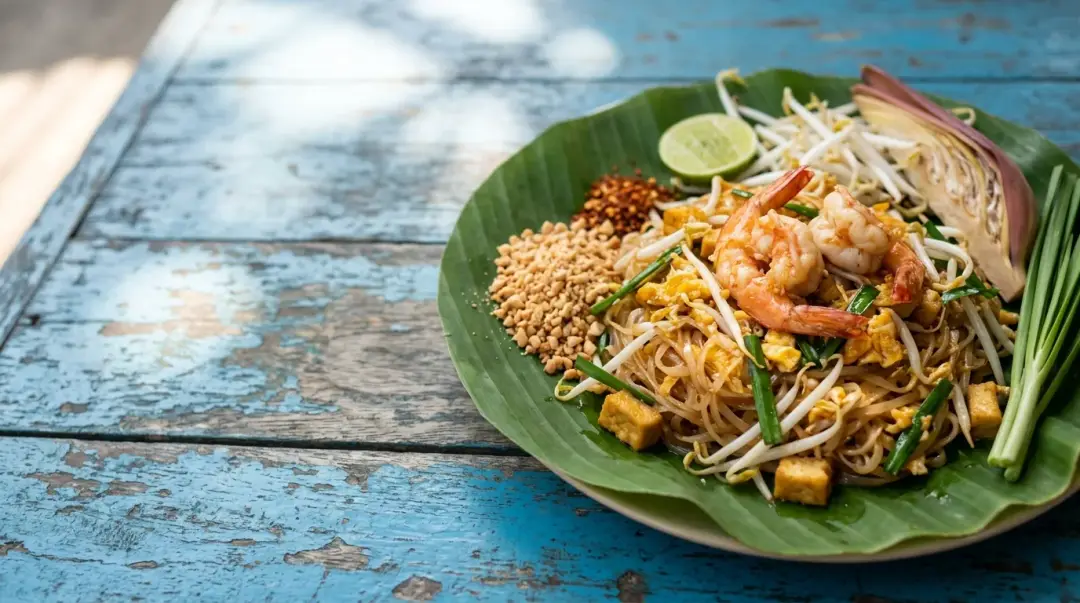
Pad thai is Thailand's stir-fried rice-noodle dish — thin flat sen lek noodles tossed with egg, shrimp, tofu, bean sprouts, and a sauce of tamarind, fish sauce, palm sugar, and dried chili, finished with crushed peanuts and lime. It anchors the menu at virtually every US Thai restaurant, from suburban strip malls to Andy Ricker's Pok Pok lineage in Portland and Brooklyn. What sets it apart is its origin story: pad thai was promoted in the early 1940s by the government of prime minister Plaek Phibunsongkhram, though historians dispute the popular claim that he invented it.
What Is Pad Thai?
Pad thai is stir-fried flat rice noodles tossed with eggs, shrimp or chicken, bean sprouts, tofu cubes, and a sauce of tamarind paste, fish sauce, palm sugar, and dried chilies. It's finished with crushed peanuts and a wedge of lime, often eaten with chopsticks or a fork and spoon. The flat rice noodles are typically sen lek — about 5mm wide — soaked in cold water for 30-60 minutes before stir-frying to soften them just enough to absorb sauce without breaking apart in the wok. The dish is sweet, sour, savory, and lightly spicy all at once — the four-flavor balance that defines Thai cuisine, expressed in one bowl. Pad thai rose to national-dish status in the early 1940s, when Plaek Phibunsongkhram's government pushed rice noodles as patriotic food; the popular claim that he invented the dish is disputed. It became Thailand's most-exported menu item by the 2000s; today it appears at virtually every US Thai restaurant, from suburban strip malls to chef-driven kitchens like Andy Ricker's Pok Pok in Portland and Brooklyn.
The Nationalist Origin (Surprising History)
Pad thai isn't ancient. It was popularized in the early 1940s under Thailand's prime minister Plaek Phibunsongkhram as part of a nationalist project (whether he invented the dish is disputed; see our pad thai history). His government wanted to:
- Reduce Thailand's rice consumption during WWII shortages by promoting noodles
- Create a "national dish" that wasn't Chinese
- Modernize Thai cuisine for international visibility
The government promoted noodle eating through speeches and campaigns. Within a few decades, pad thai went from street food to national icon.
Most "ancient Thai dishes" have Chinese origins. Pad thai is the rare one that's explicitly Thai by design.
Flavor Profile
The defining experience: tamarind sourness, palm sugar sweetness, fish sauce umami, and peanut nuttiness in every bite. Heat is mild by default — chilies are added separately at the table.
How Pad Thai Differs from Drunken Noodles
Both are Thai stir-fried noodles, but they're flavor opposites:
- Pad thai: tamarind-sour, sweet, peanut-rich. Built on thin flat sen lek noodles.
- Drunken noodles (pad kee mao): spicy basil-forward, sweet-savory. Built on wide flat sen yai noodles.
If pad thai is the "tourist menu" Thai noodle, drunken noodles is the "locals menu" Thai noodle.
Where to Eat Pad Thai Outside Thailand
Available at virtually every Thai restaurant in the US. Quality varies dramatically:
- Look for tamarind-sour balance. Cheap pad thai often skips tamarind for ketchup/sugar — that's not real pad thai.
- Look for peanut crunch. Real pad thai is heavily peanuted; sparse peanuts signals corner-cutting.
- Look for eggs visible. Real pad thai has clear egg ribbons; bad pad thai has the egg lost in the sauce.
Making Pad Thai at Home
The pantry list for home cooks:
- Noodles: Sen lek (Thai 5mm rice stick) — soak in cold water 30 min before stir-fry
- Sauce: Tamarind concentrate + fish sauce + palm sugar (or dark brown sugar) + Thai chili powder
- Other: Garlic, shallot, egg, tofu, bean sprouts, garlic chives, crushed peanuts, lime
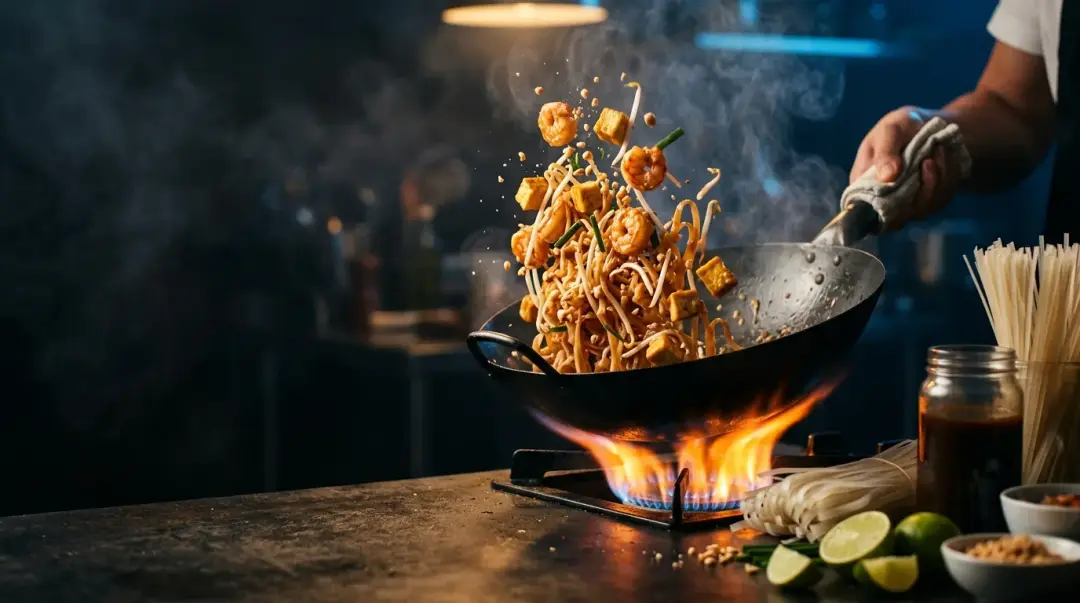
Pad thai cooks fast over high heat, so a wide carbon steel wok and a long-handled spatula matter more than any gadget. Pound the peanuts for the topping in a mortar rather than chopping them. For wok shopping, see our Chinese wok buying guide.
See Best Pad Thai Noodles & Kits for product picks.
The make-or-break ingredient is tamarind. Tamarind concentrate (sold in jars at Asian groceries) is essential — Worcestershire is not a substitute despite some recipe sites saying it is.
Frequently Asked Questions
What noodles are in pad thai?
Sen lek, thin flat rice noodles made from rice flour and water. They are soaked, then stir-fried with the sauce. Dried packs labeled "rice stick" or "pad thai noodles" are the same noodle. See our pad thai noodle buying guide.
Is pad thai Vietnamese or Chinese?
Neither. Pad thai is Thai. It was popularized in the early 1940s under Prime Minister Plaek Phibunsongkhram as a national dish, although stir-frying rice noodles came to Thailand with Chinese immigrants.