Ramyeon vs Ramen (Ramyun): What's the Difference?
· 7 min read · NoodleDex Editorial
The difference between ramen and ramyeon (ramyun): Korea's spicy instant noodle vs Japan's slow-simmered shop bowl. Broth, noodles, cook time and brands.
This page contains affiliate links. We may earn a commission at no extra cost to you. Disclosure
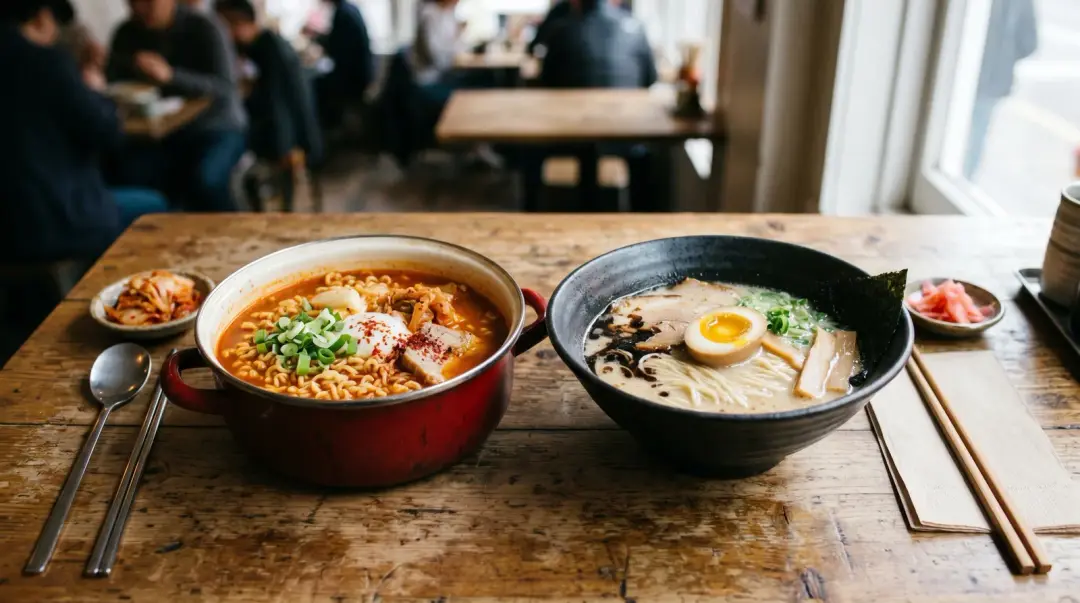
Korean ramyeon is a spicy instant noodle category built around gochugaru and a 4-minute cook time. Japanese ramen is a shop-cooked bowl built around hours of broth simmering and alkaline wheat noodles. They share one Chinese root word and almost nothing else. Names rhyme; dishes do not.
The Headline Difference
Ramyeon is a product category — a bagged or cup format engineered for the home cook with a stovetop and four minutes. Ramen is a restaurant dish — a multi-component bowl that takes a working chef 8 to 18 hours to build, then 90 seconds to plate. Even when ramen is sold instant (Maruchan, Sapporo Ichiban), the gold standard remains the shop bowl. With ramyeon, the gold standard is the bag. Shin Black at H Mart and the bowl an Ippudo cook hands you at the pass are doing different jobs from different starting points.
Side-by-Side Comparison
Ramyeon vs Ramen — At a Glance
| Korean Ramyeon | Japanese Ramen | |
|---|---|---|
| Origin | South Korea, 1963 (Samyang Foods) | Japan, late 1800s; instant version 1958 |
| Default format | Instant (bag, cup, pouch) | Shop-fresh; instant exists but is secondary |
| Broth base | Anchovy-kelp + beef + gochugaru | Tonkotsu, shoyu, miso, or shio — each its own school |
| Broth build time | 4 minutes (powder hydrates in boiling water) | 8-18 hours for tonkotsu; 4-6 hours for chicken shoyu |
| Noodle type | Pre-fried wavy wheat, no kansui | Fresh alkaline wheat (kansui-treated) |
| Noodle cook time | 3-4 minutes from frozen-dry state | 60-120 seconds from fresh |
| Default heat level | Medium to high (gochugaru-driven) | Mild; spicy variants exist (tantanmen, spicy miso) |
| US-iconic brand | Nongshim Shin Ramyun, Samyang Buldak | Ippudo (shop), Sun Noodle (supplier), Maruchan (instant) |
| Eaten with | Metal chopsticks, table scissors, kimchi | Wooden chopsticks, soup spoon, no scissors |
The Broth Split
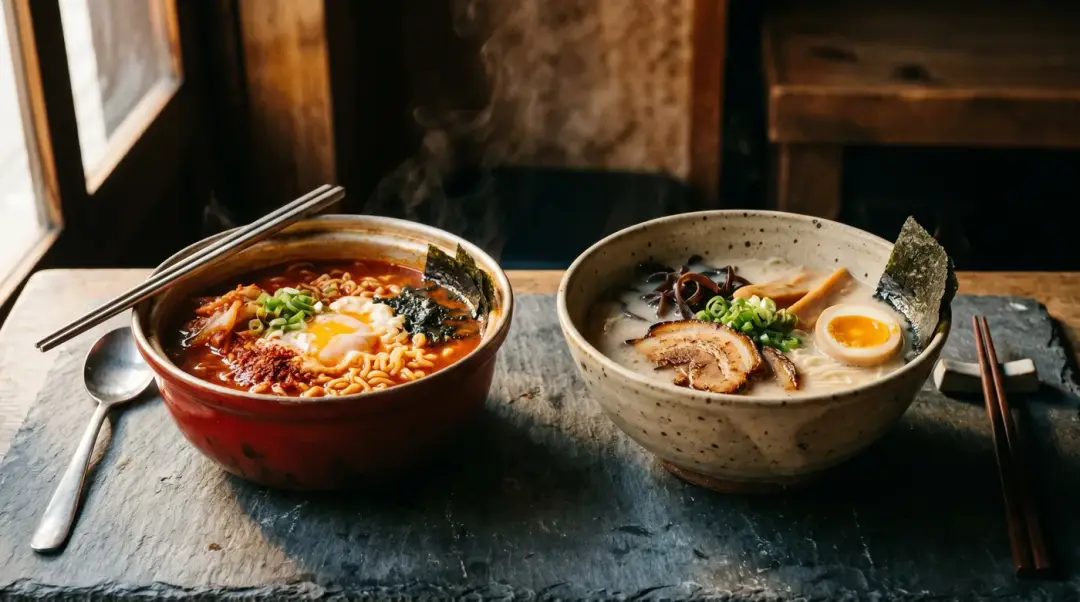
Ramyeon broth is assembled from a powder packet — usually anchovy-kelp base, beef tallow or beef extract, gochugaru (Korean red pepper flake), garlic, and MSG. The Korean philosophy is front-loaded sharpness: a clean, mineral broth tinted red, with chili heat that builds across the bowl. Shin Ramyun's powder leans beefy-spicy. Neoguri leans seafood-spicy. Jin Ramen Mild is gochugaru-light and closer to a Japanese palate. None of them simmer — they hydrate.
Ramen broth is cooked. Tonkotsu pork bones boil at a rolling temperature for 12 hours or more, emulsifying collagen into the water until it goes milky. Shoyu starts from a clear chicken-pork stock plus a soy-based tare added at the bowl. Miso layers in stir-fried aromatics. Shio is the hardest to do well — there is nowhere for a bad stock to hide. The technique is additive depth across time. A ramyeon bowl tastes finished the moment the powder dissolves; a ramen bowl tastes finished only after the chef finishes layering tare, broth, aromatic oil, noodles, and toppings in sequence.
Ramyeon hydrates. Ramen cooks. That single distinction explains 90% of what's different about the two bowls.
The Noodle Split
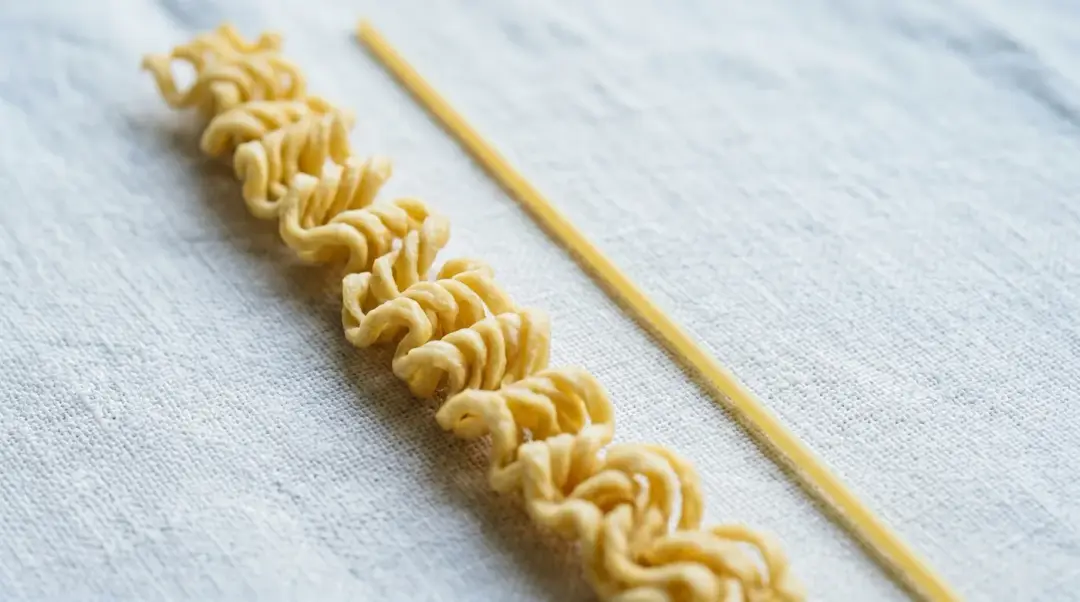
Ramyeon noodles are pre-fried — extruded, steamed, then flash-fried in palm oil to drive off moisture. That is what makes them shelf-stable for two years. They're wavy (the curls catch broth), dense, and bouncy, with a slightly fried mouthfeel that some palates love and some don't. There is no kansui in most ramyeon — Korean producers historically used alternate alkalizers, and several modern brands now use none at all. The yellow tint comes mostly from the seasoning.
Ramen noodles are alkaline wheat, made fresh, treated with kansui (an alkaline mineral water of potassium and sodium carbonates) that gives the strands their yellow color, springy bite, and characteristic ramen aroma. Sun Noodle in California supplies most serious US ramen shops — their noodles arrive twice a week, refrigerated, never frozen. Texture target: a clean snap at first bite, springy chew across the bowl, no mushy slide at the end. Cook time is 60 to 120 seconds, dropped into boiling water in a deep-cage strainer, drained hard, and plated immediately.
The Brand Map (Both Sides)
Ramyeon — what to buy in the US:
- Nongshim Shin Ramyun: the default. Beef-mushroom broth, medium-high heat.
- Nongshim Shin Black: premium tier. Beef bone broth powder added; richer mouthfeel.
- Nongshim Neoguri: seafood-spicy with udon-thick noodles. The Parasite jjapaguri half. See our seafood ramen guide.
- Nongshim Chapagetti: black-bean (jjajang-style); not technically spicy. The other Parasite half.
- Samyang Buldak (Hot Chicken): extreme heat, sauce-based, not soup. Multiple flavor remixes.
- Ottogi Jin Ramen Mild: lower-heat entry point.
- Paldo Ilpoom Bibim Myun: cold-sauce ramyeon for summer.
Ramen — what to buy in the US:
- Sun Noodle (Hawaii/California): the supplier behind most serious shops. Fresh noodle kits at Whole Foods and select H Marts, in two-serving boxes.
- Ippudo: tonkotsu, originally Hakata; US shops in NYC, LA, SF, Berkeley.
- Ichiran: solo-booth tonkotsu; NYC Brooklyn and Times Square locations.
- Jinya: California-rooted chain, broad menu.
- Tsuta and Afuri in select cities for shio and yuzu-shio.
- Instant tier: Maruchan, Sapporo Ichiban Original. Useful for technique practice, not the real bowl.
When to Reach for Each
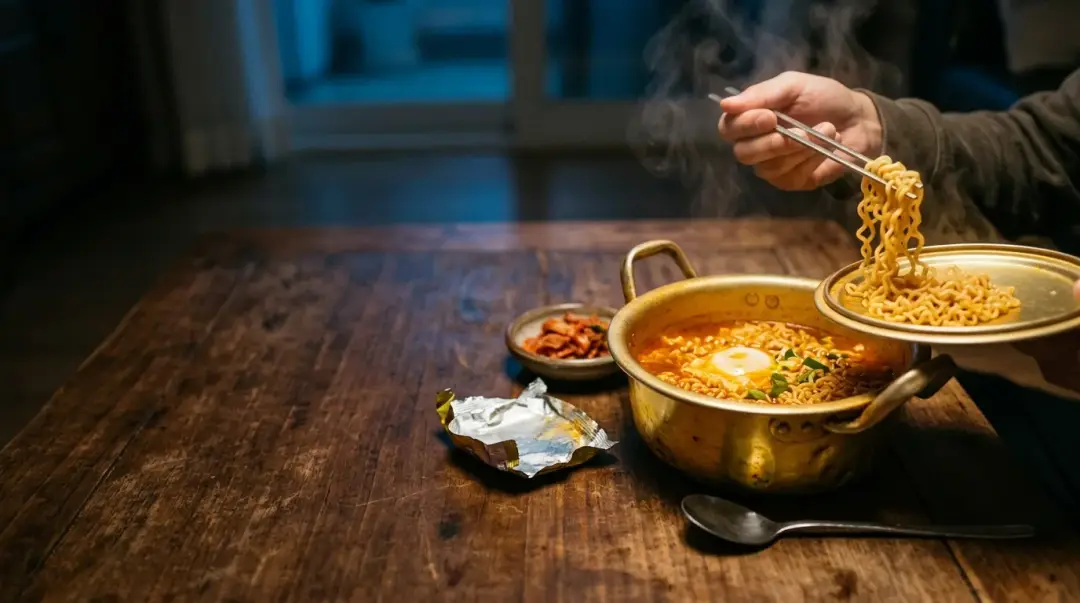
Choose ramyeon when you have four minutes, want sharp heat, and are cooking at home. Korean kitchens cook it in a thin yellow aluminum pot (see our guide to Korean noodle pots), and the cup versions of both noodles only need a kettle. Add a beaten egg in the last 30 seconds, a slice of American cheese (genuinely correct, not a meme), and chopped scallion. A frozen dumpling and a handful of frozen rice cakes upgrade it to budae jjigae-adjacent territory.
Choose ramen when you're going out, or when you have a weekend to make broth from scratch. The shop bowl is the form. Home tonkotsu is a real project — 12 hours of boiling pork bones, chashu pork, soft-boiled marinated eggs, fresh alkaline noodles. Worth doing once. Probably not worth doing weekly.
The Cultural Frame
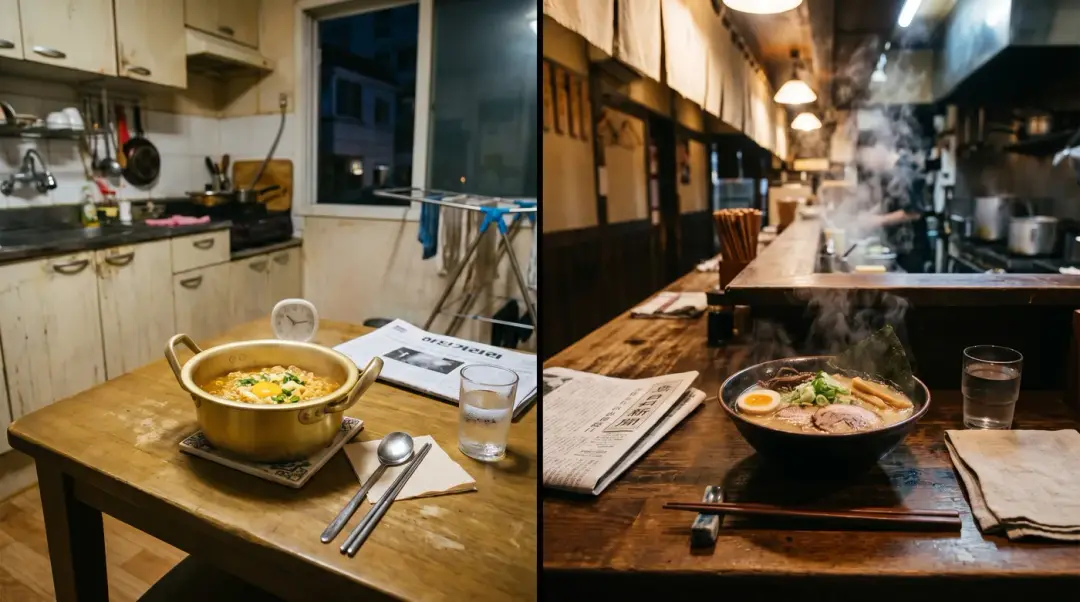
Ramyeon is everyday Korean food. It is what college students eat at 2 a.m., what office workers grab from a convenience store, what hikers heat over a portable stove at the top of Bukhansan. The phrase "ramyeon meogeullae?" — "want some ramyeon?" — appears in dozens of K-dramas as a coded after-midnight invitation, the Korean equivalent of "come up for coffee." That cultural register is fundamentally domestic and casual.
Ramen in Japan is also everyday food — but the everyday version is the shop bowl, not the bag. There is no instant equivalent to the late-night Korean ramyeon ritual in Japanese culture. Japanese instant ramen exists (it was invented in Japan by Momofuku Ando in 1958, the entire category's birth) but the cultural center of Japanese ramen sits in the shop, not the kitchen.
Where the Two Traditions Overlap
Some product categories blur the line:
- Premium instant ramen kits (Ichiran Take-Home Tonkotsu, Ippudo retail kit) take Japanese restaurant ramen and reformat it as a home product. The result is closer to Japanese ramen than to Korean ramyeon, but the format borrows from Korean culture.
- Premium Korean ramyeon variants (Shin Black, Ottogi Yeolla Yeolla, Samyang Premium lines) try to elevate instant Korean ramyeon toward restaurant-tier ingredients. Some succeed; none reach actual restaurant-Japanese-ramen quality, but they narrow the gap.
- Crossover restaurants — Tokyo and Osaka have a small number of Korean ramyeon-themed restaurants, and Seoul has a meaningful tonkotsu scene. Neither has gone mainstream in the other country.
The trend toward convergence is real but slow. The fundamental format difference (restaurant-first vs home-first) shapes consumer expectations on each side too deeply to dissolve quickly.
Where to Try Each in the US
For ramyeon, walk into any H Mart or browse the Korean aisle at 99 Ranch — every brand listed above is on the shelf. Our Korean instant ramyeon buying guide ranks the current US Amazon top picks. For ramen, the US has caught up: most metros over a million people now host at least one serious shop, and Sun Noodle's distribution map covers the rest. Look for shops that specify their broth school (Hakata-style tonkotsu, Sapporo miso, Tokyo shoyu) — the specifics signal the chef knows what they're cooking.
If You Only Remember One Thing
Ramyeon is a four-minute bag. Ramen is an eighteen-hour bowl. The names rhyme because they share one Chinese root word from a thousand years ago — but treat them as two different food categories at the grocery store and on the menu, and you'll order better at both.
FAQ
Is ramyun the same as ramyeon?
Yes. Ramyun and ramyeon are two spellings of the same Korean word, 라면. Ramyeon follows Korea's official romanization; ramyun is an older, informal spelling that brands such as Nongshim's Shin Ramyun still use on the package.
Is ramyeon the same as ramen?
No. They share a name and both are wheat noodle soups, but ramyeon is Korea's instant-noodle category: a spicy powder-packet broth and a four-minute cook. Ramen is Japan's shop bowl, built on hours of broth simmering and alkaline noodles. In Korea, "ramyeon" almost always means instant noodles.
Is ramen Korean or Japanese?
Ramen is Japanese. It developed in Japan from Chinese noodle soups in the late 1800s, and instant ramen was invented there in 1958. The Korean version, ramyeon, arrived in 1963, when Samyang Foods launched Korea's first instant noodle.
What does ramyeon mean?
Ramyeon (라면) is the Korean word for ramen, borrowed when instant noodles reached Korea in 1963. In everyday Korean it means instant noodles, usually spicy ones like Shin Ramyun.
How do you say ramen in Korean?
라면, pronounced RAHM-yawn, not "rah-MEN". It is romanized as ramyeon or ramyun. Our Korean noodle pronunciation guide covers the rest of the menu.
Is Japanese ramen spicier than Korean ramyeon?
Almost always no. Korean ramyeon is the spicier tradition by a wide margin. Japanese ramen broths rely on fat, umami and salt rather than chili.
Which is older, Korean ramyeon or Japanese ramen?
Japanese ramen. The first ramen shop opened in Tokyo in 1910, and instant ramen arrived in 1958, five years before Korea's first instant ramyeon in 1963.
Can I use Korean ramyeon noodles in Japanese ramen broth?
Technically yes, but the pre-fried, wavy ramyeon noodle tastes distinctly Korean. The result is close to Japanese ramen, not the same.
Read Next
Products mentioned in this guide
This section contains affiliate links. We may earn a commission at no extra cost to you.

Nongshim Shin Ramyun Original (20-pack)
The default bag on the ramyeon side of this comparison: beefy, medium-high heat, done in about four minutes. Add an egg and a slice of American cheese.
View on Amazon
Samyang Buldak Hot Chicken Ramen (10-pack)
Buldak shows the sauce-based branch of ramyeon, with no broth and much more heat. Buy it once you know you like Shin.
View on Amazon
Ottogi Jin Ramen Mild (20-pack)
For readers who want ramyeon without the burn, Jin Mild is the gentle entry point. It sits closest to a Japanese palate of the Korean brands here.
View on Amazon
SUN NOODLE Kaedama Ramen Noodles, 10 OZ
To taste the ramen side at home, start with fresh kansui noodles from Sun Noodle. Cook them 60 to 120 seconds and drain hard, as the noodle section explains.
View on Amazon
SVRITE Korea Noodle Pot Korean Ramen Cooking Pot with Lid, Yellow Aluminum
Ramyeon traditionally cooks in a thin yellow aluminum pot that brings a single serving to the boil fast. This listing is a yellow aluminum alloy pot with a lid and side handles, sold in 14 to 22 cm sizes, so check the size before ordering.
View on Amazon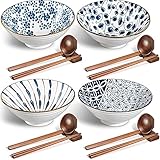
Geiserailie 40oz Ceramic Japanese Ramen Bowls Set of 4 with Chopsticks, Spoons and Rests
Ramen is served in a deep ceramic bowl that holds broth, noodles and toppings together. This is a set of four 40-ounce, 8-inch bowls with chopsticks, spoons and chopstick rests, microwave and dishwasher safe.
View on Amazon
Cosori Electric Kettle, No Plastic Contact with Water, 1.7L
Both ramyeon and ramen have cup versions that need only hot water, and a kettle gets there faster than a pot. This listing is a 1.7-liter kettle with a stainless steel interior, a wide opening and auto shut-off.
View on Amazon
Browse more related items
Opens Amazon · affiliate links