Korean vs Japanese vs Chinese Noodles
· 6 min read · NoodleDex Editorial
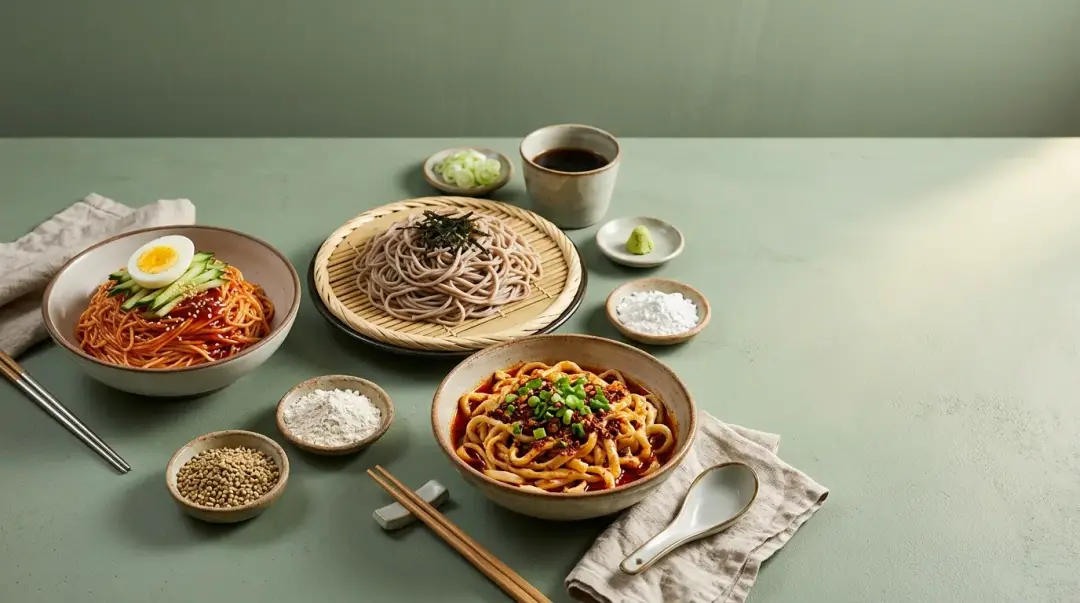
Compare Korean, Japanese, and Chinese noodles by broth scent, starch base, and serving ritual. See which Asian bowl belongs in your next dinner rotation.
This page contains affiliate links. We may earn a commission at no extra cost to you. Disclosure
On this page(13 sections)
- The Headline Difference
- Why the Three Are Often Conflated
- The Defining Differences
- Ingredient Foundations
- Broth Philosophy
- Spice as a Cultural Variable
- Cold Noodle Tradition (Korea's Unique Strength)
- The Side-Dish Divide
- Utensils and Service Conventions
- How to Tell Them Apart in a Restaurant
- If You Only Remember One Thing
- FAQ
- Products mentioned in this guide
East Asia's three great noodle cultures share one linguistic ancestor — Chinese lamian (拉麵) — and roughly a millennium of cross-borrowing. The three diverged enough that the modern bowls look related but cook on different principles. Korean noodles run sharp and gochugaru-tinted; Japanese noodles run bonito-dashi clean and technically precise; Chinese noodles run regional, anywhere from clear Cantonese stock to numbing Sichuan chili oil.
The Headline Difference
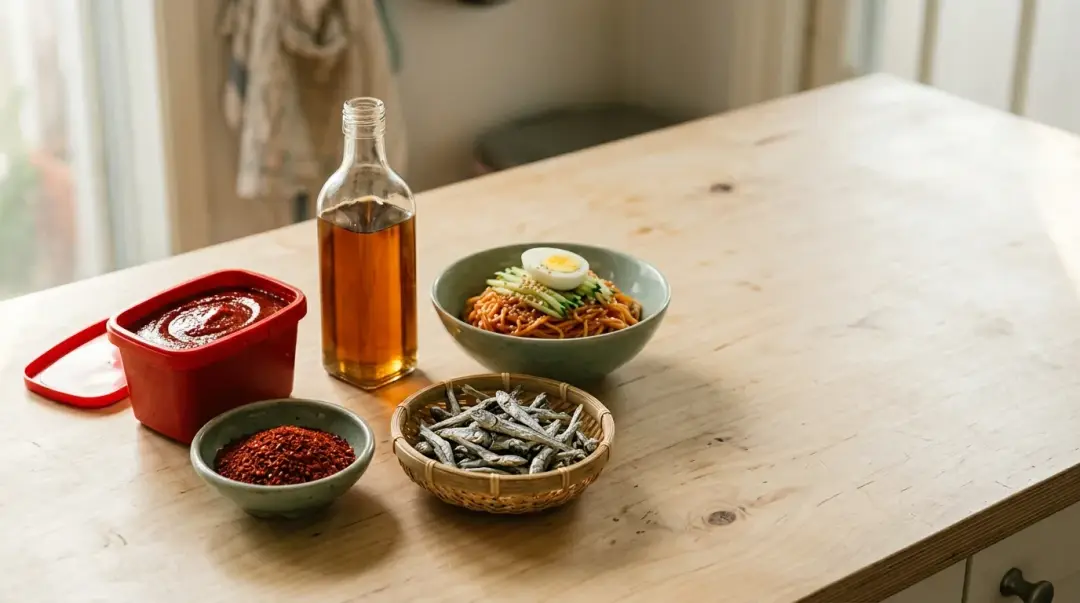
The clearest separator is the broth signature. A Korean bowl smells faintly of anchovy and gochugaru — anchovy-and-kelp stock is the base layer of nearly everything except japchae. A Japanese bowl smells of bonito and konbu — dashi anchors the whole cuisine, from clear shoyu ramen to udon broth to soba dipping sauce. A Chinese bowl smells of whatever region the kitchen comes from — pork bone in Hakka, Sichuan peppercorn in Chengdu, cumin-and-lamb in Xinjiang, clear chicken broth in Cantonese. If you can identify the broth's foundation, you've already named the cuisine.
Why the Three Are Often Conflated
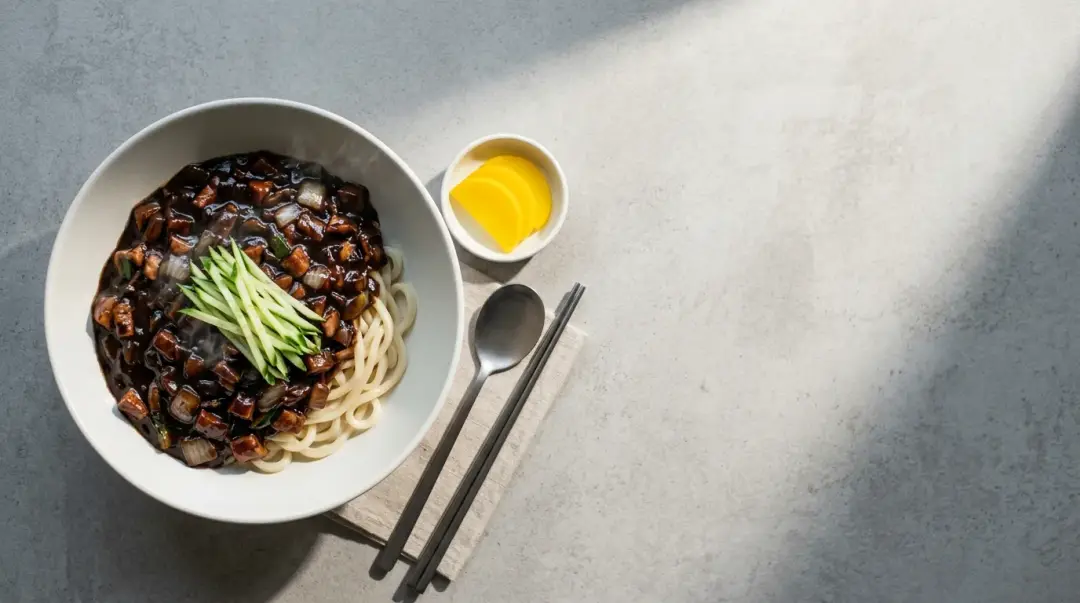
Centuries of cross-cultural exchange have left visible fingerprints across all three cuisines. Korean ramyeon descends from Japanese instant ramen, which descends from Chinese fresh noodles. Korean jjajangmyeon descends from Chinese zhajiangmian. Japanese ramen broth philosophy is closer to Chinese stock culture than to Korean broth traditions.
But the three cuisines have diverged enough that side-by-side comparison reveals three completely different food cultures with overlapping ingredients.
The Defining Differences
Korean vs Japanese vs Chinese Noodles — Cultural Profile
| Aspect | Korean | Japanese | Chinese |
|---|---|---|---|
| Primary broth | Anchovy + kelp + gochugaru | Bonito + kelp dashi | Pork bone + Sichuan peppercorn (or many regional) |
| Spice level | Often high (gochujang, gochugaru) | Usually mild | Highly regional (mild Cantonese to fiery Sichuan) |
| Cold noodle tradition | Strong (naengmyeon, kongguksu, bibim guksu) | Limited (zaru soba, hiyashi chuka) | Limited (liang mian) |
| Iconic noodle texture | Chewy and bouncy | Springy with chew (alkaline) | Hand-pulled, wide variety |
| Side dish culture | Always banchan (multiple sides) | Side dishes optional | Sides vary; pickles common |
| Eating utensils | Metal chopsticks + spoon | Wooden chopsticks | Wooden chopsticks (and spoon) |
| Most famous abroad | Shin Ramyun, Buldak | Tonkotsu ramen, udon | Lo mein, hand-pulled (lamian) |
Ingredient Foundations
Each cuisine builds noodles around different starches:
Korean cuisine uses wheat (for ramyeon, kalguksu, sundubu guksu), buckwheat (naengmyeon), and sweet potato starch (japchae). The sweet potato starch noodles are particularly distinctive — Japan and China don't use this format commonly.
Japanese cuisine uses alkaline wheat (for ramen, with kansui giving the yellow color and bounce), buckwheat (for soba), and wheat without alkaline (for udon, somen, hiyamugi).
Chinese cuisine uses wheat (the largest category, from northern noodle culture), rice (mostly southern, e.g., kway teow), and mung bean starch (glass noodles, called fensi).
Broth Philosophy
The clearest divergence is broth. Korean broths are anchovy-and-kelp forward with a mineral-clean profile, often tinted red with gochugaru. Japanese broths are bonito-and-kelp forward, with dashi as the foundation, often building to deeply layered ramen broths from pork bones and chicken. Chinese broths vary wildly by region — clear Cantonese stocks, heavy Sichuan numbing oils, smoky Hunan blends.
If you sip three bowls back-to-back with eyes closed, the Korean bowl tastes sharper and brighter, the Japanese bowl smokier and more umami-deep, the Chinese bowl wholly regional-dependent.
Spice as a Cultural Variable
Spice level is one of the clearest dividers across the three cuisines. Korean noodle cuisine treats spice as a daily condition — gochugaru appears in nearly every spicy noodle, and most adult Korean diners eat dishes that an unconditioned palate would call seriously hot. Mild Korean noodles (kalguksu, kongguksu, japchae) exist, but they're the exceptions.
Japanese noodle cuisine treats spice as a rare accent. Classical ramen is not spicy; spicy variants (tantanmen, spicy miso, kara-miso) exist but trace their heat to Chinese-influenced dishes that entered Japan in the 20th century, not to the classical ramen canon. The dominant Japanese noodle palate runs from clean-savory (shio, sōmen) to deeply umami (tonkotsu, niboshi-shoyu) — but rarely capsaicin-forward.
Chinese noodle cuisine treats spice as regional. Sichuan and parts of Hunan and Yunnan run aggressively hot; Cantonese, Shanghai, and most northern wheat cuisines are nearly always mild. The same diner in Chengdu and Hong Kong is ordering from completely different spice traditions.
Cold Noodle Tradition (Korea's Unique Strength)
Korea is unique in East Asia for the depth of its cold noodle tradition. Naengmyeon, kongguksu, bibim guksu — three distinct cold noodle dishes that are restaurant categories of their own. Japan has zaru soba and hiyashi chuka, but neither is as central to summer eating. China has liang mian (cold noodles) in some regions, but it's not a foundational dish.
If you want to understand Korean noodle culture, eating naengmyeon in August is essential.
The Side-Dish Divide
A frequently overlooked separator: what comes with the bowl.
- Korean noodle meals nearly always include banchan — small side dishes (kimchi, pickled radish, seasoned spinach, fish cake) that arrive automatically and refill for free. The bowl is one of several plates on the table.
- Japanese noodle meals are typically self-contained. A bowl of ramen comes with the toppings built in (chashu, menma, scallion, soft-boiled egg, nori); side dishes are not standard. The bowl is the entire meal.
- Chinese noodle meals are regional. Cantonese spots may offer pickled cucumber or peanuts; Sichuan and northern spots often offer chili oil, vinegar, and a small dish of pickle (cha cai or zhacai). Some dishes (zhajiangmian) come with mix-in vegetables on the side.
Walk into a US restaurant and the side situation is one of the fastest cuisine-identifiers — banchan = Korean, no sides = Japanese, regional condiment trio = Chinese.
Utensils and Service Conventions
The three cuisines also diverge on how the bowl is eaten:
- Korean diners use metal chopsticks (steel, sometimes silver-plated, often flat rather than round) and a long-handled spoon, typically held simultaneously — chopsticks in dominant hand, spoon staged in the other for broth. Noodles are often cut at the table with scissors (especially naengmyeon and ramyeon).
- Japanese diners use wooden or lacquered chopsticks and slurp — slurping ramen is a compliment to the chef and helps cool the broth on the way in. The bowl is often lifted with the non-dominant hand for sipping.
- Chinese diners use wooden chopsticks and a porcelain spoon, often together but switching freely. Slurping is more common than in Western dining but less ritualized than in Japan.
The cookware differs too. Ramyeon is cooked in a yellow aluminum pot, and Chinese stir-fried noodles are worked in the wok with a chuan (wok spatula) and ladle. For wooden Japanese-style chopsticks, see our chopsticks buying guide.
The scissors are the most visible Korean signal. If your table has scissors, you're at a Korean restaurant.
How to Tell Them Apart in a Restaurant
If you order a "noodle dish" in a US restaurant and the cuisine is unclear, here's how to tell:
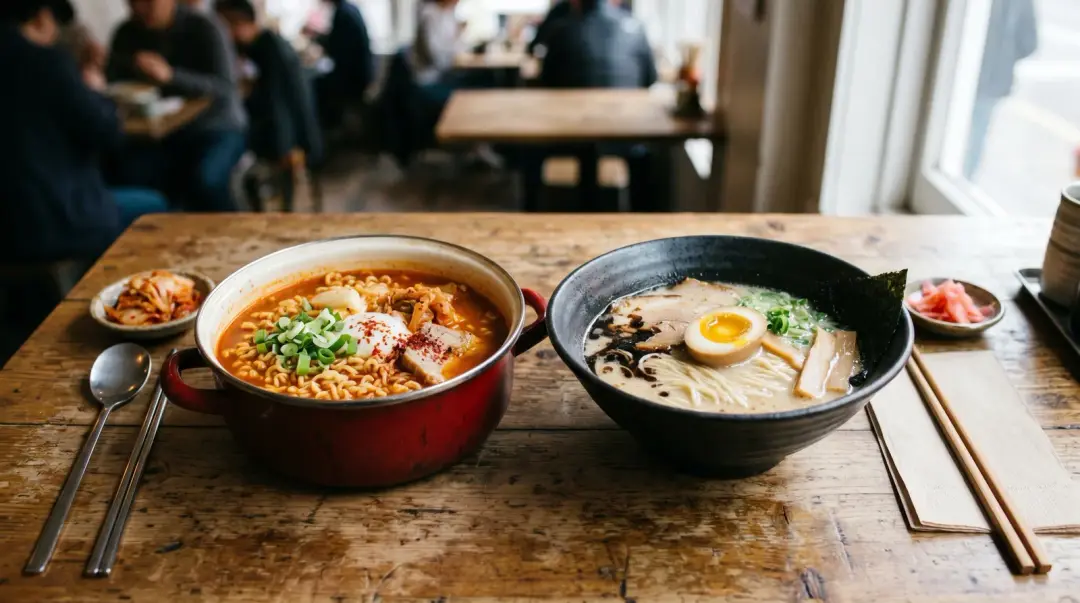
- Spicy red broth + thin springy noodles + scissors at the table? Korean ramyeon
- Brown savory broth + thick wheat noodles + flat bowl? Japanese ramen or udon
- Glossy black sauce + thick noodles? Korean jjajangmyeon
- Clear light broth + thin noodles + small plates of pickles? Chinese
- Ice-cold broth + chewy gray-brown noodles + scissors? Korean naengmyeon
If You Only Remember One Thing
Three cuisines, three broth signatures: Korean anchovy-kelp-gochugaru, Japanese bonito-dashi, Chinese regional-dependent. Smell the bowl before you taste it and you've already identified which cuisine you're eating in.
FAQ
What is the biggest difference between Korean, Japanese and Chinese noodles?
The broth signature. Korean bowls rest on anchovy and kelp stock tinted with gochugaru, Japanese bowls on bonito and kelp dashi, and Chinese bowls on whatever the region uses, from clear Cantonese stock to Sichuan chili oil.
Which cuisine has the strongest cold noodle tradition?
Korea. Naengmyeon, kongguksu and bibim guksu are restaurant categories of their own, while Japan has zaru soba and hiyashi chuka and China has liang mian in some regions.
Which is spicier, Korean, Japanese or Chinese noodles?
Korean noodles are often high in heat from gochujang and gochugaru. Japanese noodles are usually mild, and Chinese spice is regional, from mild Cantonese to fiery Sichuan.
Do Korean noodle meals come with side dishes?
Yes. Korean noodle meals nearly always include banchan such as kimchi and pickled radish, while a Japanese ramen bowl is typically self-contained.
Read Next
- Ramyeon vs Ramen — Korean and Japanese instant noodles compared
- Glass vs Rice vs Wheat Noodles — by base starch
- Hot vs Cold Korean Noodles — seasonal Korean noodle culture
- Beginner's Guide to Asian Noodles — the main noodle families in one page
Products mentioned in this guide
This section contains affiliate links. We may earn a commission at no extra cost to you.

Tae-kyung Korean Gochugaru (Coarse Red Pepper Flakes, 1 lb)
The red pepper flake that tints Korean anchovy-kelp broths. Buy this before anything else if you plan to cook Korean noodle soups.
View on Amazon
Ottogi Korean Sweet Potato Glass Noodles (Dangmyeon)
Sweet potato starch noodles, the format this page calls distinctly Korean. Use them for japchae.
View on Amazon
Hondashi Bonito Soup Stock (4.4 oz)
Instant bonito dashi granules. A fast way to taste the Japanese broth signature next to a Korean or Chinese bowl.
View on Amazon
Lao Gan Ma Chili Crisp (Original)
A staple of the Chinese condiment trio. Add it to plain wheat noodles to get close to a Sichuan-leaning table.
View on Amazon
SVRITE Korea Noodle Pot, Korean Ramen Cooking Pot with Lid, Yellow Aluminum
Korean ramyeon is cooked in a yellow aluminum pot, the visual signature of the Korean side of this comparison. The listing is a yellow aluminum pot with a lid and side handles, sold in 14 to 22 cm sizes.
View on Amazon
5 Pairs Reusable Japanese Wooden Chopsticks, Non-Slip Tip, 9 Inches, Made in Japan
Japanese noodle bowls are eaten with wooden chopsticks, in contrast to Korean metal ones. This listing is a five-pair set of reusable wooden chopsticks, about 9 inches long, with non-slip tips.
View on Amazon
YOSUKATA 17-inch Wok Spatula and Ladle, Set of 2
Chinese stir-fried noodles are worked with a wok spatula (chuan) and ladle. This is a two-piece stainless steel set with 17-inch handles, listed for 13 to 14 inch or larger woks.
View on Amazon
Browse more related items
Opens Amazon · affiliate links