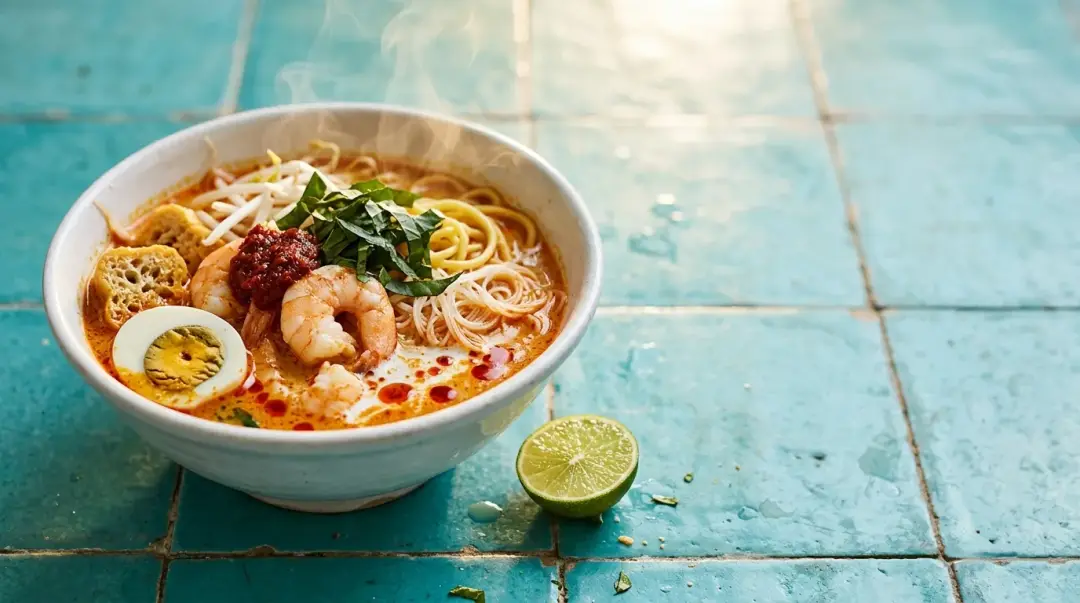
Laksa (LAHK-sah) is the spicy coconut-curry noodle soup of Peranakan (Straits Chinese) cuisine — most associated with Malaysia, Singapore, and Indonesia. Two main styles split the field: curry laksa, coconut-rich and golden, the Singaporean and Malaysian mainstream; and asam laksa, tangy with tamarind and no coconut, the pride of Penang. Rice vermicelli or the thicker laksa noodle goes in the bowl. Diners outside Southeast Asia find it at Malaysian specialists and in Prima Taste kits at Whole Foods.
What is Laksa?
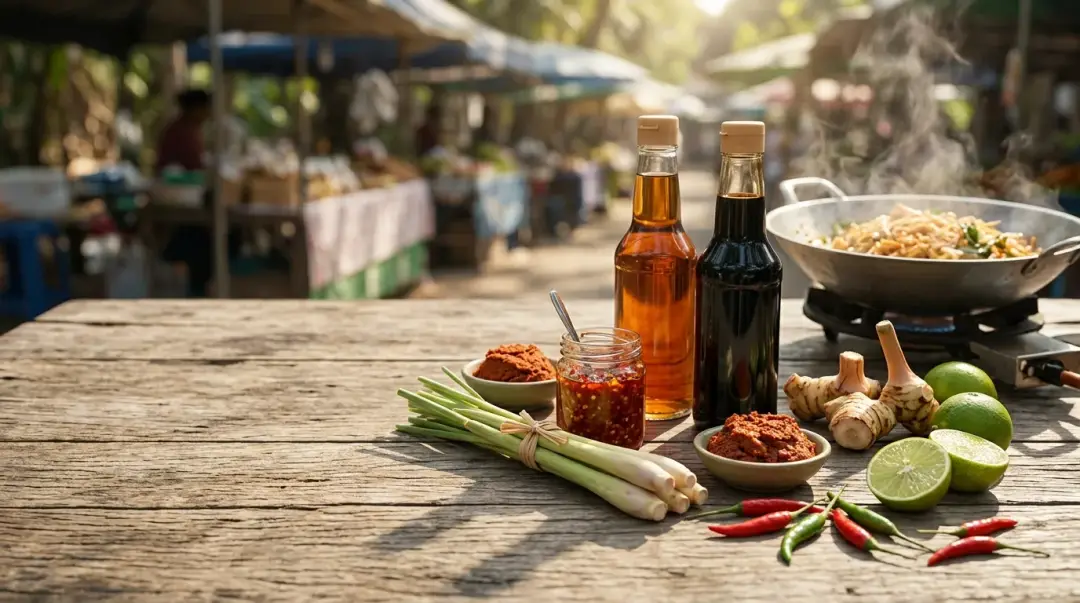
Laksa is a spicy noodle soup native to the Peranakan kitchen — the cuisine of the Peranakan (Straits Chinese, descended from 15th- and 16th-century Chinese traders who settled in Malacca, Penang, and Singapore and married into local Malay families). The cuisine that emerged from those households is called Nyonya (the Peranakan word for a married woman, used as shorthand for the whole tradition). Laksa is its most famous export — a 19th-century Chinese-Malay fusion that took the Chinese rice-noodle soup template and rebuilt it on a Malay spice-paste base of gulai (the Malay/Indonesian coconut-and-spice curry), belacan (fermented shrimp paste, the savory anchor of Southeast Asian cooking), lemongrass, galangal, turmeric, and dried chili.
The bowl itself varies by city, but the canonical version pairs broth with the laksa noodle — a thick, round, white rice vermicelli noticeably fatter than Vietnamese bún and slipperier than Japanese udon, with a soft pull that holds coconut broth without breaking. Many Singapore shops use standard bee hoon (thin rice vermicelli) instead; Penang's asam laksa uses thicker rice noodles closer in body to udon. Toppings are abundant by design: prawns, fish cake slices, fried tofu puffs (tau pok), bean sprouts, sliced cucumber, half a hard-boiled egg, and a spoon of sambal on the side.
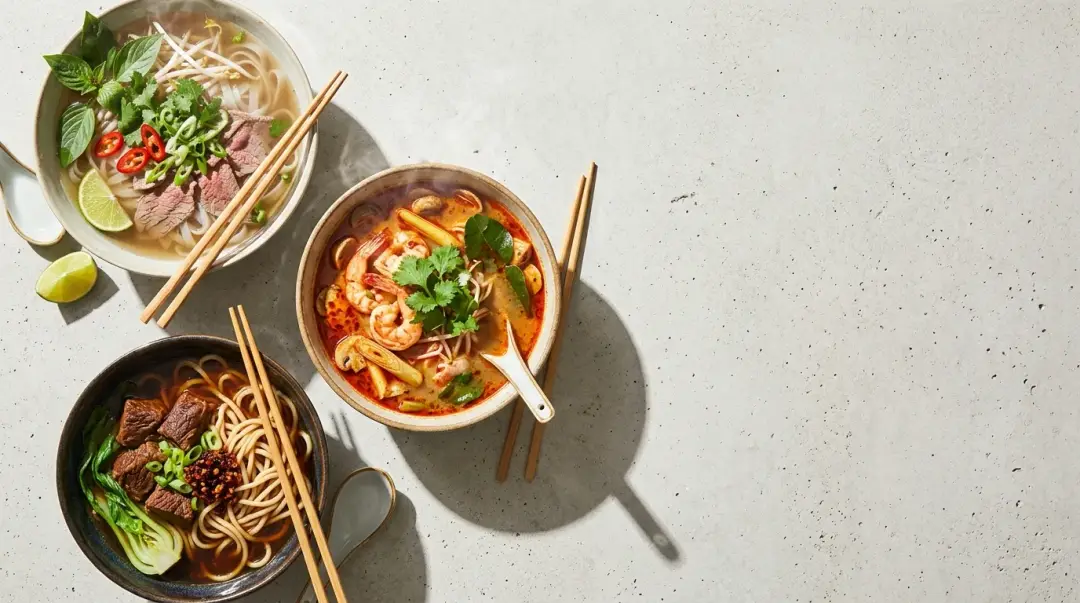
What sets laksa apart is body. Coconut milk gives curry laksa a dairy-like richness no other Southeast Asian bowl carries. Phở is clean. Tom yum is bright. Laksa is dense.
Flavor Profile
Laksa is the richest noodle soup in the Southeast Asian canon. The first taste is coconut — whole-fat coconut milk, simmered long enough to thicken but not split. Underneath sits the gulai warmth: lemongrass and galangal up front, turmeric earthiness in the back, dried chili humming at low volume. Belacan (shrimp paste) does the umami work — fermented, funky, the kind of savor that reads as depth rather than a single note. A handful of torn rau ram (Vietnamese coriander, also called laksa leaf — the herb has a sharp, citrus-pepper bite distinct from cilantro) goes on top, and a wedge of lime brings the whole bowl forward. Cooked right, laksa is heavy without being heavy-handed. The richness is the point.
Curry Laksa vs Asam Laksa vs Sarawak Laksa
The three styles share a name and almost nothing else:
- Curry Laksa (Singapore, Kuala Lumpur, most of peninsular Malaysia) — Coconut-rich, golden-orange, built on a chili-shallot-galangal-turmeric-belacan paste finished with coconut milk. Served with laksa noodles or bee hoon. This is the version most people picture when they hear "laksa."
- Asam Laksa (Penang, northern Malaysia) — Tamarind-sour (asam means sour in Malay), fish-broth-based, no coconut milk. Topped with shredded mackerel, pineapple, mint, torn rau ram, and hae ko (a thick, sweet shrimp-paste sauce). Thicker rice noodles. CNN ranked it #7 on its 2011 "World's 50 Best Foods" list.
- Sarawak Laksa (Borneo, East Malaysia) — Built on a sambal-belacan paste with tamarind, lemongrass, and a heavy hand of garlic and shallot; no curry powder, no coconut milk in the traditional version (though many modern recipes add a splash). Topped with shredded chicken, prawns, omelet strips. Anthony Bourdain called it "the breakfast of the gods" in a 2015 Parts Unknown episode shot in Kuching.
- Katong Laksa (Singapore's East Coast) — A subset of curry laksa from the Katong neighborhood. Noodles are cut short so the whole bowl can be eaten with a spoon, no chopsticks needed.
Noodles change with the style: curry laksa takes thick laksa vermicelli or bee hoon, asam laksa uses fat rice noodles, Sarawak laksa uses thin bee hoon. Read the bowl, not the menu translation.
Where to Find Laksa Outside Southeast Asia

The noodle to buy
Thai Granite Mortar and Pestle
Laksa paste is built from lemongrass, galangal and dried chili pounded together, and a deep granite mortar crushes them instead of just chopping. This listing is a hand-carved 8-inch Thai-style mortar of solid granite with a rough interior and a large pestle.
Specialized Singaporean and Malaysian restaurants are where to start. The Pan-Asian places that list "laksa" alongside pad thai usually serve a thinned-out version — for the real bowl, find a Malaysian specialist.
- New York — Nyonya (Chinatown, Grand Street), Kopitiam (Lower East Side, run by Kyo Pang from Penang — her asam laksa is the closest thing in the US to what you'd eat on Gurney Drive)
- San Francisco / Bay Area — Penang Garden (San Mateo), Azalina's (Oakland, Malay-Chinese)
- Los Angeles — Penang Malaysian Cuisine (San Gabriel), Mamak Asian Street Food (Long Beach)
- Atlanta — Top Spice (Toco Hills) for the curry version
- Houston — Singapore Banana Leaf Apolo
At grocery: Prima Taste Singapore Laksa LaMian (premium instant kit, single-serving box) sits on the shelf at most Whole Foods, every H Mart and 99 Ranch, and ships from Amazon as a four-pack. The Ramen Rater has ranked the wholegrain version of this laksa number one on its global top ten instant noodle list for about a decade. The full Prima Taste curry laksa paste kit is sold at Asian groceries.
Making Laksa at Home
Laksa rewards a paste-and-coconut-milk approach more than a from-scratch one. The aromatics list is long, and home blenders struggle to grind dried chilies and candlenuts to the silky paste a stone mortar in a Penang kitchen produces. Buy the paste, build the bowl. A deep stone mortar still earns its place for pounding fresh aromatics into a store-bought paste, and an immersion blender smooths the result in the pot.
- Paste — Prima Taste curry laksa paste kit (at H Mart; also on Amazon) or Mae Ploy curry paste cut with a spoon of belacan and a teaspoon of turmeric
- Coconut milk — Whole-fat, not light. Aroy-D or Chaokoh, both sold by the can at Asian groceries
- Noodles — Laksa noodles or thick round rice vermicelli at H Mart or 99 Ranch; bee hoon (thin rice vermicelli, Sailing Boat or Wel-Pac) at any Asian grocery as a substitute
- Laksa leaf — Rau ram (Vietnamese coriander) at any Vietnamese grocery. The dried version loses most of the aroma. Use fresh or skip it
- Toppings — Fish balls, cooked shrimp, fried tofu puffs (tau pok), and cockles or clams at H Mart and 99 Ranch; sliced fish cake (sold in clear plastic blocks near the dumpling freezer) at most Chinese groceries
The build: bloom paste in oil 2-3 minutes, add stock and coconut milk, simmer 10 minutes in a heavy lidded pot, pour over cooked noodles and toppings. Most home laksa fails because cooks dilute the paste. Use more than the package suggests.
What to Pair With Laksa
Laksa is a one-bowl meal by design. The broth is dense enough to count as both soup and main, and the toppings push it into the territory of a full lunch on their own. In Singapore and Penang it's eaten as breakfast or a late-morning meal, often without sides.
When sides do appear, the canonical pairings are otak-otak (grilled fish-paste cakes wrapped in banana leaf, spiced with chili, turmeric, and lemongrass), satay skewers with peanut sauce, and popiah (a fresh spring roll filled with stewed jicama). For dessert, cendol — a shaved-ice bowl with green pandan-rice jelly worms, coconut milk, and palm-sugar syrup — is the textbook closer. Teh tarik (pulled milk tea, frothed by pouring between two cups from arm's length) is the drink.
A Cultural Note
The Peranakan story starts in 15th-century Malacca. Chinese traders settling under the Malacca Sultanate married local Malay women, and over four or five generations the descendants — Peranakan literally means "locally born" in Malay — built a culture that was neither Chinese nor Malay but a third thing. The men were called Baba, the women Nyonya, and the cuisine took the latter name. Pork (Chinese) and belacan (Malay), wok technique (Chinese) and gulai curry (Malay), Hokkien sauces and tamarind: Nyonya cooking is the working definition of fusion centuries before the word existed.
Laksa is the dish that traveled. Each Peranakan port city — Penang, Malacca, Singapore, Medan in Sumatra, Kuching in Sarawak — built its own version, and the regional pride debate has not cooled in two centuries. Singaporeans defend curry laksa as the "real" laksa. Penangites argue asam laksa is the original, since Penang's Chinese community predates Singapore's by a century. Sarawakians point out that their version uses neither curry powder nor tamarind and is therefore the only one not derivative of something else.
Laksa broke into US food media in 2018, when CNN's "10 Asian Noodle Soups You Should Know" ranked Penang asam laksa second behind Vietnamese phở. Bourdain's Sarawak segment had put Kuching on the food-travel map three years earlier. Before that decade, the US dining-out market treated laksa as an obscure Singapore Airlines lounge dish. Now it's on the menu at Malaysian restaurants in every major US city and a permanent fixture in the Whole Foods instant-noodle aisle.
FAQ
What is laksa?
Laksa is a spicy noodle soup from Peranakan (Straits Chinese) cuisine, most associated with Malaysia, Singapore and Indonesia. Curry laksa is coconut-rich and golden, while Penang's asam laksa is tamarind-sour with no coconut.
What is the difference between curry laksa and asam laksa?
Curry laksa is built on a chili, shallot, galangal, turmeric and belacan paste finished with coconut milk. Asam laksa uses a tamarind-sour fish broth with no coconut milk and thicker rice noodles.
What noodles are used in laksa?
Curry laksa takes thick, round rice vermicelli called laksa noodles, or thin bee hoon. Asam laksa uses fat rice noodles, and Sarawak laksa uses thin bee hoon.
Where can I buy laksa?
Malaysian and Singaporean restaurants serve the fullest versions. For home, Prima Taste Singapore Laksa LaMian kits are sold at most Whole Foods, H Mart and 99 Ranch stores.
See SE Asian Pantry Essentials and Vietnamese vs Thai vs Chinese Noodle Soups.