Korean Noodle Pronunciation: 8 Names, Hangul
· 6 min read · NoodleDex Editorial
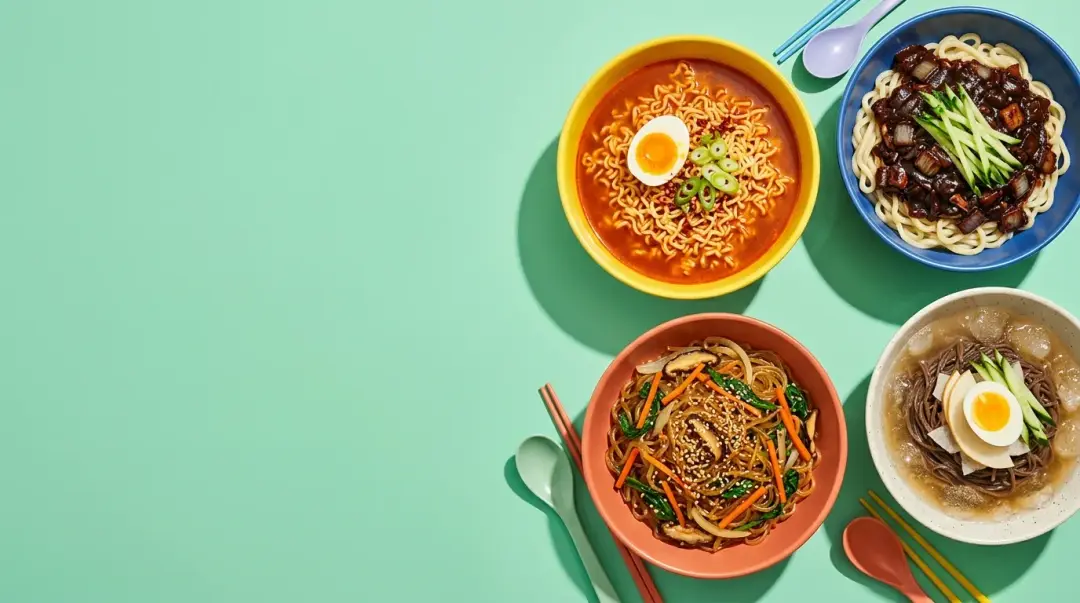
Say ramyeon, jjajangmyeon, japchae, naengmyeon correctly — 8 Korean noodles with Hangul, IPA, and English sound-alikes you can use at H Mart today.
This page contains affiliate links. We may earn a commission at no extra cost to you. Disclosure
On this page(14 sections)
- The Headline Difference
- The Korean Noodle Pronunciation Table
- The Three Pronunciation Rules That Solve 80% of Cases
- Why Korean Looks Harder Than It Is
- Common Mistakes English Speakers Make
- A Few Other Korean Food Terms Worth Pronouncing Correctly
- Why "Ramyeon" Is Not "Ramen"
- The Stress Rule
- What Romanization System Are We Using?
- Korean Loanwords on Restaurant Menus
- How H Mart Cashiers Actually Pronounce These
- If You Only Remember One Thing
- FAQ
- Products mentioned in this guide
Korean noodle names get mangled in restaurants outside Korea every day. Ramyeon comes out "RAH-men" (it isn't). Japchae turns into "JAP-chai" (it isn't). Jjajangmyeon scares off entire tables of diners who never order it because the letters look unspellable. This guide gives each name three ways — Hangul, official romanization, and the closest English approximation — so you can say them correctly at H Mart, at a Korean BBQ restaurant, and on Amazon reviews.
The Headline Difference
Korean pronunciation is regular, which makes it dramatically easier to learn than English. There are no silent letters, no irregular vowels, no "-ough" trap. Once you learn three sound rules — soft ㄹ, tense double consonants, pure vowels — you can pronounce any Korean word, including ones you've never seen, with at least 80% accuracy. The barrier to entry is appearing high (Hangul script + unfamiliar romanizations) and actually low. Korean is one of the most pronunciation-friendly major languages on earth for an English speaker willing to spend ten minutes on the rules.
The Korean Noodle Pronunciation Table
Pronunciation Guide — Every Korean Noodle on NoodleDex
| Hangul | Romanization | IPA | English Approximation |
|---|---|---|---|
| 라면 | ramyeon | /ˈɾam.jʌn/ | RAHM-yawn (not 'rah-men') |
| 짜장면 | jjajangmyeon | /t͈ɕa.dʑaŋ.mjʌn/ | JAH-jahng-myun (the 'jj' is a tense, sharper J) |
| 잡채 | japchae | /t͡ɕap̚.t͡ɕʰɛ/ | JAHP-chay (rhymes with 'sap-bay') |
| 냉면 | naengmyeon | /nɛŋ.mjʌn/ | NAYNG-myun |
| 칼국수 | kalguksu | /kʰal.ɡuk.s͈u/ | KAHL-gook-soo |
| 비빔국수 | bibim guksu | /pi.bim.ɡuk.s͈u/ | BEE-beem GOOK-soo |
| 콩국수 | kongguksu | /kʰoŋ.ɡuk.s͈u/ | KONG-gook-soo |
| 순두부국수 | sundubu guksu | /sun.du.bu.ɡuk.s͈u/ | SOON-doo-boo GOOK-soo |
The Three Pronunciation Rules That Solve 80% of Cases
If you only learn three rules, you'll pronounce Korean noodle names correctly more often than not:
Rule 1: "ㄹ" Between Vowels Is a Soft R/L
The Korean letter ㄹ (rieul) sits between English R and L. In "ramyeon," the first sound is a soft tap — like a Spanish single R, not an English hard R or rolled R. Don't over-pronounce it as "RAH" — it's lighter than that.
Rule 2: Double Consonants ("ㄲ", "ㅉ", "ㄸ") Are Tense, Not Aspirated
In jjajangmyeon, the "jj" is not an emphatic "J" — it's a tense J, made with tight throat muscles and no air burst. The sound exists in English when you say "let's go" quickly: the "g" in "go" tightens slightly. Apply that tightness to "j," and you've got "jj."
Rule 3: Korean Vowels Are Pure
Unlike English, Korean vowels don't slide into other sounds. The "yeo" in ramyeon is one steady vowel — like the "u" in "fun" — not the diphthong "yo" that English speakers naturally drift into. Hold the "aw" sound flat.
Why Korean Looks Harder Than It Is
Three things make Hangul intimidating at first sight to an English reader: it's written in syllable blocks rather than a left-to-right alphabet, it uses unfamiliar symbol shapes, and the romanizations carry letter clusters (like the jj in jjajangmyeon) that aren't found in English. None of these are pronunciation difficulties — they're visual ones. Once you accept that jj is one sound (a tense J) and not two, the spelling becomes legible.
By comparison, English spelling is genuinely irregular — "through," "though," "tough," and "thought" all spell the same "ough" four different ways. Korean has nothing remotely like that. Every Hangul block is pronounced the way it's written. The barrier is recognition; the rules underneath are friendly.
Common Mistakes English Speakers Make
| Said as | Should be |
|---|---|
| "rah-MEN" (Japanese-style) | "RAHM-yawn" |
| "JAP-chai" | "JAHP-chay" |
| "naang-MYUN" | "NAYNG-myun" (the "n" is gentle) |
| "kal-GOOK-soo" | "KAHL-gook-soo" (first syllable stressed) |
| "BEE-bim-bap noodles" | "BEE-beem GOOK-soo" (it's not bibimbap!) |
A Few Other Korean Food Terms Worth Pronouncing Correctly
Same rules apply across Korean food vocabulary:
- Gochujang (고추장) — "go-choo-jahng," not "go-cha-jang." Fermented red chili paste.
- Gochugaru (고춧가루) — "go-choo-ga-roo," not "go-cha-garoo." Coarse red pepper flake.
- Doenjang (된장) — "dwen-jahng," with a Korean oe vowel that's closer to "weh" than "doh." Fermented soybean paste.
- Tteokbokki (떡볶이) — "ttuk-bok-ki" — the tt is a tense, unaspirated T. Spicy rice cake dish.
- Banchan (반찬) — "bahn-chahn," not "ban-chan." Korean side dishes.
- Soju (소주) — "so-joo." Korean spirit; clean transfer to English.
- Makgeolli (막걸리) — "mak-gull-ee," with a soft middle G. Korean rice wine.
The same three rules carry through — soft ㄹ between vowels, tense double consonants, pure vowels.
Why "Ramyeon" Is Not "Ramen"
Ramyeon (라면) and ramen (ラーメン) share a Chinese root word, but they're not the same word, and they're not the same dish. The Japanese borrowing went through different sound shifts than the Korean borrowing. Pronouncing ramyeon as "ramen" is the equivalent of pronouncing the Spanish "rojo" as "roh-Joe" — it tells Korean speakers you don't know the dish.
Get the pronunciation right and Koreans will instantly hear that you've taken the time to learn. It's a small effort with a large social return.
The Stress Rule
Unlike English, Korean does not have heavy word stress. Each syllable gets roughly equal weight. English speakers default to stressing the first or second syllable hard — "BEE-bim-bap" with a heavy first syllable. Native Korean pronunciation is closer to even: bi-bim-bap, each syllable held the same length, slightly clipped. Same with japchae: not "JAHP-chay" with the first syllable hammered, but jap-chae with both halves balanced.
If you want to sound more native, flatten your stress rather than emphasize a syllable. The goal is rhythm, not punch.
What Romanization System Are We Using?
Two romanization systems are in active use for Korean:
- Revised Romanization (RR) — the official South Korean government system since 2000. Used on road signs, government documents, and most modern food packaging. "Bibimbap," "japchae," "naengmyeon" all follow RR.
- McCune-Reischauer (MR) — older academic system, used in much pre-2000 scholarship and some library catalogs. "Naengmyŏn," "japch'ae," "kimch'i" reflect MR conventions with the apostrophes and breves.
NoodleDex uses Revised Romanization across the site, matching the labels you'll see at H Mart and on Nongshim and Samyang packaging. If you encounter older spellings in cookbooks or academic sources, the underlying Korean words are the same — only the spelling system changed.
Korean Loanwords on Restaurant Menus
A handful of Korean food terms have settled into English with stable pronunciations that differ slightly from the textbook Korean. These are not wrong — they're loanword pronunciations, and Korean speakers understand them instantly:
- Kimchi is pronounced "KIM-chee" in English; the Korean pronunciation is closer to "gim-chi" with a very soft initial K-G blend.
- Bulgogi is "bool-GO-gee" in English; in Korean it's slightly more even and the g is closer to a soft k.
- Bibimbap is "BEE-bim-bop" or "BEE-bim-bap" in English; in Korean the final syllable rhymes more with "pop" than "bap."
- Soju is "SO-joo" in English and Korean alike — this one transferred cleanly.
These pronunciations are part of how Korean food has entered English. You can use them in conversation without correction.
How H Mart Cashiers Actually Pronounce These
If you shop at H Mart, you'll hear native pronunciations. Listen and copy. The differences from textbook pronunciation are minor (Koreans speak fast, blend syllables, drop final consonants slightly). But the textbook pronunciations in the table above are the right baseline — Koreans understand them instantly even if they sound slightly formal.
If You Only Remember One Thing
Korean spelling tells you exactly how to say the word, once you know the three rules: soft ㄹ between vowels, tense (not aspirated) double consonants, pure single-syllable vowels. Get those right and you can walk into any H Mart and pronounce every noodle on the shelf correctly — which signals to Korean speakers that you've taken the dish seriously.
FAQ
How do you pronounce ramyeon?
Say RAHM-yawn, not rah-men. The first sound is a soft tap between R and L, and the vowels do not slide.
How do you pronounce jjajangmyeon?
Say JAH-jahng-myun. The double jj is a tense J, made with tight throat muscles and no burst of air, and it is one sound, not two.
How do you pronounce japchae?
Say JAHP-chay, not JAP-chai.
Is ramyeon the same as ramen?
No. The two words share a Chinese root, but the Japanese and Korean borrowings went through different sound shifts, and they are different dishes.
Read Next
- Korean Noodle Glossary — every Korean food term we use, with pronunciations
- Korean Noodles in K-Dramas — hear these dishes named correctly in K-content
- The 8 Core Korean Noodles — full encyclopedia
Products mentioned in this guide
This section contains affiliate links. We may earn a commission at no extra cost to you.

Nongshim Shin Ramyun Original (20-pack)
The ramyeon many first-time buyers meet first, stocked at H Mart and most big grocery chains. Say it RAHM-yawn at checkout.
View on Amazon
Nongshim Chapagetti Chajang Noodle
Instant jjajangmyeon with a black bean sauce packet. A low-stakes way to practice the tense jj and eat the dish at home.
View on Amazon
Ottogi Korean Sweet Potato Glass Noodles (Dangmyeon)
Sweet potato starch noodles for japchae. Look for dangmyeon (당면) on the bag when you shop.
View on Amazon