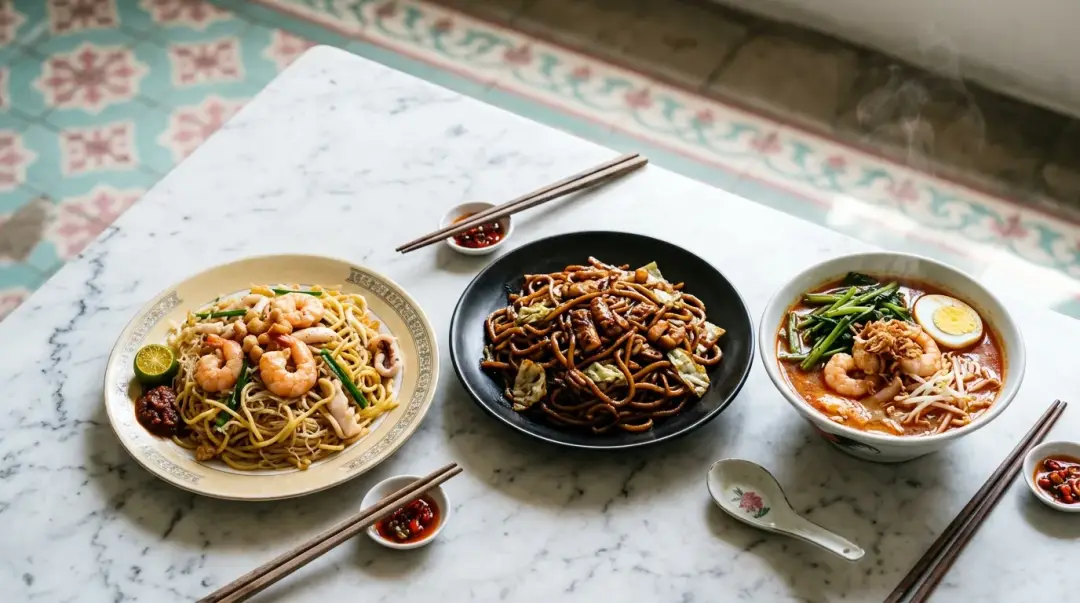
Two noodles go into the Singapore wok at once. One is the thick, springy yellow noodle that Malaysians and Singaporeans call Hokkien mee noodles, made from wheat and alkaline water. The other is bee hoon (rice vermicelli), thin and white, which soaks up liquid fast. Fried together and then braised in prawn stock, they give a plate two textures in every bite: chewy and slippery. Penang puts the same pair in a bowl of red prawn broth. Kuala Lumpur skips the bee hoon and uses a single fat noodle almost as thick as udon. Everything that separates the three dishes starts with which noodles the cook reaches for and what liquid they end up in.
One Name, Three Dishes
Hokkien is the name of a Chinese dialect group from southern Fujian province (福建, Fújiàn in Mandarin), and mee means noodles. Fujian immigrants carried noodle cooking to the Malay Peninsula in waves between the 1800s and the 1930s, and each port city built its own dish around the name. Penang ended up with a soup. Singapore and KL ended up with two unrelated fried noodles.
Hokkien mee by city
| Singapore | Kuala Lumpur | Penang | |
|---|---|---|---|
| Format | Fried, then braised wet in stock | Fried in dark soy | Soup |
| Noodles | Yellow egg noodles + bee hoon | One thick yellow noodle | Yellow egg noodles + bee hoon |
| Liquid | Prawn and pork-bone stock | Dark soy and stock | Spicy prawn-head and pork-rib broth |
| Color | Pale gold | Near black | Red-orange |
| Toppings | Prawns, squid, pork belly, egg, fried lard | Pork, squid, fish cake, cabbage, lard | Prawns, pork slices, boiled egg, water spinach, fried shallots |
| On the side | Sambal and calamansi lime | Sambal | Sambal is cooked into the broth |
| Local alias | Hokkien prawn mee, Rochor mee | Hokkien char mee, tai lok mee | Called prawn mee or hae mee elsewhere |
Penangites use Hokkien mee for their prawn soup and are puzzled when someone from KL means a plate of black noodles. In the Klang Valley around KL, the soup is prawn mee, and Hokkien mee is the dark fried dish, also called tai lok mee (Cantonese for "thick noodles"). Singapore has its own prawn noodle soup too, hae mee, kept separate from its fried Hokkien mee.
Singapore: Fried Prawn Noodles in Stock
Singapore's Hokkien mee is cooked in two stages. Noodles, egg, prawns, squid and pork belly hit a hot wok first. Then the cook pours in a ladle of stock made from prawn heads, shells and pork bones, simmered for hours, and lets the noodles braise until they absorb most of it. The finished plate is damp and glossy. Cubes of fried pork lard go on top, with sambal (a fermented shrimp and chili paste) and a calamansi lime on the side. Squeeze the lime, stir in the sambal, eat it right away.
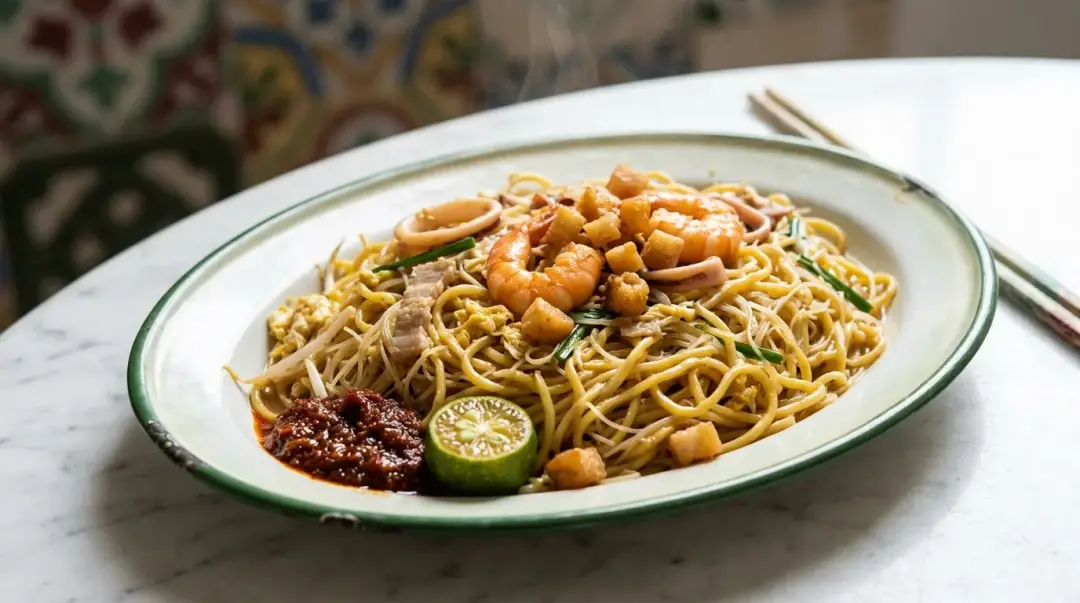
The origin story has at least two versions. One says Hokkien sailors from Fujian created the dish after World War II, gathering on Rochor Road and frying surplus noodles from nearby noodle factories over charcoal stoves. Another, collected on the Johor Kaki food-history blog, credits Ng Seng, an immigrant from Xiamen who arrived in the 1940s and ran a stall below The 7th Storey Hotel in the 1950s. His stall gave the dish its other name, Rochor mee. A third account places the first plates on Rochor Road as early as the 1880s. Whichever is right, the street name stuck.
Most Singapore stalls now cook on gas. The Michelin Guide gives a Bib Gourmand to Singapore Fried Hokkien Mee at Whampoa Makan Place, a hawker stall that fries rice vermicelli and yellow egg noodles with prawns and squid from mid-afternoon until late at night.
Kuala Lumpur: Thick Noodles in Dark Soy
In KL, fat yellow noodles are fried with pork, squid, prawns, fish cake and cabbage, then coated in thick dark soy (a syrupy, molasses-like soy used mainly for color) and pork lard until the plate turns nearly black. A little prawn stock goes in during cooking, which is why some KL eaters also call it prawn mee. At Kim Lian Kee the plate also carries pork liver and crisp lard croutons. The finish is savory, slightly sweet and caramelized.
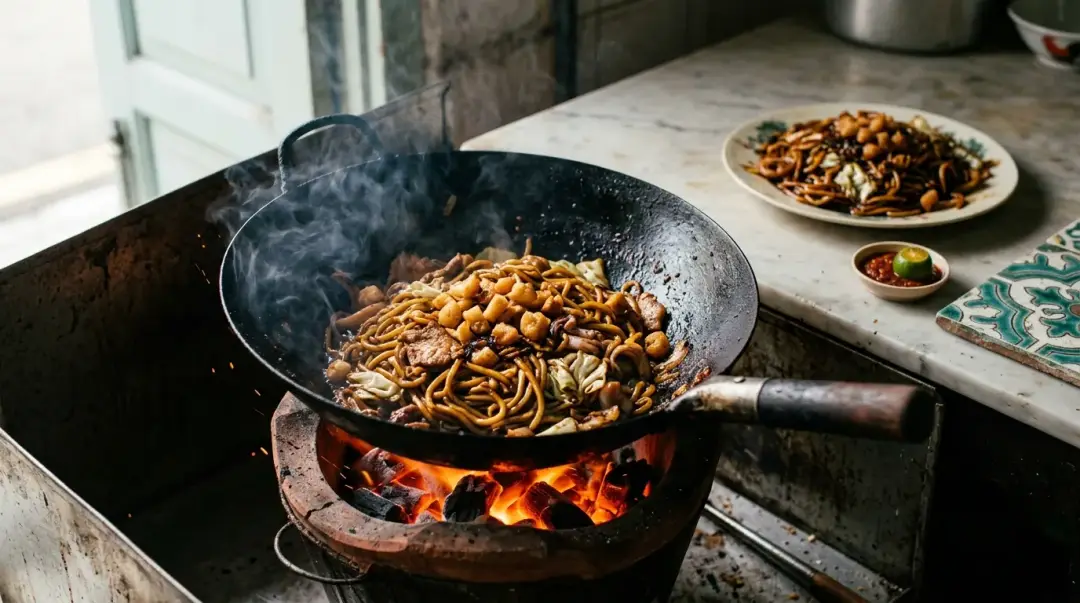
The dish has a named founder. Wong Kian Lee, known as Ong Kim Lian, came to Kuala Lumpur from Anxi county in Fujian in 1905 and sold a pale, soupy fried noodle from his hometown. In 1927 he opened Kim Lian Kee on Petaling Street in KL's Chinatown, and the dark version KL eats today is credited to him. KL cooks traditionally fry it over charcoal, and Eatbook's comparison credits the charcoal fire for the smoky wok hei (the scorched aroma a very hot wok gives food) that gas burners struggle to match.
Penang: Prawn Noodle Soup
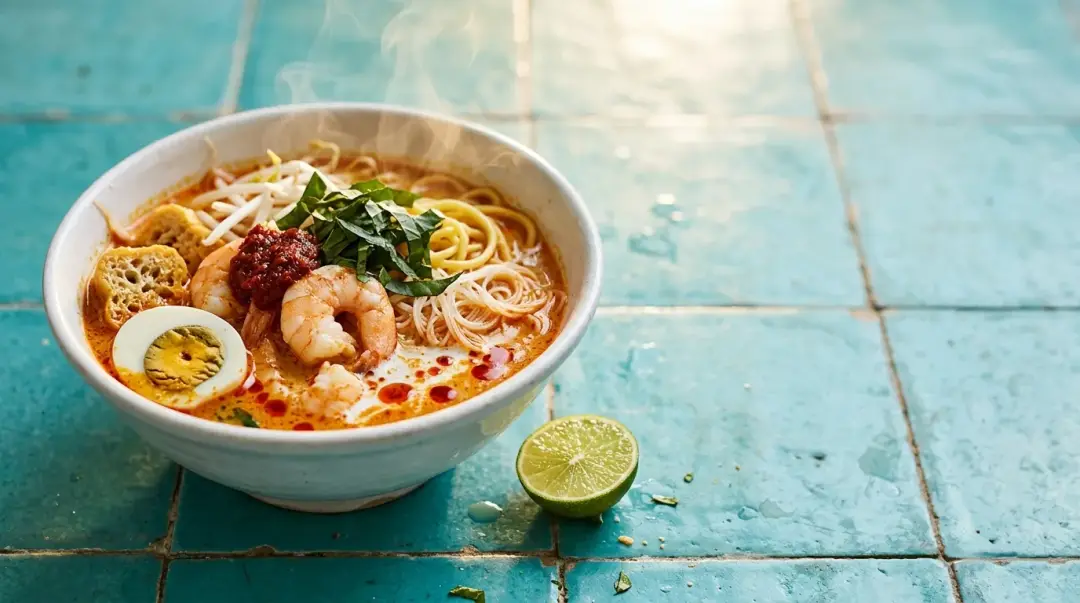
Penang's Hokkien mee is a soup, and a spicy one. The broth starts with prawn heads and shells, fried and then boiled with pork ribs and chicken or pork bones. Sambal goes into the pot rather than on the side, which turns the broth red-orange and gives it steady heat. The bowl holds both yellow egg noodles and bee hoon, topped with sliced prawns, pork slices, half a hard-boiled egg, kangkung (water spinach), bean sprouts and fried shallots.
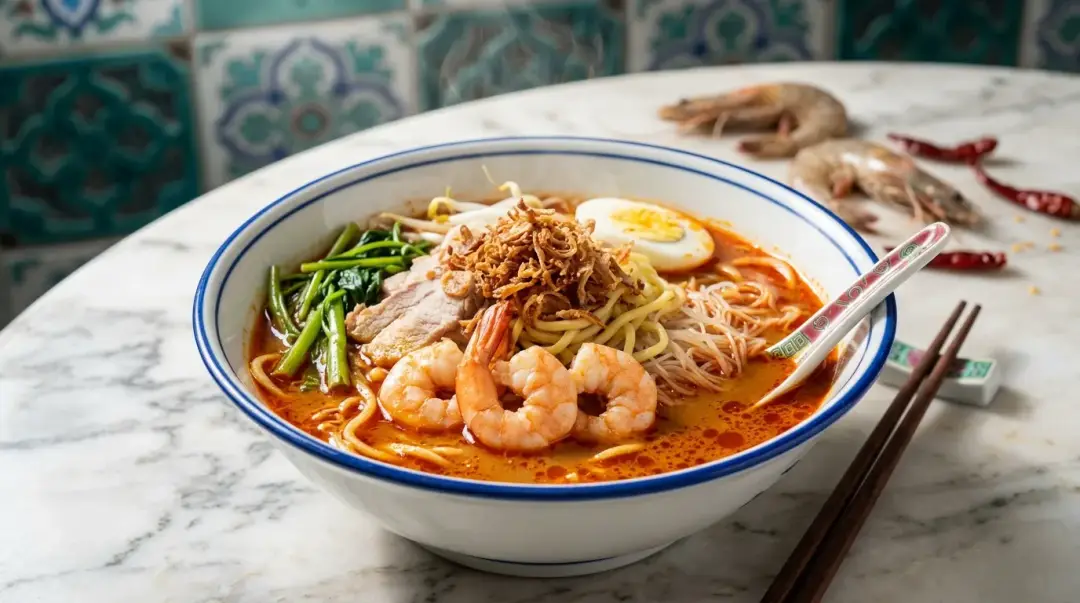
Its closest relative is in China. Xiamen, a port in Fujian, still serves a prawn noodle soup made the same way, by boiling fried prawn heads with stock bones. Most of Malaysia's Hokkien community arrived between the 1800s and the 1930s, and Hokkien speakers make up about 60% of Penang's Chinese population, and the city uses the dialect name for the dish. Xiamen garnishes with coriander. Penang swapped in water spinach and added the sambal.
The Noodles: Yellow Egg Noodles and Bee Hoon
The yellow noodle in all three dishes is a wheat noodle made with alkaline water, which turns it yellow and gives it a springy chew that survives frying and long braising. NoodleDex's egg noodles guide places it in the southern Chinese egg-noodle family, thicker and rounder than Cantonese wonton noodles. KL uses the thickest cut, slightly flat and close to udon in size.
Bee hoon is rice vermicelli, the same thin noodle used in Singapore rice noodles, which, despite the name, is a Hong Kong dish. In Hokkien mee its job is absorption. It soaks up stock and sambal while the wheat noodle keeps its bite. That pairing is also why none of the three dishes is gluten free.
Fresh Hokkien mee noodles are sold refrigerated at Southeast Asian groceries and larger H Mart locations. Thick Italian egg fettuccine is the usual fallback when you can't find them.
Where to Eat or Buy Hokkien Mee in the US
Malaysian restaurants are the place to look. Pulau Pinang in Elmhurst, Queens serves a KL-style Hokkien mee in what The Infatuation describes as a rich soy sauce gravy, alongside crisp lobak (five-spice pork rolls wrapped in bean curd skin). Because the name means different things to cooks from different cities, read the menu description before ordering, and look for prawn mee or hae mee if you want the Penang-style soup.
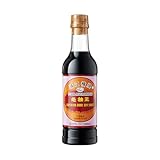
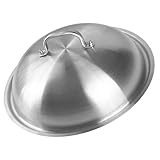
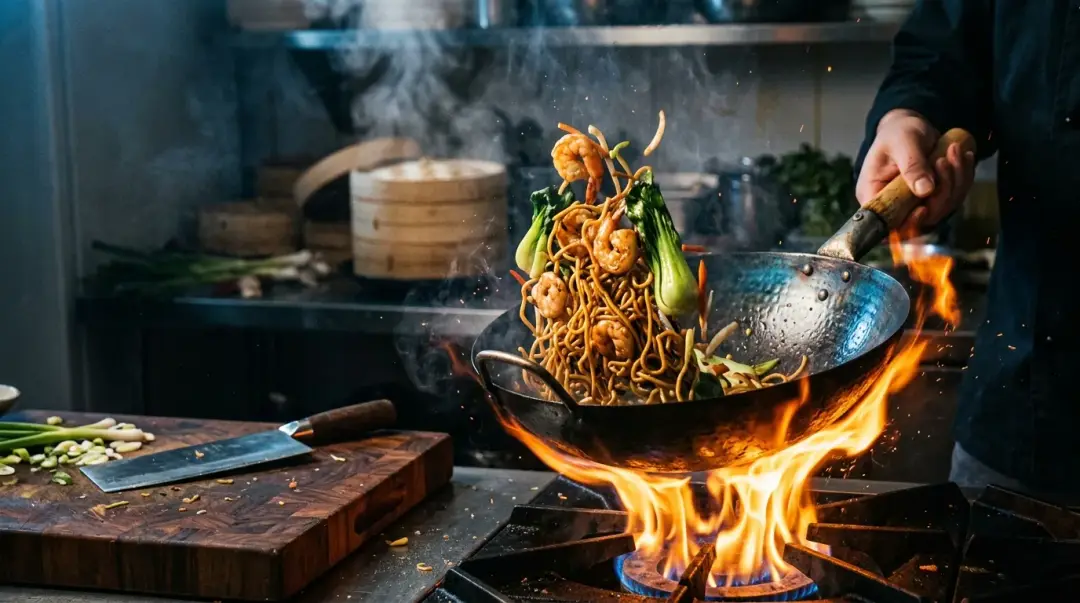
At home, the soup is the easiest to approximate. MyKuali, a Penang brand, sells a Penang Hokkien Prawn Noodle instant packet through US Asian grocers and online, with the prawn-heavy, chili-red broth the dish is known for. The fried versions need real heat: a carbon-steel wok on the strongest burner you have, a ladle and long spatula for stock and tossing, a domed lid for the brief steam in the Singapore style, and a bottle of thick dark soy for the KL style. Our Chinese wok guide covers which pans hold heat well enough on a home stove.
Hokkien Mee vs Char Kway Teow
The dish most often confused with Hokkien mee is char kway teow, the other wok-fried hawker noodle of Penang and Singapore. Both come out of southern Chinese hawker cooking, and both rely on lard and a very hot wok.
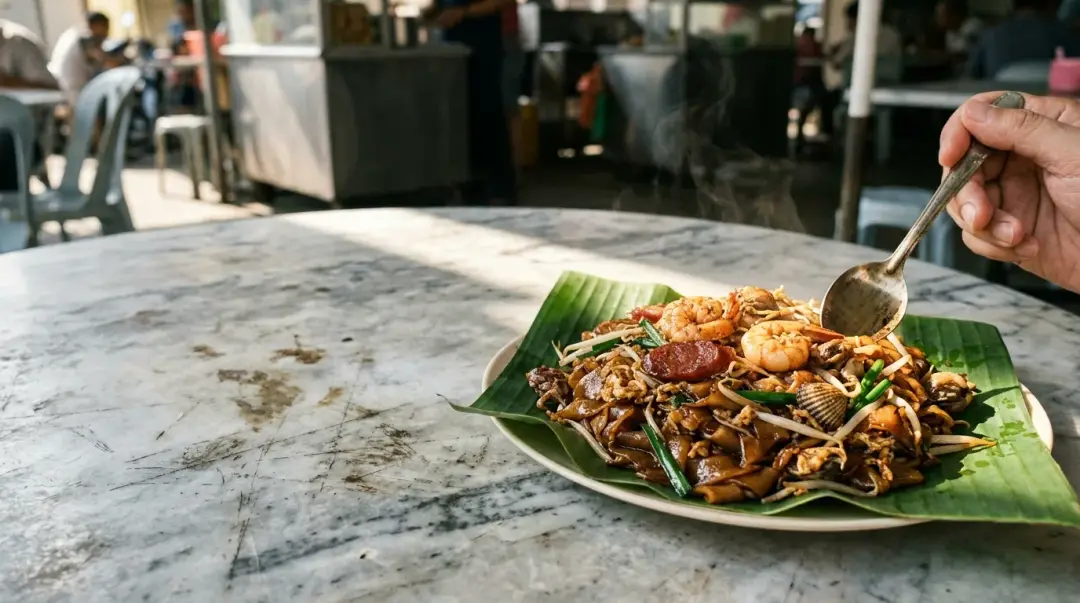
The noodle is the clearest tell. Char kway teow uses only flat rice noodles, about 8 to 10mm wide. Hokkien mee always includes a yellow wheat noodle. The sauce and moisture differ too. Char kway teow is fried dry with dark soy, lap cheong (Chinese sausage), cockles, prawns, egg and chives, and the smoky char is the point. Singapore Hokkien mee is braised wet in prawn stock and finished with lime. KL Hokkien mee sits between them, as dark as char kway teow but built on a thick wheat noodle.
When a menu says only "Hokkien mee," look at three things: a city name, the word "soup" or "fried," and the color in the photo. Pale gold and damp means Singapore. Black means KL. A red broth means Penang.
FAQ
What is Hokkien mee?
Hokkien mee is the name of three different noodle dishes from Hokkien Chinese communities. In Singapore it means yellow egg noodles and rice vermicelli fried with prawns and squid in prawn stock. In Kuala Lumpur it means thick yellow noodles fried in dark soy and lard. In Penang it means a spicy prawn noodle soup. Ask which city the cook learned in.
What noodles are used in Hokkien mee?
Singapore and Penang versions use two noodles together: thick yellow egg noodles and thin white rice vermicelli, called bee hoon. Kuala Lumpur's version uses one noodle, a thick, slightly flat yellow wheat noodle closer to udon in size. The yellow noodles are alkaline, which gives them their color and springy bite.
Is Hokkien mee the same as prawn mee?
In Penang, yes. Penang calls its spicy prawn noodle soup Hokkien mee, while Kuala Lumpur and Singapore call that same style of soup prawn mee or hae mee. In KL, Hokkien mee means the dark fried noodle instead. Singapore's fried Hokkien mee also uses prawn stock, but it is a fried dish, not a soup.
Who invented KL Hokkien mee?
Kuala Lumpur's dark Hokkien mee is credited to Ong Kim Lian, an immigrant from Anxi in Fujian who arrived in KL in 1905 and opened his stall, Kim Lian Kee, on Petaling Street in 1927. KL cooks traditionally fry the dish over charcoal with thick noodles, dark soy, pork, squid, cabbage and crisp lard.
Is Hokkien mee gluten free?
No. The yellow noodles in every version are wheat noodles, and the KL version is fried in dark soy sauce, which usually contains wheat. The bee hoon in Singapore and Penang bowls is rice, but it shares the plate with wheat noodles. Check the label on any packaged kit, since recipes vary by brand.
Where can I eat Hokkien mee in the US?
Malaysian restaurants in New York carry it most reliably. Pulau Pinang in Elmhurst, Queens serves a KL-style Hokkien mee in a rich soy gravy, according to The Infatuation. Singapore-style fried Hokkien mee is rarer. For Penang's prawn soup, MyKuali's Penang Hokkien Prawn Noodle is sold in the US as an instant packet.