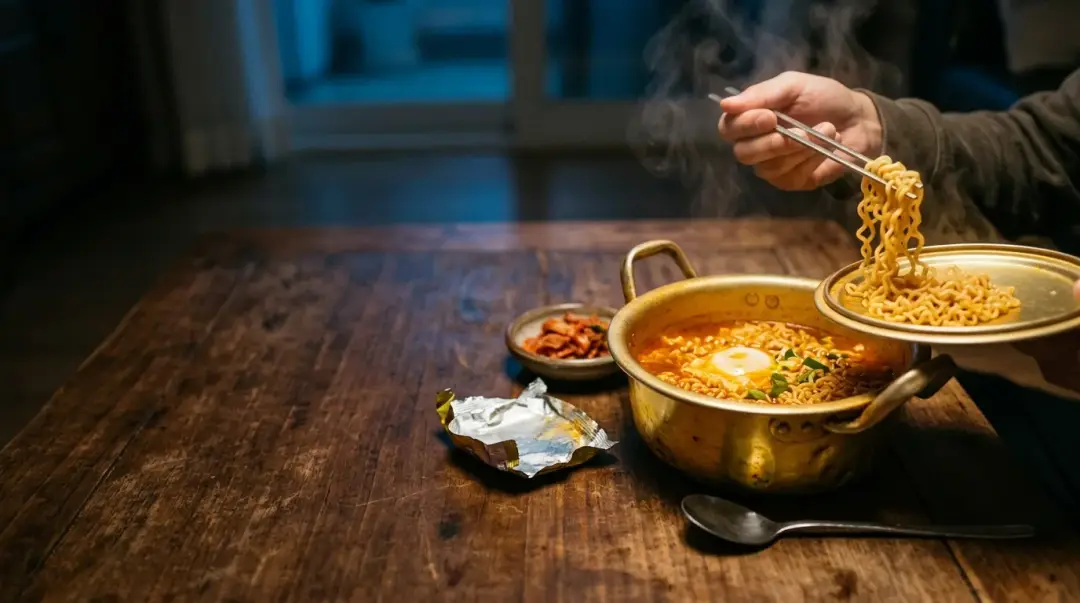
Ramyeon is Korea's defining instant noodle — a 4-minute hot wheat-noodle soup built around a single spice-forward seasoning packet, almost always eaten straight from the cooking pot. It is the most-exported Korean food category, with Nongshim's Shin Ramyun stocked at Costco, Trader Joe's, and most Target locations. It descends from Japanese instant ramen but evolved into something culturally and stylistically its own — hotter, thinner-brothed, and deeply attached to Korean kitchen ritual.
What Is Ramyeon?
Ramyeon (라면) is the Korean form of instant ramen — and despite the similar name, it's a fundamentally different dish from Japanese ramen. Korean ramyeon is almost always instant, typically spicier (Shin Ramyun lands around 3,400 SHU; Samyang Buldak Original at 4,404 SHU), and broth-thinner than Japanese ramen, built around a single concentrated seasoning packet that defines the entire flavor. The noodles are alkaline wheat (like Japanese ramen) but flash-fried during manufacturing — the technique that gives every instant noodle its springy bite and 6-month shelf life. The dish is conventionally cooked in a yellow aluminum yangeun naembi pot and eaten directly from the pot with the lid as a side plate — ritual that's half the experience. South Korea consumes more instant noodles per capita than any country on Earth (about 80 packets per person per year), and ramyeon is the cultural center of that consumption.
Korean instant ramyeon dates to 1963, when Samyang Foods licensed manufacturing equipment from Japan's Myojo Foods. The country was emerging from postwar food shortages, and ramyeon was originally subsidized as a cheap calorie source. Nongshim entered the market in 1965 and surpassed Samyang by the 1980s; its Shin Ramyun (released 1986) is now the best-selling instant noodle in Korean history and the brand most newcomers encounter first.
How Ramyeon Differs from Japanese Ramen
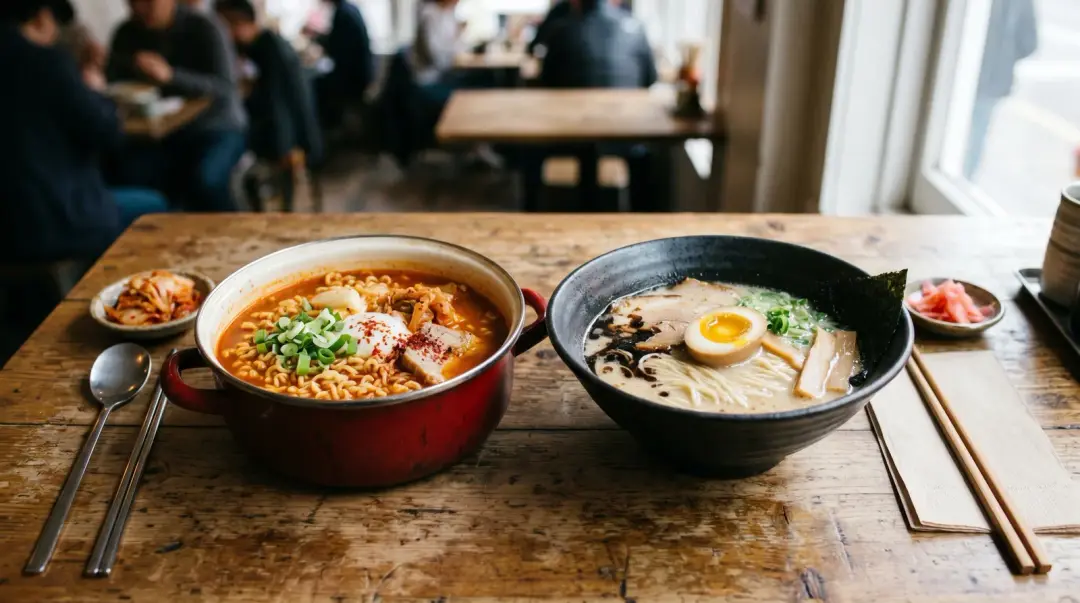
These two share Japanese-instant-noodle DNA from the 1960s but have diverged into a fresh-vs-instant question with a side of spice.
- Format. Korean ramyeon is almost exclusively instant — a packet you boil at home. Japanese ramen is almost exclusively made fresh at a shop, with bone broth simmered for hours.
- Broth. Korean ramyeon broths are thin, sharp, and built in 4 minutes by the seasoning packet. Japanese ramen broths layer tare + dashi + bone stock over a full day.
- Heat. Most popular Korean ramyeon is spicy by default (Shin Ramyun, Buldak, Neoguri). Most Japanese ramen styles (tonkotsu, shoyu, shio) are mild — only karaka miso and tantanmen are reliably hot.
- Toppings. Korean ramyeon is eaten near-naked or with a cracked egg, scallions, and kimchi. Japanese ramen arrives loaded with chashu, menma, ajitsuke-tamago, narutomaki, and nori.
- Vessel. Ramyeon is traditionally eaten straight from the cooking pot — usually the small yellow aluminum yangeun naembi. Japanese ramen comes in a wide ceramic bowl.
Full breakdown: see ramyeon vs ramen, which covers every difference between the two.
Flavor Profile
The flagship Shin Ramyun broth sits at about 3,400 Scoville Heat Units, the figure The Korea Times reported in 2023: medium heat by mainstream standards. Samyang Buldak ("fire chicken") jumps to 4,404 SHU in the standard variety; the 2X and 3X Buldak lines push well past 10,000 SHU into territory many eaters struggle with. Beyond the heat, Korean ramyeon broths share a profile: garlic-and-beef savoriness, gochugaru-driven chili warmth, an MSG-and-anchovy umami floor, and just enough fat from the noodle-fry oil to coat the tongue. The noodles themselves are medium-thin alkaline wheat, chewier than Japanese ramen noodles and engineered to survive being overcooked by 30 seconds.
How Ramyeon Is Eaten in Korea
Ramyeon is the canonical fast meal — 4 minutes from cold water to hot bowl, more often a late-dinner or post-drinks comfort snack than a planned lunch. The hack culture is its own discipline:
- The egg upgrade. Crack a raw egg into the pot in the final 30 seconds. Leave it whole for runny yolk, or stir to make ribbons. Universal.
- The cheese upgrade. Tear a slice of American cheese (Kraft singles, on purpose) on top after cooking. Cuts the heat. Mandatory for Buldak.
- The kimchi upgrade. Add a spoonful of well-fermented kimchi to the pot with the seasoning. The acidity opens the broth.
- The rice finish. When the noodles are gone, scrape leftover rice into the broth and stir — the bap-malgi finale.
- The jjapaguri. Half a packet of Chapagetti (jjajangmyeon-style) and half a packet of Neoguri (seafood-spicy), cooked together. Made globally famous by Bong Joon-ho's Parasite in 2019.
The pot is its own icon: the bright yellow aluminum yangeun naembi heats instantly and stays hot at the table. Eating ramyeon out of a ceramic bowl in Korea reads as either fussy or foreign.
Making Ramyeon at Home
Two routes, both viable.
The instant route (what 95% of cooks should do)
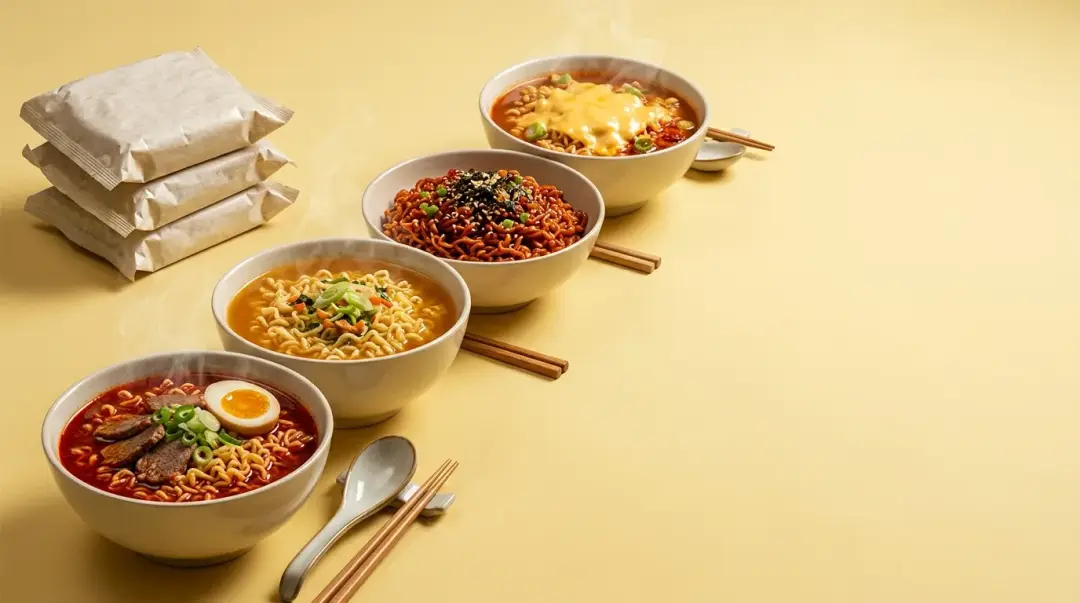
Korean instant ramyeon is one of the rare manufactured foods where there's no real upside to making it from scratch — the engineering is genuinely good. The top picks:
- Nongshim Shin Ramyun (red package) — the default. Spicy beef-mushroom broth, about 3,400 SHU. Stocked at Target, Trader Joe's, Costco, and any supermarket with an Asian aisle.
- Nongshim Shin Black — the premium upgrade, with an added beef-bone soup sachet for depth.
- Nongshim Neoguri (orange package) — seafood-spicy with udon-thick noodles. The other half of jjapaguri.
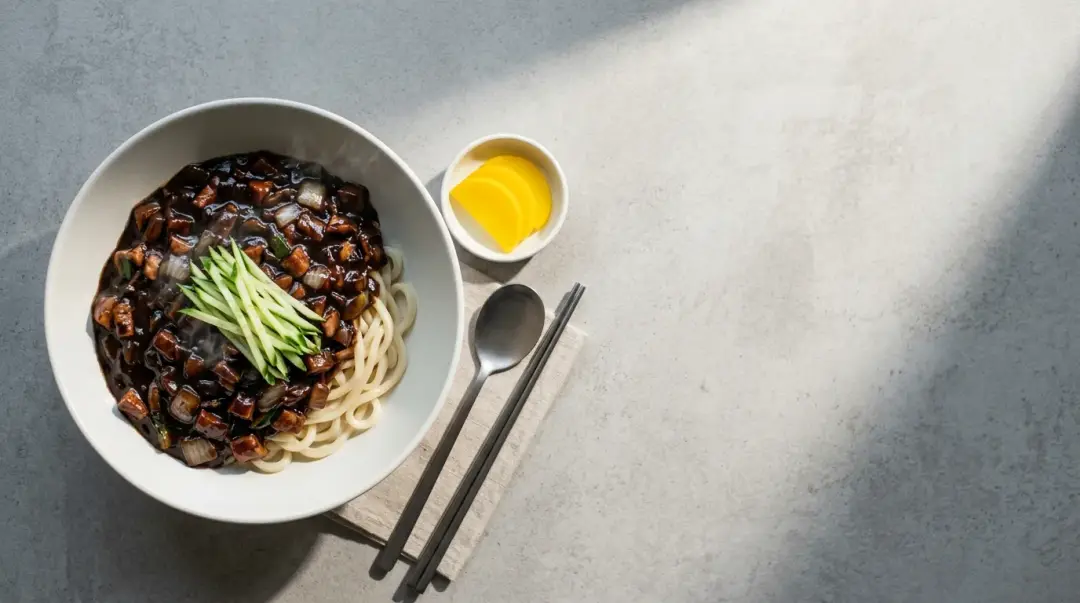
- Nongshim Chapagetti — Korean instant jjajangmyeon. Drain and toss with the included powder; not soup.
- Samyang Buldak Hot Chicken (black package, red Hochi mascot) — the TikTok fire-noodle phenomenon. 4,404 SHU. Stir-fried, not soup. Cheese upgrade non-optional.
- Ottogi Jin Ramen — mild and beef-forward. The default for anyone who finds Shin too spicy.
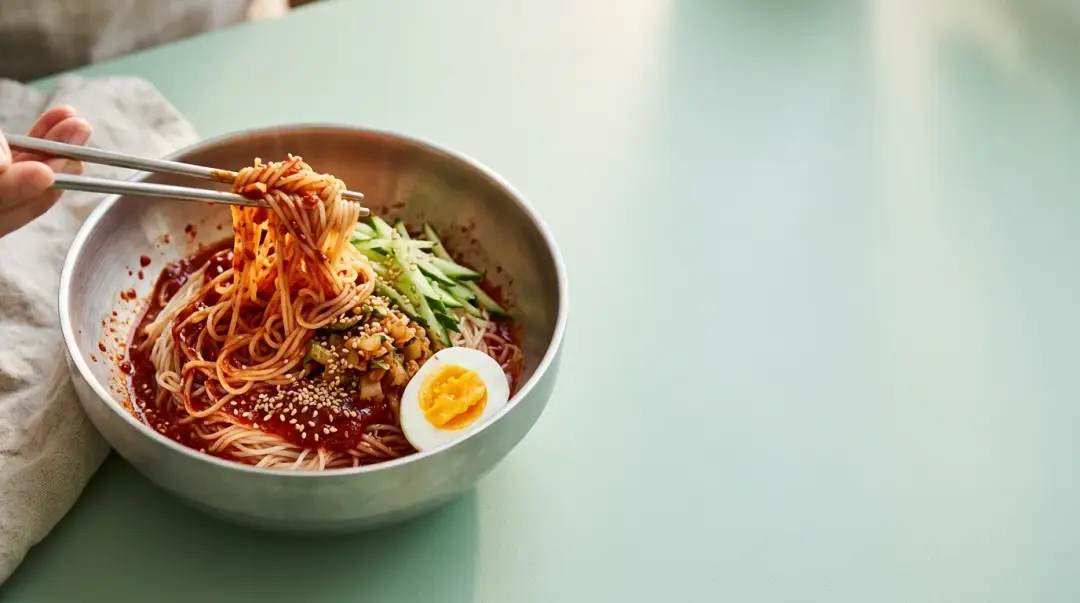
- Paldo Bibim Men — sweet-and-spicy mixed noodles, served chilled. The summer ramyeon.
The cult of Korean instant ramyeon is real. There are Korean YouTube channels dedicated entirely to ramyeon taste-testing, and Nongshim runs an annual ramyeon festival in Seoul. Treat it as a deep, brand-aware category — not a fallback meal.
The gear is simple: the thin yellow aluminum pot, a metal spoon and chopsticks for the Korean table, and, for cup ramyeon, an electric kettle for the hot water.
The from-scratch route
If you want fresh Korean wheat noodles in a homemade broth, you're essentially building kalguksu or a homestyle ramyeon-broth approximation. Fresh Korean wheat noodles for soup are sold at H Mart in two formats:
- Refrigerated fresh wheat noodles — labeled 생면 (saengmyeon, "fresh noodles"). Pulmuone and Wang Korea dominate.
- Frozen pre-cooked noodles — slightly less interesting texture but no shopping urgency.
For a homestyle broth, simmer dried anchovies (myeolchi), dried kelp (dashima), and a few aromatics — garlic, scallion, daikon — for 20 minutes, then season with gochugaru and ganjang (Korean soy sauce). This is essentially Korean grandmother ramyeon and worth knowing how to make.
FAQ
What is the difference between ramyeon and ramen?
Ramyeon is Korean instant noodle soup, almost always cooked from a packet with a thin, spicy broth. Japanese ramen is typically made fresh at a shop with a bone broth simmered for hours.
Is Korean ramyeon spicy?
Most of it is. Nongshim Shin Ramyun is about 3,400 Scoville Heat Units, the figure The Korea Times reported in 2023, and Samyang Buldak Original is 4,404 SHU, with the 2X and 3X lines well past 10,000. For little or no heat, Ottogi Jin Ramen Mild and Nongshim Chapagetti are the usual picks; see mild Korean noodles.
What is ramyun?
Ramyun is another spelling of ramyeon (라면), the Korean word for instant noodles. Ramyeon is the official romanization; ramyun is the older, informal spelling still printed on packs such as Nongshim Shin Ramyun.
Why is ramyeon cooked in a yellow pot?
The thin yellow aluminum pot, called a yangeun naembi, heats quickly and stays hot at the table. Ramyeon is traditionally eaten straight from it.
What is the most popular Korean ramyeon?
Nongshim's Shin Ramyun, released in 1986, is the best-selling instant noodle in Korean history. It is stocked at Costco, Trader Joe's and Target.
Where to Buy Ramyeon
Many major grocery chains now carry Shin Ramyun. H Mart carries 50+ brands — the entire Nongshim, Samyang, Ottogi, and Paldo catalogs plus regional Korean brands you won't find elsewhere. Costco carries Nongshim variety packs in 16-count cases. Online, Amazon has the deepest selection — variety packs let you taste 6–10 brands at once.
For a first order, a Korean noodle variety pack covers the main brands in one box. For heat, see the best spicy instant noodles or, for the gentle end, mild Korean noodles. To cook it the way Korea does, see our guide to the yellow ramyeon pot.