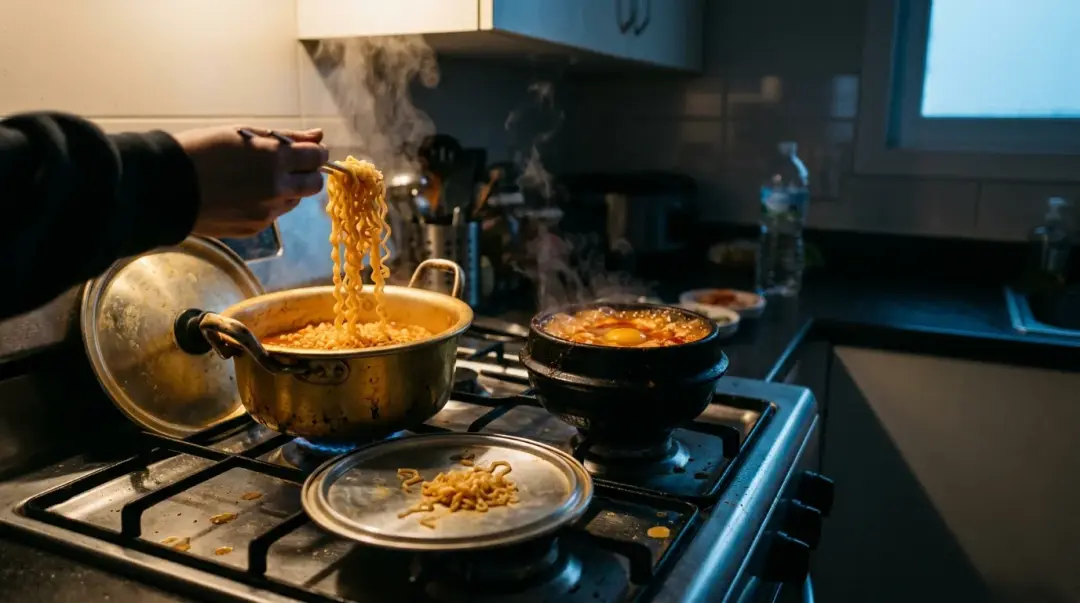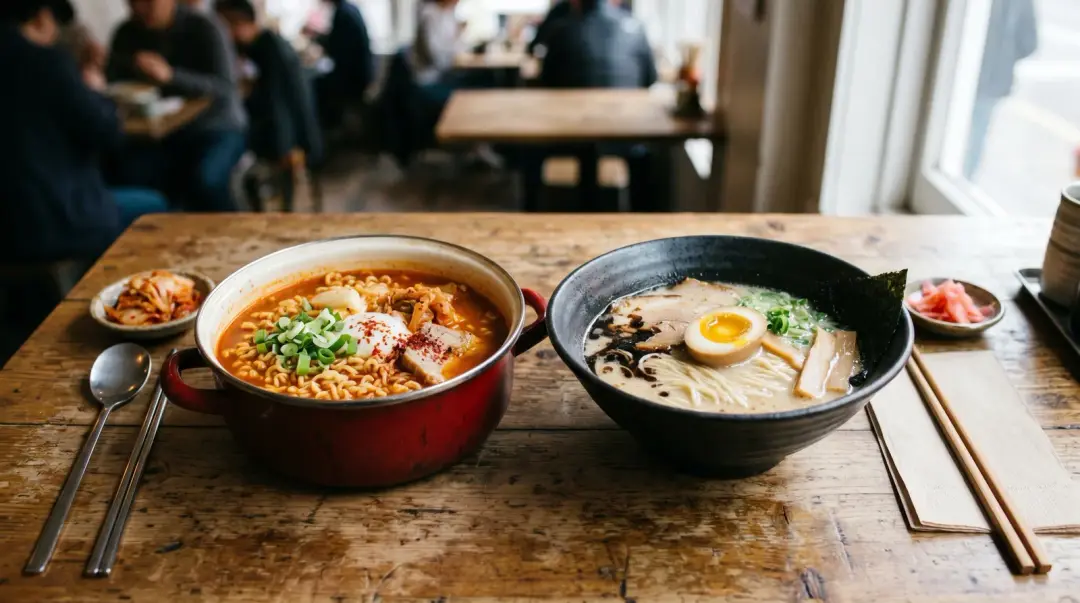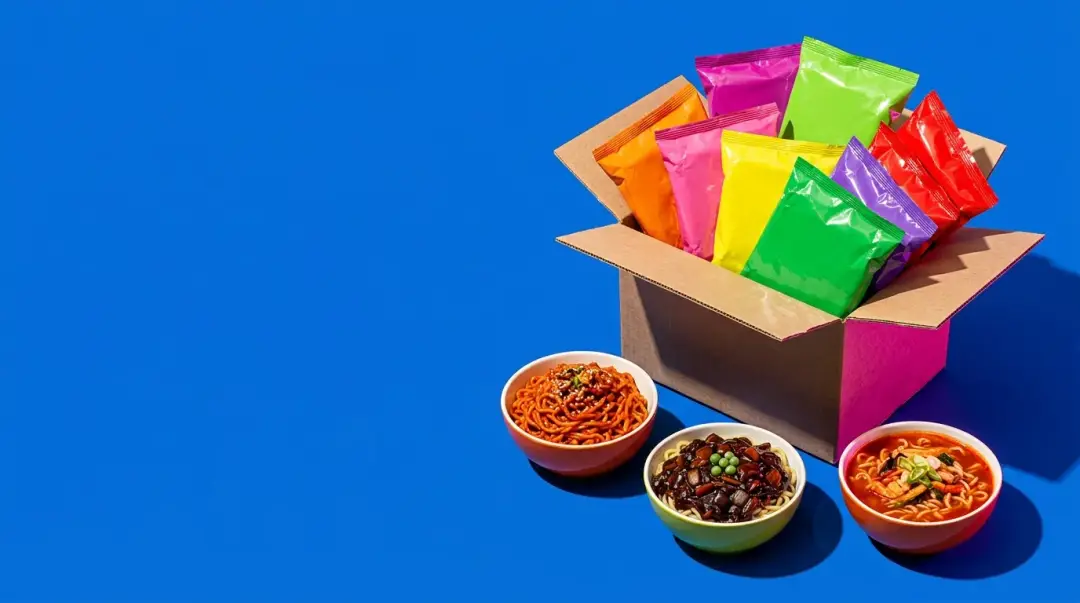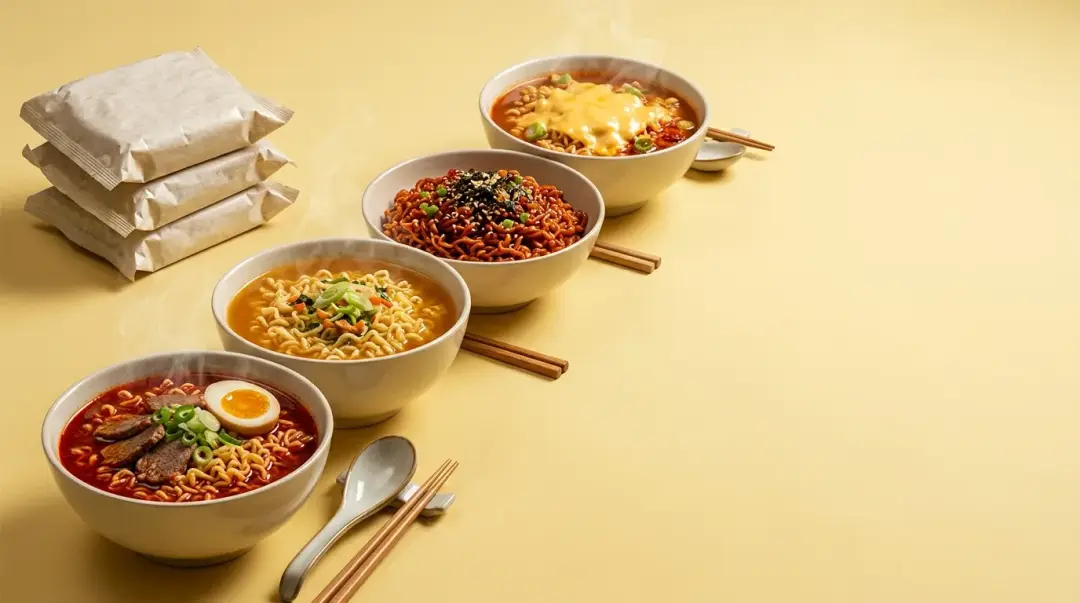


Korean instant ramyeon (the Korean spelling of ramen, pronounced rah-myun) has four brands worth buying in 2026. Nongshim Shin Ramyun is the everyday default — the bag you keep in the pantry. Samyang Buldak is the viral one — the spicy dare that built a TikTok category. Ottogi Jin Ramen is the family-friendly home staple in Korea. Paldo Mild Cheese is the gateway flavor for anyone who doesn't eat heat. Start with Shin.
How We Pick
- Heat tier diversity. We picked one bag from each spice band — mild (Paldo, under 1,000 SHU), low-medium (Ottogi Jin, ~1,000-1,500), medium (Shin, ~3,400 per Nongshim), and viral-hot (Buldak, 4,404). One household won't agree on heat, so the lineup covers the spread. Our flavors hub sorts noodles by taste.
- Distribution. Every pick is stocked on Amazon and at H Mart, with the top two also sitting on the shelves of Kroger, Walmart, and Safeway in the US. No gray-market imports that disappear in a quarter.
- Brand authenticity. All four are Korean-owned, Korean-formulated brands. Nongshim, Ottogi, Samyang, and Paldo together hold roughly 90% of Korea's domestic instant noodle market — these are the names Koreans actually buy at home, not export repackages. For packs from Japanese, American and Indonesian brands, see our best instant ramen guide. For Neoguri and other seafood-broth noodles, see our seafood ramen guide.
The Top Pick: Nongshim Shin Ramyun
Shin Ramyun is the canonical Korean instant ramen, and has been since Nongshim launched it in 1986. The "Shin" character (辛) means spicy — the bag is literally named after its heat. By 1991 it had become Korea's #1 selling instant noodle, a title it has not lost in thirty-five years. If a Korean grandparent, a Seoul college student, and an LA H Mart shopper all keep one bag in the pantry, this is the bag.
The broth runs around 3,400 SHU by Nongshim's own figure (older listings say ~2,700) — the Scoville scale (a measurement of capsaicin heat, where jalapeño sits near 5,000) puts Shin at roughly half a jalapeño per bowl. The flavor base is beef, mushroom, and gochugaru (Korean red pepper flake, sun-dried and coarser than cayenne), with a small dehydrated vegetable packet of carrot, scallion, and shiitake. The noodle itself is thick, springy, and built to hold up to a full three-minute boil without going soft.
Nongshim opened a manufacturing plant in Rancho Cucamonga, California in 2005, and a second US facility in 2022. The 20-packs sold on Amazon and at Costco are US-manufactured to the original Korean formula — same wheat noodle, same seasoning blend, same beef-pepper broth. Cook for 3 minutes in 550 ml of water, crack an egg in the last 30 seconds, top with sliced scallion. That is the bowl.

Nongshim Shin Ramyun Original
Iconic flavor — the gold standard
Best Budget: Ottogi Jin Ramen Mild
Ottogi Jin Ramen is what Korean families actually feed their kids on a weeknight. It runs around 1,000-1,500 SHU — about half the heat of Shin — with a deeper, beefier broth that reads less spicy and more savory. Ottogi has positioned Jin as the home staple since 1988, and the red bag (mild) versus orange bag (spicy) split is the easiest way to flag which household member is eating which.
Per-bowl, this is the cheapest reputable Korean instant on Amazon in the 20-pack format. Sodium clocks lower than most Korean instant brands (around 1,500 mg vs Shin's ~1,790 mg), and the noodle cooks in 4 minutes with a slightly chewier finish than Shin's springier bite. The flavor leans toward Korean beef-bone broth (seolleongtang-adjacent) rather than the chili-forward Shin profile. If Shin is the answer when you want heat, Jin is the answer when you want comfort. More non-spicy packs are in our guide to mild Korean noodles.

Ottogi Jin Ramen Mild
Cheapest per-bowl Korean ramen on Amazon
Standard Pick: Samyang Buldak Hot Chicken
Samyang's Buldak — bul-dahk, literally "fire chicken" in Korean — launched in 2012 and went globally viral around 2014 after the Korean "Fire Noodle Challenge" hit YouTube. By 2023 it had become Samyang's top export product, sold in 90+ countries. The original Buldak Hot Chicken bag runs 4,404 SHU, about the heat of a mild jalapeño, and the 2x Spicy variant sits at about 10,000. This is not a soup ramen. Buldak is a bokkeum-myeon — a stir-fry instant noodle. You boil the noodles, drain almost all the water, then return them to the pan and stir-fry in the concentrated chili sauce packet until it caramelizes.
The flavor is sweet, smoky chili — heavy on capsaicin and sugar, with a chicken-bouillon backbone and roasted sesame oil from the secondary packet. The noodles are wider and chewier than Shin's, built to hold sauce. A standard prep: boil 5 minutes, drain to ~3 tablespoons of cooking water, return to the pan with the sauce, finish with sliced scallion, sesame, and a sheet of toasted gim (Korean seaweed) crumbled on top. The viral move — adding shredded mozzarella — is real and it works. Buldak earns the "standard pick" slot because it is the noodle that put Korean instant on the global map, not because it is for everyone the first time. If a bag is too hot, see how to make Buldak less spicy, and for a heat-sorted list see the best spicy instant noodles.

Samyang Buldak Hot Chicken Ramen
The TikTok 'fire noodle' phenomenon
Best for Beginners: Paldo Mild Cheese
If Buldak is the deep end of the pool, Paldo Mild Cheese is the steps in the shallow end. Paldo (formerly Korea Yakult) launched the Cheese Ramen line in 2010 as a calculated mild entry — cream and cheddar powder buffer almost all the chili heat, leaving a savory-funky-creamy bowl that reads closer to a Korean ramyeon-meets-mac-and-cheese hybrid than to a traditional Shin or Jin bowl. SHU rating sits well under 1,000; most kids and heat-shy adults eat it without flinching.
The build is two seasoning packets — a base ramen powder and a separate dehydrated cheese powder — and a thicker, paler noodle than the red-bag Korean brands. Cook for 4-5 minutes, do not drain all the water (you want enough liquid to dissolve the cheese powder into a thick sauce), then stir vigorously. It will not impress a Shin loyalist. It will absolutely convert a household member who said they "don't do Korean ramen" because of the heat. As a gateway, it earns its slot. For more cheese ramen, see our cheesy and creamy ramen guide.

Paldo Mild Cheese Ramen
Mild creamy cheese flavor — easiest Korean ramen for newcomers
What to Look For
- Kansui-equivalent in the ingredient list. Kansui (alkaline mineral water) is the Japanese term; Korean ramyeon uses the same chemistry — usually listed as "sodium carbonate" or "potassium carbonate" — to give the noodle its yellow tint and springy chew. If the ingredient list shows neither, the noodle is a generic wheat strand, not true ramyeon.
- Scoville rating published. Samyang and Nongshim both print SHU figures on Buldak and Shin packaging respectively. A brand that hides its heat number is usually overstating it or hasn't measured.
- US-manufactured vs imported. Nongshim's US plants in Rancho Cucamonga and Korea-imported bags use the same formula but sometimes different wheat sources. The Korean-imported bag has a slightly darker broth color and costs a little more at H Mart.
- Halal status if relevant. Samyang makes halal-certified Buldak in Korea (KMF-certified) and has held MUI certification for Indonesia since 2017, but certified and uncertified packs look almost identical. Only a pack showing a halal seal counts. Our halal noodles guide shows where to look.
- Brand authenticity. Stick to Nongshim, Ottogi, Samyang, and Paldo. Korean-style ramen made by non-Korean brands (some store private labels, some Costco Kirkland Asian-section runs) usually skips the gochugaru in favor of generic chili powder, and you taste the difference in the second bite.
Common Mistakes
- Starting with Buldak 2x Spicy. The original Buldak at 4,404 SHU is already past most first-timers' comfort threshold. The 2x at about 10,000 SHU is a stunt-eat, not a meal. Eat the original first, decide if you actually want more heat, then upgrade. Buying 2x as your first Korean instant is the fastest way to write off the entire category.
- Using only the seasoning packet without garnish. Korean instant is engineered to be a 3-minute base, not the finished bowl. A cracked egg in the last 30 seconds of cooking, a handful of sliced scallion, a sheet of gim, and a few drops of sesame oil take a single bag from "fine" to "this is dinner."
- Overcooking the noodle past the 3-minute mark. Korean ramyeon noodles are designed for al dente at exactly 3 minutes (Shin, Buldak) or 4 minutes (Jin, Paldo). Five minutes turns them soft and starch-clouded; the broth thickens past the point of clarity. Set a timer.
- Treating cup format as packet-equivalent. The cup versions of Shin and Buldak use a thinner, lower-quality noodle designed to rehydrate in boiled water without simmering. They taste similar but eat noticeably softer. If you have a stove and 3 minutes, always buy the packet.
- Skipping the egg. This is the single biggest delta between a dorm-room ramyeon and a Korean-household ramyeon. Crack one egg per bowl into the simmering broth at minute two, let the white set against the noodle, leave the yolk runny. It adds almost nothing to the cost and changes the entire bowl.
FAQ
What's the difference between ramen and ramyeon?
Ramen is the Japanese fresh-noodle dish — wheat noodles in pork or chicken broth, served at specialty ramen-ya. Ramyeon is the Korean adaptation, almost exclusively associated with the instant format that Nongshim and Ottogi sell in bags. Korean ramyeon is spicier, uses gochugaru in the seasoning, and is eaten at home rather than in restaurants. Both share the same kansui-treated alkaline-noodle DNA.
Is Shin Ramyun spicy?
Yes, but at the low end of "spicy." At about 3,400 SHU, Shin sits well under a typical jalapeño — most adults who eat moderate Mexican or Thai food handle it without sweating. If sriracha is comfortable, Shin is comfortable.
What's the spiciest mass-market Korean instant?
Among the big brands, Samyang's export-only Buldak 3x Spicy, at about 13,200 SHU by The Ramen Rater's estimate. The year-round 2x Spicy, at about 10,000, is the highest-volume "extreme" SKU. Smaller Korean makers report more: a July 2024 Korean press ranking lists Yeomra Daewang ramen at about 21,000 SHU (see our spiciest noodles ranking). Paldo Volcano Curry has no published Scoville figure. Anything past 2x is novelty rather than a serious bowl of food.
Where do I buy Korean instant ramen in mainstream supermarkets?
Shin Ramyun is stocked at Kroger, Safeway, Whole Foods, Target, Walmart, and Costco — all major US chains carry at minimum the original red bag. Buldak hit Walmart and Target shelves around 2021 after the TikTok wave. Jin Ramen and Paldo Cheese are reliably stocked at H Mart, 99 Ranch, and large Asian groceries; on mainstream grocery shelves they're hit-or-miss.
Are these brands halal-certified?
Samyang (Buldak) and Nongshim (Shin Ramyun) both make halal-certified versions for export markets, and Ottogi added MUI-certified Jin Ramen for Indonesia in 2025. Standard shelf packs outside Korea are generally not the certified versions, so look for the seal on the exact pack. The halal noodles guide has the brand-by-brand detail.
Can I make Korean ramyeon healthier?
Halve the seasoning packet (the sodium hit is mostly there, not in the noodle), add a handful of baby spinach or napa cabbage in the last minute, and finish with an egg and sliced scallion instead of doubling the broth. The bowl drops to roughly 1,000 mg sodium with no loss of flavor.