Korean noodles split into eight defining dishes built across four very different starches — wheat, buckwheat, sweet potato, and rice — and shift between scalding hot and literally ice-cold depending on the season. The category leans spicy, ferment-heavy, and texture-forward, with chewy noodles and gochujang-and-anchovy seasoning logic that sounds nothing like Japanese dashi or Chinese stock. This is the encyclopedia version, written for cooks who shop at Korean grocers and order in Koreatown.
What Are Korean Noodles?
Korean noodles — collectively called guksu (국수) when fresh or hand-cut, and myeon (면) inside compound dish names like jjajang-myeon or ramy-eon — span eight core dishes built on wheat, buckwheat, sweet potato starch, and rice. Some are eaten scalding (kalguksu, ramyeon, jjajangmyeon, sundubu guksu), others ice-cold with shavings of ice in the bowl (naengmyeon, kongguksu). The defining seasoning logic is gochujang (Korean fermented red chili paste) and gochugaru (coarse Korean red pepper flakes) for hot-and-spicy dishes; doenjang (Korean fermented soybean paste, pungent cousin to miso) for earthy ones; and myeolchi yuksu (dried anchovy and kelp stock) as the universal broth base.
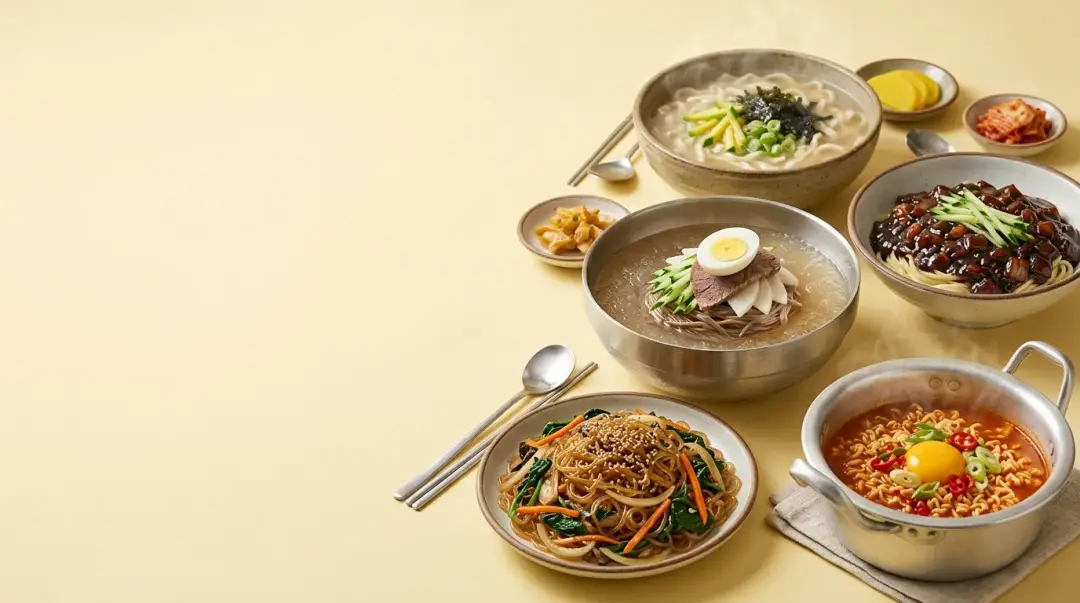
The Eight Core Korean Noodles
Each Korean noodle below has its own deep-dive page. Click through for history, flavor profile, where to buy, and brand recommendations.
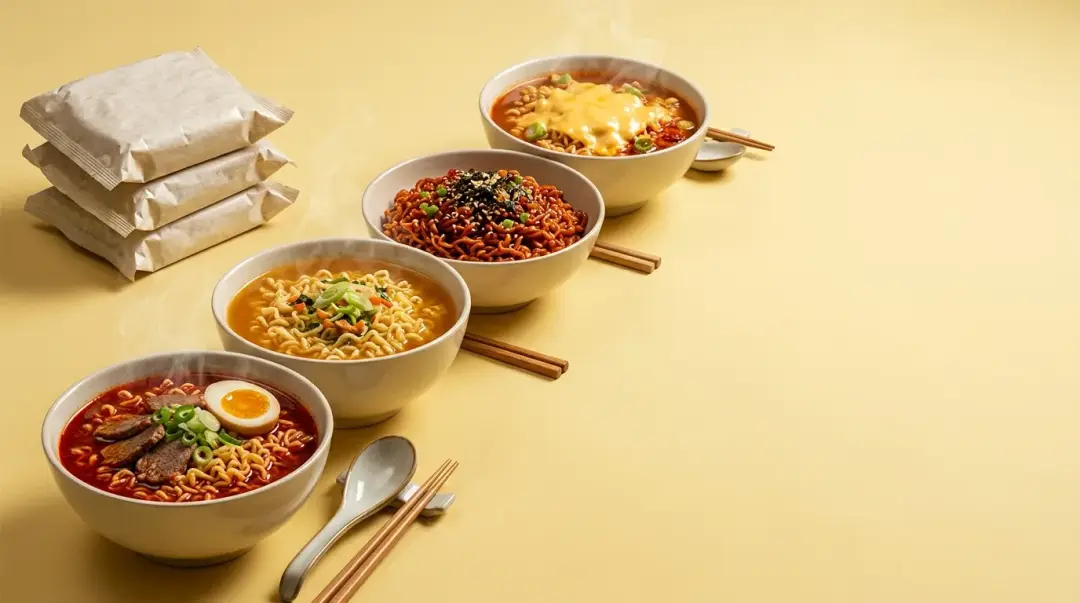
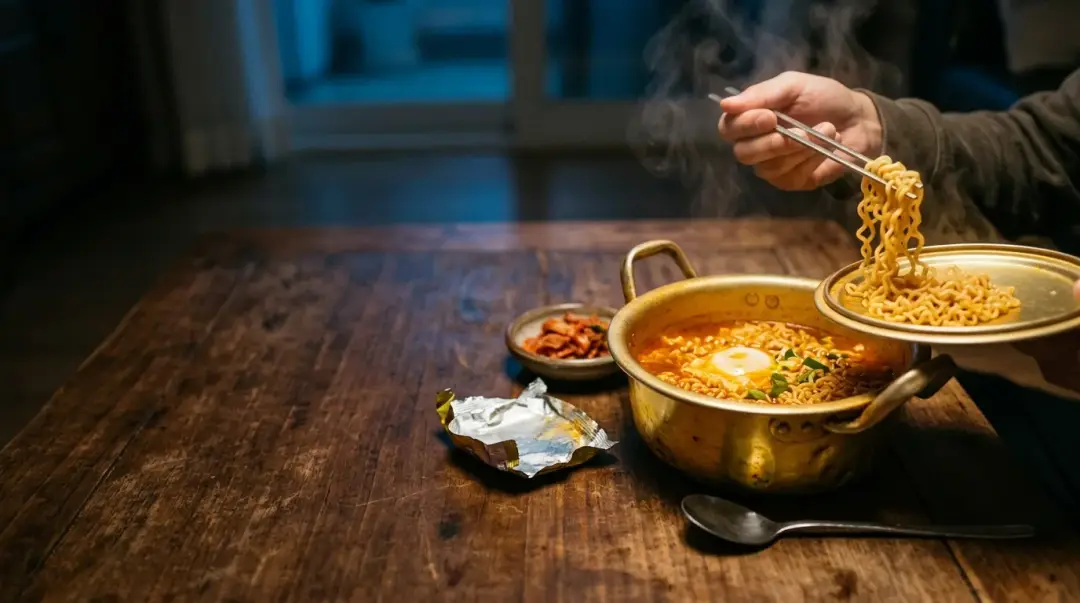
- Ramyeon (라면) — Korean instant ramen. Spicier and thinner-brothed than Japanese ramen (see ramyeon vs ramen for the full difference). The most-exported Korean food category.
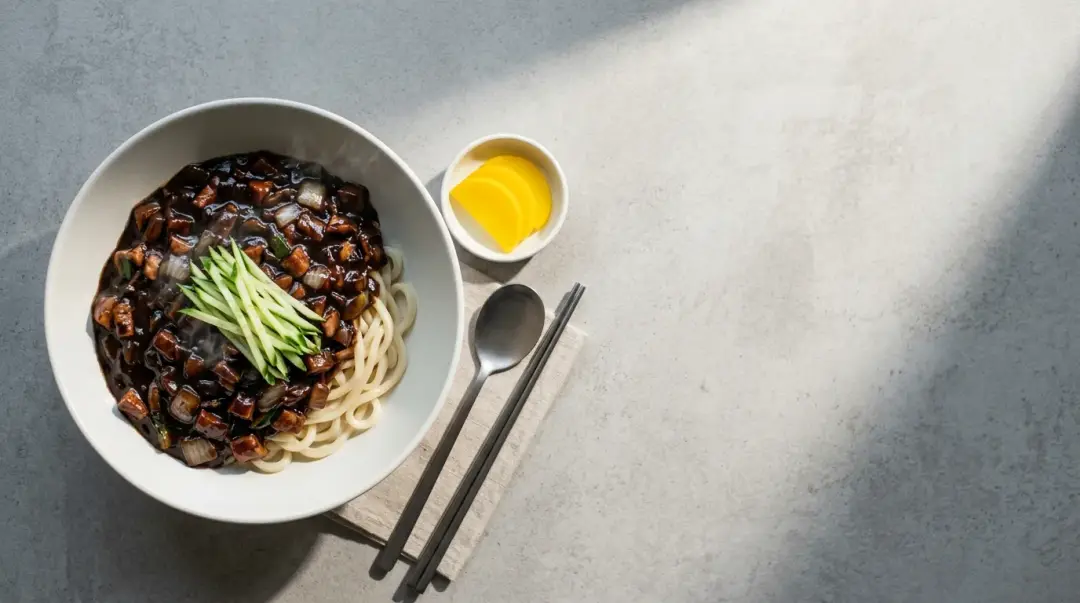
- Jjajangmyeon (짜장면) — Thick wheat noodles in fermented black bean sauce. Korea's delivery noodle and the canonical K-drama dish.
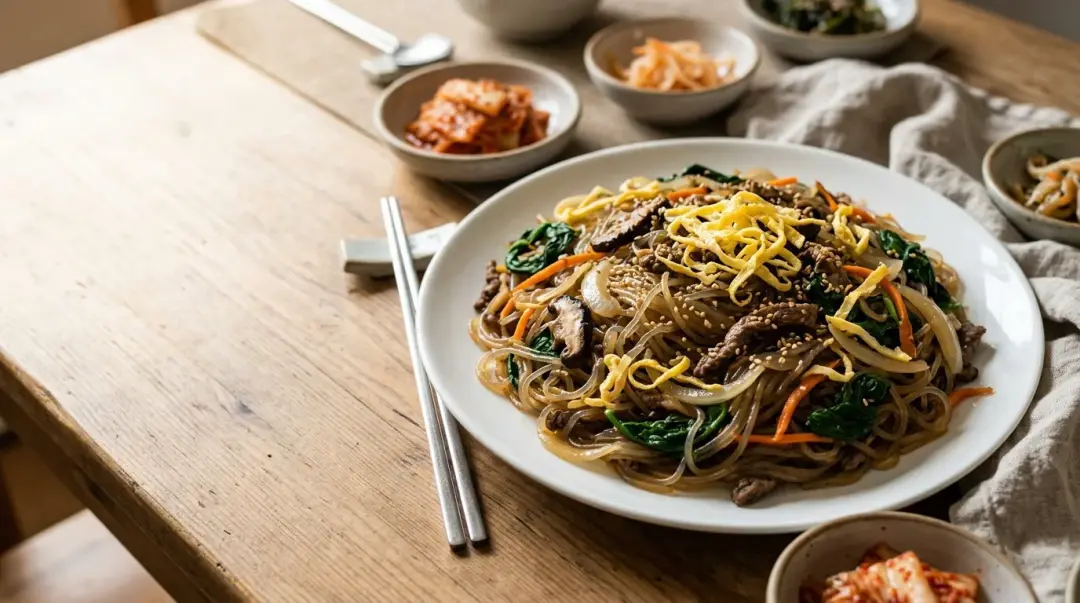
- Japchae (잡채) — Sweet potato glass noodles (dangmyeon), stir-fried with beef and vegetables. The banquet noodle.
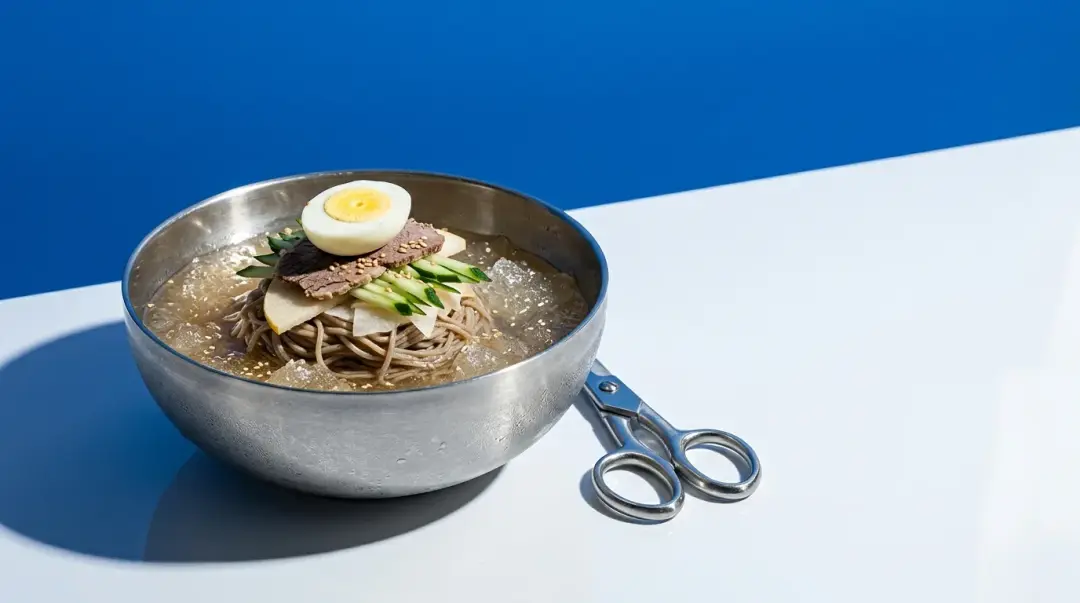
- Naengmyeon (냉면) — Cold buckwheat noodles in ice-cold beef broth. The summer dish, originally from Pyongyang and Hamhung.
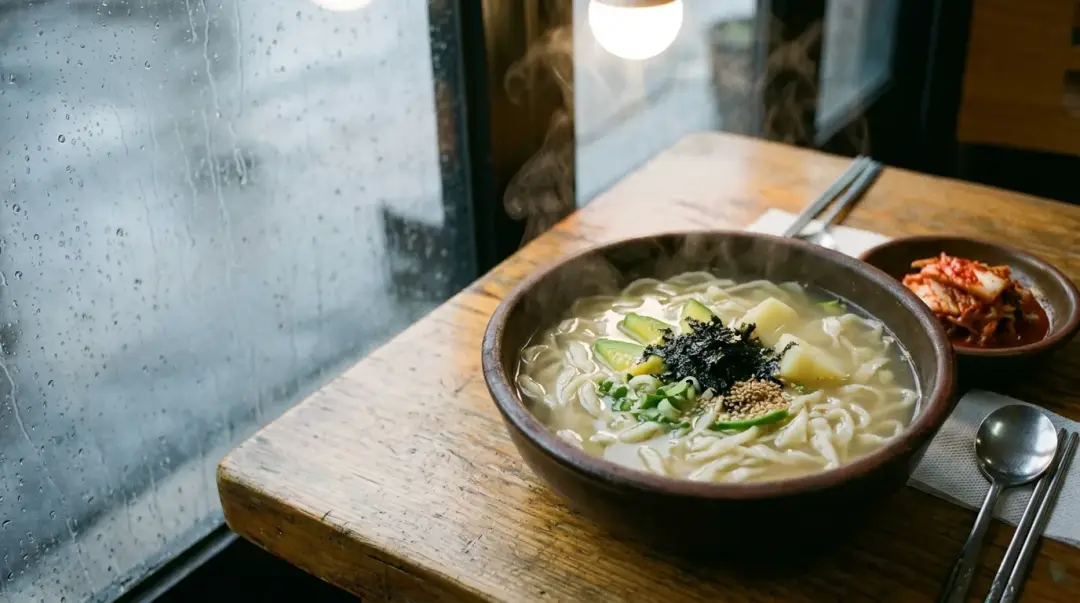
- Kalguksu (칼국수) — Hand-cut wheat noodles in clear anchovy-and-kelp broth. The rainy-day comfort dish.
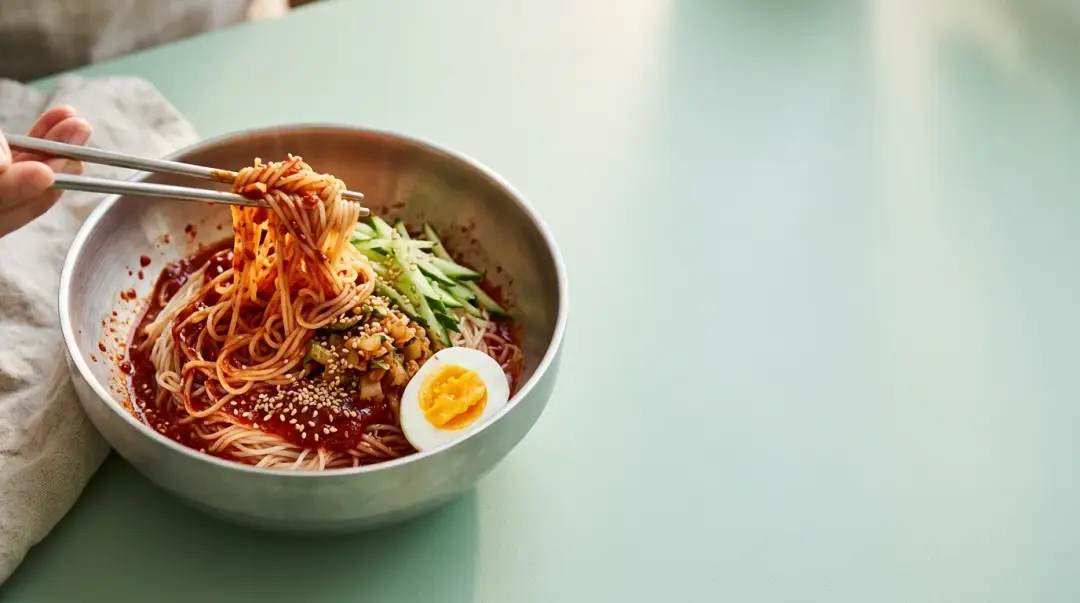
- Bibim Guksu (비빔국수) — Thin cold wheat noodles tossed in sharp gochujang sauce. The everyday spicy noodle.
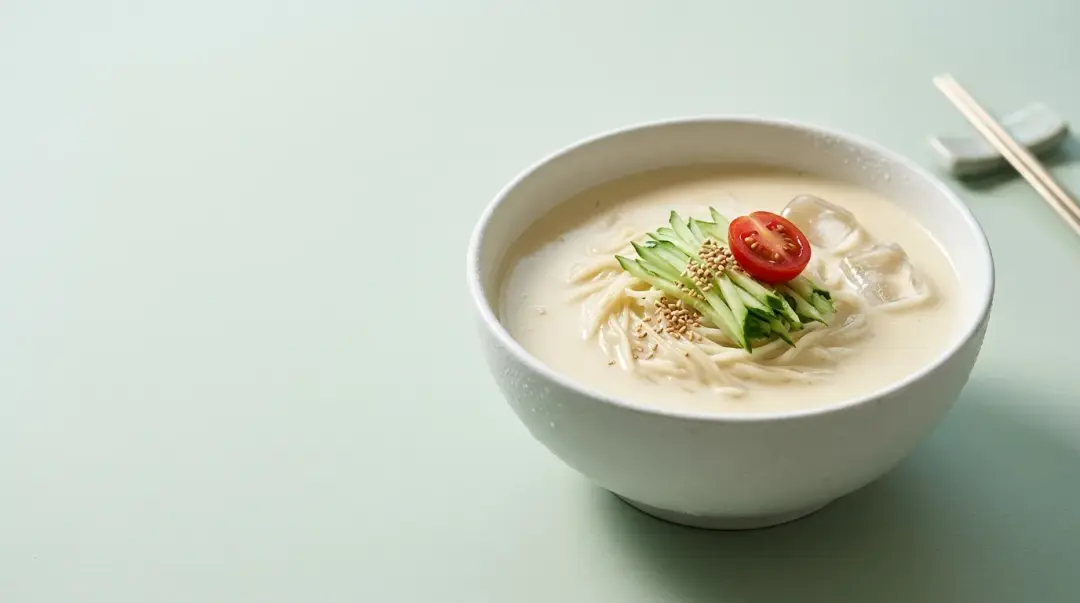
- Kongguksu (콩국수) — Chilled fresh soy-milk broth over thin wheat noodles. The most unusual Korean noodle, summer-only.
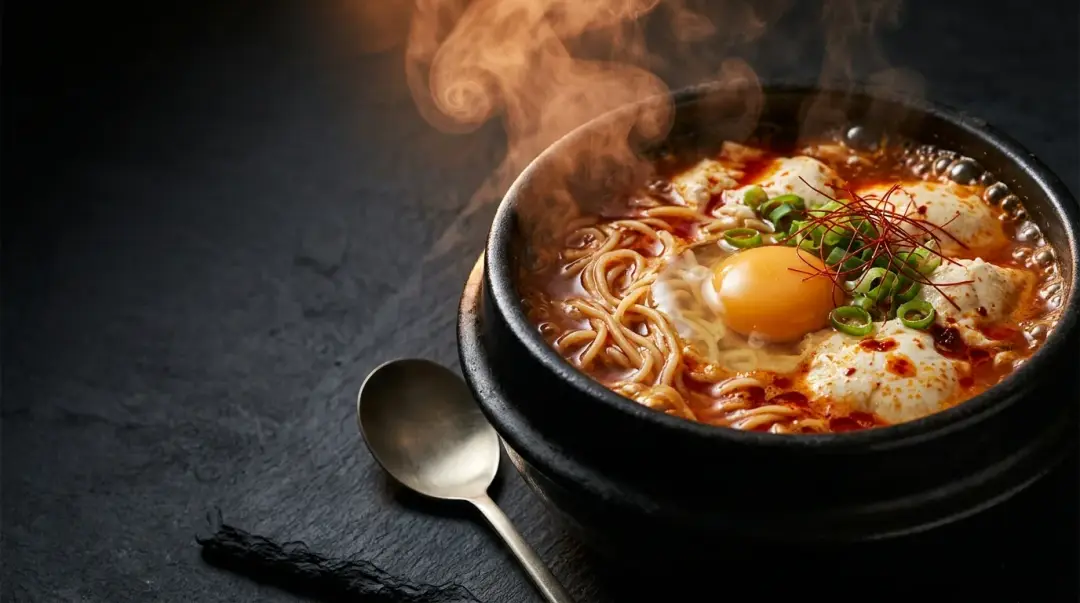
- Sundubu Guksu (순두부국수) — Silken soft tofu and thin noodles in a fiery gochugaru broth. The noodled cousin of sundubu jjigae.
Regional Roots
Korean noodle culture maps onto the peninsula's grain geography. The mountainous north grew wheat and buckwheat, which made it the birthplace of naengmyeon — both Pyongyang's clear-broth version and Hamhung's spicy mixed version are originally North Korean dishes, brought south by refugees during the Korean War. A few dishes have foreign roots they've outgrown: jjajangmyeon descends from Chinese zhajiangmian, brought to Incheon by Shandong immigrants in the late 1800s, and ramyeon is a Korean reinvention of Japanese instant ramen, first manufactured locally by Samyang Foods in 1963.
Half of Korea's most-eaten noodles are served cold, a category almost absent from Japanese and Chinese cuisine. Naengmyeon also doubles as the post-Korean-BBQ digestif — the icy broth cuts through grilled-meat richness, which is why every Korean BBQ menu lists it. See the Hot vs Cold Korean Noodles guide for the seasonal map.
How Korean Noodles Differ from Japanese and Chinese
These three traditions share alphabet-soup overlap — wheat, buckwheat, broth, slurping — but the seasoning logic is distinct enough that an experienced eater can identify cuisine from a single bite of broth.
- Stock base. Japan builds on dashi (kombu + bonito). China builds on pork-and-chicken stock. Korea builds on myeolchi yuksu — cleaner and more mineral than dashi, sharper than Chinese stock.
- Ferment vocabulary. Korea leans on gochujang, doenjang, kimchi, and ganjang (soy sauce); Japan uses miso, mirin, and shoyu; China uses doubanjiang, fermented black beans, and oyster sauce. None substitutes for the others.
- Heat philosophy. Korean food layers heat on top of savoriness. Japanese and Chinese rarely make heat the dominant note in a noodle dish.
- Cold tradition. Korea has at least three major cold noodle dishes. Japan has zaru soba and hiyashi chuka. China has liang mian. The cold category skews Korean.
- Slurping norms. Mandatory in Japan, tolerated in China, quiet in Korea.
Full breakdown in the Korean vs Japanese vs Chinese Noodles guide.
Where to Eat Korean Noodles
The four serious Korean-American food corridors:
- LA Koreatown (Wilshire and Olympic Blvd between Vermont and Western) — the largest Korean food concentration outside Korea. Naengmyeon specialists in summer; jjajangmyeon delivery year-round.
- Palisades Park, NJ (Broad Ave) — the East Coast equivalent. Bergen County has more Korean restaurants per capita than anywhere in the US.
- Annandale, VA (Route 236) — the DC-suburb Korean district. Strong on jjajangmyeon and ramyeon-bar culture.
- Duluth and Suwanee, GA (Pleasant Hill Rd and Buford Hwy) — the fastest-growing Korean food region, anchored by H Mart's Atlanta flagship.
Where to Buy Korean Noodles
H Mart carries the full range — 50+ ramyeon SKUs, frozen kalguksu and naengmyeon kits, fresh dangmyeon for japchae, and tube-format sundubu. Trader Joe's and Target now stock Shin Ramyun and a handful of Samyang Buldak flavors. Costco carries Nongshim variety packs in 16-count cases. Amazon ships every major Korean brand. Our best Korean instant ramyeon guide picks the bags worth buying, and Korean noodle variety packs covers the multipacks. For cooking at home, see Korean pantry essentials and the best pots for Korean noodles.
The four manufacturers that account for nearly all Korean instant noodle sales in the US:
- Nongshim (농심) — Shin Ramyun, Chapagetti, Neoguri. Market leader by a wide margin.
- Samyang (삼양) — Buldak fire noodles, original Samyang Ramyun. The TikTok brand.
- Ottogi (오뚜기) — Jin Ramen, Cheese Ramen. The mid-shelf alternative.
- Paldo (팔도) — Bibim Men, Kokomen. Smaller, more distinctive flavors.
See our Korean recommendations for the full curated catalog.
FAQ
What are the main types of Korean noodles?
Eight core dishes: ramyeon, jjajangmyeon, japchae, naengmyeon, kalguksu, bibim guksu, kongguksu and sundubu guksu. They use wheat, buckwheat, sweet potato starch and rice.
Which Korean noodles are served cold?
Naengmyeon, bibim guksu and kongguksu are the cold dishes. Naengmyeon comes in ice-cold beef broth, and kongguksu in chilled soy-milk broth.
What is the difference between Korean, Japanese and Chinese noodles?
Korean noodles build on myeolchi yuksu (anchovy-and-kelp stock) and ferments such as gochujang and doenjang. Japan builds on dashi and China on pork-and-chicken stock.
Where can I buy Korean noodles?
H Mart carries the full range, including 50+ ramyeon SKUs. Trader Joe's, Target and Costco stock Shin Ramyun and some Buldak flavors, and Amazon ships every major Korean brand.
Which brands make most Korean instant noodles?
Nongshim, Samyang, Ottogi and Paldo account for nearly all Korean instant noodle sales in the US. Nongshim leads by a wide margin.
What You Need
SVRITE yellow aluminum ramyeon pot. The yellow aluminum pot is the iconic way to cook ramyeon in Korea. This listing is an aluminum alloy pot with a lid and side handles, sold in 14 to 22 cm sizes, so check the size before ordering. View on Amazon
BALWOO Korean flat stainless steel chopsticks. Flat steel chopsticks are the standard Korean table utensil. This is a set of 5 pairs in 304 stainless steel, 9 1/4 inches long, made in Korea. View on Amazon
Minecook Korean galbi scissors. Long, chewy noodles such as naengmyeon are often snipped with kitchen scissors at the table. This listing is a pair of heavy-duty stainless steel shears, about 10.2 inches long, with an ABS grip, sold for cutting meat and fish. View on Amazon