Pho History: Where Vietnam's Noodle Soup Began
· 8 min read · NoodleDex Editorial
Pho history, from its contested name (pot-au-feu or Cantonese fen?) to Nam Định villages, French beef, the 1954 move south and the 1975 diaspora to the US.
This page contains affiliate links. We may earn a commission at no extra cost to you. Disclosure
Even the name is disputed. In 1937 the lexicographer Gustave Hue equated cháo phở with pot-au-feu, the French beef-and-vegetable stew whose name means "pot on the fire." Many Western sources still repeat the French reading. In 1928 the writer Jean Tardieu recorded Hanoi street vendors crying "Pho-ô!", and some Hanoians say French soldiers ordered the soup by calling for feu, fire, after the steam rising off the vendor's pot.
The rival reading runs through Chinese. A 1931 Vietnamese dictionary defined phở as "from the word phấn. A dish consisting of small slices of rice cake boiled with beef." Phấn is the Vietnamese reading of 粉 (fen in Mandarin, fan in Cantonese), the character for rice noodles. Hue and Eugène Gouin suggested in 1957 that phở was a shortening of lục phở, and in 1970 the scholar Lê Ngọc Trụ traced it to Cantonese ngau yuk fan (牛肉粉, beef noodles), a dish Chinese vendors sold in Hanoi. Around 1908 and 1909, the argument goes, the vendors' cry of ngưu nhục phấn (beef and noodles) wore down to a single syllable. The final n may have dropped to avoid phẩn, which means excrement.
Many current writers side with the noodle. The Language Log blog at the University of Pennsylvania notes that "several scholars dispute" the French derivation "on the basis of the stark differences between the two dishes." The cookbook author Andrea Nguyen calls the French reading "difficult to accept." A chef quoted by the Michelin Guide put it more modestly: "nobody can really be sure." The word fight is a small version of the larger argument over who made phở. Most accounts give it three inputs (Chinese noodles, French-era beef, Vietnamese cooks), and historians weigh them differently.
The Beef: What French Rule Changed
Before French rule, Vietnamese cooking leaned on pork and poultry. Cattle were mostly kept as draft animals. French colonists, who controlled Vietnam from the 1880s until 1954, wanted steak and slaughtered cows to get it. Andrea Nguyen describes Vietnamese cooks salvaging the bones and scraps the French left behind, which is the core of the beef-broth theory.
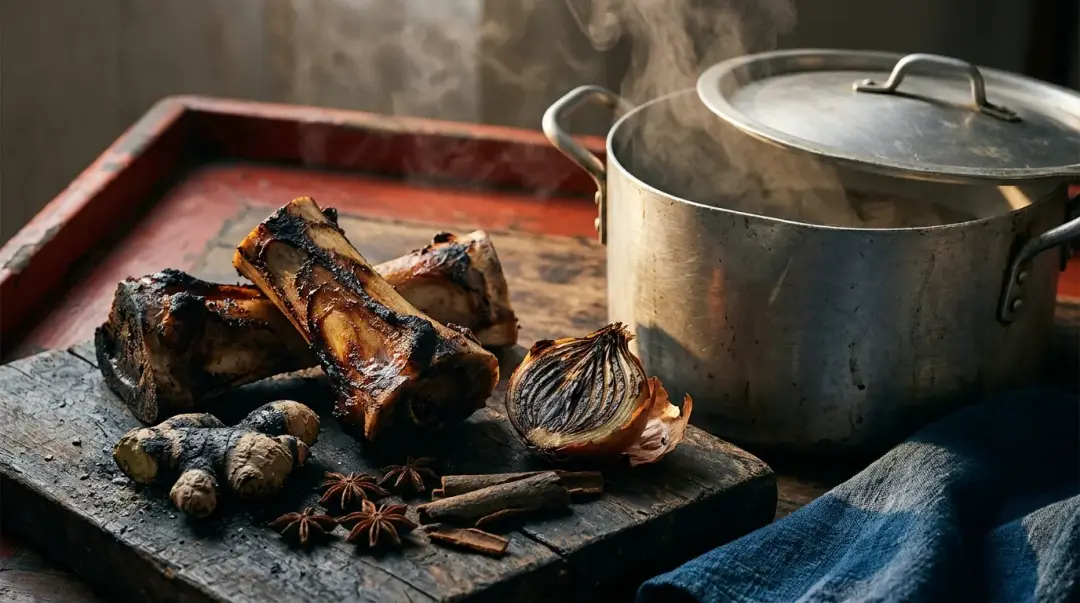
National Geographic ties this to a specific place. In 1898, it reports, French laborers came to Nam Định to build the largest textile plant in Indochina, and the beef they ate left plenty of bones for local cooks. The Michelin Guide adds other reasons Nam Định fits: cattle, flat farmland, a French Catholic community and a short trip to Hanoi.
A third theory makes the beef a substitution. Xáo trâu was a Hanoi street dish of stir-fried water buffalo in broth over rice vermicelli, eaten by commoners near the Red River. Around 1908 and 1909, when the shipping trade brought a wave of dockworkers to the city, Vietnamese and Chinese vendors cooked it for them and gradually switched from buffalo to cheap beef scraps. Nguyen accepts xáo trâu as one ancestor.
The Noodle: The Chinese Side of the Bowl
Bánh phở (flat rice noodles) are the clearest Chinese element. Chinese vendors in early Hanoi sold beef noodle soup to customers who included workers from Yunnan and Guangdong, who found it close to home cooking. One of Hanoi's early phở stands was Chinese-owned, set up in front of the Bờ Hồ tram stop.
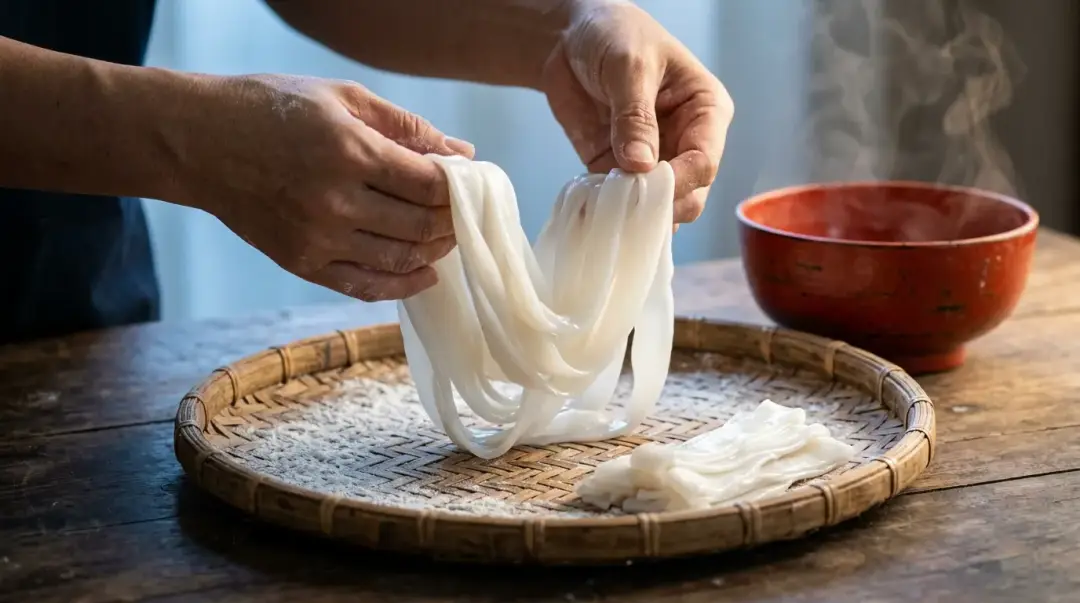
Nguyen also notes parallels with guò qiáo mǐ xiàn, Yunnan's "crossing the bridge" rice noodles. The cousins on the Vietnamese side of the family include hủ tiếu, a southern rice-noodle soup whose name, like Thai kuaitiao, comes from the Teochew Chinese word for rice noodles. The rice noodles guide explains how bánh phở differs from the round vermicelli used in bún.
The Place: Nam Định Versus Hanoi
The paper trail is thin. A short story from 1907 mentions the word phở, while Georges Dumoutier's long 1907 survey of Vietnamese food doesn't mention the dish at all. The French artist Henri Oger drew phở vendors in his Technique du Peuple Annamite (1908–1910). The writer Nguyễn Công Hoan later recalled street vendors selling it in 1913. Most accounts date the modern dish to between 1900 and 1910.
Nam Định's claim rests on two villages, Vân Cù and Dao Cù, said to have produced generations of phở cooks who moved to Hanoi. Around 1925 a Vân Cù villager named Vạn opened the first "Nam Định-style" phở stand in the capital. Hanoi already had stands by then, among them Cát Tường on Cầu Gỗ Street, and two more opened in 1918. So the dish may have been born in the countryside and grown up in the city, or developed in both at once, which is how the Michelin Guide puts it.
The Hanoi bowl kept changing through the colonial years. Vendors in the late 1920s tried húng lìu (a Vietnamese spice blend), sesame oil, tofu and even cà cuống, an essence from the giant water bug. That experiment, called phở cải lương (reformed phở), didn't last. Phở tái, with raw beef that cooks as the hot broth is poured over it, had arrived by 1930. In 1939 phở gà, chicken phở, appeared, possibly because markets didn't sell beef on Mondays and Fridays at the time. Vietnam made December 12 the official Day of Phở in 2017.
The Border: What Happened After 1954
The 1954 Geneva Accords ended French rule and split Vietnam in two. More than a million people moved from North to South, and phở, which Saigon knew but ate less often, went with them. Andrea Nguyen notes that some restaurants took names like Pho 1954 to mark the move.
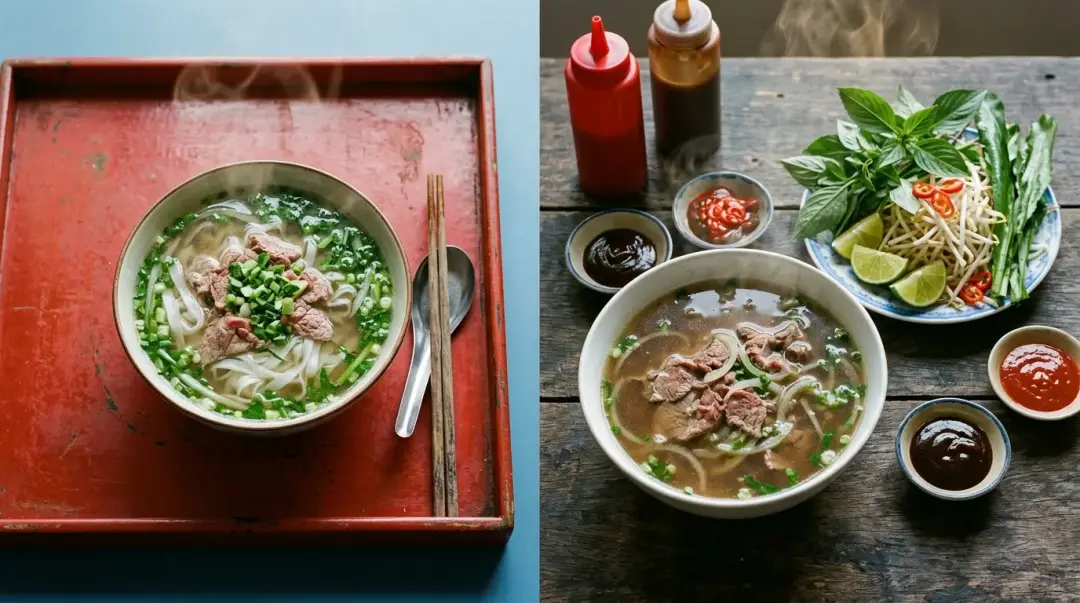
How phở split after 1954
| Northern (Hanoi) | Southern (Saigon) | |
|---|---|---|
| Broth | Delicate, simple | Sweeter, with rock sugar |
| Garnish | Minimal | Bean sprouts, Thai basil, lime, culantro, chili, plus hoisin and sriracha |
| In the bowl | Broth, noodles, cooked beef | More additions, meatballs common |
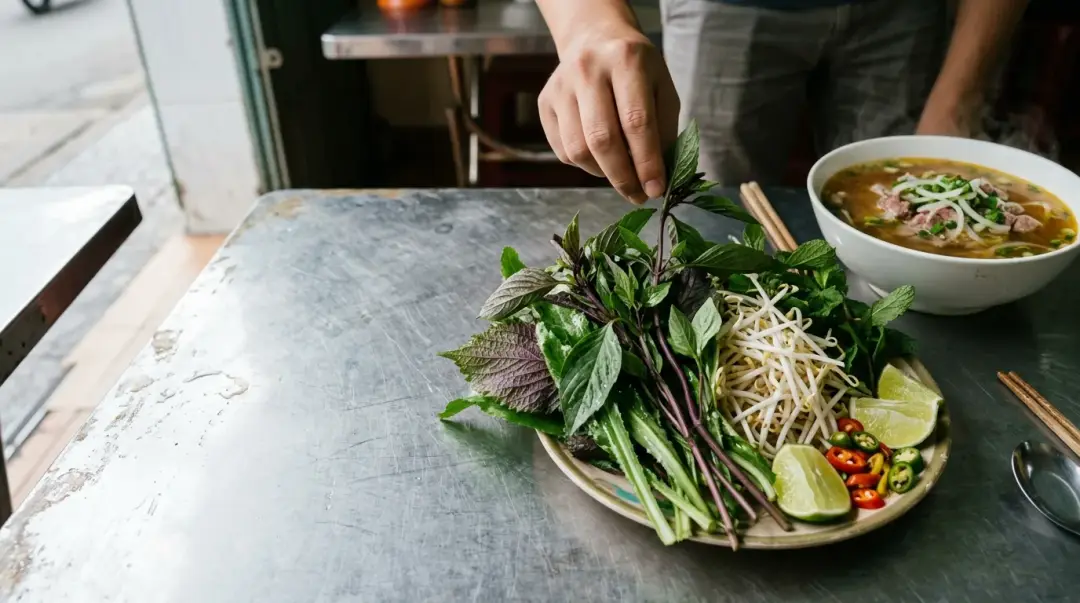
In the South, cooks added the garnish plate: mung bean sprouts, ngò gai (culantro), Thai basil, lime, plus hoisin and sriracha on the table. Those are the additions most diners outside Vietnam think of as phở itself. The full plate is broken down in our Vietnamese herb table guide.
The North went the other way. The communist government nationalized private phở shops, which began making noodles from old rice, and street vendors were pushed to noodles made from imported potato flour. During the lean subsidy years after the war, state shops sold phở không người lái, "pilotless phở," named for American reconnaissance drones because it came without meat. The broth was water and MSG. In 1979, in those scarce years, Nguyễn Trọng Thìn opened Phở Thìn in Hanoi.
The Diaspora: 1975 and the American Bowl
The fall of Saigon in 1975 began the next migration. About 140,000 Vietnamese were evacuated to the US that year, and many more came later as refugees. In 1980 the first of what became hundreds of phở restaurants opened in Little Saigon, the Vietnamese neighborhood of Orange County, California. Pho 79 opened in Garden Grove in 1982, run by Thọ and Liễu Trần, and the James Beard Foundation named it one of its America's Classics in 2019, calling it "among the area's very first restaurants of its kind."
Restaurant names carry the history. Monica Nguyen, who left Vietnam in 1977, opened Pho 86 in Westminster in 1986. Pho 45 in Garden Grove takes its name from the 1945 famine in northern Vietnam, in which more than two million people died. Early US cooks had trouble finding some ingredients and cooked for American tastes, and American phở grew meatier as a result.
Phở moved into the US mainstream in the 1990s as relations between the US and Vietnam improved. Phở Hòa grew into the largest US phở chain, with more than 70 locations in seven countries, and the Shorter Oxford English Dictionary added the word in 2007. The modern style guide is on our phở type page, and the noodles and broth kits worth buying are in the best pho noodles guide.
Further Reading: The Sources Behind This Page
Most English-language writing on phở history draws on a small set of sources. These are the ones this page relies on, with what each argues.
- Andrea Nguyen, "What Is the History of Pho?" (Viet World Kitchen, 2018). The most careful popular account in English. She favors the Chinese fen etymology, accepts xáo trâu and French beef as inputs, and says plainly that "we'll likely never know for certain."
- Language Log, "Phở" (University of Pennsylvania). A linguist's roundup of the etymology fight, citing Hue (1937), Hue and Gouin (1957), Lê Ngọc Trụ (1970) and the 1931 dictionary.
- National Geographic, "What pho can teach us about the history of Vietnam." Strongest on the Nam Định and French-beef story. It quotes Khanh Linh Trinh, a University of Michigan doctoral candidate in Vietnamese culinary history, on the southern Chinese influence on northern broth.
- Michelin Guide, "Who Invented Vietnamese Pho?" (2023). A short piece that presents phở as a hybrid of French and Chinese influence, with Nam Định and Hanoi as parallel birthplaces.
- Saigoneer, "An Abridged History of Phở." A Saigon-based view that dates the dish's arrival in the South to around 1950, slightly earlier than the usual 1954 marker.
- James Beard Foundation, 2019 America's Classics. The record for Pho 79 and the early Orange County phở trade.
FAQ
Where did pho originate?
Phở emerged in northern Vietnam in the first decade of the 1900s. The most common account places its birth in Nam Định Province, southeast of Hanoi, in the villages of Vân Cù and Dao Cù. By the 1910s street vendors were selling it in Hanoi, and around 1925 a Vân Cù villager opened the first Nam Định-style stand in the city.
Does pho come from the French pot-au-feu?
Possibly, but many specialists doubt it. The lexicographer Gustave Hue linked phở to pot-au-feu in 1937, and some Hanoians say French soldiers ordered it by calling out feu. Later scholars, including Lê Ngọc Trụ in 1970, traced the word to Cantonese fen, rice noodles. Several scholars point out that the two dishes differ sharply.
Is pho Chinese or Vietnamese?
Vietnamese, with Chinese and French inputs. The flat rice noodle and the early name likely came from Cantonese cooking in Hanoi, where Chinese vendors sold beef noodles. Beef became plentiful under French rule. Vietnamese cooks in Nam Định and Hanoi combined these into a dish that has no direct equivalent in China or France.
How did pho get to the South of Vietnam?
Mostly through the 1954 partition. After the Geneva Accords split the country, more than a million people moved from North to South Vietnam, and they brought phở with them. Saigon cooks then added the bean sprouts, Thai basil, lime, culantro, hoisin and sriracha that most diners now think of as standard.
When did pho come to the United States?
With refugees after the fall of Saigon in 1975, when about 140,000 Vietnamese were evacuated to the US. The first of hundreds of phở restaurants in Orange County's Little Saigon opened in 1980, and Pho 79 in Garden Grove followed in 1982. Phở entered the US mainstream in the 1990s.
Why do pho restaurants have numbers in their names?
Many numbers are dates. Pho 1954 and similar names mark the year northerners moved south with the dish. Others are personal: Pho 86 in Westminster, California, opened in 1986, and Pho 45 refers to the 1945 famine in northern Vietnam. Some numbers are addresses or lucky numbers.
Read Next
Products mentioned in this guide
This section contains affiliate links. We may earn a commission at no extra cost to you.

Three Ladies Brand Rice Stick, 14 oz (Pack of 4)
Flat rice noodles of the kind many Vietnamese restaurants use for phở. The noodle is the part of the bowl most historians trace to southern Chinese cooking.
View on Amazon
Lee Kum Kee Hoisin Sauce, 20 oz
Hoisin on the table is a southern habit that took hold after 1954. Keep it in a side dish for dipping meat, the way Saigon-style shops serve it.
View on Amazon
Huy Fong Sriracha Hot Chili Sauce, 28 oz
The other post-1954 southern addition, and the bottle on nearly every phở table outside Vietnam. Squeeze it beside the hoisin, not into the broth.
View on Amazon
Buying guides for this topic
- Buying guideBest Pho Noodle Brands: Rice Sticks Worth BuyingBest pho noodle brands compared: Three Ladies, Bamboo Tree, A Taste of Thai and Sailing Boat rice sticks by width, ingredients and origin, plus pho kits.
- Buying guideVietnamese Pantry Essentials in 2026The 8 items that get a home pantry from zero to making real Vietnamese noodle dishes — fish sauce, shrimp paste, hoisin, and more, ranked.
- Buying guideBest Vietnamese Cookware in 2026The pots, strainers, and bowls you actually need to make Vietnamese noodles at home. From pho stockpots to noodle bowls, real US Amazon picks.
- Buying guideBest Vietnamese Instant Noodles in 2026Vietnamese instant noodles ranked — Vifon, Acecook, Mama, and Hảo Hảo on Amazon. The convenient way to taste Vietnamese noodle culture.