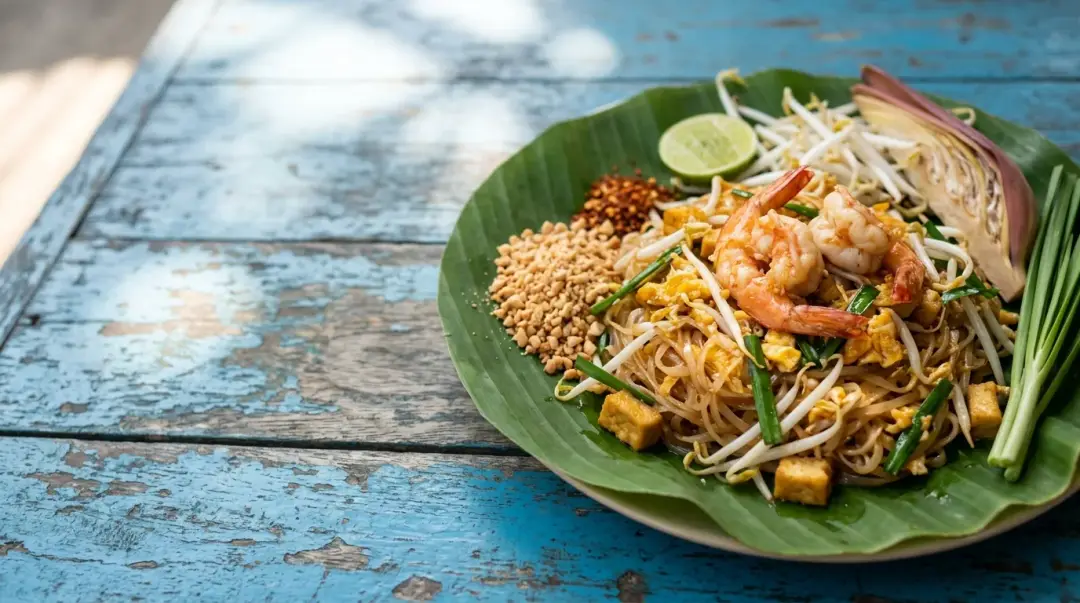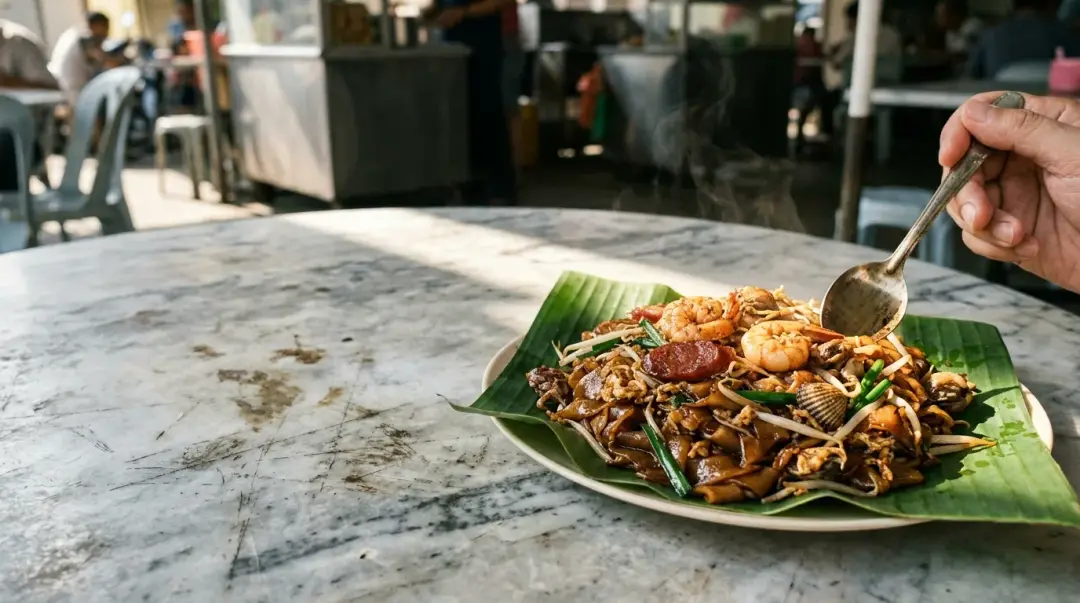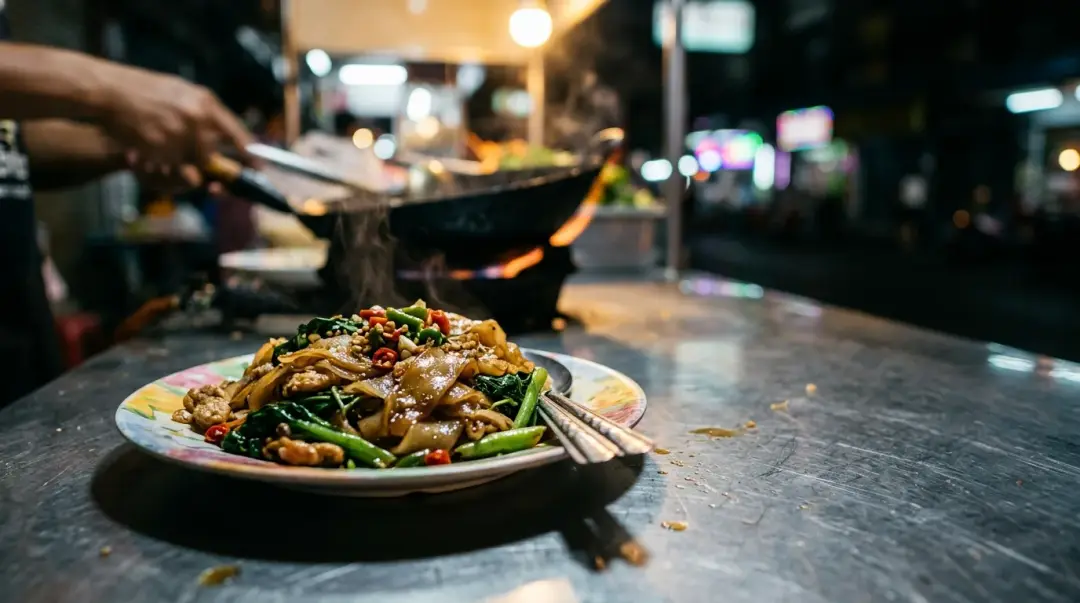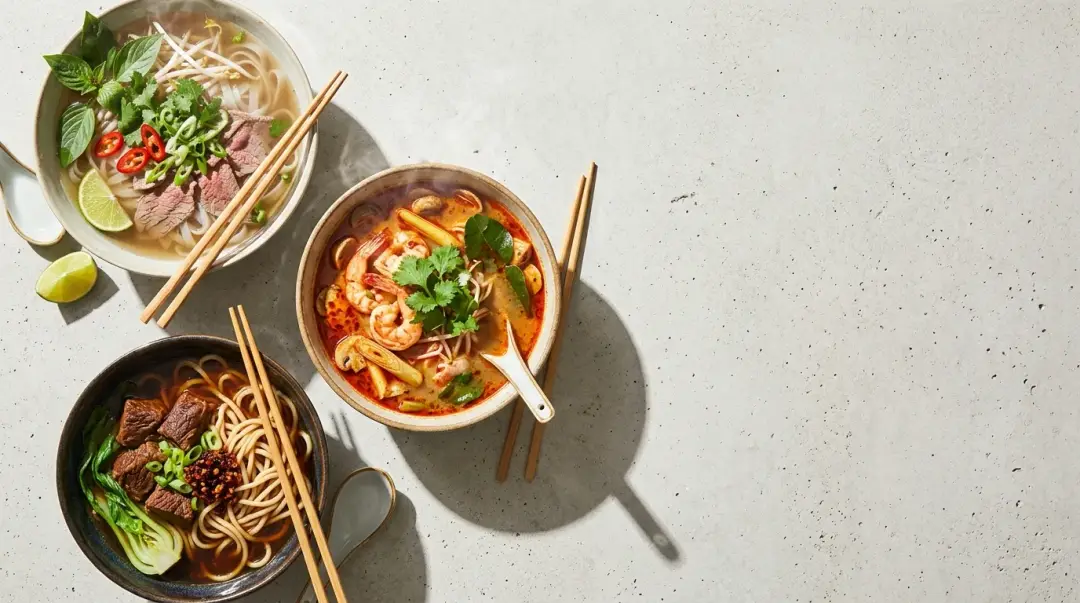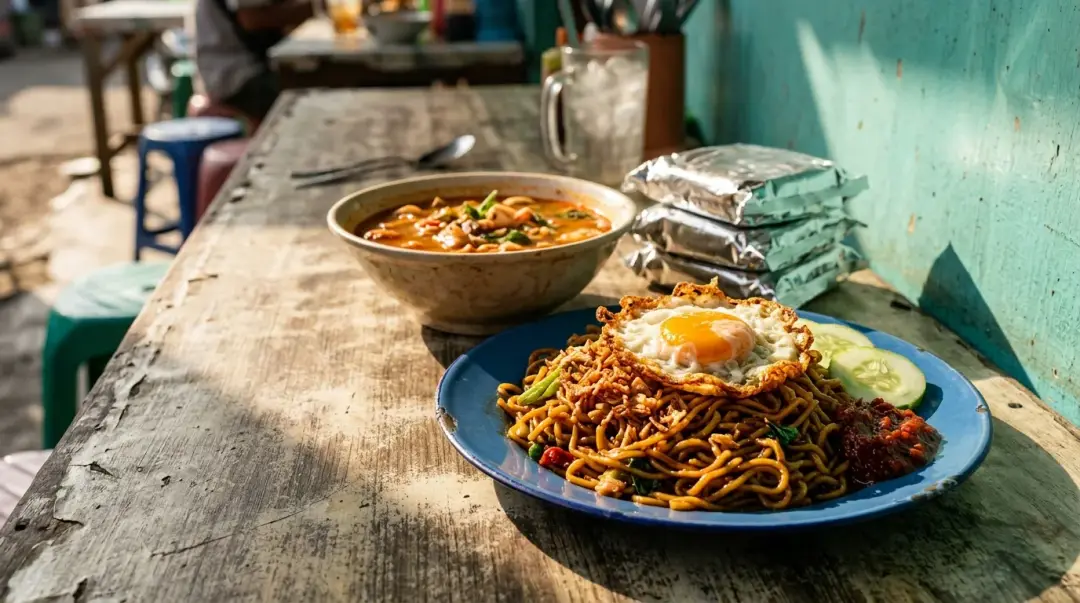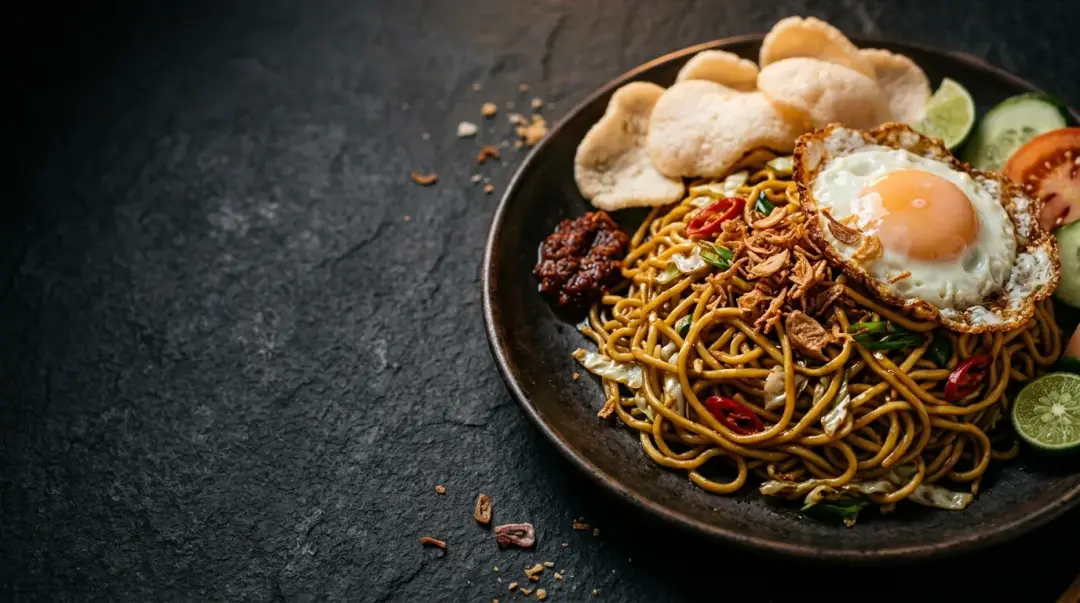
Mie goreng (Indonesian) and mi goreng (Malaysian-Singaporean) is Southeast Asia's stir-fried egg noodle — sweet, savory, and lightly spicy, built on kecap manis (sweet Indonesian soy sauce), shrimp paste, sambal chili, garlic, shallots, and a fried egg on top. Indomie Mi Goreng, the instant version launched under the Indomie brand in 1982 (the brand became part of Indofood in 1994), is the cult packet that took the dish global — sold in over 80 countries and routinely ranked the best instant noodle in the world.
What is Mie Goreng?
Mie goreng is a stir-fried egg-noodle dish from the Indonesian and Malay-speaking world. The name decomposes cleanly: mie is a loan from Hokkien Chinese (mī, 麵) for wheat noodle, and goreng is Indonesian and Malay for "fried." Same dish, two spellings — mie goreng in Indonesian, mi goreng in Malaysian-Singaporean usage.
The dish is a direct artifact of the Chinese-Hokkien diaspora to Southeast Asia. Through the 1800s and early 1900s, waves of Hokkien-speaking migrants from Fujian settled in port cities across what are now Indonesia, Malaysia, and Singapore — Batavia (today Jakarta), Penang, Medan, Surabaya, Malacca. They brought wheat-egg noodles with them. Stir-fried noodle preparations from coastal Fujian got remade in local kitchens with the regional pantry — palm-sugar-sweetened soy, fermented shrimp paste, sambal chili, lime — and within two generations the dish had localized into something the host cultures owned as their own.
The fresh version is a wok dish: yellow alkaline egg noodles, blanched then stir-fried hard over high heat with garlic and shallot, kecap manis, sambal, a small piece of terasi (Indonesian shrimp paste) or belacan (Malaysian shrimp paste), egg cracked into the wok, shrimp or chicken or fishball, shredded cabbage, scallion. It's plated with a fried egg on top, krupuk (Indonesian prawn crackers) on the side, and a wedge of lime.
Flavor Profile
Mie goreng is the sweet-savory-spicy corner of the Southeast Asian noodle map. The defining note is the kecap manis — a thick, near-molasses Indonesian soy sauce sweetened with palm sugar. It tastes nothing like Chinese light soy or Japanese shoyu; it's syrupy, dark, caramelized, and it's what gives every strand its glossy lacquered finish.
Underneath is the funk of shrimp paste — terasi in Indonesian, belacan in Malaysian. A piece the size of a pencil eraser dissolved into the wok seasons the entire dish with marine umami. You don't taste it as "shrimp"; you taste a savory floor under everything else. Sambal (Indonesian-Malay chili paste) supplies moderate heat, adjustable at the table. Garlic and shallot hit the hot oil before the noodles go in. The noodles themselves carry smoky wok char when cooked over a roaring flame — wok hei, the breath of the wok. A fried egg and a squeeze of lime at the end break the richness with brightness.
Indonesian Mie Goreng vs Malaysian Mi Goreng vs Indomie Instant
Same family, three meaningfully different dishes:
- Indonesian mie goreng leans sweet and shrimp-pasted. The kecap manis is heavier-handed, the terasi funk is more present, the chili moderate. Canonical garnishes are krupuk, sliced cucumber and tomato, a fried egg, and a lime wedge. Acar (Indonesian pickle — carrot, cucumber, shallot in vinegar and sugar) frequently rides along on the plate.
- Malaysian mi goreng runs spicier and drier. The belacan is similar to terasi but more pungent. Cooks lean harder on sambal and chili paste, less hard on the sweet soy. Garnish is fried shallots, scallion, and lime.
- Indomie Mi Goreng is the instant version and the most-eaten noodle of the family by orders of magnitude. It was launched under the Indomie brand in 1982 (the brand became part of Indofood in 1994) and is now sold in 80+ countries. Each packet ships with five seasoning sachets — sweet soy, chili powder, savory seasoning, flavored oil, fried shallots — which is what makes it taste closer to cooked food than any other instant noodle on the market. Bon Appétit ranked it the #1 instant noodle in the world in its 2019 taxonomy; LA Times, The Ringer, and NYT Wirecutter polls have landed on the same answer.
Where to Find Mie Goreng in the US
Fresh, wok-cooked mie goreng is hard to find in the US — Indonesian restaurants are rare, clustered in three or four metros. Instant Indomie, by contrast, is sold literally everywhere.
- New York — Wayan (SoHo, chef-driven Indonesian), Selamat Pagi (Williamsburg), Sky Cafe and Java Village in Elmhurst, Queens.
- Los Angeles — Bali Pearl (Glendale), Simpang Asia (Palms), Indo Cafe (Palms). LA has the largest Indonesian-American community in the US.
- Chicago — Indo Mart and Rickshaw Republic (Lincoln Park, Indonesian street food).
For the instant version, Indomie Mi Goreng is on H Mart, 99 Ranch, Patel Brothers, Whole Foods (yes, really — usually two SKUs), and every major US Amazon listing in 5-pack and 30-pack cases. The 30-pack case on Amazon is the bulk option.
Making Mie Goreng at Home
The instant route is the three-minute version: boil one packet of Indomie Mi Goreng for three minutes, drain (this version is dry-stir, not soup), and dump in all five seasoning sachets. Top with a fried egg, fresh chili, and lime. It's not a substitute for the restaurant dish — it's a different, faster product that happens to share a name.
The from-scratch version turns on four pantry items:
- Kecap manis — ABC brand (PT Heinz ABC's Indonesian sweet soy) is the defining ingredient and the bottle to buy. H Mart and 99 Ranch stock it; Amazon carries it too. There is no substitute for kecap manis; mixing soy sauce with brown sugar gets close but loses the palm-sugar caramel note. Without it, the dish is not mie goreng.
- Sambal oelek — the basic Indonesian chili paste. Huy Fong's red-cap jar is the US default and works; Indonesian brands like Cap Ibu or Heinz ABC's sambal asli are the upgrade.
- Terasi (Indonesian shrimp paste) or belacan (Malaysian shrimp paste) — sold as small dense blocks. A piece the size of a pencil eraser is transformative; the whole brick lasts a year. Toast it briefly in the wok before adding aromatics to bloom the funk.
- Fresh yellow egg noodles — the alkaline Hokkien-style noodle, sold in the refrigerated section at H Mart and 99 Ranch. Dry chow mein noodles work in a pinch; dry spaghetti does not.
A pair of silicone-tipped tongs does most of the handling here, and a nonstick pan is a forgiving choice on a home stove because the sweet soy sticks. Our wok buying guide covers woks and wok tools if you cook it the street-stall way. Aromatic base is garlic and shallot, hit hard in hot oil. Protein is shrimp, chicken, or fishball. Vegetable is shredded cabbage and scallion. Fried shallots on top, lime on the side, prawn crackers on the plate.
What to Pair With Mie Goreng
The canonical plate is built around four accompaniments:
- Telur ceplok — a sunny-side-up fried egg, set directly on top of the noodles, runny yolk broken into the strands as you eat. This is the defining garnish; without it the plate looks incomplete to an Indonesian eater.
- Krupuk (Indonesian prawn crackers) — large, light, pink-tinged shrimp-flavored crackers, served on the side. Texture contrast to the soft noodle.
- Acar (Indonesian pickle — usually carrot, cucumber, and shallot in light vinegar-sugar brine) — cuts the sweet-rich noodle with acid and crunch.
- Sambal on the side — a small dish of fresh chili paste or sambal terasi for heat-adjustment as you eat.
For the drink, Bintang (Indonesia's lager, brewed in Tangerang since 1929) is the Indonesian-restaurant default; Tiger beer pairs with the Malaysian and Singaporean versions. Iced teh tarik (pulled tea — a frothy condensed-milk tea from Malaysian-Indian hawker culture) is the non-alcoholic order.
A Cultural Note
Wheat-egg noodles were not native to maritime Southeast Asia — rice was. They arrived with Hokkien migrants from Fujian through the 1800s, and the stir-fried noodle technique came with them. Mie goreng in its modern form is what happens when a 19th-century Hokkien wok dish meets the Indonesian and Malay pantry — kecap manis, terasi, sambal, palm sugar, lime — and becomes a national dish of two countries that didn't yet exist.
The Indomie Mi Goreng phenomenon is its own arc. The Mi Goreng instant variant was launched under the Indomie brand in 1982 (the brand became part of Indofood, the Salim Group's food company, in 1994) as a dry-stir alternative to soup-style instant noodles. Indomie's US site gives the brand's annual production capacity as 19 billion packs.
Nigeria is the strangest of those outposts. The Tolaram Group began importing Indomie in 1988, the noodles became a children's-food staple through aggressive school-targeted marketing in the 1990s, and DUFIL Prima Foods, Tolaram's joint venture with the Salim Group, opened a local plant that began operating in 1996. Nigeria is now Indomie's largest single export market. A generation of Nigerian kids has grown up assuming Indomie is Nigerian; it's one of the cleanest examples of a 20th-century food brand jumping cultures completely.
FAQ
What is mie goreng?
Mie goreng is a stir-fried yellow egg noodle dish from Indonesia and the Malay-speaking world. Mie is a Hokkien loan word for wheat noodle, and goreng means fried. It is sweet, savory and lightly spicy, topped with a fried egg and lime.
What is kecap manis, and can I substitute it?
Kecap manis is a thick Indonesian sweet soy sauce sweetened with palm sugar. Soy sauce mixed with brown sugar gets close but loses the palm-sugar caramel note. Without it, the dish is not mie goreng.
Is Indomie Mi Goreng the same as mie goreng?
It is the instant version of the dish. Indomie Mi Goreng launched in 1982, comes with five seasoning sachets, and is sold in over 80 countries. It is a faster product, not a substitute for the wok-cooked restaurant dish.
What is the difference between Indonesian mie goreng and Malaysian mi goreng?
Indonesian mie goreng leans sweet, with heavier kecap manis and terasi shrimp paste. Malaysian mi goreng runs spicier and drier, with more pungent belacan and more sambal.
See Best Indomie Flavors and the Vietnamese vs Thai vs Chinese Noodle Guide.