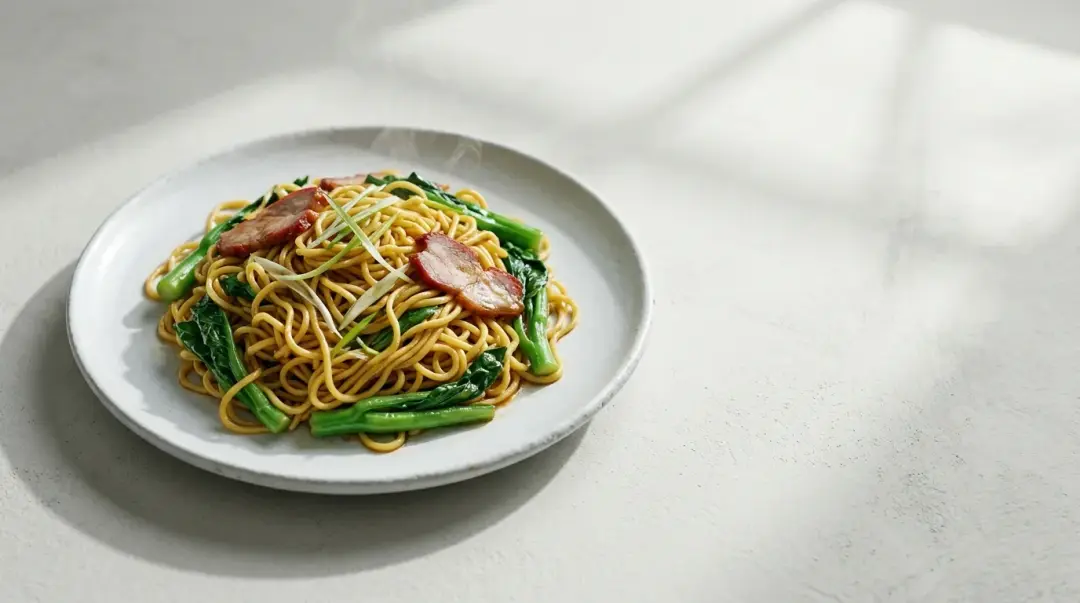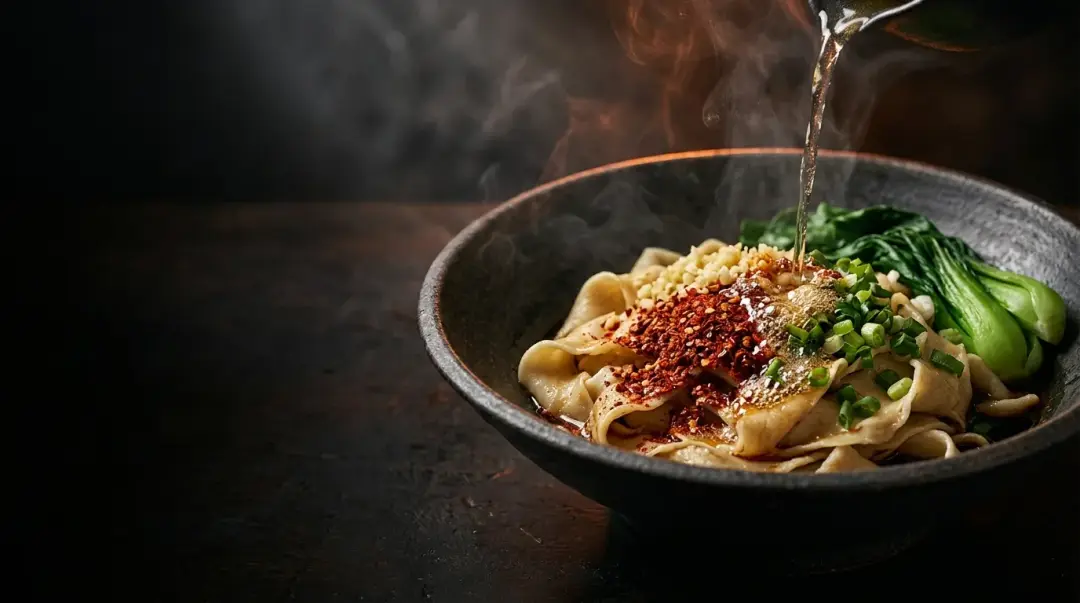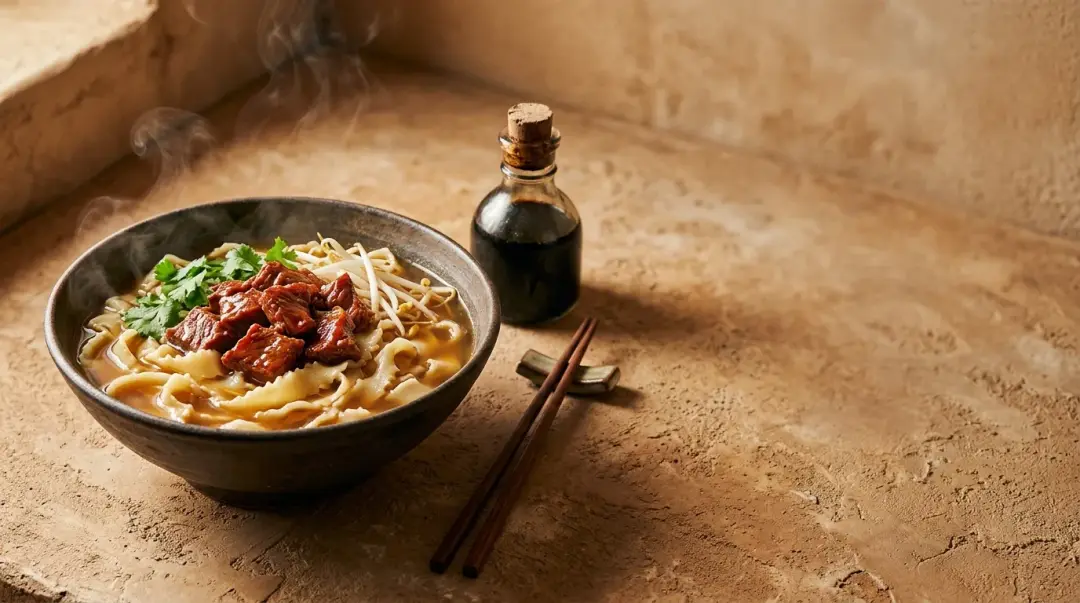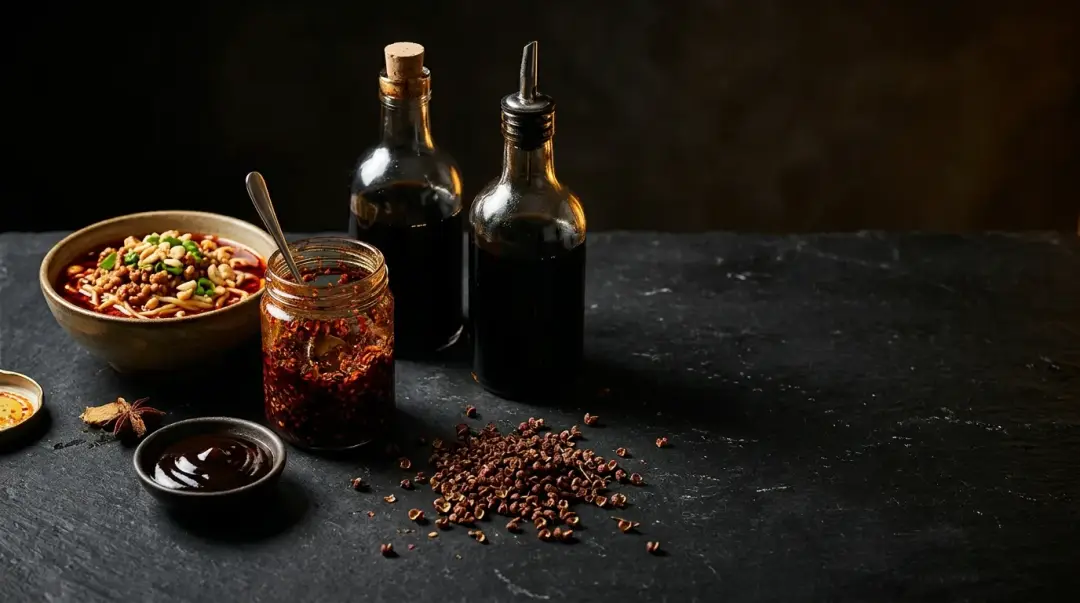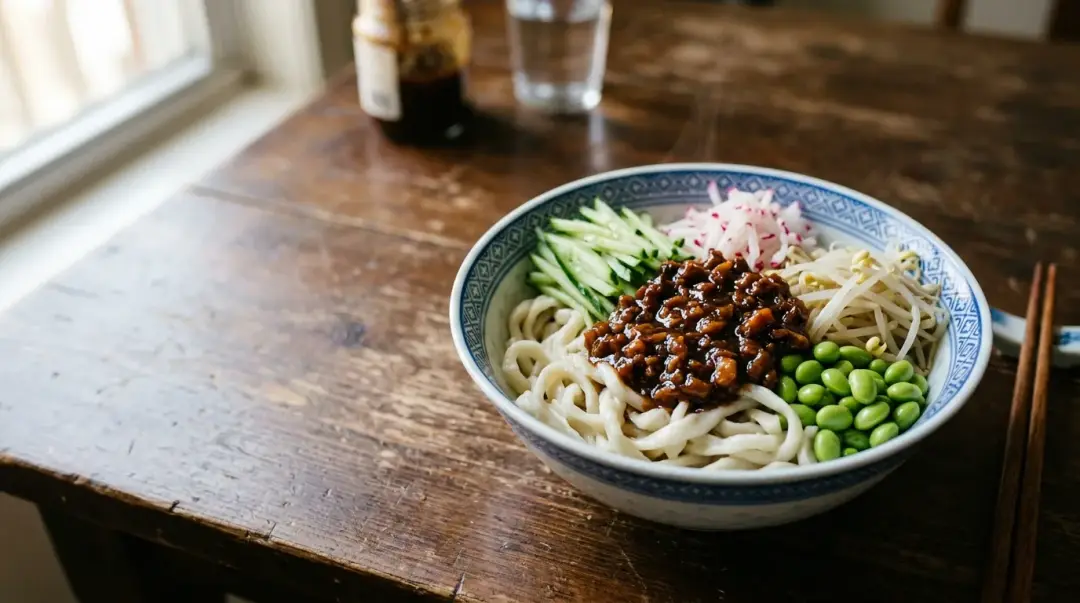
Zhajiangmian (炸醬麵, "fried sauce noodle") is Beijing's signature noodle dish — thick fresh wheat miàn (noodles) tossed with a chunky sauce of fermented yellow bean paste and minced pork, then loaded with raw cucumber, scallion, and blanched soybean. It's the direct ancestor of Korean jjajangmyeon, and the older, savorier, less-sweet original. Outside China, it appears on most northern Chinese menus, from Flushing to the San Gabriel Valley.
What is Zhajiangmian?
Zhajiangmian breaks down literally: zhá (炸, fried) + jiàng (醬, sauce or fermented paste) + miàn (麵, noodle). The "frying" is the cook step where minced pork and ginger get rendered in oil before the huangjiang (yellow bean paste — Beijing's salty, deeply fermented soybean paste, the foundation of the sauce) gets stirred in and cooked down until it goes glossy and dark.
The dish is Beijing's, but with Shandong roots. Shandong province, just south of Beijing, is the historic home of Chinese fermented-bean cooking — huangjiang, doubanjiang, and the soy-paste lineage all trace to Shandong workshops. Beijing inherited the technique when Shandong cooks staffed the Qing Dynasty imperial palace kitchens through the 1700s and 1800s. The sauce-on-noodles format shows up in Qing palace records as a daily-staff meal — fast, calorie-dense, and built from pantry ingredients that kept for weeks.
By the late 1800s the dish had moved out of palace kitchens into Beijing's hutongs — the narrow alley neighborhoods of single-story courtyard houses that defined the city's pre-modern street life. Hutong vendors sold zhajiangmian from pushcarts to laborers and rickshaw drivers; corner shops set up long tables where diners mixed their own garnishes. That street-food character is still how Beijingers describe the dish: hands-on, social, eaten at a shared table, never plated as a single composed bowl. Today it's one of the Eight Great Noodles of China in the modern culinary canon — the dish Beijing claims the way Lanzhou claims hand-pulled beef noodle soup.
Flavor Profile
Zhajiangmian is deeply savory, salty, and umami-forward, with the fermented yellow bean paste running the whole show. Huangjiang tastes like soybeans pushed five steps past soy sauce — earthy, slightly funky, with the dense salinity of long-aged miso and none of the sweetness. Cook it down with rendered pork fat and you get a sauce that coats the noodle in a thick, paste-like glaze rather than pooling at the bottom of the bowl.
The pork is the second pillar. Traditional Beijing recipes use diced pork belly (not ground) cut into 5mm cubes and rendered until the fat melts and the lean edges crisp. You get little caramelized nuggets throughout, not the uniform texture of a Bolognese-style ground-meat sauce.
The garnishes do the rest. A proper plate arrives with a garnish bar — raw cucumber matchsticks, julienned radish, blanched soybean, bean sprouts, and chopped scallion. The diner mixes them in at the table. The cucumber is non-negotiable; its cold crunch and water content cut directly through the salty fat. Authentic zhajiangmian also uses hand-pulled or hand-cut thick wheat noodles with the bite-resistance of a fresh udon — 3-4mm thick, dense, with real spring. Thinner noodles can't carry the sauce weight.
The cucumber is non-negotiable. Without it the dish reads as too heavy.
Zhajiangmian vs Jjajangmyeon
Korean jjajangmyeon descends from zhajiangmian, but a century of separate evolution has made them visibly and texturally different dishes. The fastest ways to tell them apart:
- Sauce color and base. Zhajiangmian uses huangjiang (yellow bean paste) and reads dark brown — the color of caramelized bean paste and rendered pork fat. Jjajangmyeon uses chunjang (sweet caramel-black Korean black bean paste, fried in oil before cooking) and reads glossy jet black, almost lacquered.
- Sweetness. Zhajiangmian is barely sweet — its sweetness comes from cooked-out shaoxing wine, not sugar. Jjajangmyeon is noticeably sweet; modern chunjang is sold pre-blended with caramel and sugar, and Korean recipes add more on top.
- Toppings. Beijing's garnish bar is raw cucumber, radish, scallion, blanched soybean and bean sprouts — cold, crisp, mostly raw. Korean jjajangmyeon is mixed with diced onion, zucchini, and potato that get cooked into the sauce itself, plus a single strip of raw cucumber garnish.
- Noodles. Zhajiangmian uses thick, chewy, often hand-pulled fresh wheat noodles. Jjajangmyeon uses thinner, smoother, machine-cut wheat noodles closer to a Japanese ramen-style strand.
- Eating culture. Zhajiangmian is a sit-down dish — you mix at the table from a garnish plate. Jjajangmyeon is Korea's most-delivered meal, packed in plastic bowls and ridden across cities on scooters.
Both descend from the same Qing-era Beijing original. The split happened in Incheon's Chinatown after 1905 (see Jjajangmyeon for the full lineage).
Where to Find Zhajiangmian in the US

The noodle to buy
Ken Hom 7-Inch Stainless Steel Chinese Cleaver
The garnish plate depends on cucumber and radish cut into matchsticks, and a wide cleaver blade slices and scoops them in one tool. This listing is a 7-inch stainless steel blade with a pear wood handle, marketed as a general-purpose cleaver.
Northern Chinese restaurants serve it; Cantonese-leaning Chinese-American restaurants usually don't. The reliable metros:
- NYC (Flushing) — Beijing-style shops along Main Street and Roosevelt Avenue, including the dedicated stalls in the New World Mall food court.
- NYC / Philadelphia — Han Dynasty lists it on some menus and as "Old-Fashioned Dan Dan Noodles" on others; ask.
- Chicago suburbs — Yu's Mandarin in Schaumburg is the regional standard-bearer for northern Chinese food, with the full garnish plate.
- Los Angeles (San Gabriel Valley) — Northern Cafe runs multiple SGV and Westside locations; their version leans Taipei-sweet but it's the most accessible LA option.
- Bay Area — Beijing 88 in San Francisco, plus the northern Chinese restaurants along Geary in the Richmond.
If your city has a restaurant labeled "Beijing-style," "Shandong," or "northern Chinese," zhajiangmian is almost certainly on the menu. Asian groceries stock everything for the home version.
Making Zhajiangmian at Home
The dish is built from shelf-stable pantry staples, which is why it travels well into home kitchens. The sauce starts with huangjiang (yellow bean paste), sold at H Mart, 99 Ranch and most Chinese groceries as huang doujiang or yellow soybean paste. Hoisin is not a substitute: it is sweet and aromatic, while huangjiang is salty and earthy. Some Beijing cooks blend in a little sweet bean paste (tianmianjiang), but that is optional.
The method is a single straight line. Diced pork belly renders in a wok until the fat releases, ginger and scallion whites go in, a splash of shaoxing (Chinese rice cooking wine) deglazes the pan, and the bean paste cooks down with a little water until the sauce turns thick and glossy. The noodles boil separately, thick fresh wheat noodles such as lo mein or hand-pulled lamian, and the sauce goes over the top. Each diner then builds the bowl from the garnish plate. The sauce goes in a wok, the noodles in a small saucepan, and the cucumber and radish get a cleaver; see the carbon steel wok buying guide for the wok and cleaver side.
See Best Chinese Pantry Essentials for huangjiang, shaoxing, and noodle picks worth keeping stocked.
What to Pair With Zhajiangmian
Zhajiangmian is usually a full meal on its own — the noodle, sauce, and garnish bar do the work between them. The pairings that do show up:
- Beijing-style smashed cucumber (pai huanggua) — bashed cucumber dressed with garlic, soy, vinegar, sesame oil, and chili. The canonical side; many Beijing restaurants serve a small dish of it automatically.
- Cold tofu skin salad (liangban doufupi) — shredded tofu skin with cilantro, scallion, sesame oil, and soy. Light, clean, balances the heavy sauce.
- Pickled daikon or pickled garlic — Beijing households keep a jar on the table; both cut the salt.
- Cold beer or jasmine tea — beer for the rendered-fat heaviness, tea for the salt.
Skip rice. Skip dumplings as a side. Zhajiangmian is the carb, the protein, and the vegetable in one bowl.
A Cultural Note
The dish moved from palace to street to immigrant kitchen across three centuries. The Qing Dynasty (1644-1912) origin in the imperial kitchens explains why huangjiang — an expensive aged-fermentation product — is the base; palace kitchens had access to slow ferments that street vendors didn't. By the late 1800s the technique had filtered down through the hutong cook houses and become the everyday Beijing meal it still is.
The next move was diaspora. After the First Sino-Japanese War (1894-95) and the opening of Korean treaty ports, Chinese laborers and merchants — mostly from Shandong — settled in Incheon. Local Chinese restaurants in Incheon's Chinatown started serving an adapted zhajiangmian to Korean diners around 1905, swapping the salty huangjiang for the sweeter, caramelized chunjang that Korean palates preferred, and bulking out the sauce with onion and potato to feed dock workers. The result was jjajangmyeon, which became Korea's most-ordered delivery dish through the second half of the twentieth century — and which many diners outside Asia now meet before they meet the Beijing original.
Two noodles, one bloodline, a hundred and twenty years apart.
FAQ
What is zhajiangmian?
Zhajiangmian is Beijing's fried sauce noodle: thick fresh wheat noodles tossed with a sauce of fermented yellow bean paste and diced pork belly, served with raw cucumber, scallion, radish and blanched soybean.
What is the difference between zhajiangmian and jjajangmyeon?
Zhajiangmian uses salty yellow bean paste and reads dark brown, with raw vegetable garnishes. Jjajangmyeon uses sweet, glossy black chunjang and cooks onion, zucchini and potato into the sauce.
Can I use hoisin instead of yellow bean paste?
No. Hoisin is sweet and aromatic, while huangjiang (yellow bean paste) is salty and earthy, so the dish tastes different with it.
Where can I eat zhajiangmian in the US?
Northern Chinese restaurants serve it, including Beijing-style shops in Flushing, NYC, Northern Cafe in the San Gabriel Valley and Beijing 88 in San Francisco. Cantonese-leaning restaurants usually don't.
Is zhajiangmian spicy?
No. It is deeply savory and salty, with a spice rating of 1 out of 5 on the page's flavor profile.
See Jjajangmyeon, the Japanese vs Korean vs Chinese Noodle Guide, and Best Chinese Pantry Essentials.