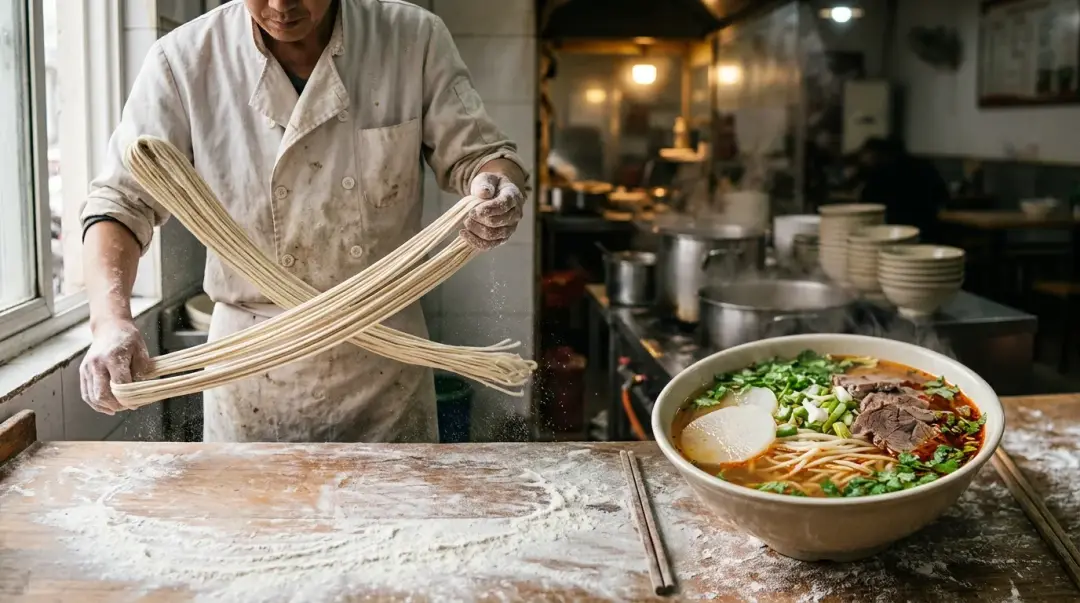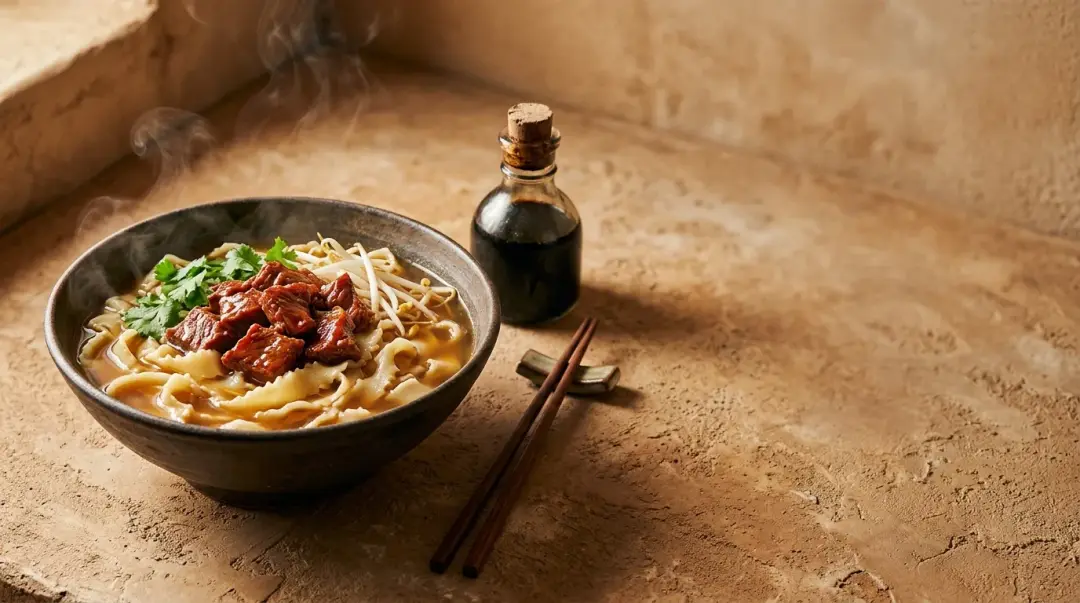
Pick up a single piece of dao xiao mian with chopsticks and turn it sideways. The cross-section is closer to a triangle than a rectangle. One long edge is thick, the other tapers to almost nothing, and the ends are ragged where the blade entered and left the dough. China Daily, describing the work of Shanxi noodle shops, says a traditional flat blade gives strands about 20 cm long with that triangular profile, while a hook-shaped knife can draw a single noodle out to 60 cm.
That shape decides how the noodle eats. The thin edge goes soft and slightly frilly in the pot. The thick side stays firm. Every bite has two textures at once, and the rough surface holds onto sauce in a way a smooth pulled noodle can't. Most of what follows is about how Shanxi cooks get that shape, and what they put on top of it.
What Is Dao Xiao Mian?
The name breaks down literally: dao (knife), xiao (to shave or pare), mian (noodle). Wikipedia describes the noodles as "ribbon-shaped, fairly thick, and chewy when cooked," usually served in broth and sometimes stir-fried.
Shanxi (shahn-shee) is the province west of Beijing. Don't confuse it with Shaanxi, its western neighbor and the home of biang biang noodles. Shanxi sits on the wheat side of China's north-south grain divide, and its kitchens are known for dough worked into dozens of shapes. A 2016 China Daily feature on Shanxi noodles describes shapes "as thick as a belt" down to "hair-like slivers," along with dough pinched into cat's ears or fish and rolled into shells.
Two cities claim them. Wikipedia's Shanxi cuisine entry says the area around Taiyuan, the provincial capital, "is especially famous for its knife-shaven noodles," and lists Datong's as a "willow-leaf-shaped noodle made by sharp sheet iron." Wikipedia's knife-cut noodle entry says the Datong style "became the most famous." In practice, Datong is the name that travels.
In 2008, China added the knife-cut noodle technique to its national intangible cultural heritage list, according to a China Daily profile of a Taiyuan noodle maker.
The Iron-Sheet Legend
Dao xiao mian's origin story is a legend, and China Daily's Datong edition gives the fullest version of it. During the Yuan dynasty (the Mongol-ruled dynasty, 1271 to 1368), the rulers confiscated metal cookware to head off rebellion, and every 10 households had to share a single kitchen knife. One day the knife was out. A man came home with a piece of sheet iron instead, and his wife, short on options, scraped the dough off a block straight into the pot with it. The noodles came out well, and the method spread across the province.
A 2016 China Daily feature puts the same story in the 12th century under Mongolian rule. A more recent China Daily piece rounds the tradition off at about 800 years. The dates vary between tellings, but the sheet iron carries through: Wikipedia still describes Datong's noodle as "made by sharp sheet iron."
How the Cut Works
Our hand-pulled vs knife-cut guide covers the basic motion and how it differs from pulling. The Shanxi-specific details are worth adding here.
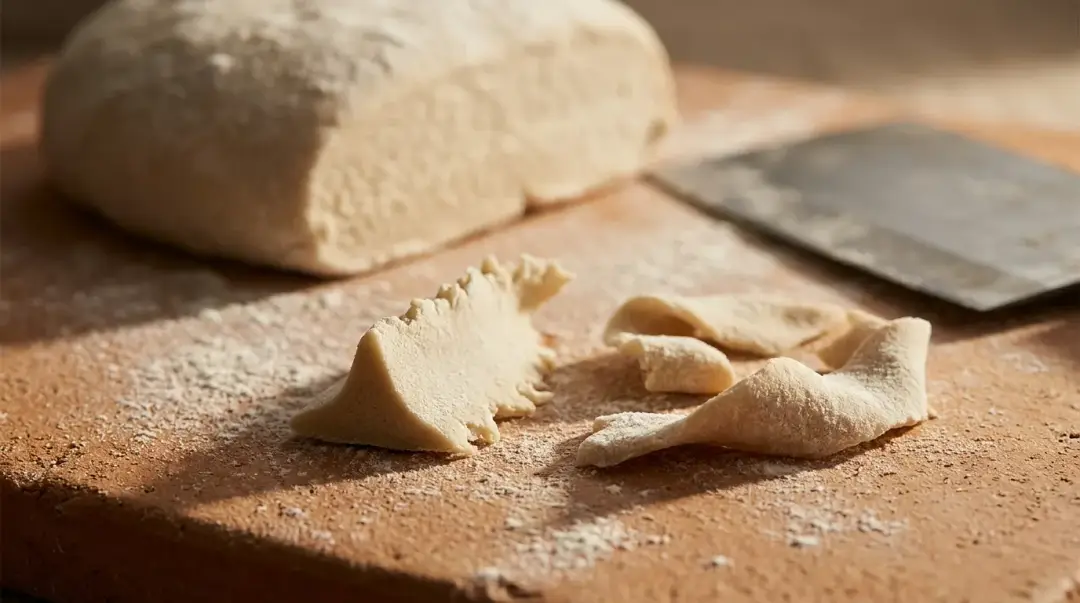
The dough is stiff. Zhao Xiping, a fifth-generation knife-cut noodle maker who trained under his father in Datong and opened his own shop in Taiyuan in 2004, gave China Daily his family's ratio as 500 grams of flour to 200 grams of water, kneaded at dawn. That's 40% hydration, well below the 50% home lamian dough in our comparison guide, and it's what lets a block sit on a cook's forearm without sagging. A separate China Daily piece describes "three kneadings and three resting periods" to push air bubbles out. Wikipedia adds that cooks work in a little oil for elasticity and chew.
The blade stays in contact with the dough. Shanghai Street Food, a guide to the city's stalls, puts the cutting angle at about 30 degrees and says "the knife always touching the dough" is what keeps the motion continuous. Speed comes with years of practice. Wikipedia and Zhao both cite about 200 strands a minute for a skilled cook.
The pot does the rest. Shavings land in rolling water and cook for roughly 5 minutes, per the same street-food guide, which is longer than a thin pulled noodle needs because of that thick spine.
Datong, Taiyuan and the Rest of the Shanxi Dough Family
Shanxi doesn't stop at one cut. Knife-shaved noodles share menus with several other shapes, and a Shanxi restaurant outside China will usually list two or three of them.
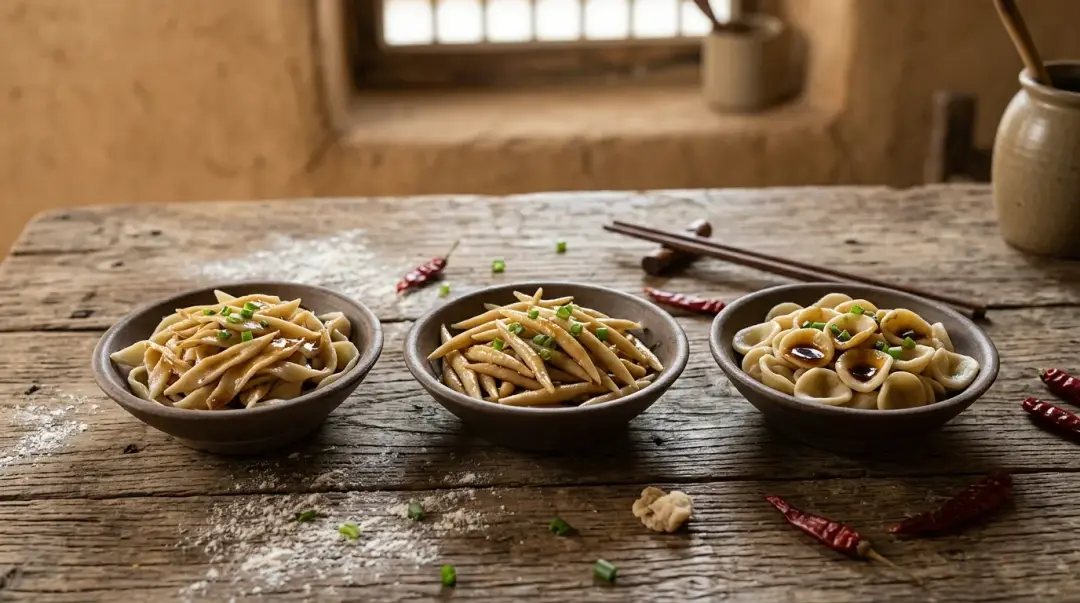
Dao xiao mian and its Shanxi relatives
| Noodle | How it is shaped | What you get | Where you will see it |
|---|---|---|---|
| Dao xiao mian (Datong style) | Shaved off a stiff block with sheet iron or a flat blade | Willow-leaf ribbons, thick spine, thin edges, about 20 cm | Datong; Lao Xi'er Noodle House, Arcadia, CA |
| Dao xiao mian (hook knife) | Drawn off the block in one long stroke | Single noodles up to about 60 cm | Taiyuan shops such as Zhao Laoqi's |
| Tijian mian (剔尖面, hand-flicked) | Dough flicked into the pot in short pieces | Short pieces, thick middle, pointed ends | Taiyuan noodle houses |
| Mao er duo (猫耳朵, cat's ear) | Dough pinched into small ear shapes | Small cupped pieces | Shanxi Noodle House, City of Industry, CA |
Tijian mian (TEE-jyen-myen) is the closest relative. A Taiyuan food guide from China Educational Tours describes cooks who "quickly flick the dough into boiling water, making noodles that are thick in the middle and thin at the ends," served with tomato-egg sauce, meat sauce or fried bean paste. The thick-middle, thin-end shape echoes a knife-cut noodle in a shorter piece.
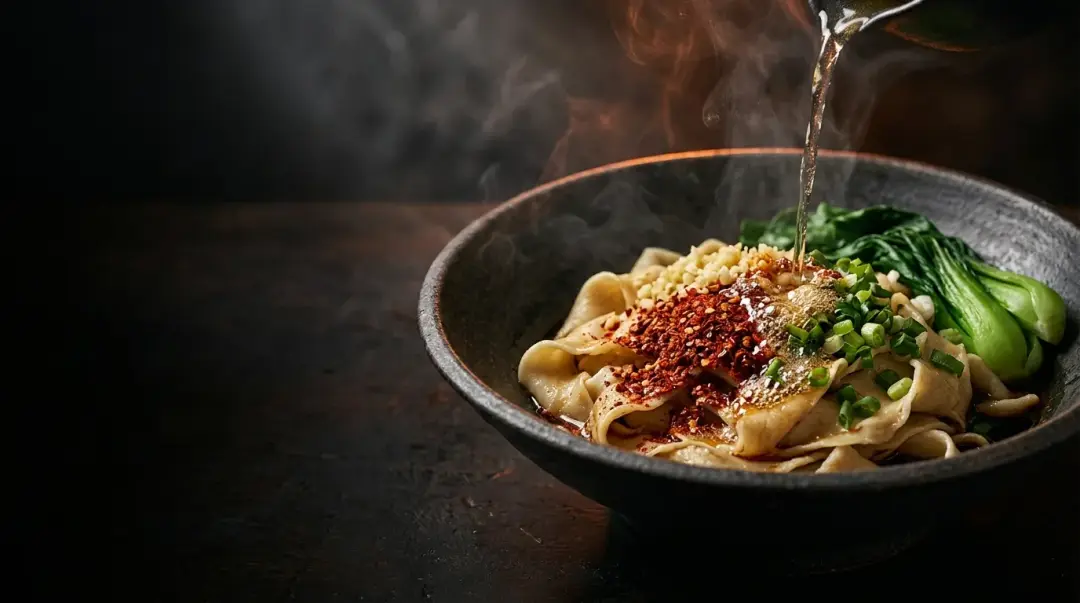
Between the two cities, Wikipedia characterizes northern Shanxi cooking, Datong's region, as putting "emphasis on colour and oil." That carries into the bowl. China Daily singles out Datong's knife-cut noodles for a red pork sauce with a sweet-savory balance and a coat of chili oil.
What Goes on Top
Shanxi cooks call the topping jiao tou (浇头, "the pour-over"), and China Daily quotes the local saying "one noodle, hundreds of ways to eat." In practice a few families of topping cover most bowls:
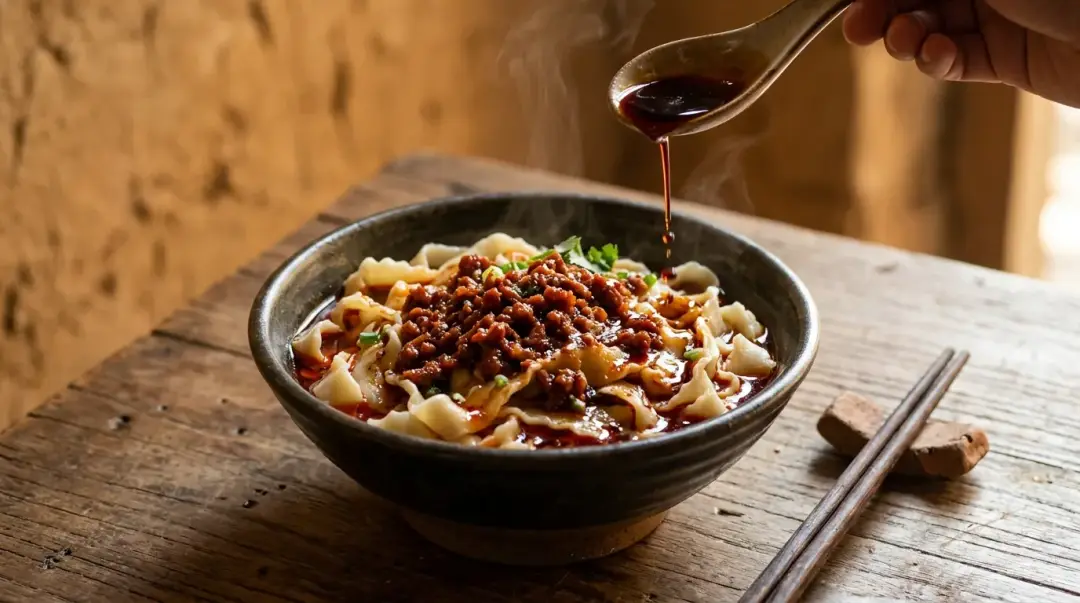
- Red-braised meat. Shanghai Street Food lists red-braised beef, mixed beef offal and pork as standard, finished with coriander and bean sprouts, at around 30 RMB a bowl in Shanghai.
- Datong red pork sauce, sweeter and oilier than most, with chili oil.
- Clear or lightly seasoned broth with sliced meat, the everyday soup bowl Wikipedia describes as the usual way to serve them.
- Stir-fried. Wikipedia notes knife-cut noodles are "sometimes fried," and some shops outside China offer them as a swap for stir-fried noodle dishes.
The constant is vinegar. Shanxi aged vinegar (老陈醋, lao chen cu) is one of China's four famous vinegars, made mainly in Qingxu County near Taiyuan, according to Wikipedia. Knife-cut bowls usually arrive with it on the table or already in the sauce. If you're stocking a pantry for northern noodles, our Chinese pantry essentials guide covers which black vinegar to buy.
Dao Xiao Mian vs Lamian
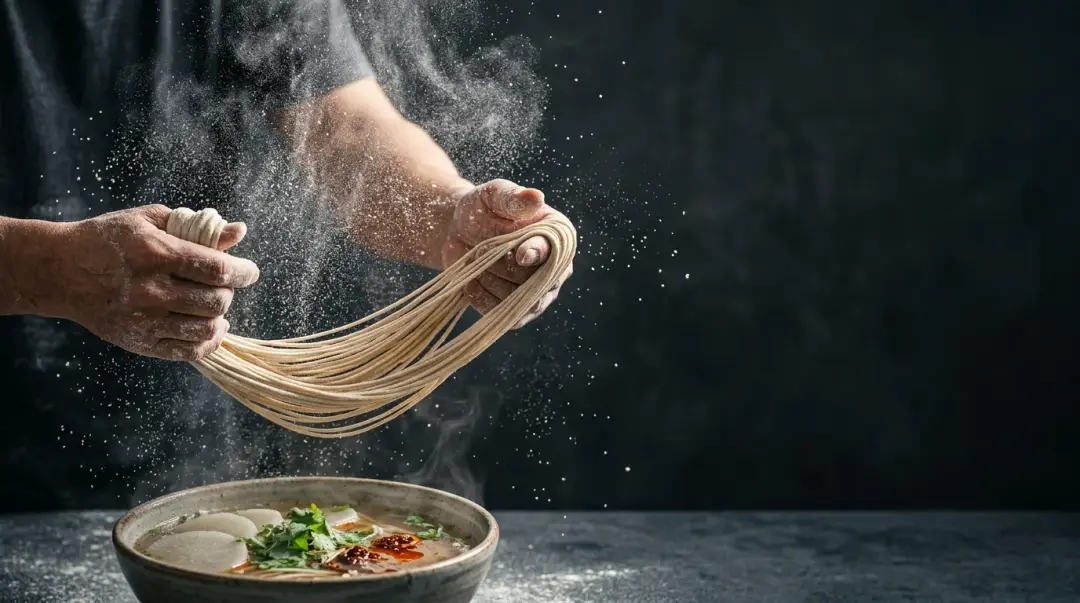
Lamian (LAH-myen) is the northern noodle most diners outside China meet first, through Lanzhou beef noodle soup. The difference is the tool. Lamian is pulled by hand from soft, alkaline dough into long, even strands that are springy and smooth. Dao xiao mian is shaved from a stiff block with a blade into short, uneven pieces that are dense and rough. Lamian suits a clear broth. Knife-cut suits a braised sauce that needs something to cling to.
Biang biang, from neighboring Shaanxi, sits between them. It's pulled like lamian but wide enough that its chew lands closer to knife-cut. The full three-way comparison, including Korean kalguksu, is in our hand-pulled vs knife-cut guide.
Where to Eat Dao Xiao Mian in the US
Knife-cut noodles are a made-to-order dish, so you're looking for restaurants, not grocery aisles. The San Gabriel Valley east of Los Angeles has the densest cluster.
- Shanxi Noodle House, 18219 Gale Ave., City of Industry, CA. LA Weekly covered it after its December 2015 opening for its imported noodle-shaving robot: about 3 feet tall, one arm, a blade like a vegetable peeler, dressed in a mannequin head and chef's hat. The menu also runs Pingyao-style marinated beef and cat's ear noodles.
- Lao Xi'er Noodle House, 600 Live Oak Ave., Arcadia, CA. The Eat the World LA blog describes its dao xiao as "wide and long meaty knife-cut noodles" with boiled pork and wood ear mushroom, with Shanxi vinegar running through the menu.
- JTYH Restaurant in Rosemead and New Mandarin Noodle Deli in Temple City, both listed by LAist for knife-cut noodles.
New York had the dish early. The Village Voice's Robert Sietsema wrote in November 2006 that a "peel noodle" had appeared at Sheng Wang, a Fujianese basement shop at 27 Eldridge Street, and that the term returned "zero Google hits." Two years later the same paper described the noodles as "band-aid-size swatches shaved from the surface," per word historian Barry Popik's archive. Outside the two coasts, search menus for "knife-cut," "knife-sliced" or "sliced noodles," and check that the restaurant is northern Chinese: a Korean menu's knife noodles are kalguksu, a different dough and method.
If you try the cut at home, the blade is the hard part: Shanxi cooks use a curved knife or a flat sheet-iron blade, and a standard Chinese cleaver is not the traditional tool. A cleaver earns its place on the other side of the bowl, slicing the braised meat, while a large board gives you room to knead the stiff dough into a block. Our Chinese wok and cleaver buying guide covers the cleaver.
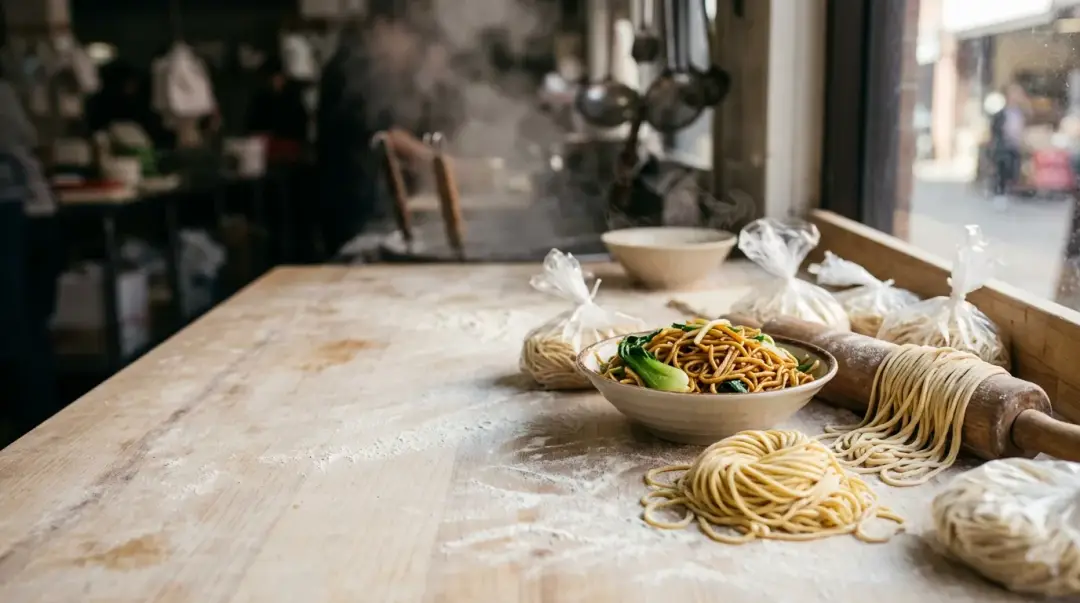
For a pantry substitute, dried "knife-cut" noodles from Taiwan's A-Sha are the most common. They're machine-made and uniform, so you get width and chew without the thin edge. Our best Chinese wheat noodles guide covers fresh and frozen options that come closer.
How to Order It
A few habits make a first visit easier at a Shanxi shop:
- Order it in broth first. The soup bowl shows the noodle itself, and you'll taste how the thin edges soften while the spine holds.
- Try one braised topping. Red-braised beef or pork is the standard pairing in Shanxi, and the rough surface is built for it.
- Ask for the vinegar if it isn't already on the table. Lao Xi'er in Arcadia builds it into several dishes; elsewhere you may need to request it.
- Eat it while it's hot. Knife-cut noodles go straight from blade to pot to bowl, and they are meant to be eaten right away.
FAQ
What is dao xiao mian?
Dao xiao mian (刀削麵) is a wheat noodle from Shanxi province in northern China. A cook holds a firm block of dough and shaves strips off it with a blade so they fall straight into boiling water. Each piece comes out thick in the middle and thin at the edges, which gives a dense, chewy bite. It is usually served in broth or under a braised meat sauce.
What does dao xiao mian mean?
Dao means knife, xiao means to shave or pare, and mian means noodle, so the name translates to knife-shaved noodles. English menus also call them knife-cut noodles, knife-sliced noodles or, in a few older New York listings, peel noodles. All of these names point to the same Shanxi technique of shaving dough into the pot.
Where are knife-cut noodles from?
Shanxi province, west of Beijing. Wikipedia names the Datong style as the best known, and the area around the provincial capital Taiyuan is also famous for them. China added the technique to its national intangible cultural heritage list in 2008, according to China Daily.
What is the difference between dao xiao mian and lamian?
Lamian is pulled: one rope of soft dough is stretched and folded until it splits into long, even strands. Dao xiao mian is shaved from a stiff block with a blade, so the pieces are shorter and uneven, with a thick spine and thin edges. Lamian is springy and smooth. Knife-cut noodles are denser and grip sauce better.
Can you buy dao xiao mian dried?
You can buy dried noodles sold as knife-cut, such as A-Sha's Taiwanese knife-cut noodles, but they are machine-made, uniform ribbons. They give a wide, chewy noodle without the thick-center, thin-edge shape of a fresh shaving. For the real texture, eat it at a restaurant where the cook shaves the dough to order.
What do you eat with knife-cut noodles?
Shanxi cooks call the toppings jiao tou, and China Daily counts them in the hundreds. Datong is known for a red, sweet-savory pork sauce. Other common bowls use red-braised beef, pork, bean sprouts and coriander in broth. Shanxi aged vinegar goes on the table with almost every version.