Hand-Pulled vs Knife-Cut Noodles Compared
· 10 min read · NoodleDex Editorial
Hand-pulled vs knife-cut noodles: how lamian is stretched, how daoxiaomian is shaved, where biang biang fits, and which texture to order at a noodle shop.
This page contains affiliate links. We may earn a commission at no extra cost to you. Disclosure
On this page(10 sections)
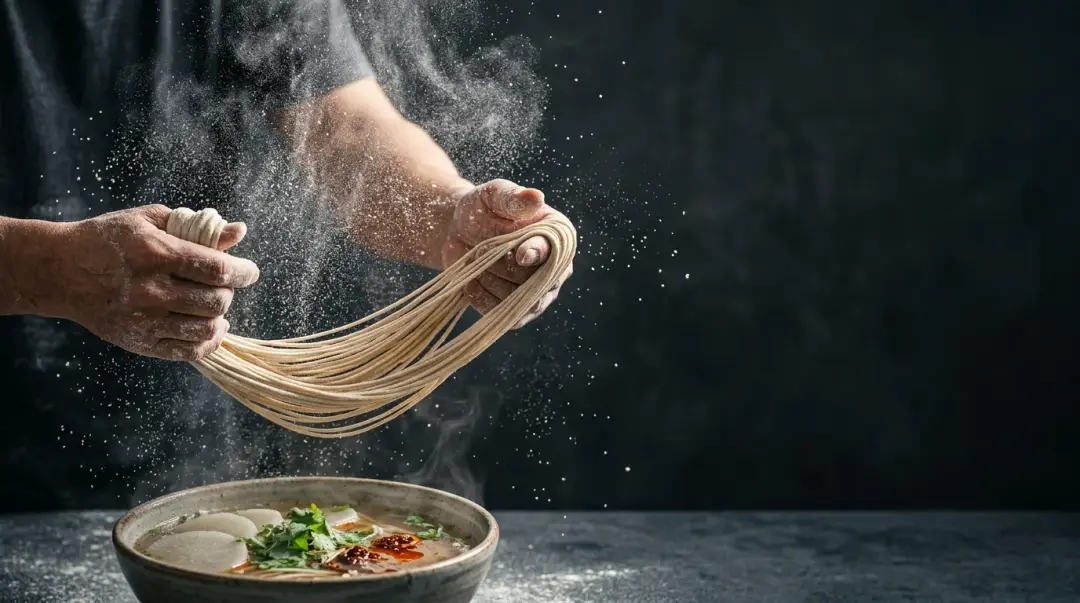
When you stretch wheat dough, two proteins do opposite jobs: glutenin makes the gluten network snap back like a rubber band, gliadin lets it extend without tearing, and a rested dough is one where gliadin is winning.
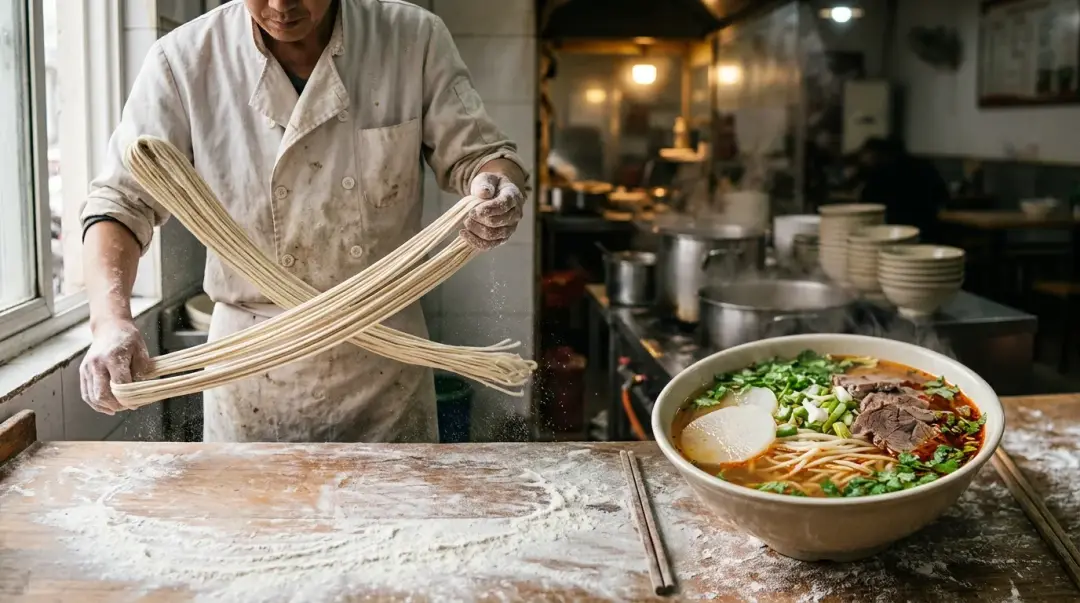
A noodle puller's whole skill is managing that balance with their hands. Rest the dough too little and it fights back and breaks. Rest it too long or make it too soft and it sags into a puddle. The cook in a Lanzhou shop window, swinging a rope of dough into a loop and then into dozens of strands, is reading that tension through their fingertips in real time. The cook at a Shanxi knife-cut station does the reverse, building a dough firm enough to stand up to a blade and then taking it apart one shaving at a time.
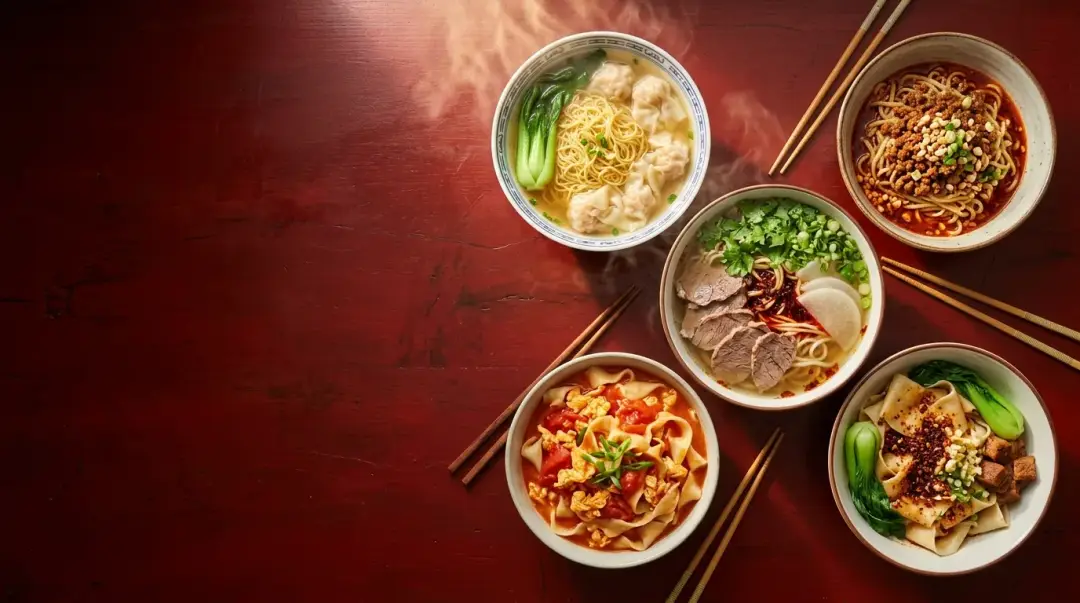
Both come from the wheat-growing north of China, both land in the same kind of bowl, and US menus often list them side by side. They aren't the same noodle, and they don't eat the same way.
Two Ways to Get a Noodle Out of Dough
Lamian (拉面, LAH-myen, "pulled noodle") starts as one piece of soft dough. Wikipedia describes the method as "twisting, stretching and folding the dough into strands, using the weight of the dough." Each stretch doubles the length of the rope while thinning it, and the cook folds it back on itself so the number of strands doubles too. How many times the dough is folded decides how thin the final strands are. The oldest known written description of the technique appears in a dietary manual from 1504, the Songshi Yangsheng Bu.
Daoxiaomian (刀削面, DOW-shyow-myen, "knife-shaved noodle") starts as a firm block. The cook holds it close to the body, often balanced on a shoulder or forearm, and slashes strips off the surface with a curved, parer-like blade so they fly straight into a pot of boiling water. Wikipedia puts a skilled cook's speed at up to 200 strands per minute. Nothing gets stretched. The blade does the shaping.
Hand-pulled vs knife-cut vs biang biang
| Lamian (hand-pulled) | Daoxiaomian (knife-cut) | Biang biang (hand-pulled, wide) | |
|---|---|---|---|
| Home region | Gansu (Lanzhou) and the northwest | Shanxi; Datong style best known | Shaanxi (Xi'an) |
| How it's shaped | Stretched and folded; strands double each fold | Shaved from a held block into boiling water | Pulled, slapped on the counter, ripped into a loop |
| Dough | Soft; Lanzhou shops add alkaline penghui | Firm, with some oil added for chew | Soft wheat dough, rested |
| Shape | Long, even strands; width chosen by diner | Short ribbons, thick middle, thin edges | Belt about 1.5 in wide, very long |
| Texture | Smooth, springy, elastic | Dense chew, rough edges | Thick, bouncy, heavy chew |
| Classic bowl | Lanzhou beef noodle soup | Broth bowls, braised meat sauces, sometimes stir-fried | Chili oil, cumin, vinegar, often lamb |
| US example | Lan Noodle, Arcadia, CA | Shanxi Noodle House, City of Industry, CA | Xi'an Famous Foods, New York |
Lamian: The Pull, Up Close
The dough for Lanzhou lamian is soft and heavily worked. Lanzhou shops add penghui (蓬灰, PUNG-hway), an alkaline agent that the recipe site Red House Spice says "makes the dough super flexible and stretchy." Wikipedia notes that in Lanzhou style the dough is "pulled in straight, quick tugs with no twisting or waving."
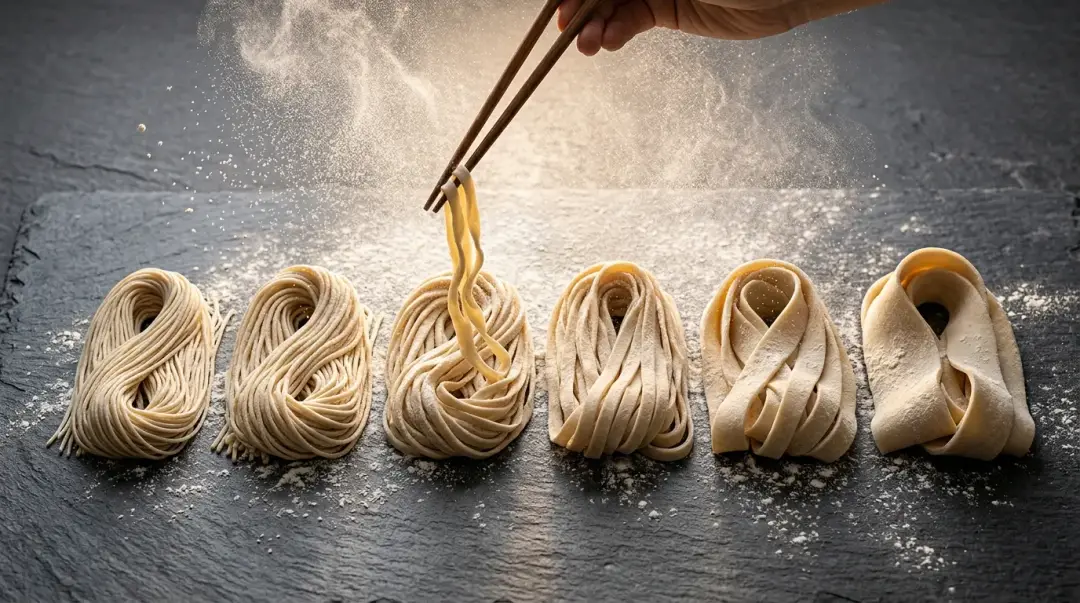
That speed is the show. At 1919 Lanzhou Beef Noodle in Arcadia, California, The Infatuation describes the noodle master "swinging long strands like a ribbon dancer." The pull happens to order, and the diner picks the width. Lanzhou shops name their widths, from hair-thin maoxi (毛细, about 1 mm) through erxi and the flat, chive-leaf-shaped jiuyezi (韭叶子) up to wide belts. Lan Noodle, also in Arcadia, offers eight shapes. 1919 Lanzhou offers seven.
The noodle that comes out is smooth and springy, with a round or neatly flat cross-section, and it cooks in about a minute. In the bowl it behaves like a long, slippery rope. It drinks in clear beef broth without going soft quickly, which is why Lanzhou beef noodle soup is its classic setting. Our lamian page covers the soup and its "one clear, two white, three red, four green, five yellow" rule for broth, radish, chili oil, herbs and noodle.
A note on names: the Japanese word ramen is borrowed from lamian, but Wikipedia's lamian entry states that the Japanese dish does not derive from it. Ramen noodles are machine-cut, and ramen's broths grew up in Japan.
Daoxiaomian: The Cut, Up Close
Knife-cut dough is the opposite of lamian dough: stiff enough to hold its shape on a cook's shoulder and survive a blade. Wikipedia notes that cooks work a little oil into it to add elasticity and chew.
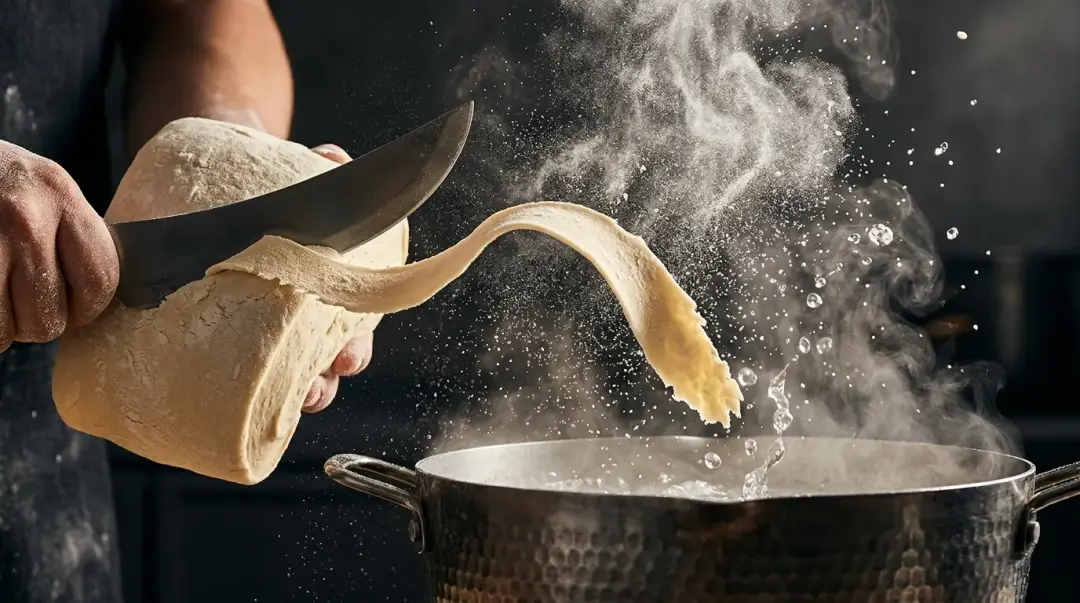
The cut is where the skill is. A chef interviewed by the South China Morning Post trained for a year in Beijing, starting at 16, and said of the technique, "It can't be orally taught." The same article describes the target shape: each strand "approximately uniform... wide and thick in the middle and slim towards the ends." That shape is the whole point. The thin edges cook soft and a little frilly, while the thick spine stays dense and chewy, so a single bite has two textures.
LAist, surveying the San Gabriel Valley outside Los Angeles, calls them "thick, rough-edged noodles" and lists several places to find them: JTYH Restaurant in Rosemead, New Mandarin Noodle Deli in Temple City, Lao Xi Noodle House in Arcadia, and Shanxi Noodle House in City of Industry, which uses a noodle-shaving robot to do the cutting.
Shanxi is also China's black vinegar province, and knife-cut bowls usually come with vinegar on the table or in the sauce. The Chinese regional noodles guide covers Shanxi's place on the north-south wheat line.
Lamian shows you the cook's skill in the window. Daoxiaomian shows it in the bowl, in every piece that's thick in the middle and thin at the edges.
Where Biang Biang Fits
Biang biang (BYAHNG byahng) is a pulled noodle, so it belongs on the lamian side of this comparison. Wikipedia describes it as made by "pulling the dough and slapping it on the table," and the slap against the counter is where the name comes from. Its written character is famous for its 58 strokes in traditional form (42 simplified) and was only added to Unicode on March 20, 2020.
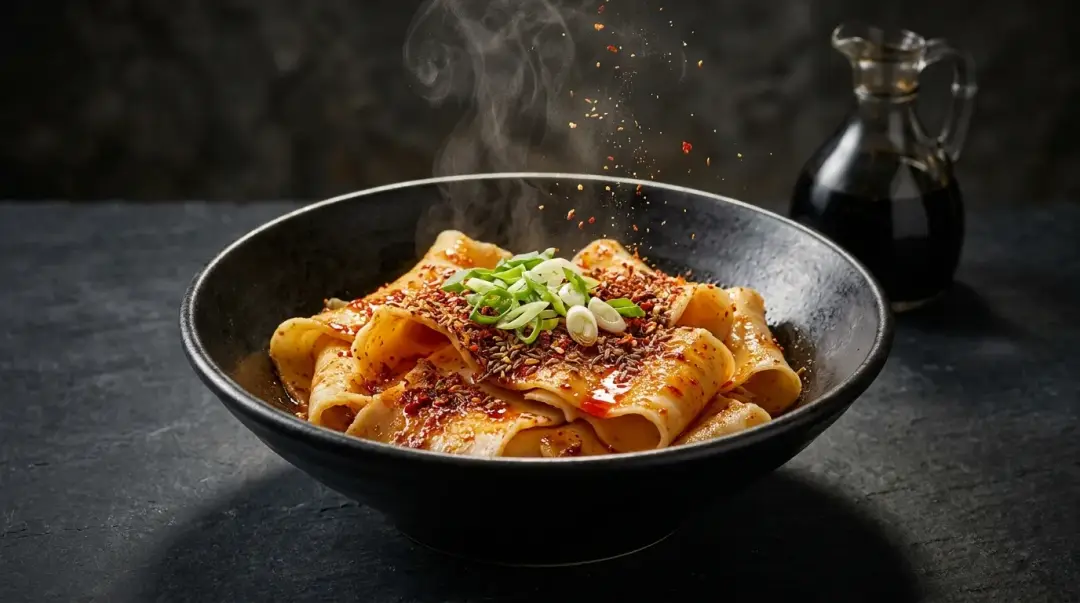
The shape is different from lamian. Jason Wang of Xi'an Famous Foods, in a method published by Food Network, starts with dough pieces about 1.5 inches wide, pulls and slaps them "until the dough is almost 4 feet long," then rips the noodle down the middle "like string cheese" without pulling all the way through, so it opens into one giant loop. His warning: "These noodles cannot sit after being pulled and are best eaten fresh."
The result is a wide belt with a heavy chew, which puts it closer to knife-cut noodles in the mouth than to thin lamian. Wikipedia notes it began as an obscure Xi'an dish for workers who didn't have time to make thinner noodles.
Xi'an Famous Foods, which Wang and his father opened in late 2005 in the basement of the Golden Shopping Mall in Flushing, Queens, had 18 locations by 2025. Its menu calls the noodles "hand-ripped," and the spicy cumin lamb version with soy and black rice vinegar sauce is the dish most New Yorkers know. Our biang biang page has the rest of the story.
Texture, Side by Side
Lamian is the springiest. Pull a strand with chopsticks and it stretches a little, then holds. The surface is smooth, so a clear broth slides off it and you taste the wheat and the alkaline edge.
Knife-cut is the densest. The pieces are shorter, each one is uneven, and the thick center fights your teeth more than any pulled strand. The rough edges hold sauce well, which is why braised meat sauces and gravy-like toppings suit them.
Biang biang is the heaviest. It's a single wide ribbon you tear with your teeth, slick with chili oil, and there's enough body that it doesn't go limp under cumin, garlic and vinegar.
Pick by what you want the noodle to do. For soup, pulled noodles in a thin or medium width. For a sauce that needs something to grip, knife-cut. For chili oil and cumin, biang biang.
Don't Confuse Daoxiaomian With Kalguksu
"Knife-cut noodles" on a US menu doesn't always mean Shanxi. Korean kalguksu (KAHL-gook-soo) also translates to "knife noodles," but the method is different: dough is rolled into a flat sheet, folded and sliced into even ribbons on a board, the way you'd cut fresh pasta. Daoxiaomian is never rolled. It's shaved off a block in midair. Kalguksu ribbons come out flat and fairly even. Daoxiaomian comes out irregular, with a thick spine. If the restaurant is Korean and the broth is anchovy and kelp, you're getting kalguksu.
Why You Can't Buy the Real Thing Dried
Both techniques make noodles that are meant to go straight into the pot. Knife-cut noodles fly off the blade into boiling water. Pulled noodles go from the puller's hands to the pot in seconds, and Wang's line about biang biang not sitting after pulling applies to lamian too.
That makes the grocery aisle a compromise. Dried noodles sold as "knife-cut," such as A-Sha's sun-dried Guanmiao noodles from Taiwan, give you a wide, wavy ribbon with a chewy bite, but they're uniform and dried, so the thick-center, thin-edge shape of a Shanxi shaving isn't there. Frozen lamian dough and meal kits get closer. Our Chinese wheat noodle buying guide covers the fresh, frozen and dried options worth stocking.
A Home Test You Can Run This Weekend
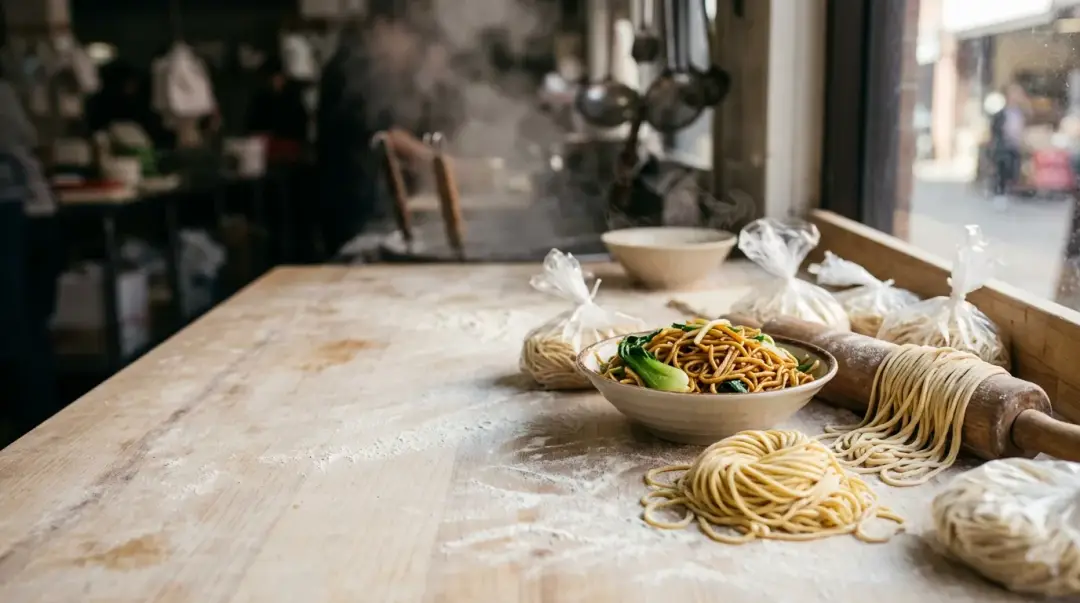
You won't pull 1 mm maoxi on your first try. You can feel the difference between pulling and cutting in one afternoon with one batch of dough.
- Make a soft dough. Use Red House Spice's ratio: 250 g of all-purpose flour, 125 ml of water and ¼ teaspoon of salt. All-purpose works better than bread flour here. The same recipe notes that high-gluten flour makes dough "shrink back and break more easily when pulled," which is glutenin winning the tug-of-war.
- Rest it under oil. Knead, rest 10 to 15 minutes, flatten, cut into strips, coat in oil and rest at least 1.5 hours. The oil keeps the strips from sticking, and the rest relaxes the gluten.
- Pull half. Hold a strip by both ends, pull gently, bounce it against the counter to help it stretch, fold and pull again. Drop it straight into boiling water. Thin noodles need about 1 minute and wide ones no more than 2.
- Cut the other half. Press the remaining strips into a compact block and shave thin slices off the edge with a sharp knife straight into the pot. Home dough is softer than a Shanxi block, so your pieces will be uneven. That's fine. A rolling pin helps with the flattening in step 2, a sharp Chinese cleaver (see our Chinese wok and tools guide) can stand in for the curved shaving blade, and a large cutting board, 24 by 18 inches or so, gives both methods room.
- Taste them side by side with a splash of black vinegar and chili oil.
Expect the pulled strands to come out springy and smooth, and the shaved pieces chewier at the center and softer at the edges. Keep a bottle of black vinegar around for the tasting; our Chinese pantry essentials guide explains which one to buy.
FAQ
What is the difference between hand-pulled and knife-cut noodles?
Hand-pulled noodles, or lamian, are stretched and folded from one piece of dough until it splits into many long, even strands. Knife-cut noodles, or daoxiaomian, are shaved off a firm block of dough straight into boiling water. Pulled noodles are smooth, round or flat, and springy. Knife-cut noodles are shorter and thicker through the middle, with thin, rough edges and a denser chew.
Which is chewier, hand-pulled or knife-cut noodles?
Knife-cut noodles usually have the heavier chew, because each piece is thick through the center and the dough is stiff enough to hold its shape under the blade. Hand-pulled noodles are springier and more elastic. Biang biang, the belt-wide pulled noodle from Shaanxi, is the exception and can be as chewy as anything a knife produces.
Are biang biang noodles hand-pulled or knife-cut?
Hand-pulled. Biang biang dough is stretched by hand and slapped against the counter, which gives the noodle its name, then ripped down the middle into a long loop. No knife is involved. The result is a belt about an inch and a half wide, wider than most lamian and thicker than most knife-cut noodles.
Is Korean kalguksu the same as Chinese knife-cut noodles?
No. Both names mean knife noodles, but kalguksu dough is rolled into a flat sheet, folded and sliced into even ribbons on a cutting board. Chinese daoxiaomian is shaved directly from a held block of dough into the pot, which gives uneven pieces with thick centers and thin edges. They taste and chew differently.
Can you make hand-pulled noodles at home?
A simple version, yes. Red House Spice's home recipe uses 250 g of all-purpose flour, 125 ml of water and a pinch of salt, rested for at least 1.5 hours under oil, then pulled one strip at a time. Lanzhou shops use an alkaline additive called penghui for much longer, thinner pulls, which takes years of practice to control.
Is lamian the origin of Japanese ramen?
The word ramen is borrowed from lamian, but Wikipedia's lamian entry states that the Japanese dish does not derive from it. Ramen noodles are cut by machine, and the dish developed its own broths and alkaline noodle style in Japan. Treat the two as related by name, with different techniques and bowls.
Read Next
Products mentioned in this guide
This section contains affiliate links. We may earn a commission at no extra cost to you.

Chinkiang Black Vinegar (Chinese, 6 oz)
Knife-cut and biang biang noodles both get a splash of black vinegar. Keep a bottle for dressing any wide wheat noodle you bring home.
View on Amazon
J.K. Adams Maple Wood Dowel Rolling Pin, 19 x 2 in, Handle-Free
The home method flattens the rested dough before it is cut into strips for pulling, and a straight, handle-free dowel presses it out evenly. This listing is a 19 x 2 in maple rolling pin with a beeswax finish.
View on Amazon
Ken Hom 7-inch Stainless Steel Cleaver with Pear Wood Handle
Shanxi cooks shave the block with a curved blade, but the home method in step 4 works with any sharp knife, and a Chinese cleaver's wide blade is one option. This listing is a general-purpose 7-inch stainless steel cleaver with a pear wood handle.
View on Amazon
Browse more related items
Opens Amazon · affiliate links
Buying guides for this topic
- Buying guideBest Chinese Wheat Noodles in 2026The best fresh and dry Chinese wheat noodles available on Amazon — Twin Marquis fresh, Wel-Pac dry, and premium hand-pulled options.
- Buying guideBest Chinese Pantry Essentials in 2026Soy, oyster sauce, Sichuan peppercorn, chili crisp, fermented bean paste, Chinese sesame paste — the Chinese cooking foundation, ranked.
- Buying guideBest Carbon Steel Wok for Home Cooks: Size and Care (2026)The best carbon steel woks for home stoves: size, flat or round bottom, hand-hammered or machine-made, and how to season one and keep it rust-free.