Barilla vs De Cecco: The Bronze Die Difference
· 10 min read · NoodleDex Editorial
Barilla vs De Cecco: De Cecco's bronze-die surface and slow drying hold sauce better; Barilla suits smooth tomato sauce. A clear pick by sauce.
This page contains affiliate links. We may earn a commission at no extra cost to you. Disclosure
On this page(14 sections)
- The Headline Difference
- Side-by-Side Comparison
- When to Choose De Cecco
- When to Choose Barilla
- What "Bronze Die" Actually Means
- Barilla Al Bronzo vs De Cecco
- A Carbonara Comparison to Run at Home
- When De Cecco Isn't Worth the Premium
- Other Italian Brands Worth Knowing
- Common Mistakes
- Where to Buy in the US
- FAQ
- If You Only Remember One Thing
- Products mentioned in this guide
De Cecco (Abruzzo, 1886) and Barilla (Parma, 1877) are the two pasta brands every US shopper recognizes — and they're built differently. De Cecco extrudes its standard line through bronze dies and dries slowly at low temperatures. Barilla extrudes most SKUs through Teflon and dries fast at high temperatures. Both make pasta you can finish in 10 minutes. Only one of them holds its sauce the way Italian restaurants expect. Here's the actual difference, and why it matters for what you cook.
The Headline Difference
De Cecco = bronze die + slow dry = better sauce adherence. Barilla = Teflon die + fast dry = smoother surface, lower price.
The bronze die is the single most important difference. When pasta dough is extruded through bronze, the bronze leaves micro-scratches across every strand. Those scratches trap sauce — they're why a properly made carbonara coats the pasta instead of pooling at the bottom of the bowl. Teflon dies produce a smoother surface, which looks prettier dry but lets sauce slide off when wet.
The drying time matters too. De Cecco dries at low temperature and lists a certified drying time for each shape (orecchiette No. 91 packs say 9 hours). Barilla doesn't publish drying times for its standard line, which is built for fast industrial output. Slow drying is gentler on the wheat's protein structure. The cooked-bite difference is real but subtle — De Cecco has a slightly chewier, more wheat-forward bite. Barilla cooks to a uniformly soft texture.
This is why Italian-American restaurants, even cheap pizzerias, almost always stock De Cecco (or Rummo, or Garofalo) — and almost never Barilla. The cost difference is real, but the sauce-adherence gap is real-er.
Side-by-Side Comparison
De Cecco vs Barilla — feature-by-feature
| Feature | De Cecco | Barilla |
|---|---|---|
| Founded | 1886 (Fara San Martino, Abruzzo) | 1877 (Parma) |
| Bronze-die extrusion | Yes — all standard SKUs | No — only the "Al Bronzo" premium line; standard SKUs are Teflon |
| Drying temperature | Low (per De Cecco) | Not published |
| Drying duration | Certified time per shape (slow) | Not published |
| Cooking time (spaghetti) | 10-12 min | 9-11 min |
| Wheat sourcing | Italian durum + select global | Italian durum + global blend |
| Texture (cooked) | Coarser surface, wheat-forward bite | Smoother, uniform soft |
| Sauce adherence | High — sauce clings | Lower — sauce can slide |
| Best for | Carbonara, ragu, arrabbiata, pesto | Smooth tomato sauce, baked pasta, lasagna |
| US availability | Whole Foods, large supermarkets, Amazon | Universal (every US grocery) |
| Country of origin (US-sold) | Italy | Italy AND Iowa (Barilla has a US plant) |
A note on Barilla US sourcing: Barilla operates plants in Ames, Iowa and Avon, New York, and most SKUs sold in the US are produced there. The packaging usually states origin. Some pasta purists prefer the Italian-produced Barilla SKUs when available — pasta marked "Made in Italy" rather than "Distributed by Barilla America".
When to Choose De Cecco
Pick De Cecco when:
- Your sauce has chunks or fat. Carbonara (guanciale, egg yolks, pecorino), ragù alla bolognese, amatriciana, arrabbiata, cacio e pepe — these sauces need a coarse pasta surface to cling to. De Cecco's bronze-die surface keeps the sauce on the pasta, not at the bottom of the bowl.
- You're cooking pesto. Pesto Genovese is mostly oil + cheese + basil + pine nuts — it has very little body to hold itself onto pasta. Bronze-die surface saves the dish.
- You're making a "dressed" pasta (aglio e olio, oil-based, garlic-and-anchovy). Same reason — the sauce needs surface area to adhere to.
- You want the closest US grocery-store match to what Italian restaurants serve. Most US Italian restaurants run on De Cecco, Rummo, or Garofalo. Of those, De Cecco is the most widely available in US grocery.
When to Choose Barilla
Pick Barilla when:
- Your sauce is smooth. Marinara, vodka sauce, simple tomato-and-basil, alfredo — these sauces have enough body to coat any surface. Bronze-die advantage diminishes; price advantage matters more.
- You're making baked pasta (lasagna, baked ziti, mac and cheese). The pasta gets bound by cheese and sauce during baking; surface texture matters less than dimensional consistency.
- You need it for a kids' meal or a quick weeknight. Barilla is universally available, cooks reliably, costs less, and produces a perfectly fine result for casual cooking.
- You can't find De Cecco. A perfectly cooked Barilla beats an overcooked De Cecco every time. Texture-of-noodle matters less than not-overcooking-the-noodle.
- You want a Whole-Grain or Protein+ SKU. Barilla's specialty lines (whole grain, protein+, plant-based) are more developed than De Cecco's; if you have specific dietary requirements, Barilla often has the SKU.
What "Bronze Die" Actually Means
You'll see this term on Italian pasta marketing constantly. Here's what it really is:
Dry pasta is extruded — dough is forced through a die (a metal plate with shaped holes) at high pressure. The die's material affects the pasta's surface texture.
- Teflon dies (PTFE-coated steel): smooth, non-stick. Extrusion is fast, easy, produces a glossy pasta surface. Cheap to use, low maintenance. Most mass-market pasta uses this.
- Bronze dies: the bronze surface is microscopically rough. When dough is extruded, it picks up that roughness — every strand of pasta has a coarse, sandy-looking surface that's invisible to the eye but visible to sauce.
Bronze dies are slower to extrude (more friction), wear out faster (need replacement), and cost more to manufacture. The pasta they produce is the same dough — same wheat, same water — but the surface is different.
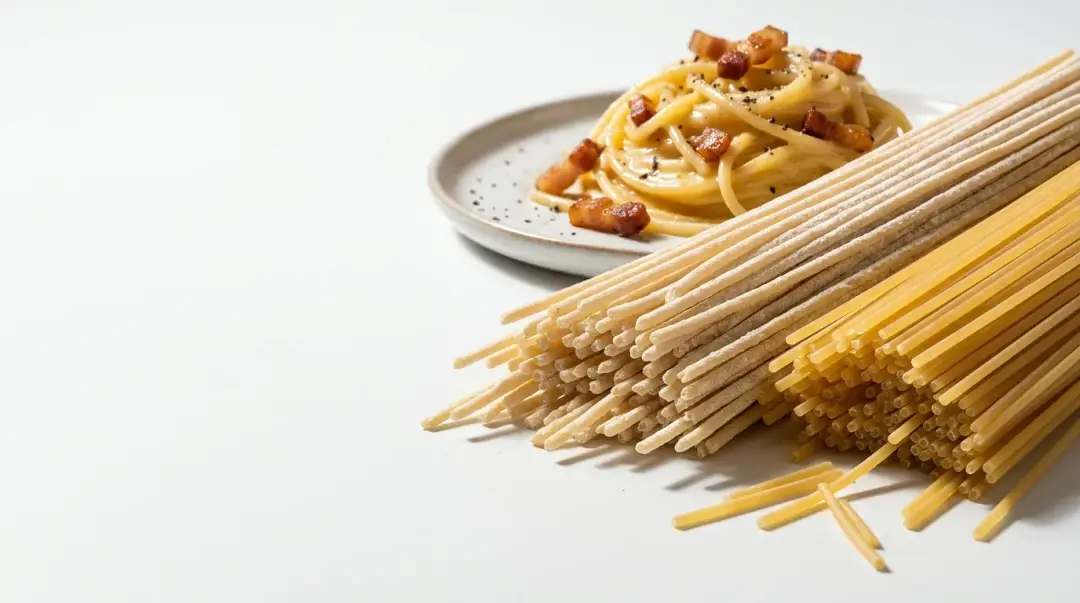
The visible test: dry pasta from bronze dies is chalky-white and matte. Dry pasta from Teflon is slightly yellow and glossy. Look at a strand of De Cecco spaghetti next to Barilla spaghetti — De Cecco looks dusted, Barilla looks polished.
Barilla Al Bronzo vs De Cecco
Barilla Al Bronzo is Barilla's answer to exactly this comparison: a separate premium line pushed through bronze dies, so its surface is rough and matte like De Cecco's rather than glossy like the blue box. On surface texture alone, the two are close, and both grip sauce far better than standard Barilla.
The remaining difference is drying. De Cecco markets every standard shape as bronze-die and slow, low-temperature dried, which is where its firmer, wheat-forward bite comes from. Barilla does not publish drying times for Al Bronzo. If sauce grip is all you want, Al Bronzo closes most of the gap; if you want the chewier bite as well, De Cecco is still the pick. Al Bronzo is easiest to find at Whole Foods, Wegmans and large supermarkets, in darker packaging than the blue box.
A Carbonara Comparison to Run at Home
If you want to see this difference yourself, the cleanest experiment is carbonara — because carbonara has no tomato or cream to mask anything. Just guanciale fat + egg yolks + pecorino + black pepper, emulsified into a sauce.
Cook the same recipe twice — once with De Cecco spaghetti, once with Barilla spaghetti. Same brand of guanciale, same eggs, same pecorino, same pan. After plating, look at the pasta surface after 30 seconds.
De Cecco: expect the sauce to coat the spaghetti uniformly, with creamy-yellow strands. Barilla: expect the sauce to begin sliding off, leaving a thin pool of egg-fat at the bottom of the bowl.
Carbonara is the cleanest way to see what "bronze die" means for sauces that depend on coating.
Two tools help here: a large pot with a strainer insert for the pasta, and a fine grater for the pecorino.
When De Cecco Isn't Worth the Premium
The sauce-adherence advantage matters most for emulsified sauces (carbonara, cacio e pepe, alfredo) and oil-based dressings (aglio e olio, pesto). It matters less for:
- Heavy ragùs that coat by sheer volume
- Smooth tomato sauces where the sauce already runs uniformly
- Baked pasta where everything binds with cheese
- Cold pasta salads where the dressing is absorbed during chilling
- Pasta soups (minestrone, pasta e fagioli) where the noodle is a starch carrier, not a sauce vehicle
For those uses, Barilla's lower price wins. There's no shame in it — Italian nonne aren't running De Cecco for every weeknight dinner either.
Other Italian Brands Worth Knowing
If you've decided you want bronze-die quality, your options aren't only De Cecco. Three other widely-available US brands:
- Rummo (Benevento, 1846): bronze-die, slow-processed Lenta Lavorazione line. Available at Whole Foods, Wegmans, online.
- Garofalo (Gragnano, 1789): bronze-die, traditional Naples region. Available at Whole Foods, larger supermarkets, Amazon. The "Pasta di Gragnano IGP" certification is rare and signals real geographic protection.
- Setaro (Torre Annunziata, 1939): smaller, premium, hard to find outside specialty Italian-American grocers.
If you can find them, Garofalo's bronze-die spaghetti is often the single best US-grocery option. Rummo's Lenta Lavorazione line is similar quality. De Cecco is the most widely available — the "if I can only get one bronze-die brand" answer.
Common Mistakes
- Overcooking De Cecco trying to hit Barilla's softer texture. De Cecco is supposed to have a firmer bite. Cook to package time, not to "I think it needs another minute."
- Buying the wrong Barilla. If you want Barilla's bronze-die experience, look specifically for Barilla Al Bronzo — the premium subline introduced in the early 2020s. Standard blue-box Barilla is Teflon-extruded.
- Using Barilla for cacio e pepe. This is the sauce that most clearly fails on Teflon-extruded pasta. The pecorino emulsion needs a coarse surface or it breaks.
- Salting the cooking water too little. This matters regardless of brand. Italian conventional wisdom is ~1 tablespoon of salt per gallon (4 liters) of water — the pasta should taste seasoned even before sauce.
- Rinsing pasta after draining. Don't, ever. The starch on the surface is what makes the sauce cling — rinsing washes it away. The only exception is pasta for cold salads.
Where to Buy in the US
Our ranked picks across De Cecco, Barilla, Rummo and Garofalo, by shape, are in best Italian pasta; if gluten is the constraint, best gluten-free pasta covers the brands that hold a bite.
De Cecco:
- Whole Foods — full line including penne, rigatoni, spaghetti, fettuccine, fusilli, orecchiette, conchiglie, paccheri. Most reliable single source.
- Wegmans, ShopRite, large East Coast supermarkets — standard SKUs, sometimes the full line.
- Amazon US — 12-pack and 16-pack bulk.
- Costco — occasionally stocks 6 lb De Cecco multi-packs. Inconsistent but worth checking.
- Italian-American specialty groceries (Eataly, Buon Italia in NYC, Borgatti's in the Bronx) — always carry the full line plus rarer Italian brands.
Barilla:
- Universal: Walmart, Target, Kroger, Safeway, Albertsons, every supermarket in the US has standard Barilla.
- Barilla Al Bronzo (the bronze-die premium line): Whole Foods, Wegmans, large supermarkets. Distinguishable by darker packaging.
- Amazon US — 12-pack and 24-pack bulk.
FAQ
Is De Cecco really worth the price difference?
For emulsified or oil-based sauces (carbonara, cacio e pepe, pesto, aglio e olio): yes. These are the sauces where the bronze-die surface matters most. For smooth tomato sauces, baked pasta, or pasta salads: probably not — the extra cost doesn't translate to a meaningfully different dish.
Is Barilla American?
Partially. Barilla is an Italian company headquartered in Parma. It operates US plants in Ames, Iowa and Avon, New York, and most SKUs sold in the US are produced there. Packaging will state origin. Some imported Italian-produced Barilla SKUs are also available, often at slightly higher price points.
What's the difference between De Cecco and the more expensive Italian brands like Rummo or Garofalo?
All three use bronze-die extrusion and slow-dry processes. Rummo's Lenta Lavorazione line and Garofalo's IGP-protected Gragnano line are arguably more refined — Rummo certifies its cooking performance through Bureau Veritas, Garofalo benefits from Naples' specific climate and water. The differences between De Cecco, Rummo, and Garofalo are subtle. The difference between any of them and standard Barilla is more pronounced.
Can I substitute De Cecco for Barilla in a recipe?
Always — they're the same dough chemistry. Adjust cooking time: De Cecco usually runs 1-2 minutes longer than Barilla for the same shape because of its slower-cooked drying.
Does the bronze die affect nutrition?
No. Bronze die is purely a surface-texture process. Macronutrients (calories, protein, carbs, fiber) are identical to Teflon-extruded pasta from the same wheat. Nutrition is determined by the durum wheat sourcing, not the die.
What about De Cecco's whole-wheat or specialty lines?
De Cecco has a limited whole-wheat line; Barilla's whole-grain, Protein+, and plant-based specialty lines are more developed. For high-protein or high-fiber needs, Barilla's specialty SKUs usually win on selection. Gluten-free is closer than it used to be: De Cecco now sells gluten-free spaghetti, linguine, penne rigate, mezzi rigatoni and fusilli in the US.
Is Barilla slow-dried?
Barilla does not market its standard blue-box line as slow-dried and does not publish its drying times. Its separate Al Bronzo line uses a bronze die for a rougher surface, but the everyday line is built for fast industrial output.
Is De Cecco bronze-cut?
Yes. De Cecco extrudes its standard line through bronze dies, which leave the rough, matte surface that helps sauce cling, and dries it slowly at low temperature, with a certified drying time for each shape (9 hours for orecchiette No. 91, for example).
Which is better, Barilla or De Cecco?
It depends on the sauce. De Cecco is better for carbonara, cacio e pepe, pesto and aglio e olio, where its bronze-die surface helps sauce cling. Barilla is the better buy for marinara, baked pasta and weeknight bowls.
Is Barilla or De Cecco better for carbonara?
De Cecco. Its bronze-die surface leaves micro-scratches that trap sauce, so a carbonara coats the pasta instead of pooling at the bottom of the bowl.
If You Only Remember One Thing
Bronze die matters when your sauce needs to cling. For carbonara, cacio e pepe, pesto, aglio e olio, and any oil-emulsion dish — De Cecco's bronze-die surface is worth the extra cost. For marinara, baked pasta, or a quick weeknight bowl with vodka sauce — Barilla's lower price wins, and the result is functionally identical. Don't pay the De Cecco premium for Barilla situations, and don't suffer Barilla texture in a carbonara.
Products mentioned in this guide
This section contains affiliate links. We may earn a commission at no extra cost to you.

De Cecco Spaghetti No. 12, 16 oz (Pack of 20)
Bronze-die, slow-dried spaghetti for carbonara, cacio e pepe and aglio e olio, where the sauce has to cling.
View on Amazon
Barilla Penne & Spaghetti Variety Pack, 16 oz Boxes (Pack of 8)
Standard blue-box Barilla for marinara, vodka sauce and baked ziti. Smooth sauces don't need the bronze-die surface.
View on Amazon
Barilla Al Bronzo Spaghetti
Barilla's bronze-die line, for anyone who wants the rougher surface without switching brands. Look for the darker box.
View on Amazon
Rummo Lenta Lavorazione Linguine No. 13 (15-pack)
If you've decided bronze die matters, Rummo is the step past De Cecco: slow-dried and firm under oil-based seafood sauces.
View on Amazon
Cook N Home 8-quart stainless steel pasta pot with strainer lid
Both brands need a roomy pot of well-salted water, and a strainer insert makes draining easy without rinsing the starch off. This is an 8-quart stainless steel set with strainer and vegetable steamer inserts and a tempered glass lid.
View on Amazon
Microplane Classic zester grater, black
Carbonara and cacio e pepe, the dishes that show the bronze-die gap, run on freshly grated pecorino. This is a 12-inch zester and grater with a photo-etched stainless steel blade and a protective cover.
View on Amazon
Browse more related items
Opens Amazon · affiliate links
Buying guides for this topic
- Buying guideBest Italian Pasta Brands in 2026De Cecco, Rummo, Garofalo, and premium bronze-die pasta brands ranked. The pasta upgrade worth making.
- Buying guideBest Gluten-Free Pasta in 2026Banza, Jovial, Tinkyada, Barilla GF — the best gluten-free pasta brands on US Amazon, ranked by texture and use case.
- Buying guideBest Pasta Maker, Extruder and Drying Rack in 2026Pasta makers compared: Marcato and Imperia hand-crank rollers, KitchenAid attachments, electric noodle machines, pasta extruders and drying racks.
- Buying guideBest Italian Pantry Essentials in 2026Tomatoes, olive oil, Parmigiano, Pecorino, anchovies, guanciale — the Italian pasta foundation, ranked.