Cup Noodles vs Bagged Ramen: Labels, Noodles and Cost
· 8 min read · NoodleDex Editorial
Cup noodles vs instant ramen bags, label by label: noodle block, cook method, calories and sodium per gram, packaging and cost tier for Nissin and Nongshim.
This page contains affiliate links. We may earn a commission at no extra cost to you. Disclosure
The Cup Was Designed Around the Noodle
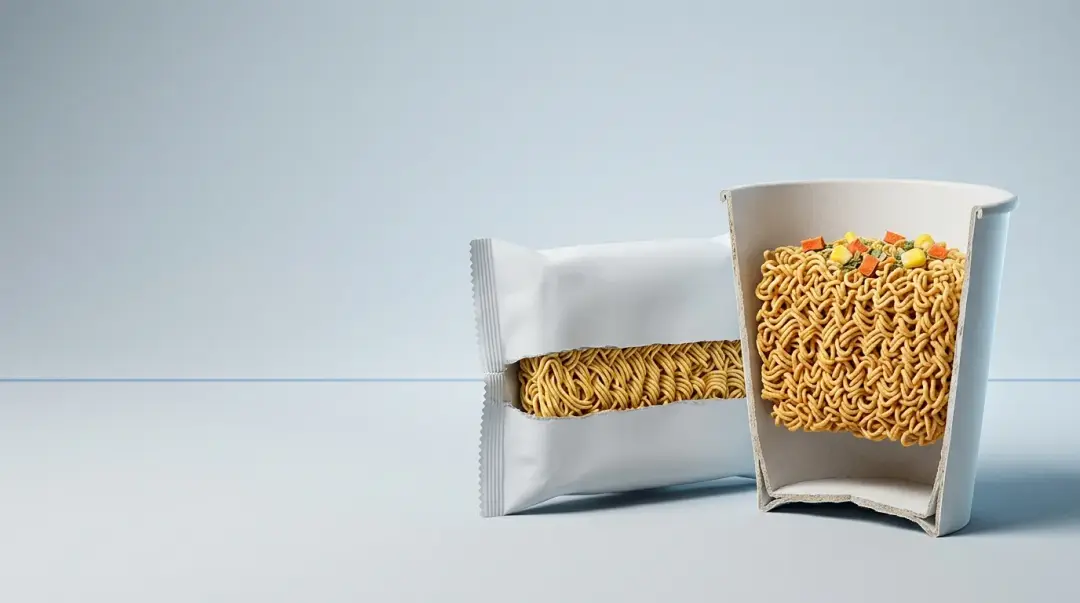
The noodle block in a cup of Nissin Cup Noodles doesn't rest on the bottom of the cup. Nissin's account of its founder says Momofuku Ando "came up with the idea of making the block of noodles larger than the bottom of the cup and suspending it in the middle of the cup." Nissin's Hong Kong site gives the reason: the noodles are "fixed firmly inside the cup and can be prevented from breaking during transportation."
Getting a wide block into a tapered cup took a second trick. Per Nissin, "the answer wasn't to drop a block of noodles into a cup, but rather to turn the block upside down and place the cup face down over it from above." The cup went over the block, and then the pair was turned right side up. Cup Noodles went on sale in Japan on September 18, 1971, and reached the US in November 1973 as Cup O'Noodles.
The Japanese Wikipedia account of the product adds two details. The hollow under the block also lets hot water circulate once you pour it in. And the block is packed densely at the top and loosely at the bottom, so it settles and separates over three minutes without stirring. A bagged block needs none of this. It goes into a pot of boiling water that does the circulating for it, and most of the other differences between the two formats follow from that.
Same Brand, Two Formats: The Labels
Here are three makers' chicken or original flavors in both formats, taken from each company's US product page. The last two columns divide by weight, which is where the formats line up. Brand-against-brand questions, such as Maruchan against Nissin, are covered in our Maruchan vs Nissin comparison; this table holds the brand constant and changes only the format.
Cup vs bag, same brand: whole package and per 100 g
| Product | Format | Net weight | Calories | Sodium | Calories per 100 g | Sodium per 100 g |
|---|---|---|---|---|---|---|
| Nissin Cup Noodles Chicken | Cup | 64 g | 290 | 1,160 mg | 453 | 1,813 mg |
| Nissin Top Ramen Chicken | Bag | 85 g | 380 | 1,590 mg | 447 | 1,871 mg |
| Maruchan Instant Lunch Chicken | Cup | 64 g | 290 | 1,150 mg | 453 | 1,797 mg |
| Maruchan Ramen Chicken | Bag | 85 g | 380 (190 × 2) | 1,520 mg (760 × 2) | 447 | 1,788 mg |
| Nongshim Shin Ramyun Cup | Cup | 75 g | 300 | 1,200 mg | 400 | 1,600 mg |
| Nongshim Shin Ramyun | Bag | 120 g | 520 | 1,620 mg | 433 | 1,350 mg |
Read across the Nissin and Maruchan rows and the cup's advantage disappears. Per 100 g, Cup Noodles and Top Ramen are 6 calories apart and within 60 mg of sodium. Maruchan's cup and bag differ by 6 calories and 9 mg. The cup reads lighter because it holds about a quarter less food. Fat follows the same pattern: Cup Noodles carries 11 g in 64 g, Top Ramen 14 g in 85 g, roughly 17 g per 100 g either way.
Shin Ramyun is the exception worth knowing. The bag is 120 g, so the cup is a much smaller meal at 75 g, and gram for gram the cup is saltier: about 1,600 mg of sodium per 100 g against 1,350 mg for the bag. A Shin cup still has less sodium in total (1,200 mg against 1,620), because you are eating less.
All six labels land at or above half the FDA's 2,300 mg Daily Value in one sitting. The cheapest sodium cut works in both formats: use half the seasoning, and leave the last of the broth. Our ramen calories guide shows how much of the salt sits in the liquid.
The Noodle: Smaller Block, Different Job
The cup noodle has to cook in water that starts cooling the moment it leaves the kettle, so its block is built for that.
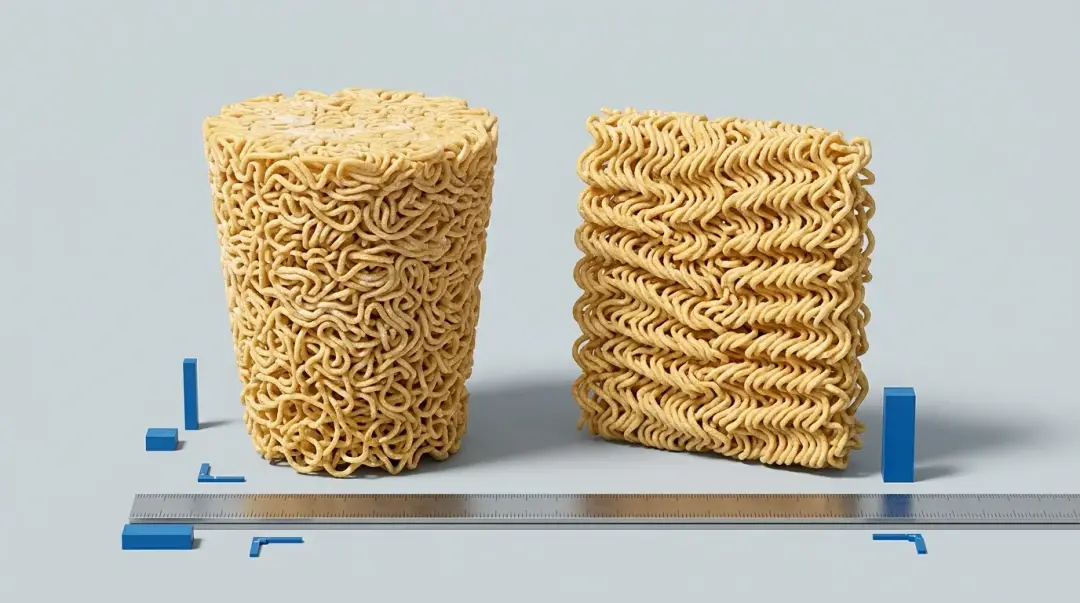
How the noodle differs between cup and bag
| Cup | Bag | |
|---|---|---|
| US block weight (Nissin chicken) | 64 g, noodle plus seasoning | 85 g, noodle plus seasoning |
| Typical weight in Japan | 60–70 g of noodle | 90–100 g of noodle |
| Block shape | Tapered, wedged mid-cup, dense on top | Flat brick |
| How it cooks | Poured hot water, or microwave in the new US paper cup | Boiled in a pot |
| Stated time | 2 min 15 sec (Cup Noodles) | 3 min (Top Ramen) |
| Extras in the package | Dried vegetables and bits of protein | Seasoning packet, sometimes a flake packet |
The Japanese figures come from Japanese Wikipedia, which notes that Cup Noodles carries 60 to 70 g of noodle against about 90 to 100 g in a standard bagged ramen. The same account says the cup block runs about 4 cm thick against roughly 3 cm for a bagged one, and that during development, ordinary frying left the center of the thicker block half raw while hotter oil burned the outside.
Strand gauge is not printed on any US label, so judge the noodle by its cook time. A bag that wants three minutes of boiling has a noodle that can take a rolling boil and stay intact, and it holds up when you crack an egg into the pot for the last minute. A cup noodle is made to soften in hot water alone. The Ramen Rater, reviewing the paper-cup version of Cup Noodles Chicken in 2024, found the noodle "a lot better than I remember. Nice and chewy," and gave it 3.5 out of 5, the same score his site gave Top Ramen Chicken in 2021.
Cook Method Decides What You Can Add
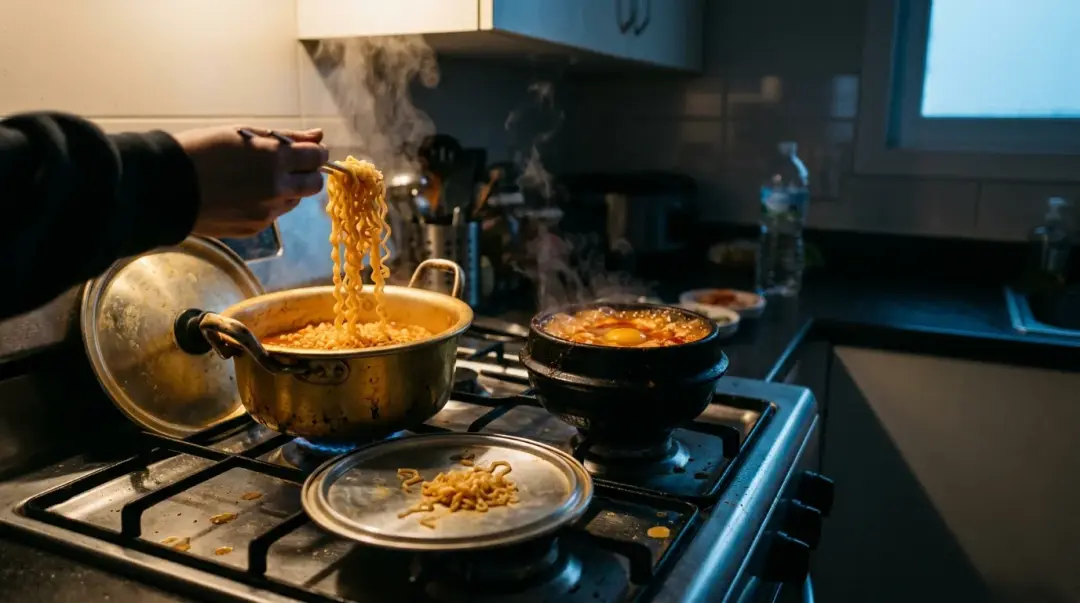
A bag of ramen is the start of a pot. You can simmer an egg in it, wilt greens, drop in frozen corn or dumplings, and stir in a spoon of gochujang (Korean chili paste) while the broth is still at a boil. Korean households cook ramyeon this way, and our Korean noodle pots guide covers the thin aluminum pot they use for it.
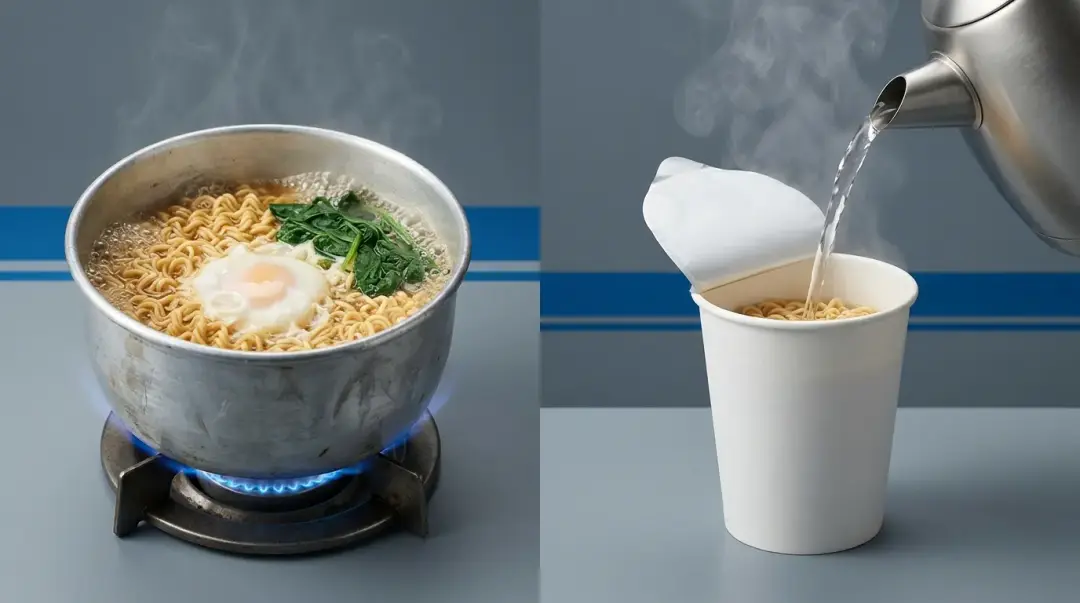
A cup is a finished meal with a kettle, and a 1.7-liter electric kettle fills several in a row. A bag asks for a small saucepan with a lid instead. You can add only what heats through in standing water: a slice of cheese, a few torn leaves of spinach, a spoon of chili crisp. Since early 2024 Nissin's US cups also go in the microwave. Nissin lists a 2:15 cook, and The Ramen Rater read the cup's directions as 2 minutes 15 seconds in the microwave and then 2 minutes standing before you stir. For a vented microwave bowl or a small electric pot, see our best ramen cookers guide.
The cup does win on one point: it comes with garnish. Cup Noodles Chicken lists dried carrot, corn and parsley. Instant Lunch lists carrot, corn, green peas, garlic, onion, celery and chive. A bag of Top Ramen or Maruchan holds noodles and a powder packet, and anything green is your job.
Packaging: Foam, Paper and a Film Pouch
For most of its US life Cup Noodles came in polystyrene foam, which Ando chose because it was light, insulated well and cost little. Japan moved the cups to paper with an insulating coating from April 2008. The US followed later: Nissin Foods USA announced a fiber-based cup on November 9, 2023, and it rolled out across flavors in early 2024. Per Nissin and Packaging Dive, the new cup uses 40 percent recycled fiber, the sleeve is 100 percent recycled paper, the clear plastic overwrap is gone, and Graphic Packaging International is the main cup supplier.
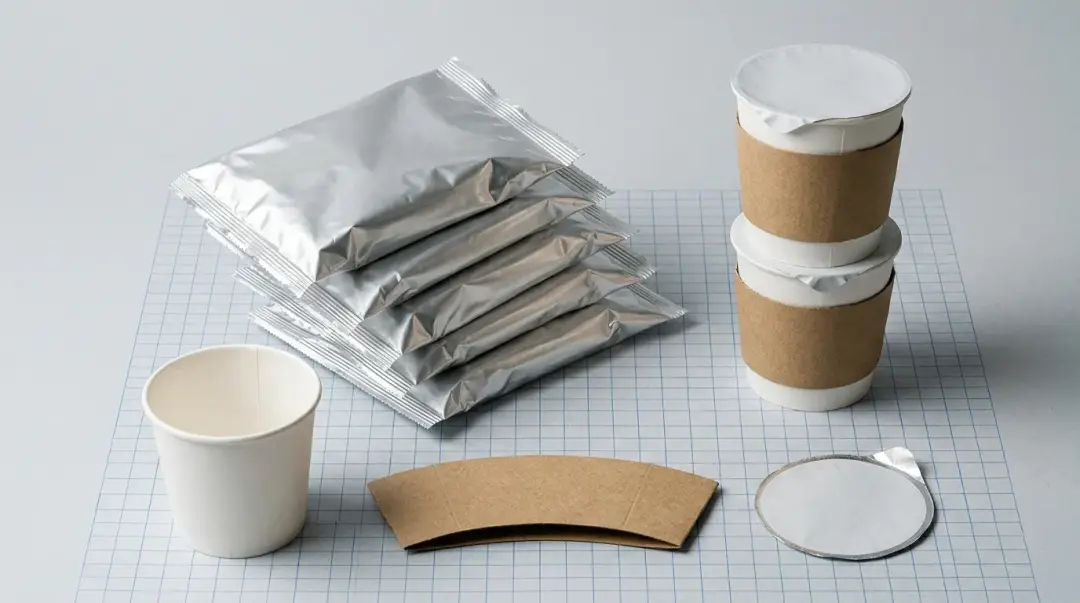
A bag is a single film pouch holding a block and one or two small packets. It packs flatter, stacks into 20- and 24-count cases, and leaves much less in the trash. Japanese Wikipedia puts the shelf life of Japanese bagged noodles at about six months at room temperature. Check the date on any multipack before you buy a case.
Cost per Serving, in Tiers
Prices change by store and week, so the pattern matters more than any one tag. The bag wins on cost per ounce for the reasons above: no cup, no lid, no sleeve, no dried vegetables, and more noodle per package.
Rough cost per serving, cheapest to priciest
| Tier | Format | What you are paying for |
|---|---|---|
| $ | Bagged ramen in 20- to 24-count cases | The largest block for the money, flat packaging |
| $ | Cup multipacks (12-count) | A smaller block plus the cup and garnish |
| $$ | Single cups at a convenience store | Convenience: hot water and a fork are all you need |
| $$ | Premium bags (Nissin RAOH, Maruchan Gold) | Non-fried or air-dried noodles in bigger packs |
| $$–$$$ | Large bowls and Korean jumbo cups | More noodle in a vessel, still with packaging cost |
On a shelf where both formats sit side by side, compare the unit price per ounce on the tag. In Japan, where bagged noodles are a mature category, Japanese Wikipedia notes that budget bags often sell for under 50 yen a serving. For better noodles than either format, see our best ramen noodles picks and the Korean instant ramyeon guide.
A Two-Shelf Plan
Most kitchens need both formats, kept in different places for different jobs.
- Desk drawer, dorm room, office: keep cups. A 12-count of Cup Noodles Chicken or Instant Lunch needs only a kettle or, since 2024, a microwave for the Nissin paper cup. Choose Instant Lunch if anyone eating it avoids egg, and check the allergen line on every new pack.
- Kitchen pantry: keep bags. A case of Top Ramen or Maruchan costs less per ounce and gives you a pot to build in. Buy Shin Ramyun bags for heat; the bag is the better buy than the Shin cup on both price and sodium per gram. Our best instant ramen guide covers which packs to stock.
- Watching sodium: either format, half the seasoning packet. The cup's lower total is a smaller portion, and per gram it is the same food.
- Road trips and camping: cups, with boiling water carried in a vacuum-insulated food jar. A bag needs a pot and a burner.
- Feeding two: two bags in one pot beats two cups. You get 170 g of noodles against 128 g, room for eggs, and one pot to wash.
FAQ
What is the difference between cup noodles and instant ramen?
Cup noodles are instant ramen sold in their own cooking vessel. The block is smaller, shaped to sit suspended in the cup and soften in poured hot water, and it usually comes with dried vegetables. Bagged ramen is a larger block meant to be boiled in a pot for about three minutes. Gram for gram, the nutrition is close.
Are cup noodles healthier than ramen packets?
Per serving they look lighter, mostly because the cup holds less. Nissin Cup Noodles Chicken is 64 g with 290 calories and 1,160 mg of sodium, while Top Ramen Chicken is 85 g with 380 calories and 1,590 mg. Per 100 g the two are within a few percent on calories and sodium. Check the label of the flavor you buy.
Can you microwave Cup Noodles?
In the US, yes, since the paper cup arrived. Nissin Foods USA announced the switch from polystyrene foam to a microwave-safe paper cup in November 2023, with all flavors moving over in early 2024. Nissin lists a 2 minute 15 second cook. Older foam cups and other brands may not be microwave safe, so read the cup.
Can you cook a ramen packet in a cup with hot water?
You can, but the bagged block is built for the pot. It is larger than a cup block and the directions call for about three minutes of boiling, so steeping it in kettle water leaves it firmer and unevenly soft. Breaking the block up, covering the bowl and giving it a couple of extra minutes helps.
Why are cup noodles more expensive than ramen packets?
You pay for the cup, the lid, the sleeve and the dried vegetables, and you get less noodle. A Nissin cup holds 64 g against 85 g in a Top Ramen bag, so even when the shelf price looks close, the cost per ounce of noodles runs higher for the cup. Compare the unit price on the shelf tag.
Why are the noodles in a cup loose at the bottom?
On purpose. Momofuku Ando made the Cup Noodles block wider than the cup's base so it wedges in the middle, which keeps it from breaking in shipping. Japanese accounts of the design add that the space underneath lets hot water circulate, and that the block is packed denser on top and looser below so it softens evenly in three minutes.
Read Next
Products mentioned in this guide
This section contains affiliate links. We may earn a commission at no extra cost to you.

Nissin Cup Noodles Chicken Flavor, 2.25 oz (12-count)
The cup this page is built around: a 64 g block suspended in a paper cup that now goes in the microwave. Keep a few where there is a kettle and no stove.
View on Amazon
Nissin Top Ramen Chicken Flavor, 3 oz (24-pack)
The bagged counterpart from the same company. A bigger 85 g block for the stovetop, and room in the pot for an egg and vegetables.
View on Amazon
Nongshim Shin Ramyun Original (20-pack)
The bag that shows the biggest cup-versus-bag gap on this page: 120 g of noodles against 75 g in the Shin cup, with less sodium per gram.
View on Amazon
Nongshim Shin Ramyun Original Cup
The Korean cup for desk lunches when you want more heat than a chicken cup. Smaller portion, lower totals, saltier gram for gram than the bag.
View on Amazon
Cosori Electric Kettle, No Plastic Contact with Water, 1.7L
A cup needs nothing but hot water, and a kettle delivers it without a stove or a pot. This listing is a 1.7 L stainless steel kettle with auto shut-off and boil-dry protection.
View on Amazon
Ciwete 2 Qt Stainless Steel Saucepan with Glass Strainer Lid
A bagged block cooks in a small pot of boiling water, and a 2-quart pan leaves room to drop in an egg or greens. This listing is a tri-ply stainless steel saucepan with a glass strainer lid, and it works on induction.
View on Amazon
Browse more related items
Opens Amazon · affiliate links
Buying guides for this topic
- Buying guideBest Ramen Noodles & Kits in 2026The best fresh and dry ramen noodles, plus premium ramen kits, available on Amazon — Sun Noodle, Hakubaku, Marusan, and Maruchan Seimen ranked.
- Buying guideBest Korean Instant Ramyeon Brands in 2026The best Korean instant ramen brands ranked — Shin, Buldak, Paldo, Ottogi compared by spice, flavor, and value.
- Buying guideBest Pots for Korean Noodles and RamyeonThe iconic yellow Korean ramyeon pot plus stoneware ddukbaegi for sundubu and stainless options — the best Korean noodle cookware on US Amazon.
- Buying guideBest Japanese Pantry Essentials in 2026The 10 Japanese pantry items needed to cook ramen, udon, soba, and yakisoba at home. Soy, dashi, mirin, miso, and yakisoba sauce, ranked.