Maruchan vs Nissin: Labels, Texture, Verdict
· 8 min read · NoodleDex Editorial
Maruchan vs Nissin, label against label: Top Ramen and Cup Noodles vs Maruchan packs and Instant Lunch on sodium, allergens, texture, range and value.
This page contains affiliate links. We may earn a commission at no extra cost to you. Disclosure
Packet vs Packet: The Chicken Labels
Put the two 3 oz chicken packets face down on a counter and read the backs. Both nutrition panels come straight from the brands' own US sites, maruchan.com and nissinfoods.com.
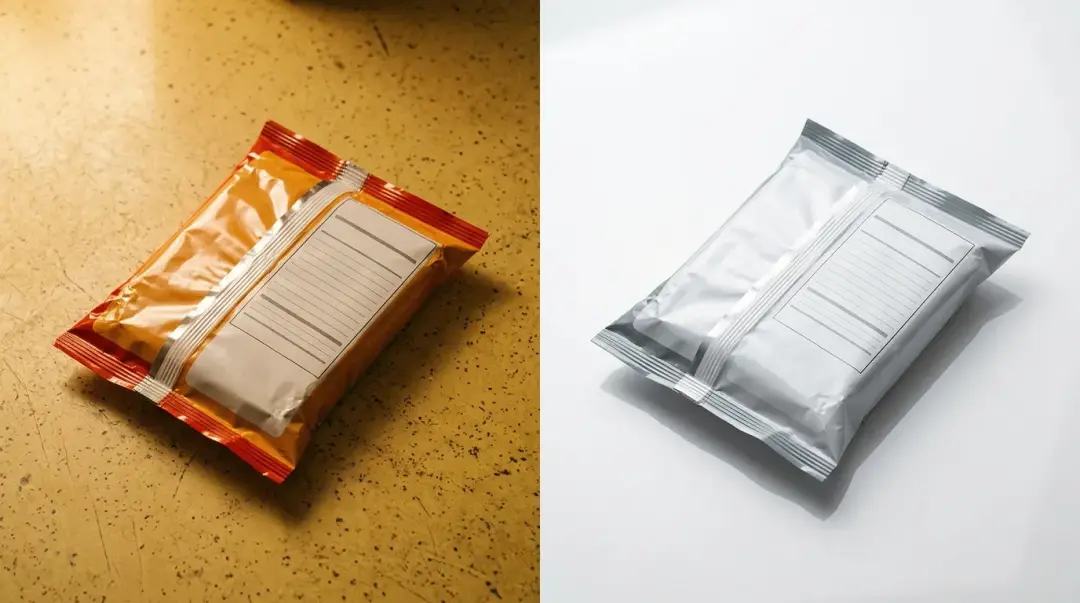
Maruchan Ramen Noodle Soup Chicken vs Nissin Top Ramen Chicken, whole 85 g package
| Label line | Maruchan Chicken | Nissin Top Ramen Chicken |
|---|---|---|
| Net weight | 3 oz (85 g) | 85 g |
| Serving printed on label | ½ block + ½ packet (43 g) | ½ package and whole package, side by side |
| Calories | 380 (190 × 2) | 380 |
| Total fat | 14 g (7 × 2) | 14 g |
| Saturated fat | 7 g (3.5 × 2) | 7 g |
| Sodium | 1,520 mg (760 × 2) | 1,590 mg (69% DV) |
| Carbohydrate | 54 g (27 × 2) | 53 g |
| Protein | 8 g (4 × 2) | 9 g |
| Frying oil | Canola, cottonseed and/or palm | Palm |
| MSG | Yes, in the soup base | No added MSG |
| Allergens | Wheat, soy, milk | Wheat, soy, egg, milk |
The first difference is not nutritional. Maruchan prints one serving as half a block with half the flavor packet, so the panel reads 190 calories and 760 mg of sodium, and you have to double it yourself. Nissin prints both columns: half a package on the left, the whole 85 g package on the right. Most people eat the whole block, which makes the Top Ramen label the more honest one at a glance. The ramen calories guide explains why that half-serving line catches so many readers out.
Once you double Maruchan's numbers, the blocks are almost twins. Calories, fat and saturated fat match exactly. Top Ramen has 1 g less carbohydrate and 1 g more protein. Sodium is the only gap worth a sentence: Maruchan comes in 70 mg lower per block, about 3% of the FDA's 2,300 mg Daily Value.
The allergen lines matter more for some readers. Top Ramen Chicken lists egg white in its ingredients and egg on its allergen statement; Maruchan's chicken packet does not list egg. Both contain milk (Maruchan's soup base lists lactose, and the company says every US product contains it), so neither is vegan.
Cup vs Cup: Instant Lunch and Cup Noodles
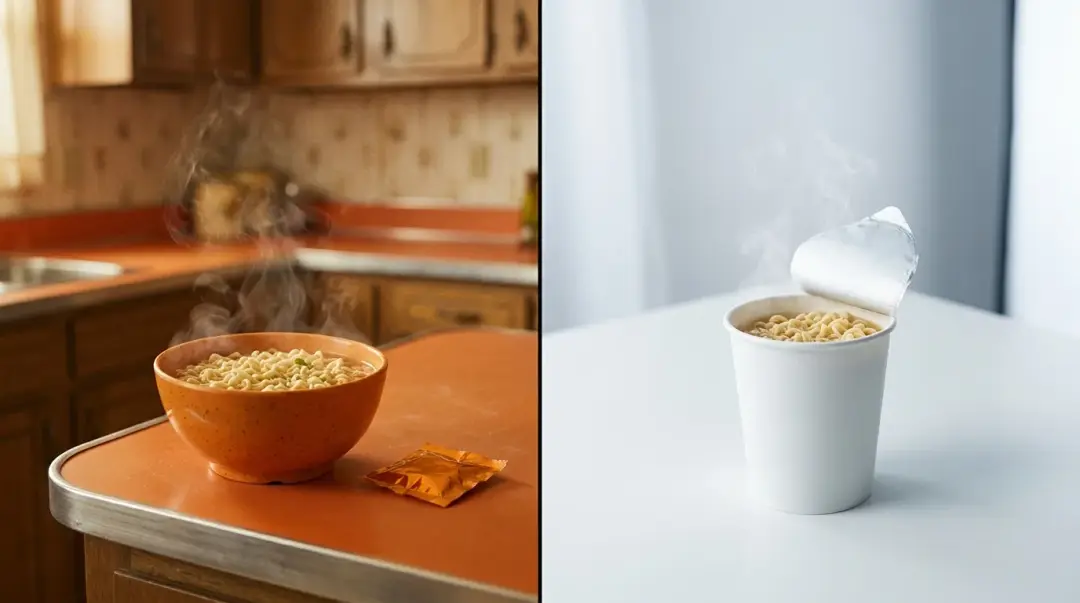
The cups are where the two companies met head on. Nissin launched Cup Noodles in Japan in 1971 and brought it to the US in November 1973 as Cup O'Noodles; Maruchan answered with Instant Lunch. Today both chicken cups weigh the same 64 g.
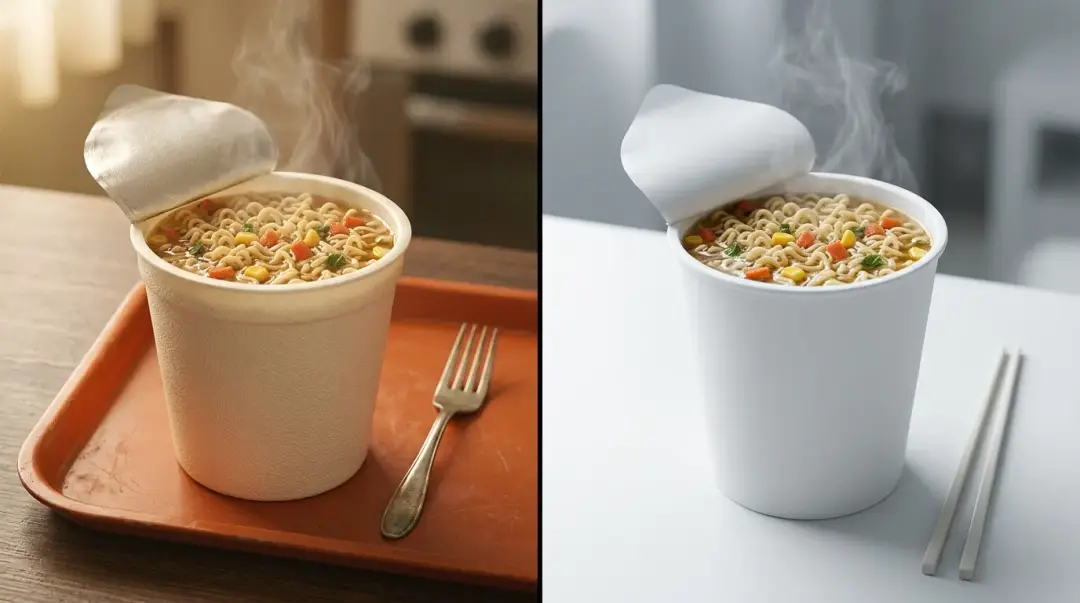
Maruchan Instant Lunch Chicken vs Nissin Cup Noodles Chicken, one 64 g cup
| Label line | Instant Lunch Chicken | Cup Noodles Chicken |
|---|---|---|
| Calories | 290 | 290 |
| Total fat | 12 g | 11 g |
| Saturated fat | 6 g (30% DV) | 5 g (25% DV) |
| Sodium | 1,150 mg (50% DV) | 1,160 mg (51% DV) |
| Carbohydrate | 39 g | 41 g |
| Protein | 6 g | 6 g |
| Dried vegetables | Carrot, corn, green peas, garlic, onion, celery, chive | Carrot, corn, parsley |
| MSG | Yes | No added MSG |
| Allergens | Wheat, soy, milk | Wheat, soy, egg, milk |
This one is closer still. Cup Noodles has a gram less fat and a gram less saturated fat; Instant Lunch has 10 mg less sodium. Instant Lunch packs a longer vegetable list, though in both cups the dried vegetables are a garnish rather than a serving. Nissin states a cook time of 2 minutes 15 seconds and uses a paper cup. On calories, fat and sodium the gaps are too small to matter over a week of desk lunches, so the egg and MSG lines decide it for people who care about either.
Noodle Texture and Frying
Both companies fry their standard blocks, which is what lets a 3 oz packet sit on a shelf and still cook in three minutes. Maruchan's noodle uses canola, cottonseed or palm oil, preserved with TBHQ; Top Ramen lists palm oil, and Nissin says it has used responsibly sourced palm oil since the end of 2016. Both doughs contain potassium carbonate and sodium carbonate, the alkaline salts Japanese makers call kansui (kahn-soo-ee), which give ramen its spring and pale yellow color.
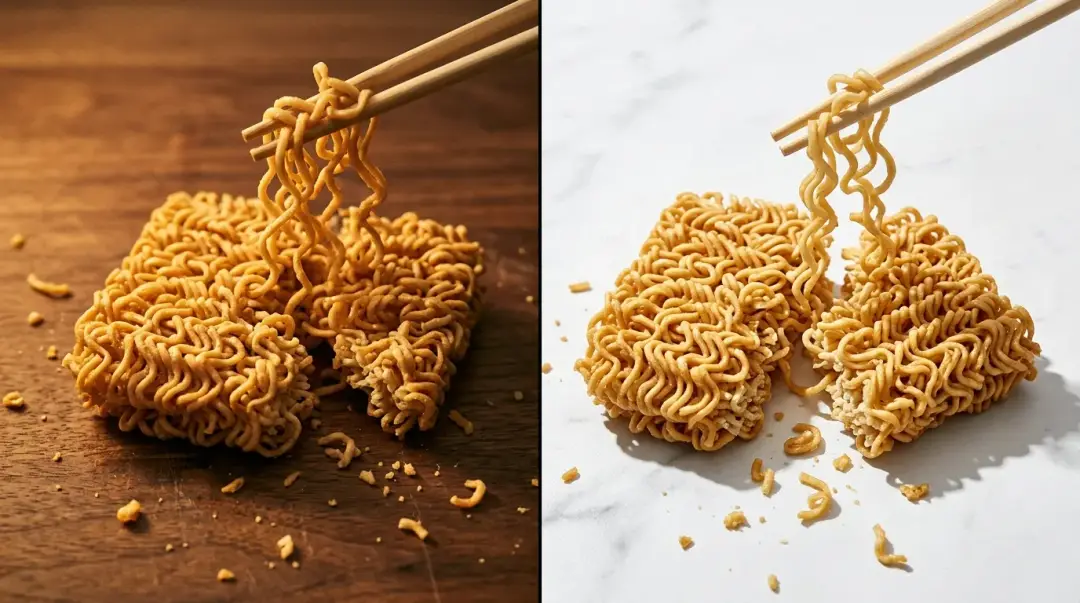
On texture, the best independent record is The Ramen Rater, a long-running review site with thousands of instant noodles rated. Its reviewer gave both chicken packets the same 3.5 out of 5 stars. Of Maruchan Chicken in 2022 he wrote that the noodle was "a nice one – thinner than I remember though," and of a 2023 anniversary pack that it had "a plump and bouncy character, yet is quite soft." Of Top Ramen Chicken in 2021 he wrote that the noodles have "a nice light chew and they slurp up broth well." Read together, the reviews describe a softer Maruchan noodle and a Top Ramen with slightly more bite. Pull either one at 2 minutes 30 seconds instead of 3 if you like a firmer noodle. A small lidded saucepan boils a single block quickly, and the cups need only hot water from a kettle.
Broth: Two Chicken Soups, Built Differently
Maruchan's chicken soup base starts with salt and sugar, then lists monosodium glutamate, hydrolyzed corn, wheat and soy proteins, celery seed, turmeric, chive, garlic, onion, lactose and powdered cooked chicken. Top Ramen's seasoning leans on rendered chicken fat and powdered chicken, with citric and succinic acid, leek flake, garlic and onion powder, and the flavor enhancers disodium guanylate and disodium inosinate in place of added MSG.
In the bowl, both read as the same idea: mild, salty, savory chicken. The Ramen Rater called the Maruchan broth "comfort food chicken flavor and then some" and Top Ramen's "a very standard chicken flavor which I find a definite comfort food." If you are sensitive to MSG, or simply prefer to avoid it, Nissin's "no added MSG" label settles the broth question; otherwise, call it a tie and add your own scallion and sesame oil.
Sodium: The Line That Decides It
Every other line on these labels is a rounding error next to sodium. A whole chicken packet uses about two-thirds of the FDA's daily limit on its own: 1,520 mg for Maruchan, 1,590 mg for Top Ramen. The cups land at roughly half.
Maruchan is the only one of the two with a reduced-sodium basic bag. Its Less Sodium Chicken pack lists 560 mg per half block, or 1,120 mg for the whole thing, 400 to 470 mg below the regular packets. We found no reduced-sodium version in Nissin's current Top Ramen range. The easier trick works on both brands: use half the seasoning packet and leave the last of the broth. Our low-sodium noodles page has better long-term options if salt is a medical concern, and your clinician can tell you what target fits you.
Range and Availability
Maruchan carries more flavors of its basics. Its US site lists 14 Ramen Noodle Soup flavors, from Chicken and Creamy Chicken to Lime Chili Shrimp and Picante Chicken, plus 13 Instant Lunch cups. Nissin lists five Top Ramen bag flavors (Chicken, Beef, Shrimp, Soy Sauce and Chili) and five Cup Noodles, including Spicy Birria Beef and Spicy Jalapeño Chicken.
Nissin goes deeper at the edges. It has a dedicated spicy range, Hot & Spicy, with a liquid chili sauce packet, and a premium non-fried line called RAOH. Maruchan's premium answer is Gold, air-dried, sold in the US since 2019.
Premium lines: Maruchan Gold vs Nissin RAOH, soy sauce flavor
| Maruchan Gold Soy Sauce | Nissin RAOH Soy Sauce | |
|---|---|---|
| Noodle | Air-dried | Non-fried, triple-layered |
| Package | 3.79 oz (107.5 g) | 107 g serving |
| Calories | 360 per pack (180 × 2) | 350 |
| Sodium | 2,180 mg per pack (1,090 × 2) | 2,400 mg |
| Other flavors | Spicy Miso, Spicy Tonkotsu, Spicy Creamy Chicken | Tonkotsu |
On shelves, both are easy. Walmart sells single packs, 24-count cases and cup 12-packs of both brands, plus RAOH and Gold. A Costco price tracker lists Top Ramen chicken bowls in 12-counts and Instant Lunch in 24-cup packs, though stock varies by warehouse. Nissin's store locator also names Kroger, Albertsons, H-E-B, Meijer, BJ's, WinCo, Weis, Stop & Shop, Giant Food and Hy-Vee. For more Japanese and Korean packs worth buying alongside these two, see our best ramen noodles guide.
The Verdict, Use by Use
As a cheap base for add-ins, buy Maruchan Chicken. It matches Top Ramen on calories, carries slightly less sodium, and its softer noodle takes an egg, frozen vegetables and a spoon of chili crisp well. If you are watching sodium, step down to Maruchan Less Sodium Chicken at about 1,120 mg per block, and use half the seasoning if you can live with it.
For the desk drawer or the dorm, Cup Noodles Chicken wins narrowly on its paper cup, its slightly lower fat and the absence of added MSG. Switch to Instant Lunch if anyone eating it avoids egg; on the current chicken labels, Maruchan is the egg-free choice in both formats, though an allergy means checking every new pack.
For heat, Nissin Hot & Spicy is the better buy, because it ships with its own liquid chili sauce. As a step toward a ramen-shop bowl, Gold and RAOH split the vote: Gold has less sodium per pack and four flavors, RAOH has a non-spicy tonkotsu. Buy one of each. The Nissin brand page covers RAOH and the rest of Nissin's US range, and the Maruchan brand page does the same for Gold, Yakisoba and the cups. For packs from other brands, see our best instant ramen guide.
Scorecard
| Category | Winner | Why |
|---|---|---|
| Packet calories | Tie | 380 per block for both |
| Packet sodium | Maruchan | 1,520 mg vs 1,590 mg per block |
| Reduced-sodium option | Maruchan | Less Sodium Chicken, ~1,120 mg per block |
| Label clarity | Nissin | Prints half and whole package side by side |
| Egg-free (chicken flavors) | Maruchan | No egg on the allergen line |
| No added MSG | Nissin | Top Ramen, Cup Noodles and Hot & Spicy |
| Cup nutrition | Nissin, narrowly | 1 g less fat and sat fat; sodium within 10 mg |
| Noodle bite | Nissin | Firmer chew in independent reviews |
| Flavor range (basics) | Maruchan | 14 bag and 13 cup flavors |
| Spicy line | Nissin | Dedicated Hot & Spicy range with chili sauce |
| Premium line | Tie | Gold has less sodium; RAOH has a non-spicy tonkotsu |
| Overall | Maruchan for packets, Nissin for cups | Margins are small on both |
FAQ
Which is better, Maruchan or Top Ramen?
For the basic chicken packet, Maruchan wins narrowly. Both 3 oz blocks come to 380 calories, but Maruchan has 1,520 mg of sodium per block against Top Ramen's 1,590 mg, no egg on its allergen line and 14 flavors against five. Top Ramen is the pick if you want no added MSG or a label that shows whole-package numbers.
Is Maruchan or Top Ramen healthier?
Neither is a health food, and the gap is small. The chicken packets match on calories (380), fat (14 g) and saturated fat (7 g) per block. Maruchan has 70 mg less sodium per block, and its Less Sodium Chicken drops to about 1,120 mg. Top Ramen has a gram more protein. Using half the seasoning helps more than switching brands.
Maruchan Instant Lunch vs Cup Noodles: which cup is better?
They are almost the same on paper: both are 64 g and 290 calories, with 1,150 mg of sodium for Instant Lunch and 1,160 mg for Cup Noodles. Cup Noodles edges ahead with a gram less fat, a paper cup and no added MSG. Instant Lunch is the one to buy if you avoid egg or want more flavors.
Are Maruchan and Nissin the same company?
No. Maruchan belongs to Toyo Suisan, a Tokyo company founded in 1953. Nissin Foods Holdings is based in Osaka, traces its founding to 1948 and invented instant ramen in 1958. Both are Japanese, both make their US products in American factories, and they compete directly in US supermarkets.
Which has more sodium, Maruchan or Nissin?
Nissin, by a small margin, in the chicken packets: Top Ramen Chicken lists 1,590 mg per package and Maruchan Chicken works out to 1,520 mg per block. In the cups the difference is 10 mg. Both use most of the FDA's 2,300 mg Daily Value in a single serving with all the broth.
Do Maruchan or Nissin noodles contain egg?
Nissin's Top Ramen Chicken and Cup Noodles Chicken list egg among their allergens; Top Ramen's ingredients include egg white. Maruchan's chicken packet and chicken Instant Lunch list wheat, soy and milk but not egg. Formulas change, so read the allergen statement on the pack you buy, especially for an allergy.
Read Next
Products mentioned in this guide
This section contains affiliate links. We may earn a commission at no extra cost to you.

Maruchan Ramen Noodle Soup, Chicken Flavor, 3 oz (24-pack)
Our packet pick: slightly less sodium than Top Ramen, no egg on the allergen line and 14 flavors to rotate through.
View on Amazon
Nissin Top Ramen Chicken Flavor, 3 oz (24-pack)
The packet to buy if you want no added MSG and a label that prints whole-package numbers next to the half-package ones.
View on Amazon
Nissin Cup Noodles Chicken Flavor, 2.25 oz (12-count)
Our cup pick by a nose: same calories as Instant Lunch, a gram less fat, a paper cup and a stated 2:15 cook time.
View on Amazon
Maruchan Instant Lunch, Chicken Flavor, 2.25 oz (12-pack)
The cup for people avoiding egg, or for anyone who wants more flavor choice: Maruchan lists 13 Instant Lunch varieties.
View on Amazon
Ciwete 2 Qt Stainless Steel Saucepan with Glass Strainer Lid
A 3 oz block fits a small pot, and a lid keeps the water at a boil so you can pull the noodles at 2 minutes 30 seconds. This is a 2-quart tri-ply stainless steel saucepan with a glass strainer lid, listed as induction compatible.
View on Amazon
Cosori Electric Kettle, 1.7L, Stainless Steel Interior
Cup Noodles and Instant Lunch need only hot water, so a kettle replaces the stove at a desk or in a dorm. This 1.7-liter kettle has a stainless steel interior, a wide opening and auto shut-off.
View on Amazon
Browse more related items
Opens Amazon · affiliate links
Buying guides for this topic
- Buying guideBest Ramen Noodles & Kits in 2026The best fresh and dry ramen noodles, plus premium ramen kits, available on Amazon — Sun Noodle, Hakubaku, Marusan, and Maruchan Seimen ranked.
- Buying guideBest Korean Instant Ramyeon Brands in 2026The best Korean instant ramen brands ranked — Shin, Buldak, Paldo, Ottogi compared by spice, flavor, and value.
- Buying guideBest Japanese Pantry Essentials in 2026The 10 Japanese pantry items needed to cook ramen, udon, soba, and yakisoba at home. Soy, dashi, mirin, miso, and yakisoba sauce, ranked.