Ramen Calories: Restaurant Bowls vs Instant (2026)
· 8 min read · NoodleDex Editorial
Ramen calories, built bowl by bowl: noodles, broth, oil, chashu and egg, plus the real label math for Maruchan, Top Ramen and Shin Ramyun, and sodium.
This page contains affiliate links. We may earn a commission at no extra cost to you. Disclosure
Build the Bowl: A Tonkotsu Calorie Ledger
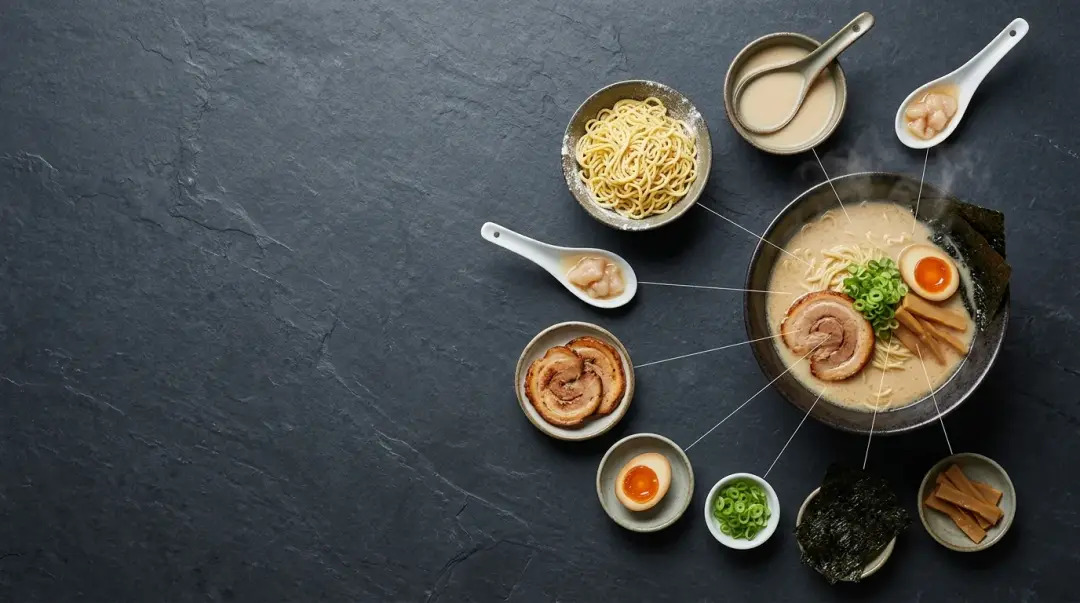
Ramen (RAH-men) calories make more sense when you add them up one ladle at a time. Here is a restaurant tonkotsu (tohn-KOH-tsoo, pork-bone broth) bowl built component by component, with a running total. Each figure comes from Japan's official food composition tables (MEXT), USDA FoodData Central, or published shop data. Where a component varies by shop, you get a range.
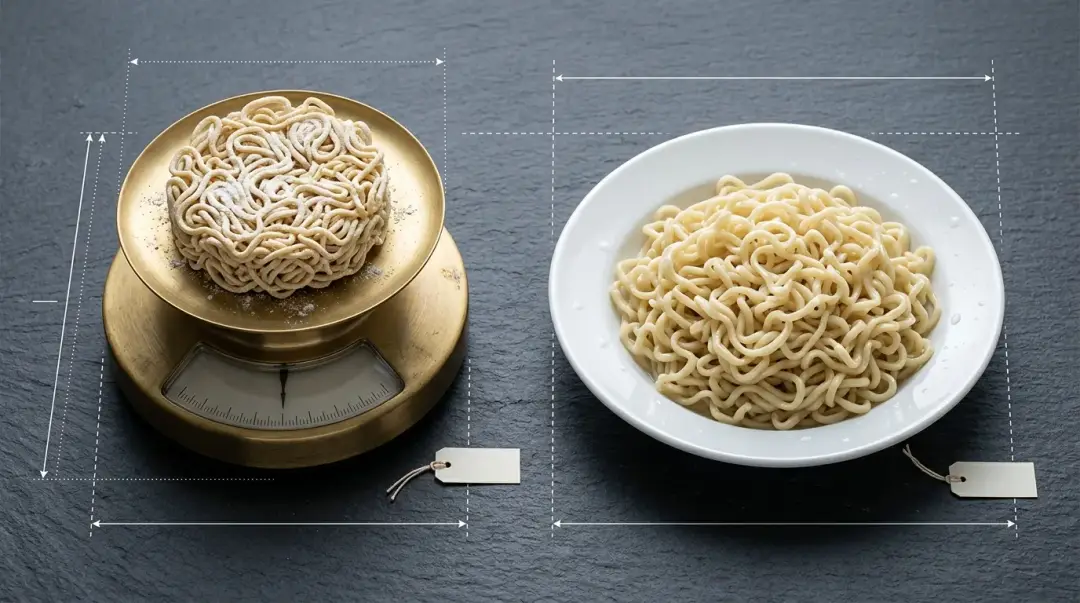
Restaurant tonkotsu ramen, built one component at a time
| Component | Typical amount | Calories | Running total |
|---|---|---|---|
| Noodles | 120–130 g raw (one portion) | ~300–325 kcal | ~300–325 |
| Broth + tare | Full bowl of soup | ~150–300 kcal | ~450–625 |
| Aroma oil or back fat | 1 tbsp lard-type fat | ~115 kcal | ~565–740 |
| Chashu | 2 slices | Under 40 to ~300 kcal | ~600–1,040 |
| Ajitama (marinated egg) | 1 large egg | ~78–80 kcal | ~680–1,120 |
| Scallion, nori, menma | Garnish | A few kcal to low tens | ~700–1,150 |
Noodles: about 300 kcal
Ramen noodles are chūka men (中華麺, "Chinese noodles"), wheat noodles made springy with alkaline salts. MEXT lists them at 249 kcal per 100 g raw and 133 kcal per 100 g boiled; they nearly double in weight in the pot. A retail portion in Japan weighs 120 to 130 g raw, and 120 g raw boils up to about 226 g. That is roughly 300 to 325 kcal before anything else goes in the bowl.
Broth and tare: 150 to 300 kcal
Tare (tah-reh) is the concentrated seasoning, usually soy-, salt- or miso-based, spooned into the empty bowl before the broth. It is light on calories (USDA puts a tablespoon of soy sauce at 8 kcal) and heavy on salt (879 mg in that same tablespoon). The broth carries the calories. A dietitian-reviewed Japanese estimate built on the MEXT tables puts the soup portion of a typical bowl at 150 to 300 kcal, and tonkotsu, with its pork fat emulsified into the liquid by hours of hard boiling, belongs at the upper end. Our broth philosophy guide explains why the boil matters.
Aroma oil: about 115 kcal per spoon
Many shops finish the bowl with a flavored fat: garlic oil, chicken fat, or seabura (背脂, pork back fat) shaken over the top. USDA lists lard at 115 kcal per tablespoon, a fair stand-in for a pork-fat spoon. Some bowls get none and some get two.
Chashu: the widest range
Chashu (chah-shoo) is braised or roasted pork, and the cut decides the count. A thin slice of lean pork comes in under 20 kcal by the Japanese estimate. Raw pork belly is 147 kcal per ounce per USDA, and braising renders off part of that fat, so two thick belly slices can still approach 300.
Egg: about 78 kcal
A marinated soft-boiled egg, ajitama (味玉), works out to about 78 kcal per 50 g of egg using USDA's 155 kcal per 100 g for hard-boiled egg, close to the Japanese estimate of about 80 for a soft-boiled one. The soy marinade adds salt more than calories.
Garnishes: close to zero
Scallions, a sheet of nori and a few strips of menma (fermented bamboo shoot) barely register.
The total, 700 to 1,150 kcal, lines up with what shops publish. In Japan, Kourakuen lists its shoyu-style chūka soba at 697 kcal and Tenkaippin lists its thick kotteri bowl at 949 kcal. Large US tonkotsu bowls with extra chashu and back fat run higher still, past the top of our ledger.
The 250-calorie gap between Kourakuen's basic bowl and Tenkaippin's kotteri comes from the same lines in the table, scaled up. A larger noodle portion, a fattier broth, a spoon or two of finishing fat and thick belly chashu each add a few hundred calories or less on their own, and together they stack. When a shop doesn't publish its numbers, the ledger is a reasonable way to estimate: count the noodles at about 300 per portion, then look at how much fat is floating on the broth and how much pork is on top.
Instant Ramen: The Half-Packet Trap
Instant ramen labels are short, but they have one trap: the serving size. Several brands define a serving as half a packet, even though almost nobody cooks half a block of noodles. Here are three labels, taken from the manufacturers' own product pages.
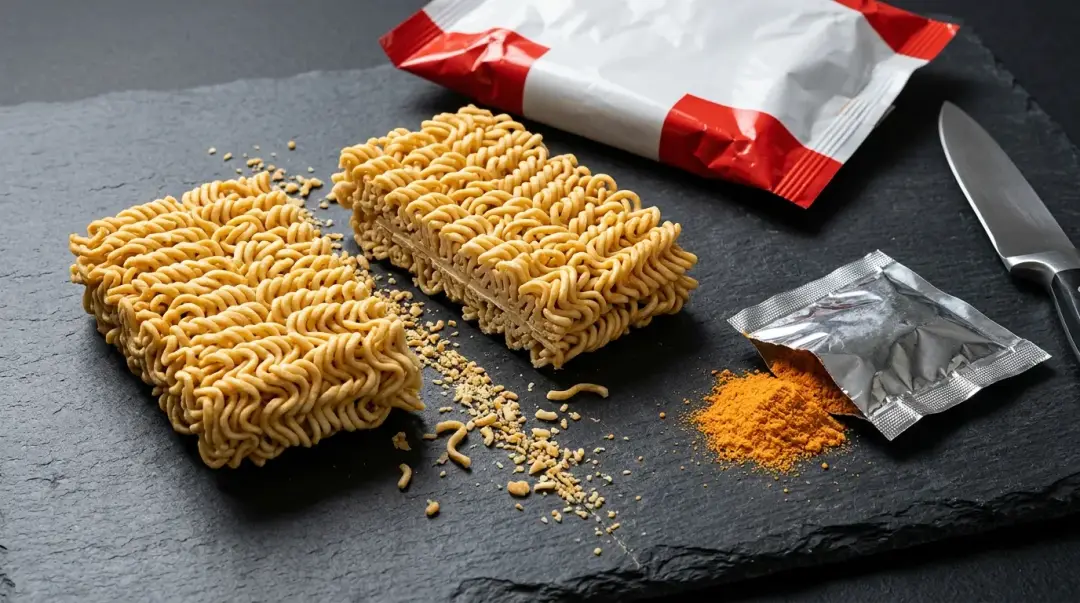
Instant ramen labels: per serving vs per packet
| Product | Label serving | Calories (serving / packet) | Sodium (serving / packet) |
|---|---|---|---|
| Maruchan Ramen Chicken (3 oz) | ½ block + ½ packet (43 g) | 190 / 380 | 760 mg / 1,520 mg |
| Nissin Top Ramen Chicken (85 g) | Dual column: ½ package and whole | 190 / 380 | 790 mg / 1,590 mg |
| Nongshim Shin Ramyun (bag) | ½ bag (60 g), 2 per bag | 260 / 520 | 810 mg / 1,620 mg |
Maruchan prints only the half-block serving, so the per-packet figures above are that serving doubled. Top Ramen prints both columns side by side, which makes the math easy. Shin Ramyun lists two servings per bag and gives both numbers.
Most instant blocks are fried in oil during manufacturing (Top Ramen lists palm oil among its ingredients), which is why a 3 oz packet lands at 380 kcal with 14 g of fat (Top Ramen's figure) while the same weight of fresh ramen noodles is lower. Korean ramyeon (라면, the Korean take on instant ramen) runs a bit larger per bag; Shin's 120 g bag explains its 520 kcal. If you are comparing brands, our Korean instant ramyeon picks list the main contenders, and our best instant ramen guide ranks mainstream packs by use.
Sodium and the Broth Question
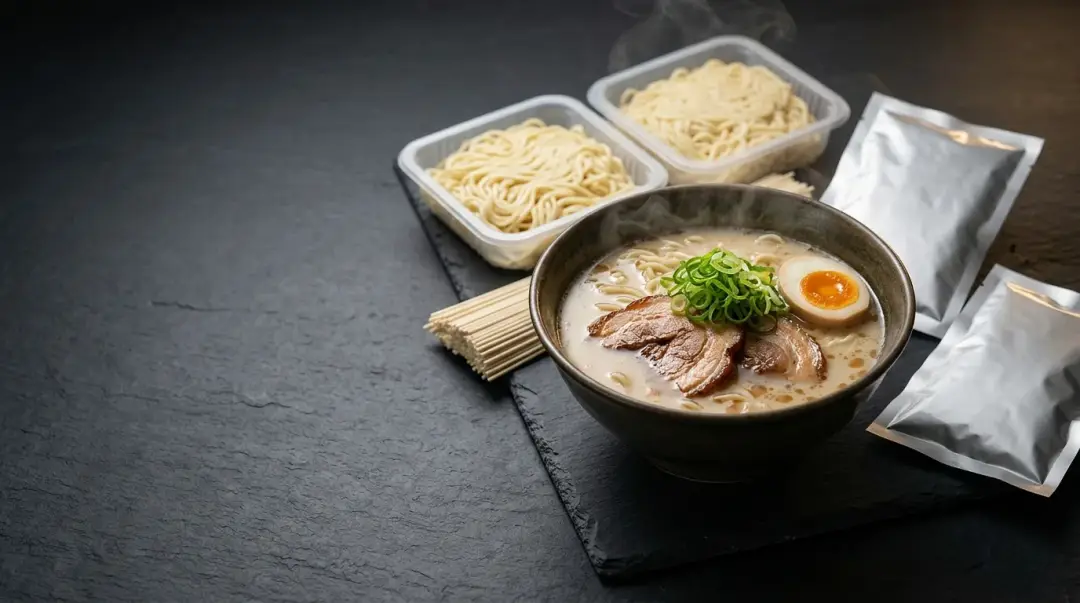
Calories get the headlines, but sodium is the number that stands out on a ramen label. The FDA's Daily Value for sodium is less than 2,300 mg, and Americans already average about 3,400 mg a day. One full packet of any of the three instant brands above uses up roughly two-thirds of the Daily Value: 1,520 to 1,620 mg. Fresh ramen kits can run higher. Sun Noodle's miso ramen kit lists 2,650 mg of sodium for one 192 g package with its soup base.
Where does it sit? Mostly in the liquid. MEXT puts raw ramen noodles at 410 mg of sodium per 100 g and boiled noodles at just 70 mg, because the salt in the dough leaches into the cooking water. The tare and broth carry most of what is left. That makes broth the single biggest lever on both numbers. The Japanese estimate above puts the soup at 150 to 300 kcal, and leaving it behind also leaves most of the salt in the bowl.
For noodles that start low, see our low-sodium noodles guide. If you manage blood pressure, kidney disease or another condition with a sodium or calorie target, talk to your clinician about what fits; this page is general information.
Six Ways to Trim a Bowl
None of these change the dish beyond recognition. Each one comes with the number it moves.
- Leave the broth, or most of it. That saves up to 150–300 kcal plus the bulk of the sodium, and drinking half is a reasonable middle path.
- Ask for no aroma oil or no seabura. One tablespoon of lard-type fat is about 115 kcal.
- Choose a lighter broth. Tenkaippin's clear assari bowl is 490 kcal against 949 for its kotteri, and a dietitian-reviewed estimate puts a basic shio (salt-seasoned) bowl around 450 kcal versus about 500 for tonkotsu.
- Pick lean chashu, or keep it to one slice. An ounce of raw pork belly is 147 kcal per USDA; a thin lean slice is under 20.
- Add an egg instead of ordering kaedama (替え玉, kah-eh-dah-mah), the extra noodle portion many shops sell once your bowl is empty. A second 120 g raw portion adds about 300 kcal; an egg adds about 78.
- Halve the instant packet, or its seasoning. Half a block of Maruchan or Top Ramen is 190 kcal, and using half the seasoning cuts the sodium that comes with it. Fresh vegetables or tofu fill the bowl back out.
If you cook at home, fresh noodles and your own broth give you control over every line of the ledger. A digital scale with 1 g readings turns the 120 g noodle portion into a real number, and deli containers let you freeze broth in single bowls so the soup portion stays measured. Our best ramen noodles guide covers fresh and dried noodles that hold up in a homemade bowl, and our tsukemen page covers the dipping style, where you choose how much concentrated broth each bite picks up.
Calorie Cheat Sheet
Approximate per-bowl ranges, taken from the labels and published shop figures above. Portions vary by shop, so treat these as a starting point.
| Bowl type | Approx. kcal | Basis |
|---|---|---|
| Instant packet, label serving (½ packet) | 190–260 | Maruchan, Top Ramen, Shin Ramyun labels |
| Instant packet, whole | 380–520 | Same labels, full packet |
| Basic shio bowl | ~450 | Japanese estimate built on MEXT tables |
| Light, clear broth (assari) | ~490 | Tenkaippin assari |
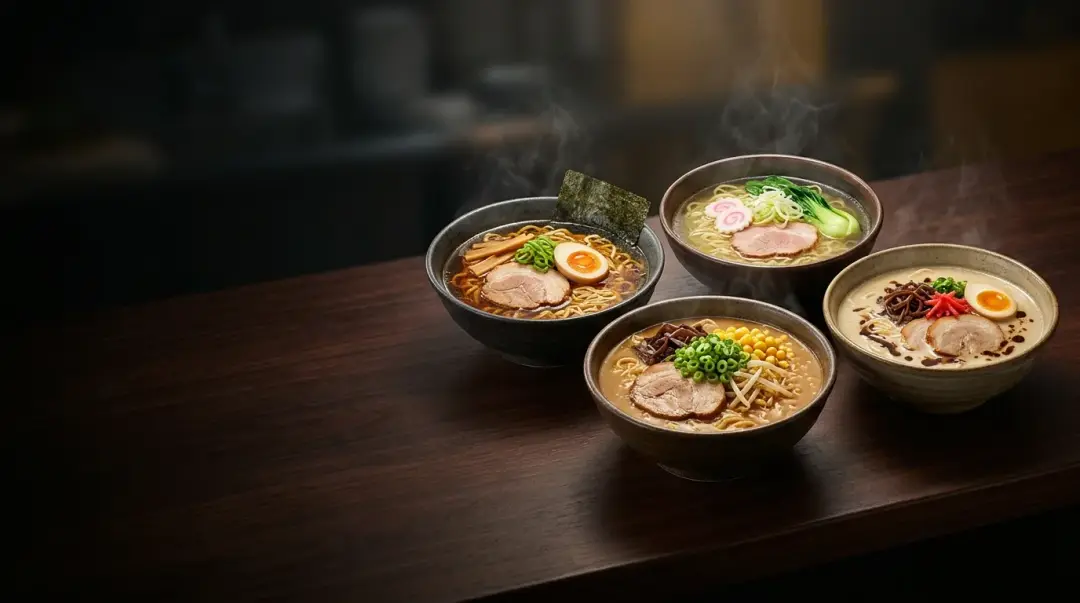
| Shoyu / chūka soba at a Japanese chain | ~690–700 | Hidakaya 688, Kourakuen 697 |
| Miso ramen at a Japanese chain | ~850 | Kourakuen 854 |
| Rich, thick broth (kotteri) | ~950 | Tenkaippin kotteri 949 |
| Soupless ramen (shirunashi) | ~1,050 | Hidakaya 1,049 |
| US restaurant tonkotsu, full toppings | ~1,100–1,300 | Ledger estimate, large portion |
FAQ
How many calories are in a bowl of ramen?
It depends on the style and the shop. Published chain figures in Japan run from about 690 kcal for a basic shoyu bowl to 949 kcal for Tenkaippin's thick kotteri bowl. A large US-style tonkotsu bowl with full toppings can pass 1,200 kcal. A whole packet of instant ramen lands between 380 and 520 kcal on the labels we checked.
How many calories are in instant ramen?
A full packet of Maruchan Chicken or Nissin Top Ramen Chicken is 380 kcal, and a full bag of Shin Ramyun is 520 kcal. Watch the serving line: Maruchan and Shin list half a packet as one serving, so the big number on the front of the panel is only half of what most people eat.
How many calories are in tonkotsu ramen?
A restaurant tonkotsu bowl usually lands somewhere between 800 and 1,300 kcal, with the big US-style bowls at the top of that range. The pork-bone broth carries emulsified fat, and shops often add an aroma oil or pork back fat on top, which is why tonkotsu sits above shoyu and shio.
Does drinking the broth add a lot of calories?
Yes. A Japanese dietitian-reviewed estimate puts the soup at roughly 150 to 300 kcal of a typical bowl, so leaving it saves that much. It also saves most of the sodium, since boiled ramen noodles hold only about 70 mg of sodium per 100 g. The tare and broth carry the rest.
How much sodium is in ramen?
A lot. Shin Ramyun lists 1,620 mg per bag, Top Ramen Chicken 1,590 mg per package, and Maruchan Chicken works out to 1,520 mg per block. The FDA Daily Value is under 2,300 mg, so one packet with all its broth uses up most of a day's limit.
How can I make ramen healthier?
Leave most of the broth, skip the extra spoon of fat, choose a shio or shoyu bowl over a rich tonkotsu, and add an egg or vegetables instead of an extra noodle portion. For instant packets, use half the seasoning. If you manage a medical condition, ask your clinician what targets make sense for you.
Read Next
Products mentioned in this guide
This section contains affiliate links. We may earn a commission at no extra cost to you.

Nongshim Shin Ramyun Original (20-pack)
The 520-calorie bag from the label table above. Read the two-servings-per-bag line before you count it, and try half the soup packet to cut sodium.
View on Amazon
Maruchan Ramen Noodle Soup, Chicken Flavor
The classic 3 oz block behind the half-packet trap on this page. Using half the seasoning is the simplest way to bring its sodium down.
View on Amazon
Nissin Top Ramen Chicken Flavor
Top Ramen prints both the half-package and whole-package columns, so it is the easiest instant label to read honestly.
View on Amazon
Hakubaku Organic Ramen Noodles, 9.5 OZ
Dried noodles with no frying step and no seasoning packet, so you control the broth, fat and salt line by line. A good base for a lighter homemade bowl.
View on Amazon
Etekcity Food Kitchen Scale, Digital Grams and Ounces, 11 lb
The ledger above counts noodles by the gram, and weighing a 120 g portion makes your own total accurate. This scale reads to 1 g, holds up to 11 lb, has a tare function and switches between grams and ounces.
View on Amazon
GUSTO 32 oz Plastic Deli Containers with Lids, 24 Sets
Portioning broth into single servings makes it easy to measure how much soup goes in a bowl, and to freeze the rest. This listing is 24 plastic 32 oz containers with lids, described as microwave, dishwasher and freezer safe.
View on Amazon
Buying guides for this topic
- Buying guideBest Ramen Noodles & Kits in 2026The best fresh and dry ramen noodles, plus premium ramen kits, available on Amazon — Sun Noodle, Hakubaku, Marusan, and Maruchan Seimen ranked.
- Buying guideBest Korean Instant Ramyeon Brands in 2026The best Korean instant ramen brands ranked — Shin, Buldak, Paldo, Ottogi compared by spice, flavor, and value.
- Buying guideBest Japanese Pantry Essentials in 2026The 10 Japanese pantry items needed to cook ramen, udon, soba, and yakisoba at home. Soy, dashi, mirin, miso, and yakisoba sauce, ranked.