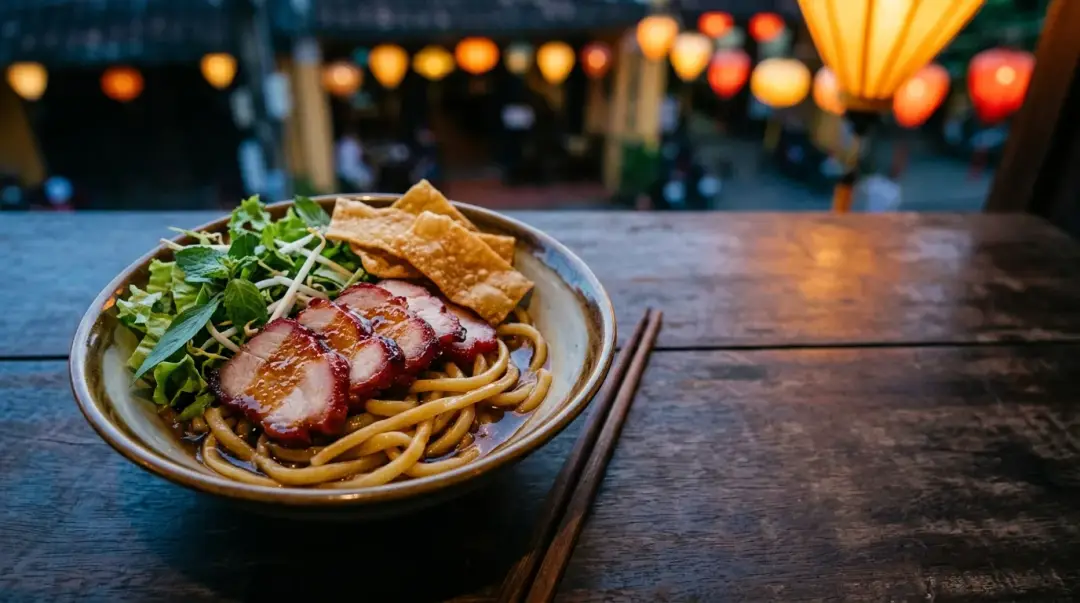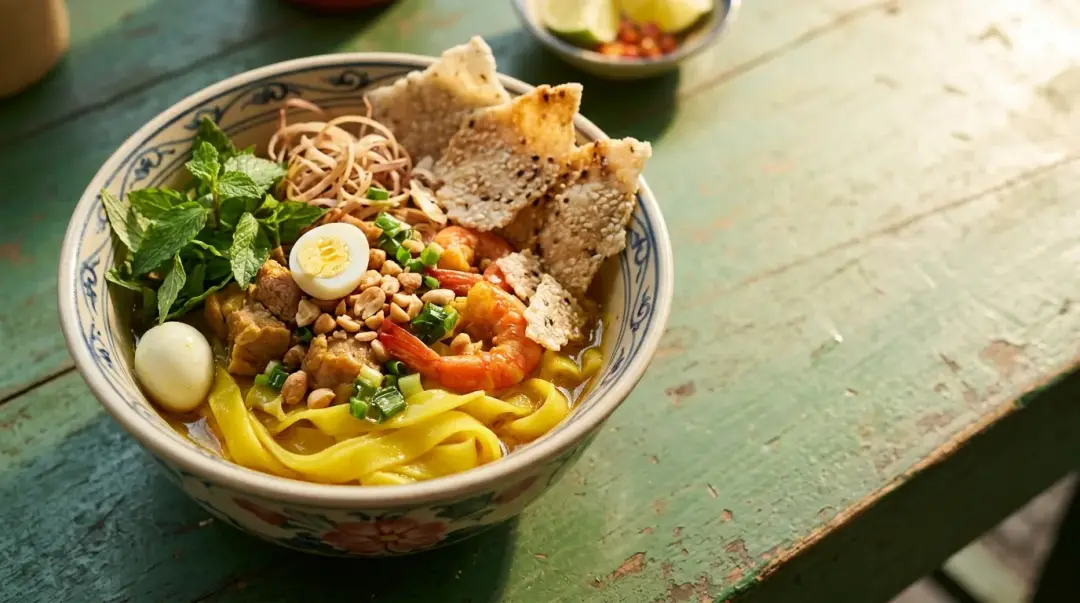
Mì Quảng is the signature noodle dish of central Vietnam's Quảng Nam province — wide turmeric-yellow rice noodles, layered toppings, and only a few tablespoons of intensely concentrated broth pooled at the bottom. It's rare on US Vietnamese menus outside Westminster CA, Houston, and Falls Church VA, often listed in English as "Da Nang noodles" or "Hoi An noodles." The crispy sesame rice cracker broken on top is the structural finish — without it, the dish is incomplete.
What Is Mì Quảng?
Mì Quảng (literally "Quang noodles") is the signature dish of Quảng Nam province in central Vietnam — the region around Da Nang and Hoi An. It's a noodle dish that defies easy categorization. It's not a soup (too little broth). It's not a stir-fry (no wok). It's somewhere in between: wide flat rice noodles dyed yellow with turmeric, topped with shrimp, pork, chicken, or fish, with just a few tablespoons of concentrated broth pooled at the bottom, finished with crushed peanuts and a sesame rice cracker broken on top.
The Vietnamese have a saying: "Mì Quảng đi đâu cũng được" — "Mì Quảng goes anywhere," because the format adapts to whatever protein is available. You'll see shrimp-and-pork versions in Da Nang coastal restaurants, chicken versions inland, and even frog-leg versions in Hoi An night markets.
How It Differs from Phở
If phở is a bowl with lots of broth and a few elements, mì Quảng is a plate with little broth and many elements:
- Noodles: Mì Quảng noodles are wider, flatter, often dyed yellow with turmeric during the pressing. Phở noodles are thinner and white.
- Broth volume: Mì Quảng has just enough broth to coat (3-4 tablespoons), not enough to drink. Phở has a full bowl of broth.
- Toppings: Mì Quảng is layered with multiple proteins, peanuts, herbs, and a rice cracker. Phở is simpler.
- Eating style: Mì Quảng is mixed at the table — you toss everything together before eating. Phở is eaten as-is, with noodles and broth taken together.
The Crispy Rice Cracker
The signature finishing element is the bánh tráng nướng — a thin, crispy sesame-seeded rice cracker. It's served alongside the bowl, and the diner breaks it into shards and tosses them in. The cracker adds crunch and absorbs the small amount of broth, creating textural contrast that makes the dish.
Without the rice cracker, mì Quảng is incomplete. Restaurants that serve mì Quảng without the cracker are flagging that they're not central-Vietnamese-authentic.
Flavor Profile
Mì Quảng is earthy, deeply savory, nutty, slightly sweet, and texturally complex. The turmeric gives a faint warm bitterness. The peanuts add nuttiness. The dipping shrimp paste (served on the side) adds funk. It's a dish about layers, not about a single dominant flavor.
Where to Find Mì Quảng in the US

The noodle to buy
Large 8-Inch Thai Granite Mortar and Pestle
A mortar crushes the peanuts for the topping, and it also pounds the aromatics for the seasoning base. This listing is an 8-inch Thai-style mortar of solid granite with a rough grinding interior and a large pestle.
Rare outside dedicated central-Vietnamese restaurants. Best US cities for finding authentic mì Quảng:
- Houston, TX (large central-Vietnamese diaspora)
- Westminster, CA (Little Saigon — several Hoi An-style restaurants)
- Falls Church, VA (Eden Center)
Many US Vietnamese restaurants don't serve mì Quảng at all. Those that do often label it as "Da Nang noodles" or "Hoi An noodles" in English.
Making Mì Quảng at Home
This is one of the harder Vietnamese dishes to source ingredients for in the US:
- Mì Quảng noodles — Specifically yellow-tinted, flat, wider than phở. Three Ladies makes a turmeric-dyed bánh phở that works as a substitute. Real mì Quảng noodles are harder to find — try Asian groceries that stock central-Vietnamese imports.
- Bánh tráng nướng (sesame rice cracker) — Sold dry at Vietnamese groceries; you toast them under a broiler 30 seconds per side. Don't skip this — it's not the same dish without it.
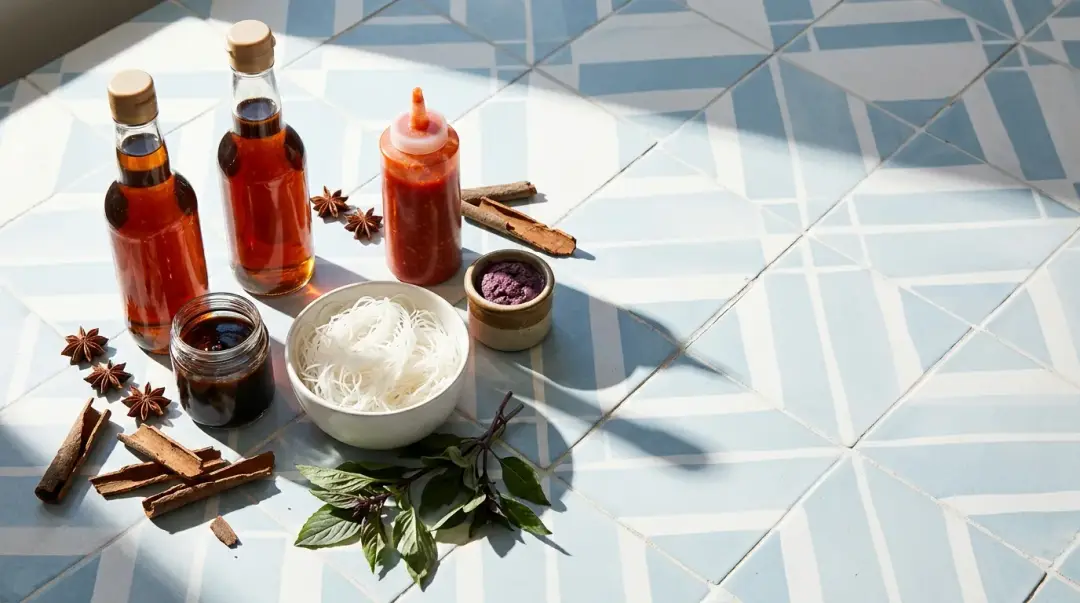
- Annatto-dyed broth concentrate — The bowl's bottom-of-the-plate broth is intensely concentrated. Made by simmering shrimp shells, pork bones, and annatto seeds.
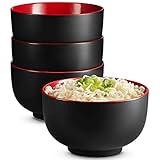
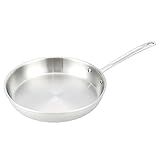
- Roasted peanuts — Crushed (not whole) for topping. A granite mortar does this well, a wide skillet handles the shrimp and pork, and a shallow bowl suits a dish with so little broth. Our Vietnamese cookware guide covers the bowls and pots.
See our Vietnamese Pantry Essentials guide.
FAQ
What is mì Quảng?
Mì Quảng is the signature noodle dish of Quảng Nam province in central Vietnam. It uses wide turmeric-yellow rice noodles, layered toppings and only 3 to 4 tablespoons of concentrated broth.
Is mì Quảng a soup?
No. It has too little broth to be a soup and no wok cooking to be a stir-fry. It is a plate that diners toss together before eating.
What is the cracker on mì Quảng?
It is bánh tráng nướng, a thin, crispy sesame-seeded rice cracker. Diners break it into shards and toss it in for crunch.
Where can you find mì Quảng in the US?
It is rare, with the best odds in Houston, Westminster, CA and Falls Church, VA. Menus often list it as Da Nang noodles or Hoi An noodles.
Why Mì Quảng Matters
Mì Quảng is the dish that proves Vietnamese cuisine isn't just phở and bánh mì. Each region of Vietnam has a defining noodle dish that's its own art form — northern Hanoi has phở and bún chả, central Hue has bún bò Huế, central Da Nang/Hoi An has mì Quảng, southern Saigon has hủ tiếu.
If you understand mì Quảng, you understand that Vietnamese cuisine is regional, deep, and far more varied than the US restaurant scene suggests.