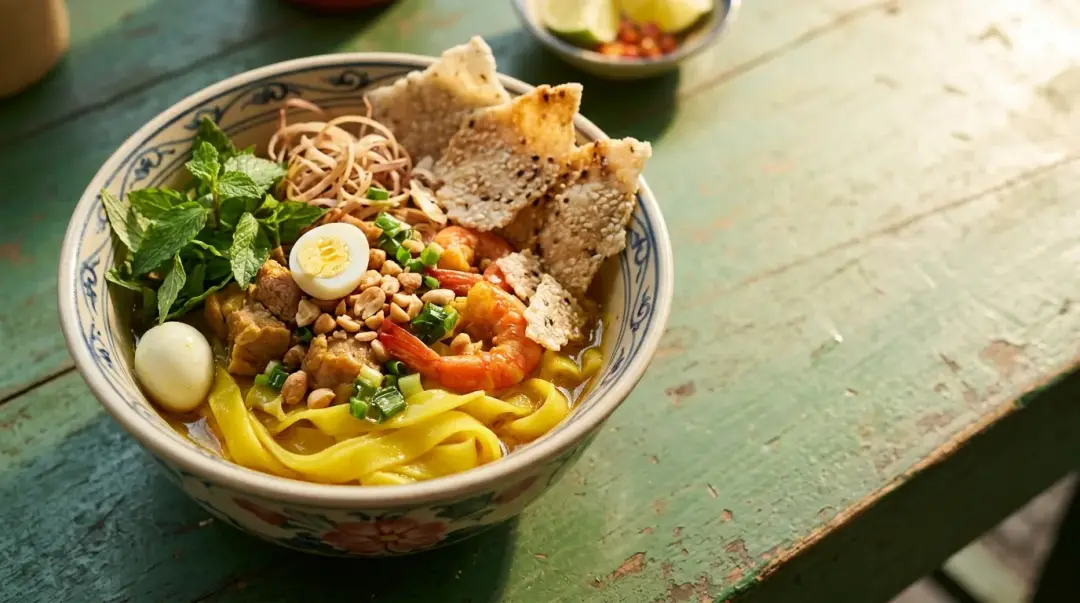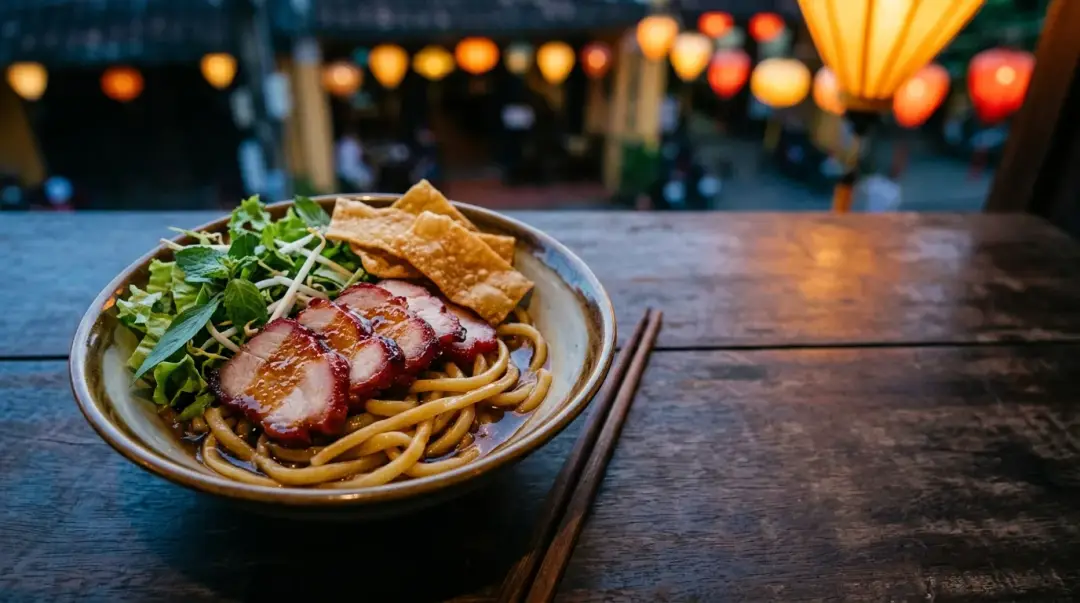
Cao lầu is Hoi An's lye-water-treated noodle dish — thick chewy noodles, char-siu-style pork, fresh herbs, and a few spoonfuls of concentrated broth, topped with crispy fried noodle squares. It's almost impossible to find abroad — in the US, a handful of Westminster CA specialists and occasional SF restaurant specials cover it, and that's the entire list. The dish is geographically locked to one Vietnamese town, where Japanese, Chinese, and Vietnamese trading-port history collide in a single bowl.
What Is Cao Lầu?
Cao Lầu is the most geographically restricted noodle dish in Vietnam — and arguably one of the most interesting dishes in Asian cuisine. It comes from Hoi An, a small UNESCO-protected port town on Vietnam's central coast. Locals insist that authentic cao lầu can only be made in Hoi An because of the specific lye water used to treat the noodles, which comes from a specific well (called the Ba Le well) and is alkalinized with ash from a specific type of wood found only in that area.
The dish itself is simple: chewy thick noodles, char siu-style pork slices, fresh herbs, bean sprouts, a few spoonfuls of dark concentrated broth, and crispy fried noodle squares (made from the same dough) as a topping. The result is half-noodle salad, half-noodle stew — a unique format.
Why It Tastes Like Three Cuisines at Once
Hoi An was a major international trading port from the 16th to 19th centuries. Japanese, Chinese, and European merchants lived there. Cao Lầu reflects this:
- The noodles are alkaline-treated, similar to Japanese soba and Chinese lamian — completely unlike other Vietnamese rice noodles, which are made without alkalinity.
- The pork is char siu-style, descended from Chinese Hokkien immigrants.
- The fresh herbs and overall format are unmistakably Vietnamese.
You can taste all three culinary traditions in one bowl. There's nothing else like it in Vietnam.
The Ba Le Well Mythology
Hoi An residents claim that genuine cao lầu requires three specific local ingredients:
- Ba Le well water — alkaline, from a specific well that's been used since at least the 17th century
- Ash from cajeput wood — a specific tree native to Cham Islands
- Rice from Tra Que village — a specific farming area just outside Hoi An
This is partly culinary mythology and partly real terroir. Cao Lầu made outside Hoi An never quite tastes the same — though plenty of restaurants try.
Flavor Profile
Cao Lầu is chewy, deeply savory, smoky from char-siu pork, herbal, and texturally complex. The noodles dominate the experience — they're heavier and more substantial than any other Vietnamese noodle. The crispy fried noodle squares add crunch contrast.
Where to Find Cao Lầu Outside Hoi An

The noodle to buy
Ken Hom 7-Inch Stainless Steel Cleaver
The char siu-style pork is sliced thin, and a sharp cleaver blade makes even slices easier. This listing is a 7-inch stainless steel Chinese cleaver with a pear wood handle.
Almost impossible to find authentic Cao Lầu abroad. In the US, a handful of restaurants serve it:
- Hoi An Restaurant (Westminster, CA) — specialist
- The Slanted Door (San Francisco) — occasional special, modernized version
- Westminster CA Little Saigon — a few places make it with imported noodles or close substitutes
Most Vietnamese restaurants there don't carry it. If you want real cao lầu, you have to go to Hoi An.
Making a Substitute at Home
Since you can't get Ba Le well water outside Hoi An, you'll need a substitute approach:
- Noodles: Closest substitutes are fresh Japanese udon (similar chew, alkaline-treated) or Chinese lamian (also alkaline). Skip standard rice noodles — wrong texture.
- Pork: Char siu sliced thin with a sharp cleaver. Sold pre-made at Chinese BBQ shops, or homemade with hoisin + five-spice + maltose.
- Broth concentrate: Soy sauce + fish sauce + sugar + pork stock reduction. Spoonfuls, not bowls.
- Crispy noodle squares: Make extra noodles, deep-fry them.
- Herbs: Fresh Thai basil, mint, perilla — the standard Vietnamese herb plate.
Tongs lift the chewy noodles out of the pot, and a wide, shallow bowl suits the plate-style serving. For bowls suited to Vietnamese dishes, see our Vietnamese cookware guide.
It won't taste like real cao lầu. But it's the closest you can get without flying to Hoi An.
FAQ
What is cao lầu?
Cao lầu is a noodle dish from Hoi An, Vietnam. It combines thick, chewy lye-treated noodles, char-siu-style pork, fresh herbs, bean sprouts, a few spoonfuls of broth and crispy fried noodle squares.
Why can cao lầu only be made in Hoi An?
Locals say authentic cao lầu needs water from the Ba Le well, ash from cajeput wood and rice from Tra Que village. This is partly culinary mythology and partly real terroir.
Where can you eat cao lầu outside Hoi An?
It is very rare. In the US, a few Westminster, CA specialists and occasional San Francisco restaurant specials serve it, and most Vietnamese restaurants there do not carry it.
What noodles substitute for cao lầu noodles?
Fresh Japanese udon and Chinese lamian are the closest substitutes because both are alkaline-treated and chewy. Standard rice noodles have the wrong texture.
Why This Dish Matters
Cao Lầu is a reminder that culinary regionality is real. In an era of food globalization, it stands out as a dish that genuinely can't be replicated outside its origin. For travelers, that's a feature. For home cooks, that's an itinerary item: "next time we go to Vietnam, eat cao lầu."
It's also a lovely intersection point — three cultures, one bowl, one specific corner of the world.