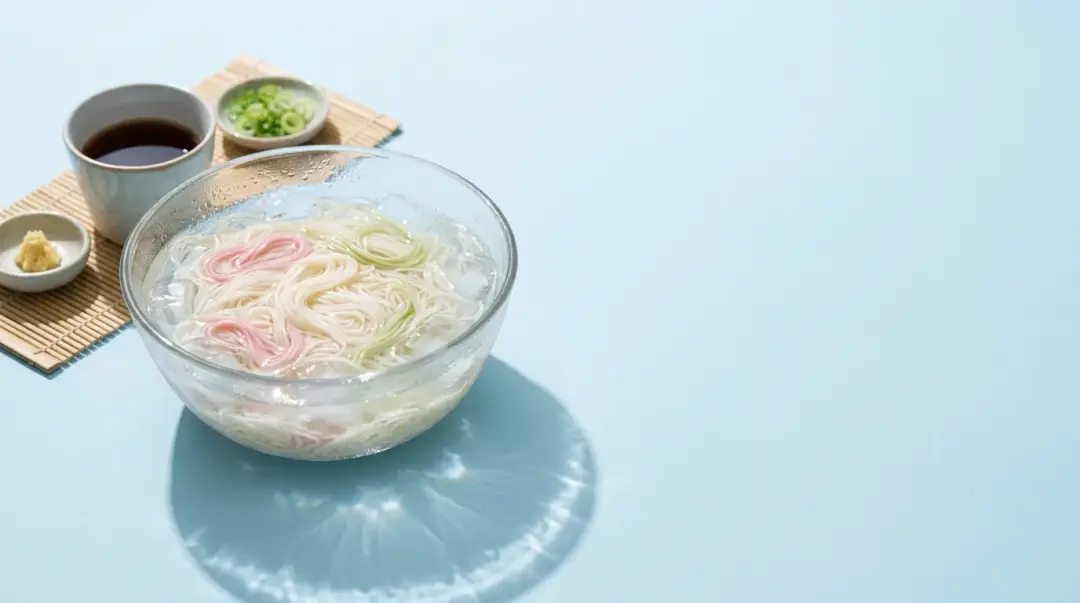
Hiyamugi (literally "cold wheat") is Japan's cold thin wheat noodle sized between sōmen and udon — government-defined as 1.3-1.7mm in diameter, cut from rolled dough rather than hand-stretched. It turns up at Mitsuwa and H Mart in summer packages flecked with a few pink-and-green dyed strands, a visual marker that distinguishes hiyamugi from pure-white sōmen. What sets it apart is production: that knife-cut origin gives hiyamugi noticeably more bite than sōmen, the trade-off for losing sōmen's stretched delicacy.
What Is Hiyamugi?
Hiyamugi (literally "cold wheat") is a cold thin wheat noodle, slightly thicker than sōmen and slightly thinner than thin udon. Like sōmen, it's primarily a summer dish in Japan, served chilled with a dipping sauce. Unlike sōmen, hiyamugi is cut from rolled dough rather than hand-stretched and oiled — a different production technique that yields a slightly chewier texture.
The Japanese government formally defines the diameter ranges:
- Sōmen: ≤1.3mm
- Hiyamugi: 1.3-1.7mm
- Cold udon: ≥1.7mm
In practice, the textures overlap enough that casual diners often can't tell sōmen and hiyamugi apart.
When Hiyamugi Is Served
Hiyamugi is almost exclusively served:
- Cold, with dipping sauce on the side
- In summer — May through September in Japan
- As a quick, light meal — lunch or light dinner
- At home more often than at restaurants
Many Japanese households keep a stock of dried hiyamugi in summer specifically for hot days when they don't want to cook much.
Visual Trick — The Colored Strands
Japanese hiyamugi packaging often includes a small number of pink-and-green dyed noodles mixed in with the white ones. This isn't decorative — it's a cultural marker that distinguishes hiyamugi from sōmen at a glance. (Sōmen packets are almost always pure white.) The colored strands aren't flavored differently; they're a tradition.
If you're shopping at Mitsuwa or H Mart and see a Japanese cold-noodle pack with a few pink strands visible through the wrapper — that's hiyamugi.
Flavor Profile
Hiyamugi has slightly more chew than sōmen but the same mild wheat flavor. The dish's character comes from the dipping sauce (tsuyu) and garnishes. The noodle itself is a vehicle.
How Hiyamugi Differs from Sōmen
For most diners, the two are interchangeable. The technical differences:
- Diameter: Sōmen is thinner. Hiyamugi is slightly thicker.
- Production: Sōmen is hand-stretched and oiled. Hiyamugi is cut.
- Cooking time: Sōmen cooks in 90 seconds. Hiyamugi cooks in 2-3 minutes.
- Chew: Hiyamugi has slightly more bite.
If you've never had either, start with sōmen — it's more widely available and slightly more refined.
Where to Find Hiyamugi
Less common than sōmen in Japanese groceries outside Japan. Hakubaku makes a hiyamugi sold at H Mart and Amazon. Itsuki brand has a popular hiyamugi sold at Mitsuwa.
For Japanese restaurants, hiyamugi appears occasionally on summer menus alongside sōmen but isn't usually called out specifically — many restaurants just call both "cold wheat noodles" in English.
Making Hiyamugi at Home
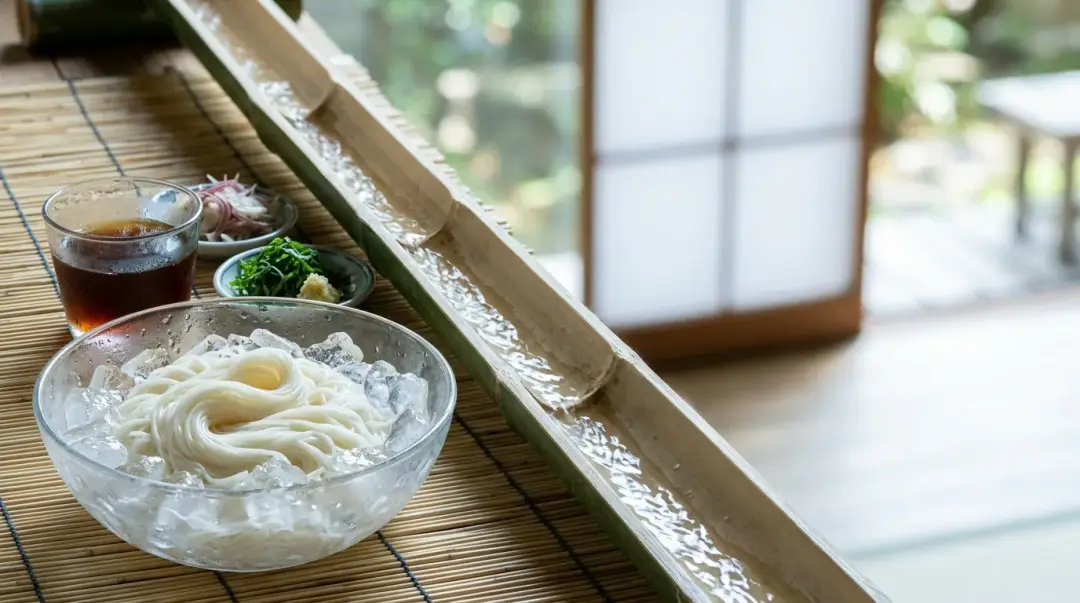
Hiyamugi is prepared like sōmen, with a slightly longer boil of 2 to 3 minutes in unsalted water. The noodles are then rinsed under cold water until completely cool, plated over ice in a bowl and served with chilled tsuyu (dashi-soy-mirin dipping sauce) and garnishes. The sauce is the same one used for sōmen.
Two pieces of gear make the cold-noodle routine easier: a tebo (a handled mesh basket) to lift the noodles out in one motion, and a large bowl of ice water for the rinse. For more tools, see our Japanese cookware guide. Our spider strainer guide covers tebo baskets.
A Sōmen-Hiyamugi Comparison Plate
Some Japanese restaurants serve a combo plate with both sōmen and hiyamugi side-by-side, with the same dipping sauce. It's a great way to taste the texture difference. If you see this on a menu in summer, order it — you'll learn more about Japanese cold noodles in one bite than from any reading.
FAQ
What is hiyamugi?
Hiyamugi is a cold, thin Japanese wheat noodle 1.3 to 1.7mm in diameter, sized between sōmen and thin udon. It is cut from rolled dough and served chilled with a dipping sauce, mostly in summer.
Why are some hiyamugi noodles pink and green?
Packs often include a few pink-and-green dyed strands as a tradition that tells hiyamugi apart from pure-white sōmen. The colored strands are not flavored differently.
What is the difference between hiyamugi and sōmen?
Sōmen is thinner, hand-stretched and oiled, and cooks in about 90 seconds. Hiyamugi is slightly thicker, cut from rolled dough, has a bit more chew and cooks in 2 to 3 minutes.
Where can I buy hiyamugi?
It is less common than sōmen, but Japanese groceries such as Mitsuwa and H Mart stock it, including Hakubaku and Itsuki brands.