Whole Wheat vs Regular Pasta: Fiber, Protein, Taste
· 7 min read · NoodleDex Editorial
Whole wheat vs regular pasta, per USDA data: twice the fiber, almost the same protein, less folate. Plus taste trade-offs and whole grain noodles to buy.
This page contains affiliate links. We may earn a commission at no extra cost to you. Disclosure
USDA FoodData Central puts the fiber in cooked whole wheat pasta at 3.9 g per 100 g. Cooked enriched pasta, the regular kind, has 1.8 g (FDC 168910; FDC 169737).
That's the number behind most "swap to whole wheat" advice, and it holds up. The next row down in the same two records is protein: 5.99 g against 5.80 g. The row after that is folate, where the refined pasta wins, 73 micrograms to 21. Whole wheat versus regular pasta is a trade across the whole nutrient panel, and fiber is the biggest gap in whole wheat's favor.
The USDA numbers, row by row
Both records are cooked pasta without added salt, per 100 g, from USDA's SR Legacy dataset.
Cooked whole wheat pasta vs cooked enriched pasta, per 100 g (USDA FoodData Central)
| Nutrient | Whole wheat (FDC 168910) | Enriched (FDC 169737) | Which is higher |
|---|---|---|---|
| Calories | 149 kcal | 158 kcal | Enriched, by 9 |
| Protein | 5.99 g | 5.80 g | About equal |
| Carbohydrate | 30.1 g | 30.9 g | About equal |
| Fiber | 3.9 g | 1.8 g | Whole wheat, 2.2x |
| Fat | 1.71 g | 0.93 g | Whole wheat |
| Magnesium | 54 mg | 18 mg | Whole wheat, 3x |
| Iron | 1.72 mg | 1.28 mg | Whole wheat |
| Folate | 21 µg | 73 µg | Enriched, 3.5x |
| Thiamin (B1) | 0.156 mg | 0.274 mg | Enriched |
A cup of cooked spaghetti, not packed, weighs 117 g for whole wheat and 124 g for enriched in the same records. Per cup, that works out to about 4.6 g of fiber against 2.2 g.
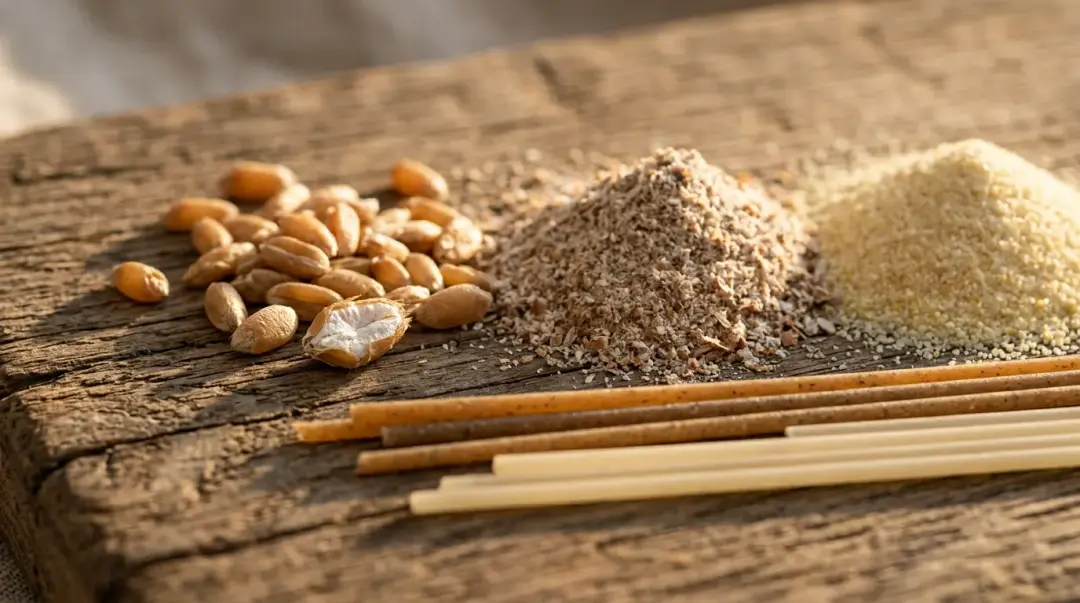
The extra fat is real but small, under a gram, and it comes from the germ, the oily embryo of the wheat kernel that milling removes from white flour. The bran, the kernel's outer layer, carries most of the fiber and much of the magnesium.
What enrichment puts back, and what it doesn't
Refined pasta starts as flour or semolina with the bran and germ milled away. US enriched pasta then gets specific nutrients added: Barilla's regular spaghetti lists niacin, iron and other B vitamins after the semolina and durum wheat flour on its ingredient line (Giant listing). That is why enriched pasta beats whole wheat on folate and thiamin in the USDA table.
Fiber and magnesium don't go back in. The table splits along that line: the nutrients that enrichment restores favor the regular box, and the ones it doesn't favor whole wheat.
Reading a whole grain pasta box
The front of the box is less useful than the ingredient line. Barilla Whole Grain spaghetti lists one ingredient, whole grain durum wheat flour, and claims 56 g or more of whole grain per serving (Giant listing). Its label, per 2 oz dry, reads 180 calories, 8 g protein and 7 g fiber. The regular blue box reads 200 calories, 7 g protein and 3 g fiber.
Label figures are per dry serving and the USDA figures are per cooked weight, which is why the gram counts don't line up. The ratio does: roughly twice the fiber, one extra gram of protein.
Watch for blends. The Whole Grains Council's stamp, introduced in 2005, comes in two tiers (Whole Grain Stamp). The 100% stamp requires at least 16 g of whole grain per serving and no refined grain. The basic stamp needs only 8 g, so a box carrying it can be mostly refined flour. "Made with whole grain" on its own promises nothing about the ratio. The first ingredient tells you more: "whole wheat flour" or "whole grain durum wheat flour" means the real thing, and "semolina" first means the pasta is mostly or entirely refined.
How it tastes and cooks
Whole wheat pasta has a reputation, and a 2013 sensory study from the University of Guelph's food science group put numbers behind it. Researchers made pasta at 0%, 25%, 75% and 100% whole grain and ran it through sensory and instrumental tests. Bitterness rose at every step and sweetness fell. Branny and wheaty notes climbed. On texture, the higher-whole-grain pastas were rougher and grainier and less firm and cohesive. Drying the pasta slowly at low temperature made it firmer, but otherwise drying method didn't change how it tasted (West, Seetharaman and Duizer, Journal of Cereal Science, 2013).
In practice that points to a few kitchen moves:
- Pull it a minute before the package time. A less firm pasta has less margin, so cook it in a large pot with plenty of water.
- Weigh the dry pasta on a kitchen scale if you are tracking fiber or calories; the label figures are per 2 oz (56 g) dry serving.
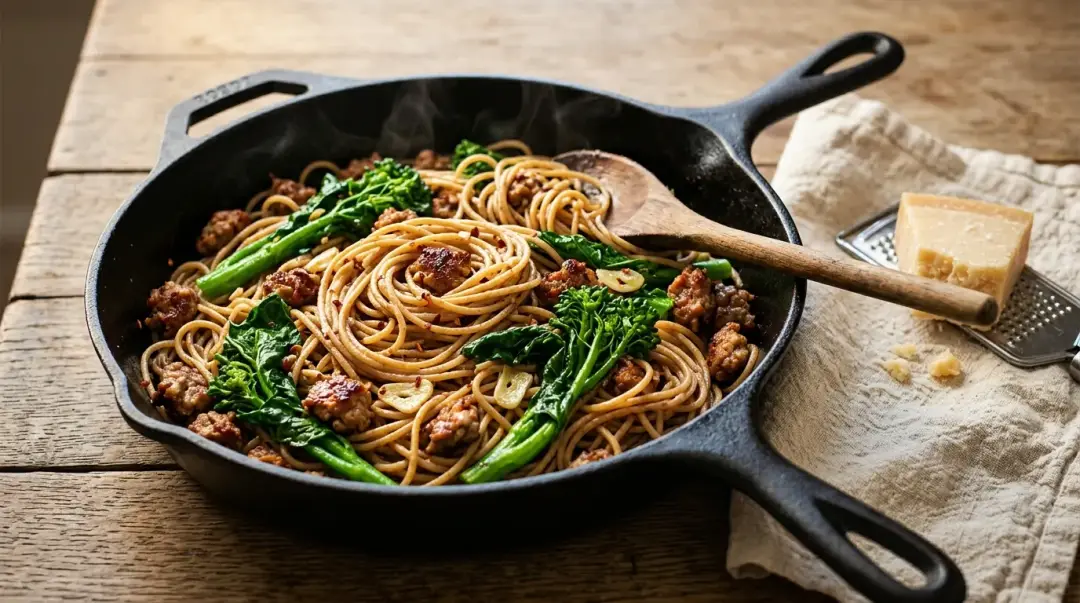
- Pair it with sauces loud enough to stand up to bran: walnut pesto, sausage and broccoli rabe, puttanesca, a long-cooked ragù. Plain butter and parmesan shows every bitter note.
- Try a bronze-die brand if the smooth ones taste flat. The rougher surface holds oil-based sauces, which matters more when the pasta itself brings less sweetness. NoodleDex's Italian pasta buying guide covers which brands use bronze dies.
De Cecco sells a Spaghetti No. 12 in 100% whole wheat, and Barilla runs a full Whole Grain line next to its blue box.
Whole grain noodles outside the pasta aisle
Whole grain isn't only a wheat question. Several Asian noodles are whole grain by default or come in whole grain versions.
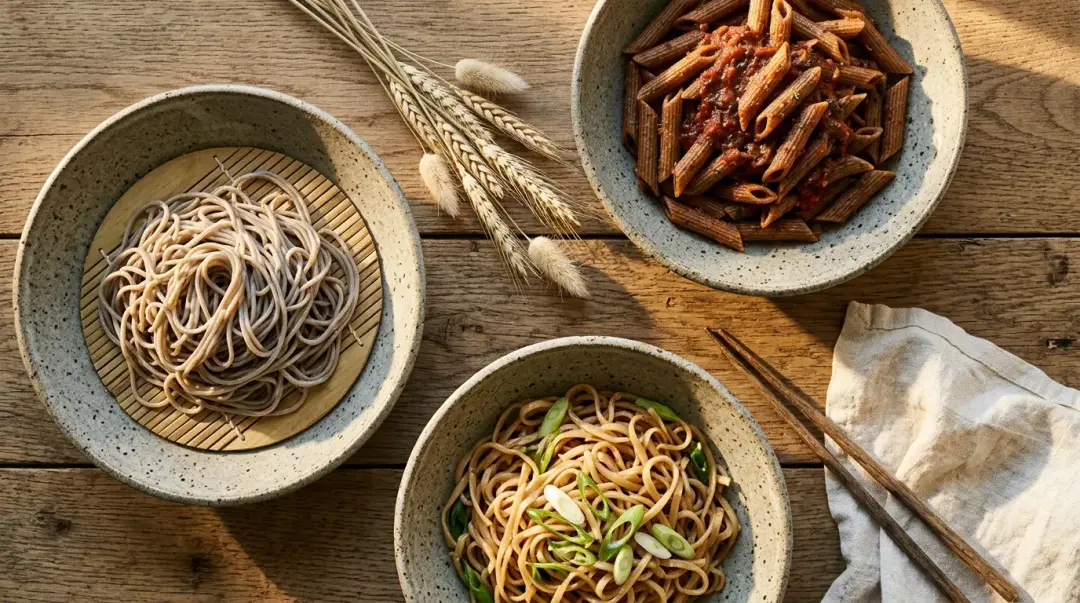
Soba, the Japanese buckwheat noodle (SOH-bah), is made from buckwheat, a seed eaten as a grain. Most US soba blends buckwheat with wheat flour, while 100% buckwheat versions like Eden's are wheat-free. NoodleDex's soba buying guide sorts the two. USDA's record for cooked soba lists 5.06 g of protein per 100 g, close to wheat pasta, but no fiber value.
Brown rice noodles keep the bran on the rice. Lotus Foods' Organic Brown Pad Thai Rice Noodles list a single ingredient, organic brown rice flour, and the brand also sells a buckwheat and brown rice soba and a millet and brown rice ramen (Lotus Foods). For scale, USDA's cooked white rice noodle record lists 1.0 g of fiber and 1.79 g of protein per 100 g, both lower than enriched wheat pasta.
Glycemic index barely moves
Fiber is often sold as a blood sugar fix, and for pasta the GI tables don't show much of one. The 2008 international tables list whole meal spaghetti at a GI of 48 and white spaghetti at 49, a gap inside the margin of error (Atkinson et al., Diabetes Care, 2008). Regular pasta already digests slowly, so adding bran changes little. The glycemic index of noodles page has the full ranking.
The long-term research points somewhere else. A 2016 BMJ meta-analysis of 45 prospective studies found that each additional 90 g of whole grains a day was associated with a 19% lower risk of coronary heart disease and a 17% lower risk of death from all causes (Aune et al., 2016). Those are observational associations, and the specific foods with clear associations were whole grain bread, breakfast cereals and added bran. Pasta wasn't singled out. The American Diabetes Association lists whole grain pasta among its nutrient-dense carbohydrate choices alongside brown rice and oatmeal (ADA).
For readers whose main target is protein, whole wheat is the wrong lever; the highest-protein noodles page covers the chickpea and lentil pastas that carry far more.
Which box for which dinner
Matching the noodle to the dish
| Dinner | Reach for | Why |
|---|---|---|
| Cacio e pepe, aglio e olio, buttered noodles | Regular durum wheat pasta | Simple sauces expose whole wheat bitterness |
| Ragù, sausage and greens, puttanesca | Whole wheat spaghetti or penne | Strong sauces cover the bran; you keep the extra fiber |
| Cold soba with dipping sauce (zaru, served on a bamboo tray) | 100% buckwheat soba | Whole grain, wheat-free, built to be eaten cold |
| Pad thai or stir-fried rice noodles | Brown rice pad thai noodles | Single-ingredient whole grain, gluten-free |
| Folate is the priority | Enriched pasta | Enriched pasta has 3.5x the folate per USDA |
| Protein target | Chickpea or lentil pasta | Whole wheat adds about 0.2 g protein per 100 g |
Cooking half a box of each in the same pot splits the difference. By the USDA figures, the fiber lands at about 2.9 g per 100 g.
FAQ
Is whole wheat pasta healthier than regular pasta?
It has more of some nutrients and less of others. Per USDA data, cooked whole wheat pasta has about twice the fiber and three times the magnesium of enriched pasta, with similar protein and slightly fewer calories. Enriched pasta has more folate and thiamin because those vitamins are added back after milling.
How much more fiber is in whole wheat pasta?
USDA FoodData Central lists 3.9 g of fiber per 100 g of cooked whole wheat pasta and 1.8 g for cooked enriched pasta. On the box, Barilla Whole Grain spaghetti lists 7 g per 2 oz dry serving against 3 g for its regular spaghetti.
Does whole wheat pasta have more protein?
Hardly. USDA lists 5.99 g of protein per 100 g of cooked whole wheat pasta and 5.80 g for enriched pasta. Barilla's labels show 8 g versus 7 g per 2 oz serving. Readers after protein will get further with chickpea, lentil or other legume pastas.
Why does whole wheat pasta taste bitter?
Whole grain flour keeps the bran, which tastes bitter and branny next to refined semolina. A 2013 study in the Journal of Cereal Science found that bitterness rose and sweetness fell at each step from 0% to 25%, 75% and 100% whole grain, and that whole grain pasta was also less firm and more grainy.
Is whole wheat pasta lower on the glycemic index?
Not meaningfully. The 2008 international glycemic index tables list whole meal spaghetti at 48 and white spaghetti at 49. Both are low GI. The extra fiber in whole wheat pasta does not shift its glycemic index much, because ordinary pasta already digests slowly.
What does 100% whole grain mean on a pasta box?
It means all the grain in the product is whole grain, with no refined flour. The Whole Grains Council's 100% stamp requires at least 16 g of whole grain per serving and no refined grain. A basic stamp needs only 8 g, which allows blends of whole and refined flour.
Read Next
- Glycemic Index of Noodles
- Resistant Starch Noodles: the leftover-pasta studies
- Highest-Protein Noodles
- De Cecco vs Barilla
Products mentioned in this guide
This section contains affiliate links. We may earn a commission at no extra cost to you.

Barilla Whole Grain Spaghetti, 16 oz
One ingredient, whole grain durum wheat flour, with 7 g of fiber per 2 oz serving on the box. The easiest whole wheat pasta to find in a US supermarket.
View on Amazon
De Cecco Spaghetti No. 12 100% Whole Wheat, 16 oz
A bronze-die whole wheat spaghetti with a rougher surface for oil and garlic sauces. Worth trying if the smoother supermarket versions taste flat to you.
View on Amazon
Lotus Foods Organic Brown Rice Pad Thai Noodles (8 oz, 6-pack)
Brown rice flour is the only ingredient, so it counts as a whole grain noodle and is GFCO certified gluten-free. Boil it 7 minutes and rinse cold.
View on Amazon
Eden Organic 100% Buckwheat Soba, 8 oz (3-Pack)
All-buckwheat soba, a whole grain noodle from outside the wheat family. Earthier than whole wheat spaghetti and best served cold with dipping sauce.
View on Amazon
Cook N Home 8 Quart Stainless Steel Pasta Pot with Strainer Lid
Whole wheat pasta is less firm and has less margin, so it wants plenty of water and a quick drain once you pull it early. This is an 8-quart stainless pot with a strainer insert, steamer insert and glass lid.
View on Amazon
Etekcity Digital Kitchen Scale, 11 lb, 1 g, Grams and Ounces
Fiber and calorie figures are per weighed serving, so weigh the dry pasta instead of eyeballing it. This scale reads to 1 g, has a tare function and switches between grams and ounces.
View on Amazon
Browse more related items
Opens Amazon · affiliate links
Buying guides for this topic
- Buying guideBest Italian Pasta Brands in 2026De Cecco, Rummo, Garofalo, and premium bronze-die pasta brands ranked. The pasta upgrade worth making.
- Buying guideBest Soba Noodles in 2026The best dry soba noodles available on US Amazon — Hakubaku, Mishima, and premium juwari (100% buckwheat) brands ranked.
- Buying guideBest Rice Noodles for Pho, Pad Thai, and MoreThe best rice noodles on Amazon: Three Ladies bánh phở, A Taste of Thai, Annie Chun's and Lotus Foods, ranked for pho, pad thai and more.
- Buying guideBest Italian Pantry Essentials in 2026Tomatoes, olive oil, Parmigiano, Pecorino, anchovies, guanciale — the Italian pasta foundation, ranked.