Resistant Starch Noodles: What Cooling Pasta Changes
· 8 min read · NoodleDex Editorial
Resistant starch noodles, by the numbers: what chilling and reheating pasta and rice noodles does to starch and blood sugar across six human studies.
This page contains affiliate links. We may earn a commission at no extra cost to you. Disclosure
On this page(10 sections)
- Resistant starch, and why the fridge makes more of it
- Six trials, side by side
- Why the numbers disagree so much
- Rice noodles: the gap in the evidence
- Chickpea pasta starts lower
- Cooled starch and insulin dosing
- Leftover rules still apply
- What the evidence supports, claim by claim
- FAQ
- Products mentioned in this guide
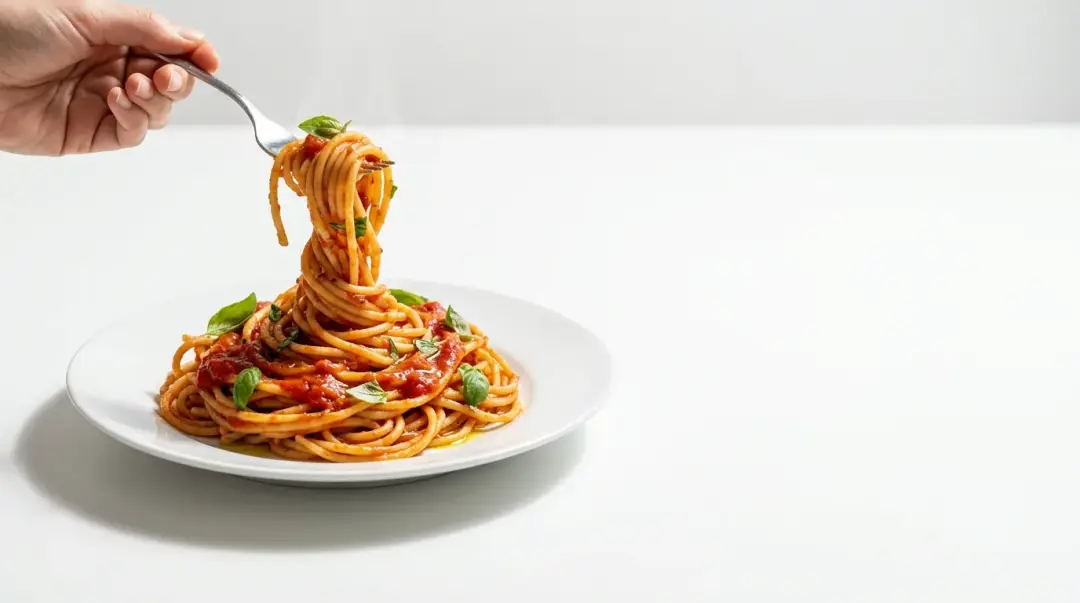
Forty-five healthy volunteers, aged 20 to 24, ate the same pasta meal three ways: freshly cooked, chilled for 24 hours at 4°C, and chilled then microwaved for 3 minutes. Their blood glucose curves came out at 735, 722 and 703 units of area under the curve (mmol/L × minutes). The reheated pasta beat the fresh pasta by about 4%, a gap the researchers found statistically significant (p = 0.003), and blood sugar after the reheated meal returned to fasting levels about 30 minutes sooner (Hodges et al., Foods, 2020).
A 4% shift is real and small. Headlines about "healthier leftover pasta" tend to skip that number, and the trials since then have landed all over the map.
Resistant starch, and why the fridge makes more of it
Resistant starch is starch that gets through the small intestine without being broken down into glucose. It reaches the colon intact, where gut bacteria ferment it, so it behaves more like fiber than like the rest of the starch on the plate.
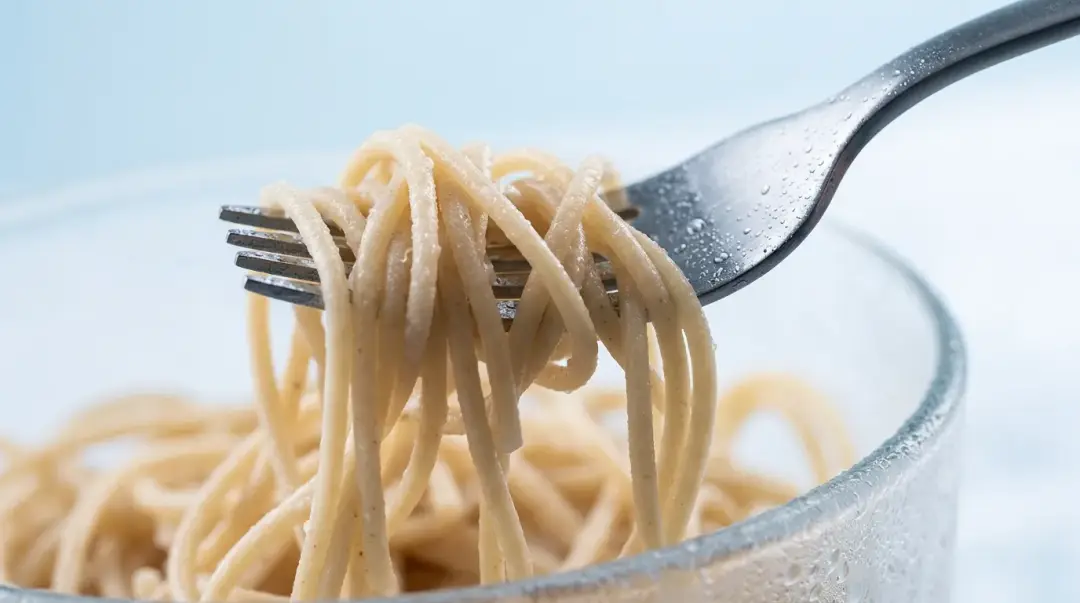
Cooking makes noodles digestible. Boiling water swells the starch granules and pulls their tightly packed chains apart, a process called gelatinization, which is why a cooked noodle is soft and why digestive enzymes can get at it quickly. When the cooked noodle cools, some of those loosened chains, mostly the straight-chained amylose, pack back together into tighter crystalline regions. Food scientists call this retrogradation. It's the same process that turns day-old rice firm and makes cold spaghetti stiff.
Reheating doesn't seem to undo it. Most of the trials below tested reheated leftovers and still measured more resistant starch than in the freshly cooked food.
Six trials, side by side
Most of these trials used a crossover design, where the same people eat both versions of the meal on different days and serve as their own control.
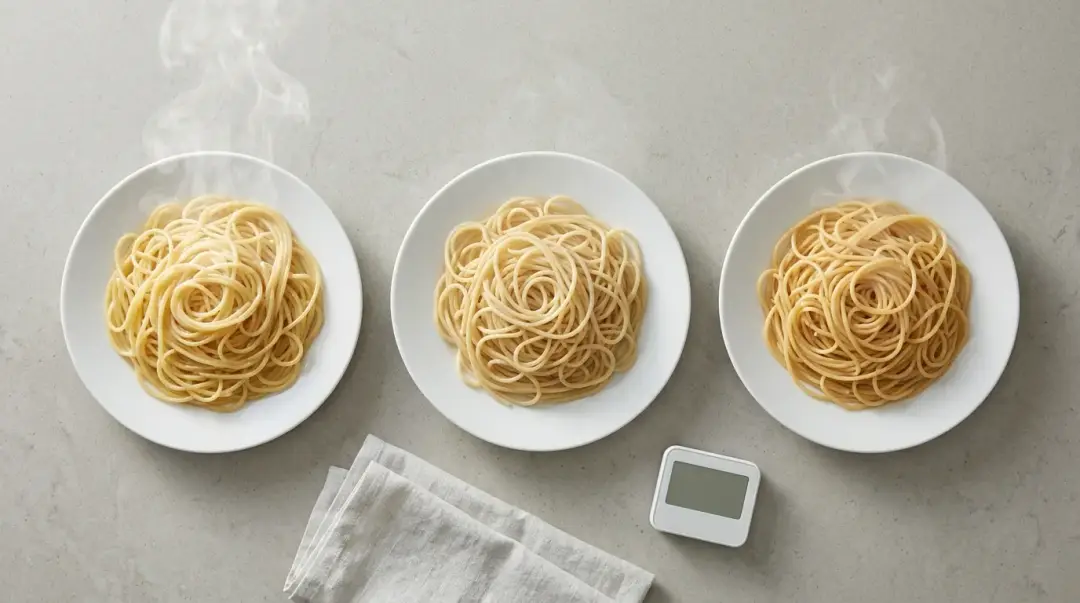
Human studies on cooling and reheating cooked starches
| Study | Food | People | Resistant starch, fresh → chilled | Glucose result |
|---|---|---|---|---|
| Hodges 2020, Foods | Wheat pasta | 45 healthy adults | Not reported | About 4% lower curve when reheated |
| Alhussain 2022, Progress in Nutrition | Wheat pasta | 8 healthy men | Not reported | No significant difference |
| Rogowicz-Frontczak 2026, Nutrients | Wheat pasta | 32 adults, type 1 diabetes | 8.03 → 12.88 g/100 g | Peak rise 4.7 → 2.8 mmol/L; curve area down ~60% |
| Bojarczuk 2024, Metabolites | Chickpea pasta | 12 healthy adults | 1.83 → 3.65 g/100 g | GI 39 → 33; curve area down ~15% |
| Sonia 2015, Asia Pac J Clin Nutr | White rice | 15 healthy adults | 0.64 → 1.65 g/100 g | Response 152 → 125 (p = 0.047) |
| Strozyk 2022, Nutrition & Diabetes | White rice | 32 adults, type 1 diabetes | 7.52 → 11.96 g/100 g | Curve area 336 → 135; more lows |
Two of the studies are pasta trials in healthy people, and they disagree. Hodges found a small, significant drop in 45 people. The Alhussain trial, with 8 young men eating pasta that was cooked, chilled overnight and reheated, found no significant difference in glucose or insulin at all. What it did find was appetite: participants rated themselves fuller after the chilled-and-reheated pasta and reported less desire to eat (both p = 0.03).
The large effects come from two type 1 diabetes trials that share most of their authors. In the 2026 pasta study, 32 adults on insulin pumps ate 50 g of carbohydrate as pasta, either fresh or cooled for 24 hours and reheated. The peak rise in glucose fell from 4.7 to 2.8 mmol/L, and the area under the 3-hour curve fell from 524.8 to 211.9. That is the source of the "40% lower spike" figure that circulates online, and the arithmetic holds.
Why the numbers disagree so much
The first difference is who is eating. People with type 1 diabetes make no insulin of their own, and their pumps deliver a dose set in advance. A healthy pancreas answers a fast glucose rise with an insulin surge that flattens it, which hides part of any difference between two meals. A slower-digesting starch has more room to show its effect when nothing is correcting for it in real time.
Measurement is the second. Fresh rice tested at 0.64 g of resistant starch per 100 g in the Indonesian study and 7.52 g in the type 1 diabetes rice trial, a twelvefold gap for what is nominally the same food. Labs use different assay methods and different rice, so comparing absolute grams across studies is risky. The change inside one study is the safer number, and in every study that measured it, chilling raised the figure: by roughly 60% for wheat pasta, about 2.6 times for rice in Indonesia, and about double for chickpea pasta.
Then there is sample size. Eight, twelve and fifteen participants are pilot-scale numbers. The 2026 authors list their own limits plainly: a single centre, no formal sample-size calculation, a 180-minute observation window, one type of pasta, and a trial that was not registered in advance. None of that makes the result wrong, though one replication could move it.
Rice noodles: the gap in the evidence
For readers who mostly cook rice noodles, the evidence runs out early. NoodleDex found no published human trial of chilled pad thai noodles, pho noodles or rice vermicelli. The closest data come from cooked rice grains, where both rice trials in the table found more resistant starch after 24 hours in the fridge.
Rice noodles are rice flour gelatinized into sheets or strands, and they firm up in the fridge the way rice does. NoodleDex's rice noodle cooking guide warns that a day in the fridge turns cooked rice noodles into a brittle clump that never fully softens again, which is retrogradation you can feel with chopsticks. How much it changes blood sugar is unknown.
Lab work on wheat noodles adds one wrinkle. A 2021 Food Chemistry study of Asian white salted noodles, digested in vitro rather than eaten, found more resistant starch in noodles stored at 25°C than at 4°C. Treat that as starch chemistry and leave the noodles out of the countertop experiment: USDA food safety guidance says cooked food goes into the refrigerator within 2 hours, or 1 hour above 90°F (FSIS).
Chickpea pasta starts lower
The chickpea pasta study is useful for a different reason. Fresh chickpea pasta scored a glycemic index of 39 before any chilling, already in the low band. Cooling and reheating it brought the GI to 33 and doubled its resistant starch, from 1.83 to 3.65 g per 100 g, and the 12 tasters rated the cooled pasta no differently for flavor and texture (Bojarczuk et al., Metabolites, 2024).
Swapping the noodle moves the starting point more than chilling moves it. NoodleDex's gluten-free pasta buying guide covers the chickpea and lentil brands sold in US supermarkets, and the glycemic index of noodles page lists where wheat pasta, rice noodles and glass noodles fall before any fridge time.
Cooled starch and insulin dosing
The 2022 rice trial is the one with the warning attached. Cooled rice cut the area under the glucose curve from 336 to 135 in 32 people with type 1 diabetes. Hypoglycemic episodes, meanwhile, rose from 3 after fresh rice to 12 after cooled rice (p = 0.0039) (Strozyk et al., Nutrition & Diabetes, 2022). The authors concluded that people using standard insulin doses with cooled rice may need those doses adjusted.
The 2026 pasta trial did not see a significant rise in lows, so the signal comes from one trial out of two. The American Diabetes Association describes carb counting as matching grams of carbohydrate to an insulin dose (ADA), and resistant starch changes how many of those grams reach the blood. Anyone on insulin should raise it with their care team before changing how they prepare starches.
Leftover rules still apply
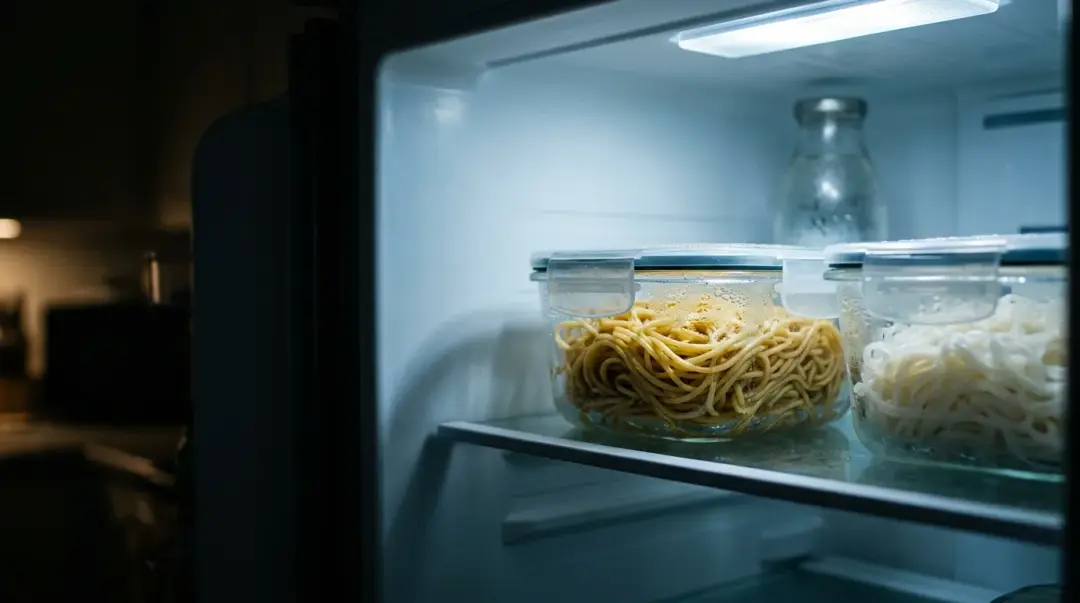
The trials chilled their pasta and rice for 24 hours at about 4°C, the temperature of a working home fridge. That fits inside the standard leftover rules from the USDA Food Safety and Inspection Service:
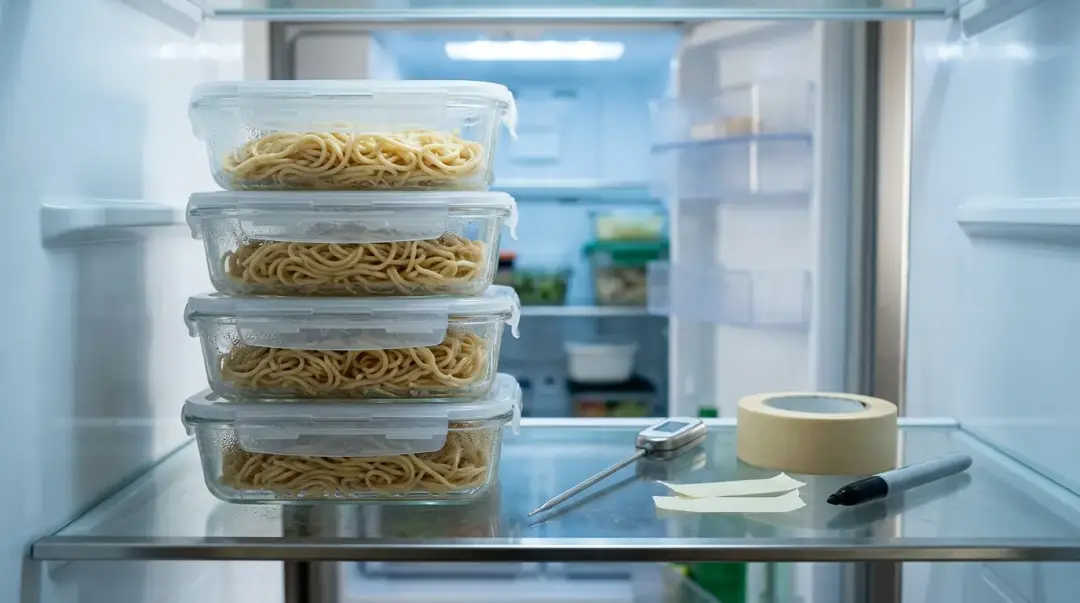
- Refrigerate cooked noodles within 2 hours, and spread a big batch into shallow containers so it cools fast.
- Eat refrigerated leftovers within 3 to 4 days, or freeze them for 3 to 4 months.
- Reheat to 165°F, measured with a thermometer.
A one-day chill sits well inside those limits. Lidded containers make the routine easy: portion the batch into separate containers, note the day you cooked it, and reheat one portion at a time.
What the evidence supports, claim by claim
Chilling cooked pasta or rice for a day raises its resistant starch. Every study that measured this found it, with increases from about 60% to more than double.
Reheating keeps at least part of the effect. The Hodges trial and both type 1 diabetes trials tested reheated food and still saw differences.
A lower glucose response in healthy adults is plausible but modest. One trial of 45 found about 4%, one of 8 found nothing, and one of 15 eating rice found about 18%.
A large drop in people with type 1 diabetes held up in two trials from one research group, with a hypoglycemia signal in one of them.
We found no human data on chilled rice noodles, soba or udon, and none on weight. The Alhussain trial's fullness finding, from 8 men, is the only appetite data in this set.
FAQ
Does cooling pasta really create resistant starch?
Yes, in every trial that measured it. Chilling cooked pasta for 24 hours at 4°C raised resistant starch from 8.03 to 12.88 g per 100 g in a 2026 study, and chickpea pasta went from 1.83 to 3.65 g. What varies is how much that changes blood sugar, which ranges from large to undetectable depending on the study.
Is reheated pasta better than cold pasta for blood sugar?
In the largest healthy-adult trial, 45 people, reheated pasta produced the lowest glucose curve and cold pasta sat in between, but cold and reheated were not statistically different from each other. Reheating does not appear to undo the effect. Most chilled-pasta studies tested the reheated version.
Do rice noodles get resistant starch when chilled?
Rice starch does retrograde in the fridge, and cooled rice has more resistant starch than fresh rice in human studies. NoodleDex found no published human trial on chilled rice noodles specifically, though, so the size of any effect on blood sugar for pad thai or pho noodles is unknown.
How long do noodles need to chill to gain resistant starch?
Most human studies used 24 hours at about 4°C, a normal fridge temperature. One rice study also tested 10 hours at room temperature and saw a smaller rise, but USDA food safety guidance says cooked food should go into the fridge within 2 hours, so room-temperature storage is not a home method.
Does resistant starch reduce the calories in pasta?
Slightly, in theory, because resistant starch is not digested in the small intestine. The shift is a few grams of starch per 100 g of pasta, so the calorie change is small. The studies on this page measured blood glucose and appetite, not calories or weight.
Should people with diabetes eat chilled pasta?
That is a question for a diabetes care team. In a 32-person type 1 diabetes trial using cooled rice, glucose rose less but low-blood-sugar episodes went from 3 to 12 when insulin doses stayed the same. Anyone dosing insulin by carbohydrate count should talk to their clinician before changing how they prepare starches.
Read Next
- Glycemic Index of Noodles: where each noodle starts before the fridge
- Whole Grain vs Refined Noodles: fiber, the other slow-digestion lever
- Lowest-Carb Noodles: shirataki, hearts of palm and the rest of the low-starch shelf
- 5 Healthiest Noodles, Ranked
Products mentioned in this guide
This section contains affiliate links. We may earn a commission at no extra cost to you.

De Cecco Spaghetti No. 12, 16 oz (Pack of 20)
A durum wheat spaghetti like the ones used in the pasta trials on this page. Cook a full pound on Sunday and you have the chilled-and-reheated leftovers the studies tested.
View on Amazon
Banza Chickpea Pasta Variety Pack, 8 oz (Pack of 6)
Chickpea pasta starts with a low glycemic index before any chilling. In one small trial, cooling and reheating it doubled its resistant starch.
View on Amazon
Three Ladies Brand Rice Stick Pad Thai Noodle (14 oz, 3-pack)
The everyday rice stick at H Mart and 99 Ranch. Nobody has run a human chilling trial on rice noodles yet, so treat any cold-noodle benefit as unproven.
View on Amazon
GUSTO 32 oz Plastic Deli Containers with Lids, 24 Sets
The trials chilled cooked pasta and rice for 24 hours at about 4°C, and separate lidded portions make that easy to repeat and to reheat one at a time. This listing is 24 clear 32 oz plastic containers with lids, described as microwave, dishwasher and freezer safe.
View on Amazon
Buying guides for this topic
- Buying guideBest Italian Pasta Brands in 2026De Cecco, Rummo, Garofalo, and premium bronze-die pasta brands ranked. The pasta upgrade worth making.
- Buying guideBest Gluten-Free Pasta in 2026Banza, Jovial, Tinkyada, Barilla GF — the best gluten-free pasta brands on US Amazon, ranked by texture and use case.
- Buying guideBest Rice Noodles for Pho, Pad Thai, and MoreThe best rice noodles on Amazon: Three Ladies bánh phở, A Taste of Thai, Annie Chun's and Lotus Foods, ranked for pho, pad thai and more.
- Buying guideBest Pad Thai Noodles & Sauces in 2026The best sen lek rice noodles and pad thai sauce kits on Amazon — A Taste of Thai, Erawan, and premium Thai brands ranked.