Glycemic Index of Noodles: 11 Types Ranked by GI
· 7 min read · NoodleDex Editorial
The glycemic index of noodles, ranked: spaghetti, udon, rice, glass and instant noodles with the published GI value and source behind every number.
This page contains affiliate links. We may earn a commission at no extra cost to you. Disclosure
Plain white spaghetti scores 49 on the glycemic index. Rice noodles, the default "lighter" choice on a takeout menu, average 53. Udon averages 55. Boiled white rice comes in at 73 and white wheat bread at 75, all from the same 2008 international tables compiled by the University of Sydney's glycemic index group (Atkinson, Foster-Powell and Brand-Miller, Diabetes Care, 2008).
So the bowl of spaghetti that low-carb diets cut first sits below rice noodles and well below the rice it's often swapped for. The spread between noodles is narrower than most readers expect, and the tests behind each number disagree with one another more than the averages let on.
Noodle GI values, lowest to highest
The glycemic index (GI) compares how far a food raises blood glucose over two hours against pure glucose, which is set at 100. The University of Sydney's cutoffs are 55 or under for low, 56 to 69 for medium, and 70 or over for high (glycemicindex.com). Every value below is a measured GI from human testing, with the source on each row.
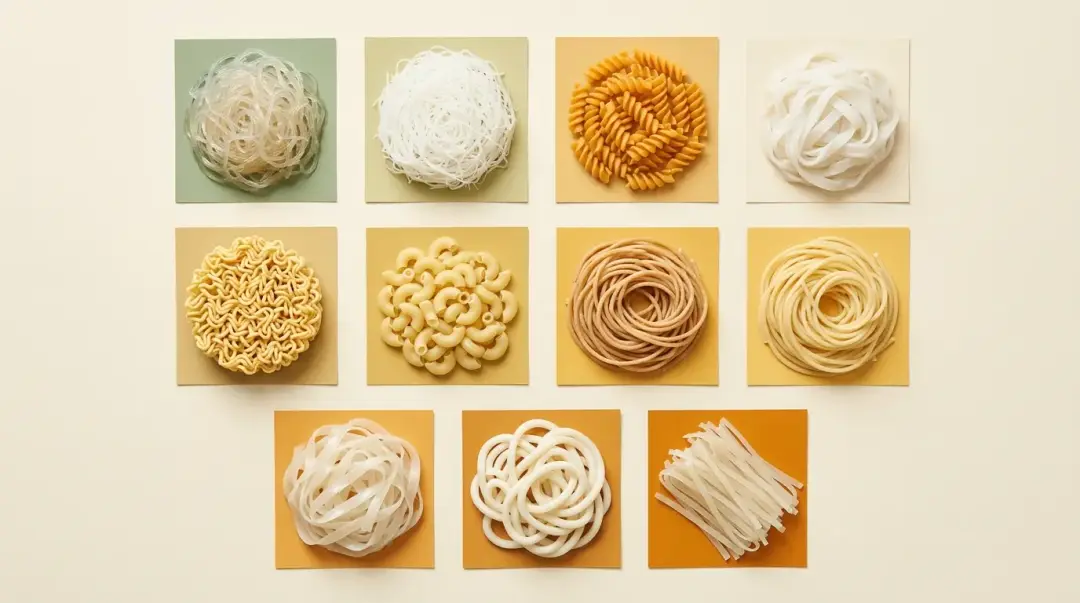
Glycemic index of noodles (glucose = 100), with source per row
| Noodle | GI | Band | Source |
|---|---|---|---|
| Mung bean (glass) noodles, China | 33 | Low | 2002 International GI Table |
| Wheat vermicelli, white, boiled, Australia | 35 | Low | 2002 International GI Table |
| Chickpea pasta, freshly cooked | 39 | Low | Bojarczuk et al., Metabolites, 2024 |
| Rice noodles, freshly made, Australia | 40 | Low | 2002 International GI Table |
| Instant noodles (mean of tests) | 47 | Low | 2002 International GI Table |
| Macaroni, plain (mean of tests) | 47 | Low | 2002 International GI Table |
| Spaghetti, whole meal | 48 | Low | Atkinson et al., Diabetes Care, 2008 |
| Spaghetti, white | 49 | Low | Atkinson et al., Diabetes Care, 2008 |
| Rice noodles (mean of tests) | 53 | Low | Atkinson et al., Diabetes Care, 2008 |
| Udon noodles | 55 | Low | Atkinson et al., Diabetes Care, 2008 |
| Rice noodles, dried, boiled, Thailand | 61 | Medium | 2002 International GI Table |
| For reference: white rice, boiled | 73 | High | Atkinson et al., Diabetes Care, 2008 |
The 2002 rows come from the earlier edition of the same international table, by Foster-Powell, Holt and Brand-Miller, which lists individual tests by country and a 180 g cooked serving for each (pasta and noodle section). The chickpea figure comes from a single 12-person trial.
Eleven noodles, and ten of them land in the low band. The real gaps are between noodle families and the rice bowl next to them, and between one test of a noodle and the next.
Why spaghetti beats rice noodles
The University of Sydney group gives a one-line mechanism for pasta: ungelatinized starch granules stay physically trapped in a sponge-like network of gluten proteins, so digestive enzymes reach them slowly. The same group files Asian wheat noodles like hokkien and udon in the low-to-intermediate range.
Rice noodles have no gluten network. They're rice flour and water set into a gel, and the average lands a few points higher. Glass noodles break the pattern, since mung bean starch noodles have no gluten either and still post the lowest number in the table at 33. Gluten is one route to a low GI, and the starch itself is another.
A 2003 study from Japan pointed the same way from a different angle. With white rice as the reference food, 58 volunteers tested 32 common Japanese foods, and udon, soba and spaghetti all came out with low GI values next to the rice (Sugiyama et al., European Journal of Clinical Nutrition, 2003).
One noodle, several numbers
Rice noodles appear in the tables at 40 when freshly made in Australia and 61 when dried and boiled in Thailand. That is a 21-point gap, enough to cross from low into medium, for what a shopper would call the same food. Udon shows the same split: 62 in one Australian test, 55 as the 2008 average.
Averages move between editions too. White spaghetti went from a mean of 38 in the 2002 table to 49 in 2008. Each value also carries a standard error, from plus or minus 1 to 8 points across the rows above, so two noodles a point or two apart, like whole meal spaghetti at 48 and white at 49, are not meaningfully different.
A noodle's GI is better read as a range. The brand, the flour, how long it was cooked and who ate it in the test all move the number.
The al dente question
The University of Sydney advice is direct: cook pasta al dente, because overcooking boosts the GI. The one controlled test of cooking time NoodleDex could find is older and smaller. In 1986, a research team fed 13 people with diabetes spaghetti boiled for 5 minutes and for 15 minutes and measured GIs of 45 and 46, which the authors described as virtually no difference (Wolever et al., Diabetes Care, 1986). The same study found protein-enriched spaghetti at 38, also not a significant difference.
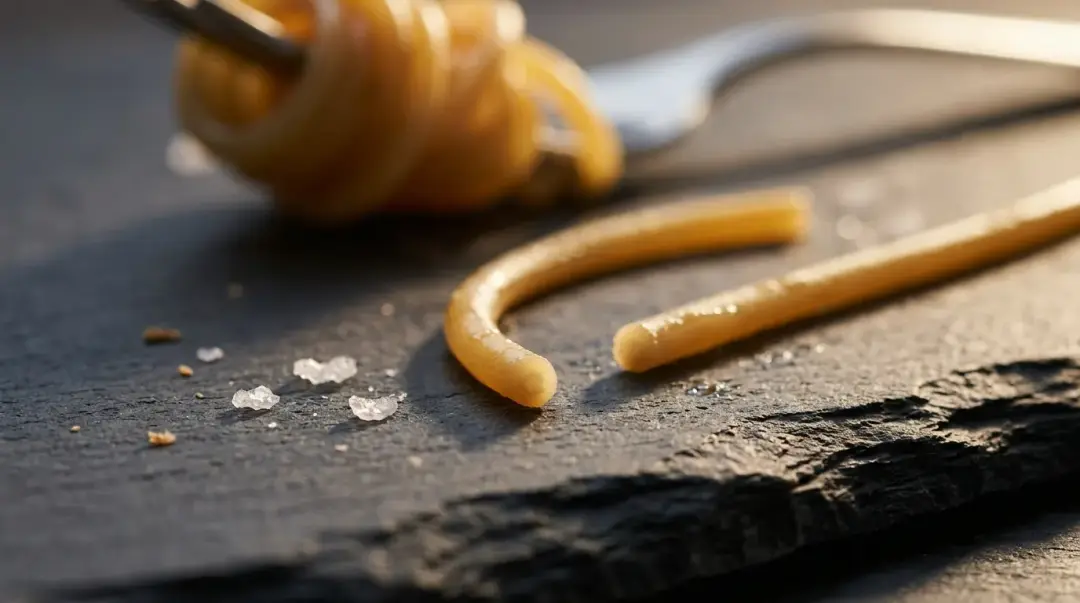
The two don't fully contradict each other. The 1986 test stopped at 15 minutes and used 13 people, so it says little about pasta left boiling for half an hour. Al dente is the better-tasting choice either way.
Glycemic load changes the order
GI says nothing about portion. Glycemic load (GL) does: multiply the GI by the grams of available carbohydrate in a serving and divide by 100. For a 180 g cooked serving, the 2002 table gives fresh rice noodles a GL of 15, white spaghetti 18, instant noodles 19, dried Thai rice noodles 23, and plain udon 30.
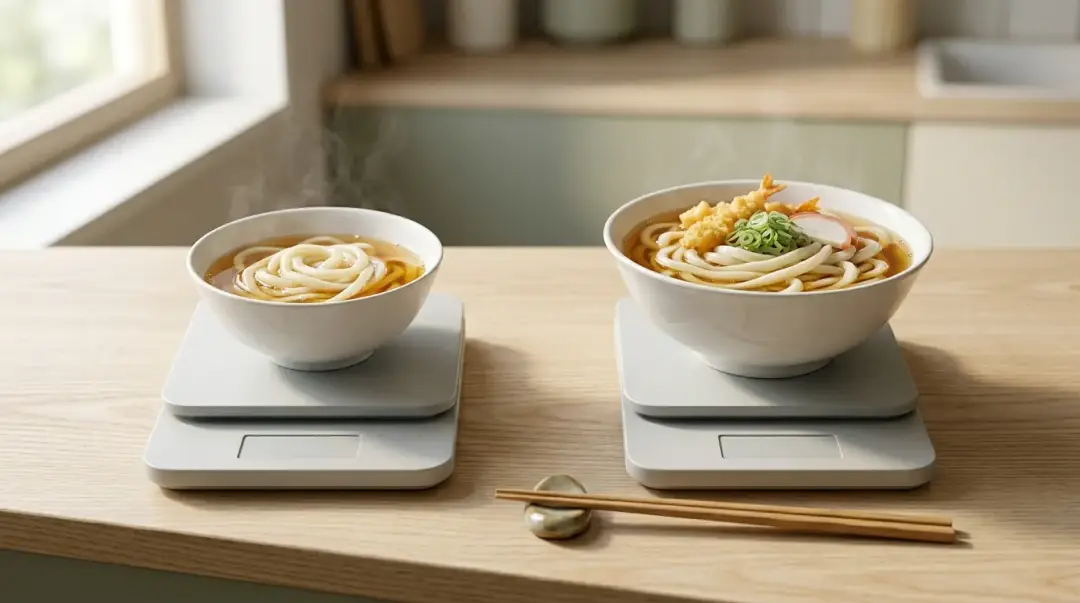
Udon and white spaghetti carry close to the same carbohydrate per 180 g serving in that table, roughly 48 g, so udon's load of 30 comes from its higher GI in that particular test (62, against 38 for spaghetti in the same edition). GL also scales directly with the bowl. Doubling the noodles doubles the load, which is where a restaurant portion matters more than the noodle family. For the carbohydrate side of the question, see the lowest-carb noodles, and for udon specifically, the udon type page.
What else on the plate moves it
A GI test feeds people the food on its own after an overnight fast. Nobody eats noodles that way. In the Japanese study, adding vinegar, dairy or bean products to white rice cut its GI by 20 to 40%, a bigger swing than the gap between most noodles in the table.
Preparation counts too. Chickpea pasta dropped from a GI of 39 to 33 after a day in the fridge and a reheat in the 2024 trial, and the resistant starch noodles guide covers the full set of chilling studies, including one where reheated pasta cut the rise in blood glucose by about 40% in people with type 1 diabetes and others where the effect was small.
Where the GI tables run out
Plenty of noodles on a US shelf have no published GI at all. The international tables give no single soba value, and Korean dangmyeon (sweet potato starch noodles, dahng-myun), fresh lo mein and most supermarket brands have never been tested in a human GI study that NoodleDex could find. Shirataki is absent for a different reason: konjac noodles carry almost no digestible carbohydrate, so there's nothing to measure. NoodleDex's shirataki buying guide covers the brands for low-carb cooks.
Every value on this page was measured in a lab, mostly in healthy adults, with the noodle eaten plain after an overnight fast. Even the 2008 tables still list rice noodles under a single averaged line: 53, plus or minus 7.
FAQ
Which noodles have the lowest glycemic index?
Among noodles with published values, mung bean glass noodles are lowest at 33, followed by thin wheat vermicelli at 35 and chickpea pasta at 39. Freshly made rice noodles tested at 40 in one Australian study. Shirataki is not listed because it contains almost no digestible carbohydrate to test.
Do rice noodles have a high glycemic index?
It depends on the test. The 2008 international tables average rice noodles at 53, which is low. Individual studies range from 40 for fresh Australian rice noodles to 61 for dried Thai rice noodles, which is medium. Rice noodles sit higher than plain spaghetti on average, but well below boiled white rice at 73.
Is pasta low glycemic?
Yes, by the standard cutoffs. White spaghetti averages 49 in the 2008 international tables, under the low-GI line of 55. The University of Sydney attributes this to starch granules trapped inside a dense gluten network, which slows digestion. Macaroni and instant noodles average 47 in the earlier 2002 tables.
What is the glycemic index of udon?
Udon averages 55 in the 2008 international tables, right at the top of the low band. One Australian test put plain udon at 62, which is medium, with a glycemic load of 30 for a 180 g cooked serving, the highest load of any noodle on this page.
Does whole wheat pasta have a lower GI than white pasta?
Barely. The 2008 tables list whole meal spaghetti at 48 and white spaghetti at 49, a difference well inside the margin of error. Whole wheat pasta has about twice the fiber of enriched pasta, but its glycemic index is close to the same.
Does overcooking noodles raise the glycemic index?
The University of Sydney GI group says it does and recommends cooking pasta al dente. The one controlled test NoodleDex found, a 1986 study of 13 people, saw almost no difference between spaghetti boiled 5 minutes (GI 45) and 15 minutes (GI 46). The evidence is thinner than the advice suggests.
Read Next
- Resistant Starch Noodles: what a night in the fridge does to these numbers
- Whole Grain vs Refined Noodles: fiber and protein, per USDA
- Glass vs Rice vs Wheat Noodles
- Lowest-Carb Noodles
Products mentioned in this guide
This section contains affiliate links. We may earn a commission at no extra cost to you.

De Cecco Spaghetti No. 12, 16 oz (Pack of 20)
Plain durum wheat spaghetti, the noodle that lands lower on the GI tables than most people expect. Boil it to the package's al dente time.
View on Amazon
Banza Chickpea Pasta Variety Pack, 8 oz (Pack of 6)
Chickpea pasta tested at a GI of 39 in a 2024 trial, under wheat spaghetti. It cooks faster and turns soft if you leave it in the pot.
View on Amazon
Hakubaku Organic Soba Noodles (Pack of 3)
A wheat and buckwheat soba. A Japanese GI study grouped soba with udon and spaghetti as low-GI noodles, though the international tables give it no single number.
View on Amazon
Buying guides for this topic
- Buying guideBest Italian Pasta Brands in 2026De Cecco, Rummo, Garofalo, and premium bronze-die pasta brands ranked. The pasta upgrade worth making.
- Buying guideBest Udon Noodles in 2026The best dry, frozen, and fresh udon noodles available on US Amazon — Hakubaku, Maruchan Seimen, Sanuki, and Inaniwa ranked.
- Buying guideBest Rice Noodles for Pho, Pad Thai, and MoreThe best rice noodles on Amazon: Three Ladies bánh phở, A Taste of Thai, Annie Chun's and Lotus Foods, ranked for pho, pad thai and more.
- Buying guideBest Shirataki Noodles in 2026House Foods, Miracle Noodle, and Skinny Noodle shirataki ranked. The zero-calorie keto noodle, US Amazon best picks.