Ramen Toppings Ranked: 12 Picks, Best to Niche (2026)
· 9 min read · NoodleDex Editorial
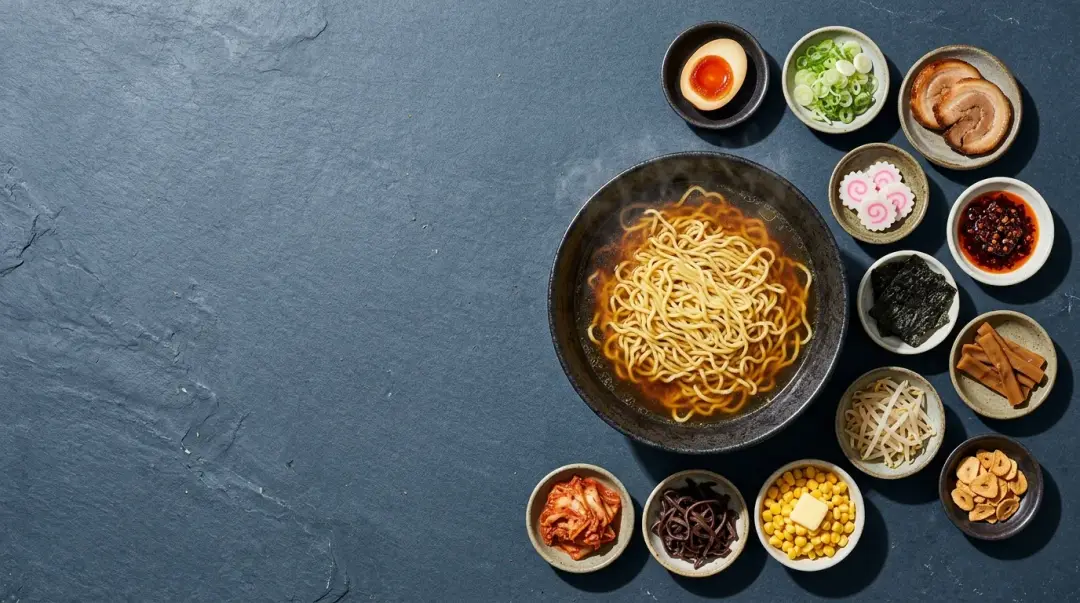
Ramen toppings ranked 1 to 12 by versatility, availability and effect on the bowl: ajitama, scallions, chashu, chili crisp, menma, corn, naruto and more.
This page contains affiliate links. We may earn a commission at no extra cost to you. Disclosure
"What Goes on Ramen Besides an Egg?"
Start with the pink swirl. That spiral fish cake, narutomaki (nah-roo-toh-MAH-kee), is the topping cartoon ramen bowls almost always include, and Just One Cookbook puts about 90 percent of its production in a single fishing city: Yaizu, in Shizuoka Prefecture. The swirl is named after the Naruto whirlpools between Awaji Island and Shikoku. It is white fish paste with a dyed pink layer rolled inside, it is already cooked, and in a bowl of ramen it does almost nothing.
Fame and usefulness rank toppings differently, so this list scores twelve of them on three counts:
- Versatility, meaning how many broth styles it improves, from clear shio to cloudy tonkotsu to a packet of Shin Ramyun.
- Availability, meaning whether a regular supermarket has it or you need an Asian grocer such as H Mart, Mitsuwa or Uwajimaya.
- Effect on the bowl: what it changes among richness, crunch, acid, heat, aroma and salt. A topping that only adds color scores low.
Japanese diners agree with the top of this list. A 2022 d Point Club survey of respondents aged 15 to 69 named chashu (64.1 percent), egg (43.6 percent) and scallions (39.5 percent) as their favorite toppings, followed by menma (28.7), garlic (16.7) and bean sprouts (16.2). The order below differs because a home cook outside Japan has to weigh effort and shopping as well as taste.
The Ranking at a Glance
Twelve ramen toppings scored for a home cook
| Rank | Topping | Versatility | Availability | What it does to the bowl |
|---|---|---|---|---|
| 1 | Ajitama (marinated egg) | Every style | Any supermarket | Richness, salt, a jammy yolk |
| 2 | Scallions (negi) | Every style | Any supermarket | Sharp, fresh aroma |
| 3 | Chashu (braised pork) | Most styles | Make it, or a Japanese market | Fat, protein, savory depth |
| 4 | Chili crisp | Most styles, best on instant | Most supermarkets | Heat, crunch, fermented bean |
| 5 | Nori | Shoyu, tonkotsu, iekei | Most supermarkets | Sea-mineral aroma |
| 6 | Menma (bamboo shoot) | Shoyu, shio, miso | Asian and Japanese markets | Tang and a firm bite |
| 7 | Bean sprouts (moyashi) | Miso, spicy, instant | Most supermarkets | Crunch, water, volume |
| 8 | Garlic and mayu | Tonkotsu, miso | Any supermarket (garlic) | Pungency, roasted bitterness |
| 9 | Butter and corn | Miso mainly | Any supermarket | Sweetness, a buttery slick |
| 10 | Kikurage (wood ear) | Tonkotsu | Asian markets, dried | Crunch, almost no flavor |
| 11 | Kimchi and American cheese | Korean ramyeon | Any supermarket | Acid and heat, then creaminess |
| 12 | Narutomaki (fish cake) | Shoyu, tonkotsu | Japanese markets, frozen | Color, mild sweetness |
1 to 3: The Toppings Every Bowl Wants
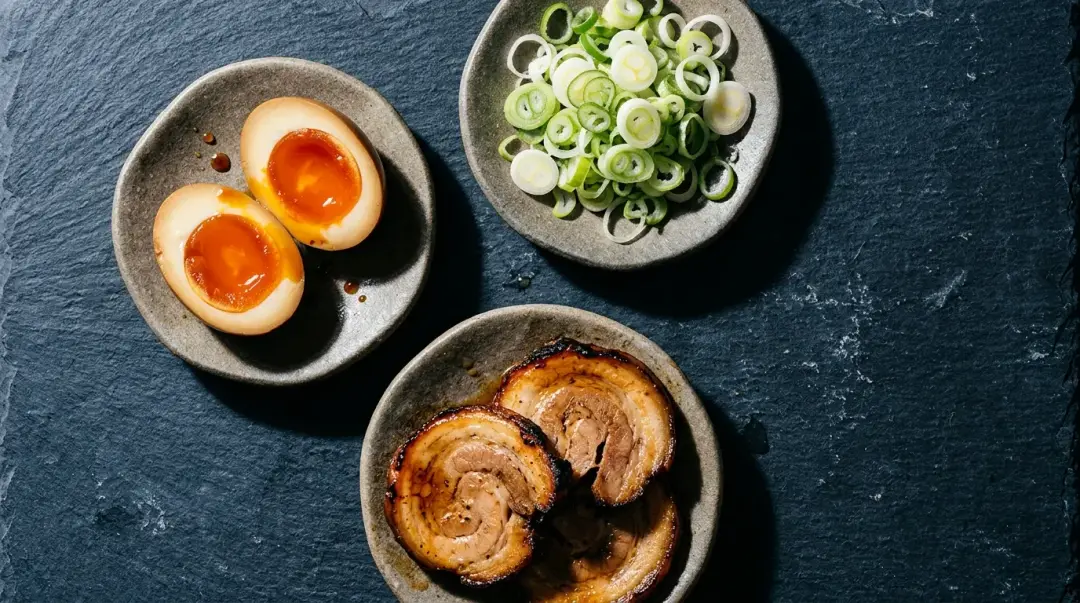
1. Ajitama
Ajitama (ah-jee-TAH-mah), short for ajitsuke tamago, is a soft-boiled egg peeled and soaked in a soy-based marinade. Just One Cookbook boils its eggs for 7 minutes for a jammy yolk, then marinates them in equal parts soy sauce, mirin, sake and sugar for about 8 hours, and warns that past 12 to 24 hours the white turns salty and firm. The eggs keep 3 to 4 days in the fridge.
It wins on all three counts. Eggs are in every store, the marinated egg improves shio, shoyu, miso, tonkotsu and a packet of instant noodles alike, and the yolk thickens whatever broth it bleeds into. The only cost is planning a night ahead. Our ramen eggs guide covers timings, peeling and the marinade ratios in detail.
2. Scallions
Negi (NEH-ghee), Japanese green onion, appears on nearly every ramen in Japan, and in the survey above it came third. Outside Japan, plain scallions are the stand-in. They cost almost nothing and add the one thing a heavy broth lacks: something sharp and raw. Slice the white parts thin for bite and the green parts on a bias for aroma. Iekei shops in Yokohama put green onion on the standard bowl next to spinach and nori.
3. Chashu
Chashu (CHAH-shoo) is the survey's runaway favorite, and it would be first on taste alone. Japanese chashu is pork belly, often rolled and tied with twine, braised in soy sauce, sake, sugar and water with ginger and leek. That makes it softer than Chinese char siu, which is roasted and glazed. Just One Cookbook braises a rolled belly for about 2 hours, then rests it 8 hours in the cooking liquid so it slices cleanly.
Chashu ranks third because of that effort and because supermarkets rarely sell it ready-made. The leftover braising liquid also seasons ajitama, so one project feeds two toppings. Some shops finish sliced chashu with a kitchen torch, a sear called aburi (炙り, flame-seared), and a small butane torch does the same at home. The chashu pork guide has cuts, braise times and the roll-versus-slab debate.
Scallions cost almost nothing and rank second. Naruto needs a trip to a Japanese freezer case and ranks last.
4 to 7: Cheap Moves With Big Payoff
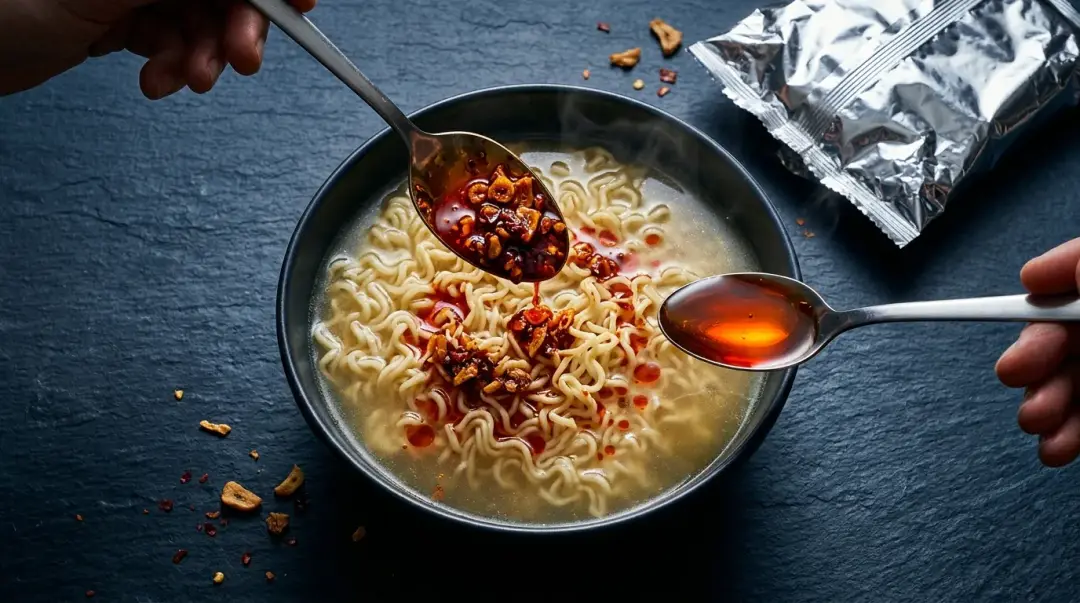
4. Chili crisp
The only modern topping in the top half. Chili crisp is chili flakes fried in oil with garlic, onion, Sichuan peppercorn and sometimes fermented soybeans, per National Geographic's history of the condiment. Lao Gan Ma, founded by Tao Huabi in Guizhou Province, began selling its Spicy Chili Crisp in 1997 and still sets the standard many shoppers know.
It ranks this high because it does three jobs at once (heat, crunch and savory oil) and it rescues instant ramen better than anything else on this list. A teaspoon on a packet of chicken-flavor noodles changes it more than any other single spoonful on this list. It is less welcome on a delicate shio, where it covers everything. Lao Gan Ma and its rivals sit in our Chinese pantry essentials picks. For the jars side by side, see our best chili crisp guide.
5. Nori
Roasted seaweed sheets lean against the rim, soften in the broth and give off a sea-mineral smell. Iekei ramen, which Yoshimuraya created in Yokohama in 1974, serves three sheets on the standard bowl, and regulars wrap rice or noodles in them. Nori comes in sushi packs at most supermarkets now. Add it last, at the edge of the bowl, so it stays crisp for the first few bites. The style gets its own page in our Yokohama iekei ramen guide.
6. Menma
Menma (MEN-mah) is bamboo shoot that has been boiled, fermented, dried and then seasoned. Wikipedia traces most of it to southern China and Taiwan, and notes that it was called shinachiku until the 1940s, when Japan's Foreign Ministry discouraged the word "Shina." Uwajimaya describes the flavor as slightly salty with "a bit of a pickley tang" and a firm bite, and shelves it next to pickled and canned vegetables.
It ranks sixth because it is the best texture contrast in a classic shoyu bowl and nearly impossible to fake, but most shoppers need an Asian grocery to buy it.
7. Bean sprouts
Moyashi (moh-YAH-shee) adds crunch, cools the first bites and stretches a bowl for very little money. Food in Japan lists bean sprouts among the defining toppings of Sapporo miso ramen, and the survey had them sixth. They are wrong for a clear shio, where they water the broth down, and right for miso, spicy bowls and instant packets. Blanch them briefly, or drop them into the instant-noodle pot for the last minute.
8 to 12: Specialists
8. Garlic and mayu
Raw garlic was the survey's fifth choice, and Fukuoka tonkotsu counters often leave a garlic press within reach. Kumamoto takes it further with mayu (MAH-yoo), a black garlic oil, plus fried garlic chips. Fresh garlic is everywhere; mayu is a project or a specialty jar. Both belong on tonkotsu and miso and fight with a light chicken shio.
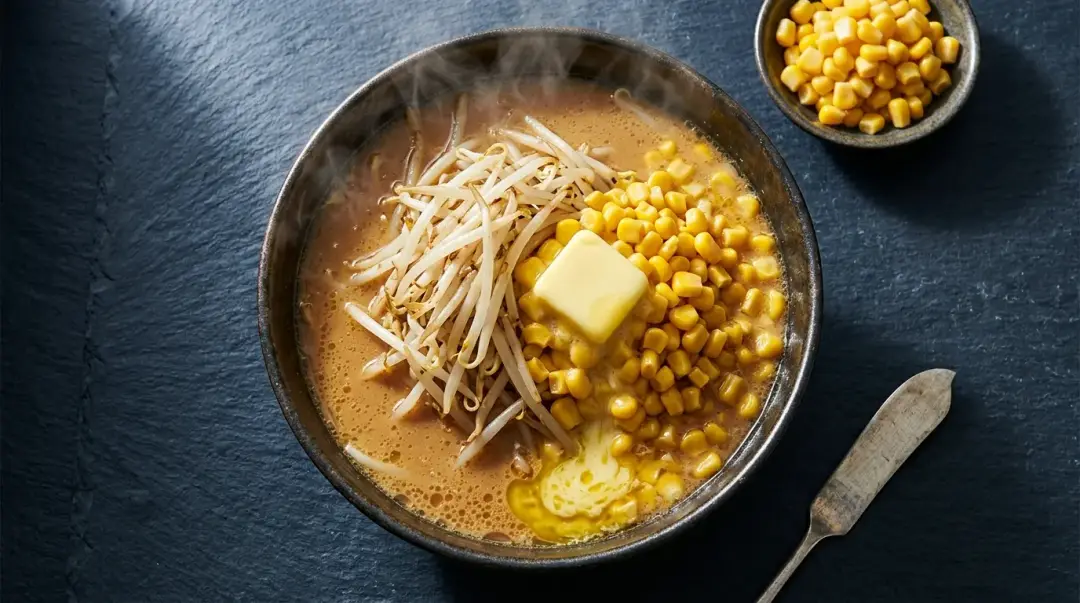
9. Butter and corn
The Sapporo pair. Aji no Sanpei places its first miso ramen around 1954 or 1955, and Food in Japan credits Hokkaido's dairy farms and cornfields for the butter-and-corn version that followed. A pat of butter melts into the miso and softens its salt, and canned or frozen sweet corn adds bursts of sugar. Outside a miso bowl the pair loses most of its point, which is why it sits at nine.
10. Kikurage
Kikurage (kee-koo-RAH-geh), wood ear mushroom, is cut into strips for tonkotsu. Food in Japan notes that it "stays crunchy," which balances the soft noodles, and that is its whole job, since it tastes of very little. Buy it dried at an Asian market and soak it until soft before slicing. Fukuoka counters set out beni shoga (BEH-nee SHOH-gah), red pickled ginger, next to it, with the warning to add it slowly because it takes over the broth.
11. Kimchi and American cheese
This is the Korean ramyeon (instant noodle) pair, and it only makes sense on that bowl. Both trace to budae jjigae (BOO-deh JJEE-geh), the army-base stew that grew out of food scavenged from US military bases after the Korean War; Wikipedia lists kimchi, instant noodles and American cheese among its standard ingredients. Kimchi brings acid and more heat. A slice of cheese laid on top off the heat melts into the spicy broth and softens it. On a Japanese shoyu bowl, both are out of place. Our ramyeon page covers the Korean instant side, and our cheesy and creamy ramen guide covers cheese-style ramen.
12. Narutomaki
Back to the swirl. It is pleasant, mildly sweet and springy, and it adds a pink circle to a brown bowl. But it changes neither the broth nor the texture much, and most shoppers will find it only in the freezer case of a Japanese market. Buy a log if you want the look of a Tokyo-style shoyu bowl. Skip it if the money could go to eggs.
Build Three Bowls From This List
Put the ranking to work by matching three toppings to the broth. These combinations use only items from the top ten and stay within one shopping trip.
Three-topping builds by broth
| Bowl | Three toppings | Why this trio |
|---|---|---|
| Shoyu or shio | Ajitama, menma, scallion | Yolk for body, tang for contrast, onion for lift |
| Tonkotsu | Chashu, kikurage, garlic | More pork, crunch against the creamy broth, pungency to cut fat |
| Miso | Butter and corn, bean sprouts, scallion | The Sapporo set: sweet, crunchy, sharp |
| Instant chicken packet | Ajitama, chili crisp, scallion | Three minutes of work, three new textures |
| Korean ramyeon | Kimchi, American cheese, egg | Acid, then cream, then yolk to round the heat |
For the broth side of each pairing, our ramen broth guide explains how the tare and stock change what a topping needs to do.
FAQ
What are the most common ramen toppings?
In Japan, chashu (braised pork), a seasoned soft-boiled egg and scallions lead most surveys. A 2022 d Point Club survey of Japanese respondents aged 15 to 69 put chashu at 64.1 percent, egg at 43.6 percent and scallions at 39.5 percent, followed by menma, garlic and bean sprouts. Nori, corn and butter round out the classic set.
What can I put in instant ramen besides an egg?
Scallions, a spoon of chili crisp, a sheet of nori, frozen corn with a pat of butter, bean sprouts or kimchi all work and need no special shopping. For Korean ramyeon, a slice of American cheese melted on top is a common move. Add sprouts and corn in the last minute of cooking so they stay crisp.
What is the pink and white swirl on ramen?
It is narutomaki, or naruto, a steamed fish cake made from white fish paste with a dyed pink layer rolled inside. The spiral is named after the Naruto whirlpools between Awaji Island and Shikoku. Most of it comes from Yaizu in Shizuoka Prefecture. Look in the freezer or fridge case at Japanese and Asian markets.
What is menma made of?
Menma is bamboo shoot that has been boiled, fermented, dried and then seasoned, usually with soy sauce and sesame oil. Most of it comes from southern China and Taiwan. It tastes mildly salty and a little tangy, with a firm bite. Japanese markets such as Uwajimaya stock it in jars near the pickles and canned vegetables.
Why do people put butter and corn on ramen?
It is a Sapporo habit. Miso ramen took shape there in the mid-1950s, and Hokkaido's dairy farms and cornfields put butter and sweet corn on top of it. The butter melts into the miso broth and rounds out its salt, and the corn adds sweetness. The pair works best on miso and is much less convincing on a clear shoyu or shio bowl.
How long does a ramen egg need to marinate?
Most recipes marinate a peeled soft-boiled egg for about 8 hours or overnight in a mix of soy sauce, mirin, sake and sugar. Past 12 to 24 hours the white turns salty and firm. Just One Cookbook boils the eggs for 7 minutes for a jammy yolk and says the marinated eggs keep 3 to 4 days in the fridge.
Read Next
Products mentioned in this guide
This section contains affiliate links. We may earn a commission at no extra cost to you.

Kikkoman Traditionally Brewed Soy Sauce, 33.8 oz
The base of the ajitama marinade that tops this list, and of a quick chashu braise. One bottle covers months of eggs.
View on Amazon
Lao Gan Ma Chili Crisp (Original)
Number four on the ranking and the fastest upgrade for a packet of instant ramen. A spoonful adds crunch, chili oil and fermented soybean in one move.
View on Amazon
SUN NOODLE Kaedama Ramen Noodles, 10 OZ
Plain fresh ramen noodles with no soup base, which makes them the right canvas for testing toppings against your own broth.
View on Amazon
Jo Chef Butane Torch Lighter Gun
A torch sears the face of a chashu slice just before it goes in the bowl, which is the aburi finish some shops use. This listing is a refillable butane torch with a built-in safety lock and a grip handle.
View on Amazon
Dash Rapid Egg Cooker: 6 Egg Capacity Electric Egg Cooker
The ajitama at number one starts with a soft-boiled egg, and a rapid cooker makes that step repeatable. It holds six eggs, cooks soft, medium or hard, and shuts off automatically.
View on Amazon
Browse more related items
Opens Amazon · affiliate links
Buying guides for this topic
- Buying guideBest Ramen Noodles & Kits in 2026The best fresh and dry ramen noodles, plus premium ramen kits, available on Amazon — Sun Noodle, Hakubaku, Marusan, and Maruchan Seimen ranked.
- Buying guideBest Japanese Pantry Essentials in 2026The 10 Japanese pantry items needed to cook ramen, udon, soba, and yakisoba at home. Soy, dashi, mirin, miso, and yakisoba sauce, ranked.
- Buying guideBest Chinese Pantry Essentials in 2026Soy, oyster sauce, Sichuan peppercorn, chili crisp, fermented bean paste, Chinese sesame paste — the Chinese cooking foundation, ranked.
- Buying guideKorean Pantry Essentials: A Complete Guide (2026)The 10 Korean pantry items you actually need to cook Korean noodles at home — gochujang, gochugaru, sesame oil, dashi anchovies, and more.