Chashu Pork Explained: From Char Siu to Ramen Topping
· 8 min read · NoodleDex Editorial
Chashu pork is ramen's braised, rolled pork belly. How it got its name from Cantonese char siu, how shops braise it, and why some slices are now pink.
This page contains affiliate links. We may earn a commission at no extra cost to you. Disclosure
On this page(10 sections)
A Word That Kept Its Name and Lost Its Fork
Char siu (叉燒, CHAH-syoo) is Cantonese for "fork roasted." The first character is the fork, the second is the roast, and together they name a method: meat held on a fork and roasted. Wikipedia notes that the ovens used today are usually large gas rotisseries, and that in Hong Kong, where home ovens are uncommon, people buy char siu from a siu mei (Cantonese roast meat) shop. The name stayed the same through all of it.
Japan borrowed the word along with the dish. Wikipedia's ramen entry notes that early ramen was wheat noodles in broth topped with char siu, and Japan-guide describes ramen as a noodle soup "originally imported from China." In Japanese the pork became チャーシュー, chāshū, a straight phonetic borrowing. It is also written with the kanji 叉焼 or 焼豚, and Sudachi Recipes points out that both spellings lead back to char siu.
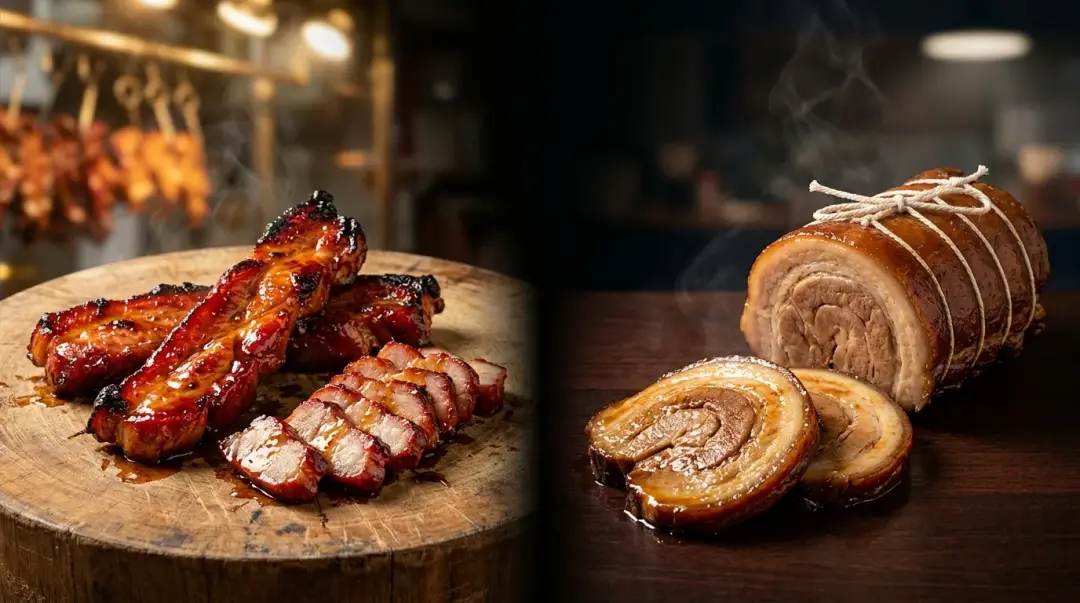
Then the cooking changed while the name stayed put. In most ramen shops the pork is no longer roasted on a fork. It is rolled, tied and simmered in soy sauce. Japanese Wikipedia keeps two words for the two methods:
- Yakibuta (焼豚, yah-kee-BOO-tah), "roasted pork": loin or belly stuffed with minced garlic and ginger, tied, marinated in soy sauce and sake, then roasted. This is the closer descendant of char siu.
- Nibuta (煮豚, nee-BOO-tah), "simmered pork": belly, leg or shoulder, tied, seasoned with salt and pepper, then braised in a soy-based liquid. This is what most ramen shops serve, and they still call it chāshū.
Why the Japanese Version Became a Braise
Japanese Wikipedia gives four practical reasons the braise took over ramen counters. Braised pork keeps longer, which cuts waste. It suits cheap belly cuts. The braising liquid can be reused for stock or seasoning. And the softer texture pairs better with noodles in soup than a firm roasted crust does.
The seasoning changed with the method. Cantonese char siu marinates in hoisin, soy sauce, Chinese wine and five-spice powder, gets a glaze of maltose or honey, and is traditionally colored red with fermented red bean curd and red yeast rice (red food coloring is common now). Wikipedia notes that the Japanese version drops the red color and the five-spice entirely and braises in soy sauce, sake, mirin and sugar.
Cantonese char siu vs Japanese ramen chashu
| Char siu (叉燒) | Ramen chashu (チャーシュー) | |
|---|---|---|
| Name means | Fork roasted | Borrowed from char siu |
| Method | Roasted, often on a rotisserie | Mostly braised (nibuta); some shops roast (yakibuta) |
| Typical cut | Shoulder collar (mui tau); also loin, belly, butt, neck | Skinless belly, rolled; also shoulder loin, leg |
| Seasoning | Hoisin, soy, Chinese wine, five-spice | Soy sauce, sake, mirin, sugar |
| Finish | Honey or maltose glaze, often red | Brown from the soy; sometimes torched |
| Texture | Firm, caramelized outside | Soft, fork-tender |
| Where you eat it | Over rice, in buns, on noodles | Sliced over ramen, or on rice |
Just One Cookbook sums up the difference by texture: Japanese chashu is succulent and fork-tender, while char siu has a firmer bite. Someone who knows only one of them would struggle to call the other a variation of it.
How Ramen Shops Make It
The standard is skinless pork belly with clear bands of fat and lean. Sudachi Recipes looks for three or four bands and an even thickness, so the slab rolls tight and slices into a spiral. Just One Cookbook works with a 2 to 2½ lb block.
Roll, tie, sear
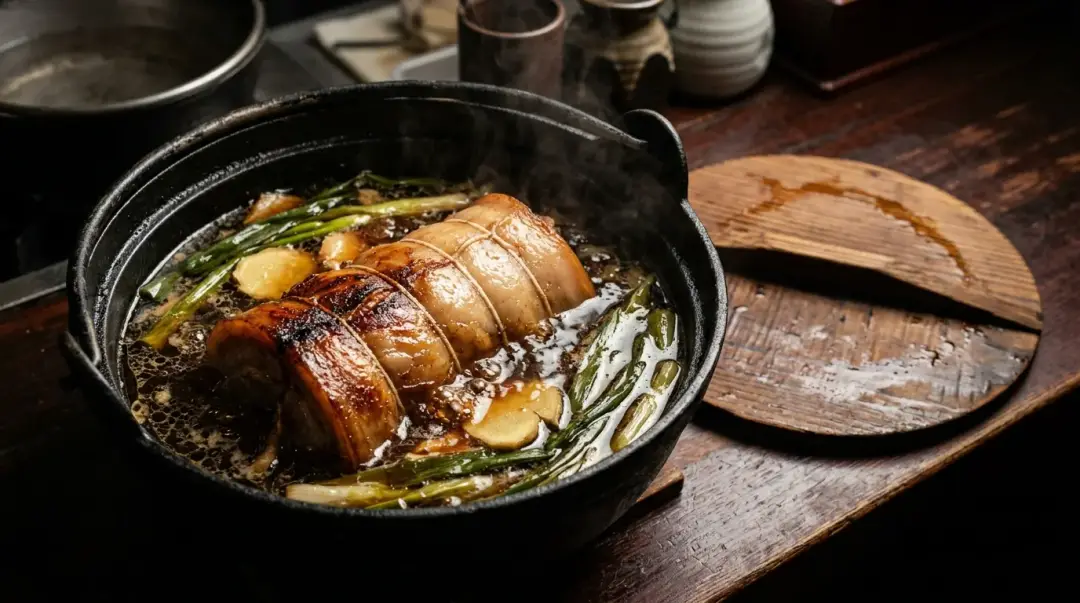
The belly is rolled lengthwise into a log and tied with butcher's twine or a meat net to hold the spiral. Just One Cookbook sears it on all sides before the braise. If rolling sounds fussy, its alternative is smaller ¾ to 1 lb blocks left flat, which braise in about half the time.
Braise low
Just One Cookbook's liquid for a full rolled belly is 1 cup sake, 1 cup soy sauce, 2 cups water and ⅔ cup sugar, with ginger and the green tops of Tokyo negi (a long Japanese leek). The rolled log braises about 2 hours, turned every 30 minutes. Sudachi Recipes keeps the liquid between 80 and 85°C (176 to 185°F) for two one-hour stretches, flipping between them, under a drop lid that keeps the meat submerged. NoodleDex's bowl-building guide gives 2 to 3 hours at a bare simmer and warns that rushing it dries the meat.
Chill, then slice
The step most home cooks skip is the overnight rest. Just One Cookbook leaves the pork in its liquid in the fridge for at least 8 hours so it absorbs the seasoning, and slices it the next day, when the cold fat holds together. Sudachi Recipes cuts 0.5 cm slices; the NoodleDex bowl guide says 6 mm. Either way, thin enough to warm through in hot broth.
Sliced chashu keeps up to 7 days in the fridge and about a month in the freezer, by Just One Cookbook's numbers. Sudachi Recipes freezes slices wrapped individually rather than submerged in liquid. To serve, warm slices in a little of the braising liquid, lay them on the bowl, or torch the edges for a smoky char.
The Braising Liquid Is the Second Product
The pot of liquid left after the braise is worth as much as the pork. Sudachi Recipes describes its finished marinade of sake, mirin, soy sauce, oyster sauce, sugar and honey as "an 80-percent-done ramen kaeshi," the soy-based seasoning that sits at the bottom of a shoyu bowl. Our tare guide covers how that seasoning works and how much goes in a bowl.
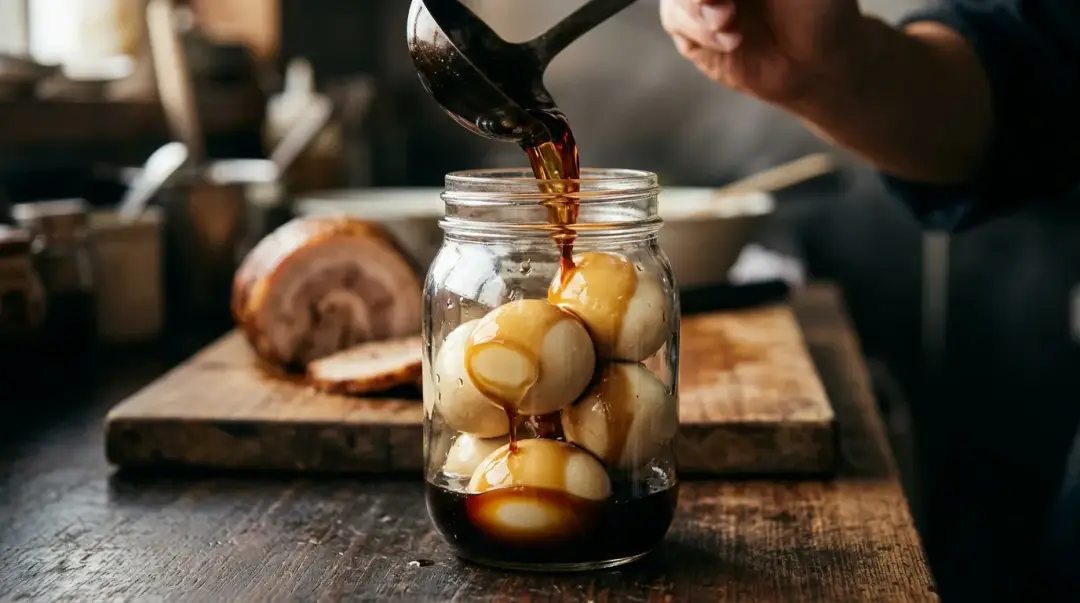
The same liquid is the classic marinade for ramen eggs, recommended by both Just One Cookbook and Sudachi Recipes. A soft-boiled egg left in chashu liquid overnight turns into ajitama, the soy-cured ramen egg; see our ramen egg guide for timing. Japanese Wikipedia lists this reuse as one of the reasons braising won out in the first place.
Belly, Shoulder or Leg
Cut decides both texture and calories.
Chashu cuts compared
| Cut | Japanese | What it gives you | Calorie note |
|---|---|---|---|
| Belly | バラ (bara) | Soft, rich, rolls into a spiral | Raw pork belly is 147 kcal per ounce (USDA) |
| Shoulder loin | 肩ロース (kata rōsu) | Leaner and less tender than belly (Just One Cookbook) | — |
| Leg | もも (momo) | The leanest of the three | A thin lean slice runs under 20 kcal |
Just One Cookbook treats belly as essential for its fat-to-meat ratio and says shoulder works but is less tender. The calorie spread is wide: our ramen calorie breakdown puts two slices of chashu anywhere from under 40 to about 300 kcal depending on cut and thickness, since braising renders off only part of the belly's fat.
The Pink Chashu Turn
Traditional Japanese chashu is brown, because it is simmered in soy sauce and sugar. An article from the Japanese publisher Kanzen notes that in recent years many shops, especially those that show up in annual ramen rankings, had switched to pink chashu cooked at low temperature.
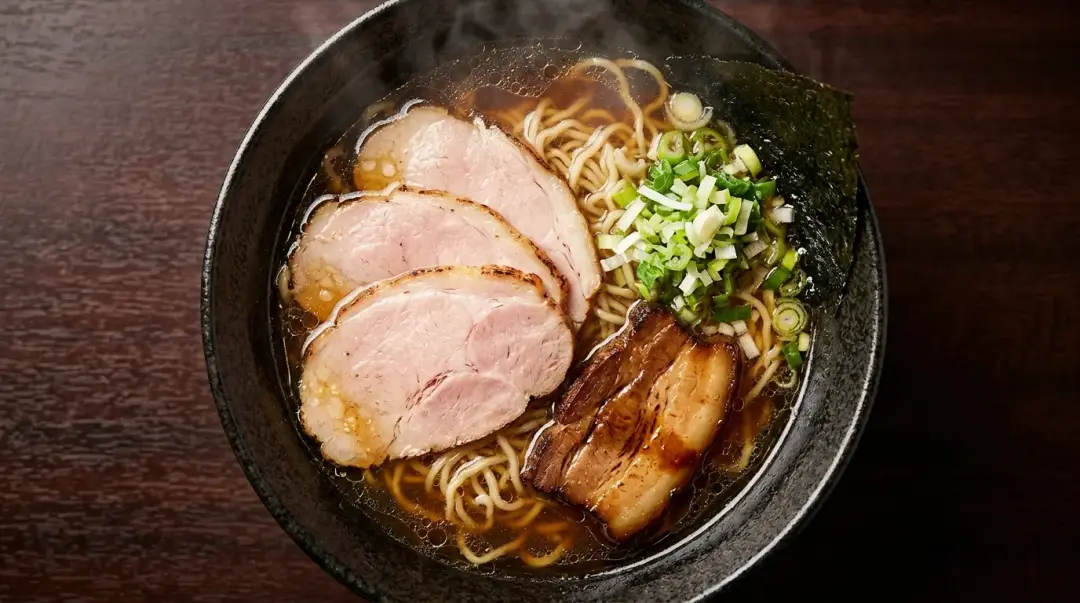
The method is a French low-temperature technique, the one home cooks know as sous vide. The pork is vacuum-sealed and held in water at 63 to 68°C for a long stretch, then seared for color. At that range the proteins set without squeezing out as much moisture, so the slice stays juicy. Japan's restaurant-review site Tabelog files it under rea chāshū (レアチャーシュー), "rare chashu," and its keyword page for Tokyo alone lists more than 1,000 ramen and tsukemen shops serving it.
Low temperature leaves less margin for error. In March 2021, Hiroshi Yamaguchi, owner of Ramen Yamaguchi in Tokyo's Nishi-Waseda, posted a warning on Twitter against low-temperature chashu made without proper knowledge, citing food poisoning cases tied to chashu over the previous five years. His own shop uses industrial vacuum-cooking equipment and digital thermometers. J-Cast's report gives the Japanese standard as a core temperature of 63°C held for at least 30 minutes. In the US, the USDA set its guidance for whole cuts of pork in 2011 at 145°F (63°C) with a three-minute rest. A home sous vide setup needs a reliable thermometer.
Making Either Version at Home
For the Japanese braise, everything comes from the soy sauce shelf: soy sauce, sake, mirin and sugar, plus a ginger knob and a leek. Our Japanese pantry essentials guide picks the bottles. You need a heavy, lidded pot that holds the rolled belly snugly, so the liquid covers more of the meat; an enameled cast iron Dutch oven is one fit for a braise that sits at 80 to 85°C for two hours. Cotton butcher's twine holds the roll together, and a butane kitchen torch gives the sliced edges their char just before serving.
For the Cantonese original, a bottled char siu sauce is the fast route. Lee Kum Kee's version is sold at Walmart, and our Chinese pantry essentials guide covers the hoisin and five-spice if you'd rather build the marinade yourself. Roast a marinated shoulder strip, slice it, and eat it next to a slice of braised belly. Hoisin and five-spice on one plate, plain soy and mirin on the other: that is what changed when the dish crossed to Japan.
Reading Chashu on a Menu
| On the menu | Script | What you get |
|---|---|---|
| Chāshū | チャーシュー / 叉焼 / 焼豚 | Sliced pork for ramen, braised or roasted; "fatty slices of roasted or braised pork," in Japan-guide's words |
| Chāshūmen | チャーシューメン | The same ramen with extra slices of chashu across the top; a standard bowl has one or two |
| Nibuta | 煮豚 | Simmered pork, the braised belly most shops serve |
| Yakibuta | 焼豚 | Oven-roasted pork, closer to the Cantonese original |
| Rea chāshū | レアチャーシュー | Low-temperature pink chashu, usually seared before slicing |
| Char siu | 叉燒 | The Cantonese red-glazed roast pork, at a Chinese barbecue shop rather than a ramen counter |
FAQ
What is chashu pork?
Chashu is the sliced pork served on ramen. In Japan it is usually pork belly rolled into a log, tied with twine, braised in soy sauce, sake, mirin and sugar, chilled, and sliced about 5 to 6 mm thick. Some shops roast it instead or cook it at low temperature, and leaner cuts like shoulder and leg are also used.
Is chashu the same as char siu?
No, though the name is the same word. Cantonese char siu means fork-roasted pork: usually shoulder, marinated with hoisin, soy, Chinese wine and five-spice, glazed with honey or maltose and roasted, often red. Japanese ramen chashu is mostly braised in soy, sake, mirin and sugar, with no five-spice or red color, and is much softer.
What cut of pork is used for chashu?
Skinless pork belly is the standard for rolled ramen chashu, because its layers of fat and lean braise soft and slice into a spiral. Japanese recipes also use shoulder loin and leg. Just One Cookbook calls for a 2 to 2.5 lb belly block and says shoulder works but is less tender.
How long does chashu take to make?
A rolled belly braises about 2 hours; unrolled smaller blocks take about 1 hour in Just One Cookbook's recipe. Sudachi Recipes holds the liquid at 80 to 85 C for 2 hours. Then the pork should rest in its liquid in the fridge overnight, at least 8 hours, before slicing.
Why is some chashu pink?
Pink chashu is cooked at low temperature, vacuum-sealed and held around 63 to 68 C, then seared. Many highly ranked Japanese shops have adopted it. Japan's standard is a core temperature of 63 C held for 30 minutes; the USDA standard for whole pork cuts is 145 F with a three-minute rest.
What is chashumen?
Chashumen is a ramen order with extra slices of chashu laid over the bowl. A standard bowl usually comes with one or two slices, according to Japan-guide. On a menu it is the same ramen and broth as the base bowl, with more pork laid across the top.
Read Next
Products mentioned in this guide
This section contains affiliate links. We may earn a commission at no extra cost to you.

Kikkoman Naturally Brewed Soy Sauce, 15 oz
The braising liquid for Japanese chashu is mostly soy sauce and sake. A full rolled belly uses about a cup of soy, so buy the larger bottle.
View on Amazon
Kikkoman Manjo Aji-Mirin, 10 fl oz
Mirin is one of the four seasonings that replaced char siu's hoisin and five-spice in Japan. It also goes into the tare you make from the leftover braise.
View on Amazon
Lee Kum Kee Char Siu Sauce (14 oz, 2-pack)
For the Cantonese original. A bottled char siu marinade gets you the sweet, red-glazed roast pork this page starts with, and makes the contrast with ramen chashu easy to taste.
View on Amazon
GoodCook Everyday 300 ft Cotton Twine, Food Safe and Oven Safe
The belly is rolled and tied before it braises, and the twine is what keeps the spiral together through two hours in the liquid. This listing is a 300 ft spool of cotton twine marked food safe and oven safe.
View on Amazon
Lodge Essential Enamel Cast Iron Dutch Oven, 6 Quart
A covered pot that holds a low, steady heat suits the 80 to 85°C braise this page describes. This listing is a 6-quart enameled cast iron Dutch oven with a lid that works on the stovetop and in the oven.
View on Amazon
Buying guides for this topic
- Buying guideBest Japanese Pantry Essentials in 2026The 10 Japanese pantry items needed to cook ramen, udon, soba, and yakisoba at home. Soy, dashi, mirin, miso, and yakisoba sauce, ranked.
- Buying guideBest Chinese Pantry Essentials in 2026Soy, oyster sauce, Sichuan peppercorn, chili crisp, fermented bean paste, Chinese sesame paste — the Chinese cooking foundation, ranked.
- Buying guideBest Japanese Cookware in 2026The donabe, ramen bowls, sōmen sets, and tools you need to cook Japanese noodles at home. Real US Amazon picks across budget tiers.
- Buying guideBest Ramen Noodles & Kits in 2026The best fresh and dry ramen noodles, plus premium ramen kits, available on Amazon — Sun Noodle, Hakubaku, Marusan, and Maruchan Seimen ranked.