Iekei Ramen: Yokohama's Tonkotsu-Shoyu Bowl
· 8 min read · NoodleDex Editorial
Iekei ramen is Yokohama's tonkotsu-shoyu bowl, born at Yoshimuraya in 1974: thick noodles, spinach, nori, chicken oil, and how to order it your way.
This page contains affiliate links. We may earn a commission at no extra cost to you. Disclosure
The Order Comes Before the Bowl
The ticket machine stands by the door. You feed it yen, press the button for ramen (and probably one for rice), and it drops a small paper ticket. That part is the same at plenty of Japanese noodle shops. The iekei part comes next. You hand the ticket across the counter, and before the cook touches a noodle, you owe three answers.
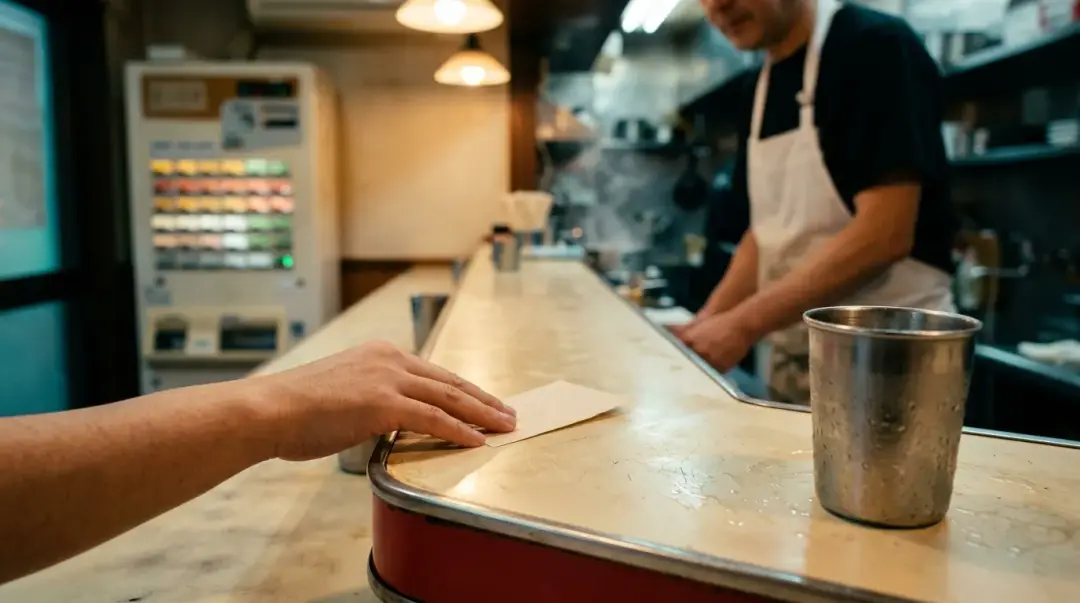
The three iekei preferences, and how to say them
| What you are choosing | Firmer / more | Normal | Softer / less |
|---|---|---|---|
| Noodle firmness (men no katasa) | Katame (kah-tah-meh) | Futsuu (foo-tsoo) | Yawarakame (yah-wah-rah-kah-meh) |
| Flavor strength (aji no kosa) | Koime (koh-ee-meh) | Futsuu | Usume (oo-soo-meh) |
| Chicken oil (abura no ryō) | Oome (oh-oh-meh) | Futsuu | Sukuname (soo-koo-nah-meh) |
Futsuu means "normal," and saying it three times is a complete order. OK Ramen's iekei primer gives the enthusiasts' order as katame, koime, oome: firm noodles, strong seasoning, extra oil. That combination is the bowl at full volume, salty and slick enough that the rice on the side starts to look like a necessity.
The three settings map onto the three things that make an iekei bowl. Firmness is about the noodle, which is thick and chewy to begin with. Strength is about the tare (TAH-reh), the concentrated soy-sauce seasoning ladled into the bowl before the broth. Oil is about chiyu (chee-yoo), chicken fat rendered from the skin and floated on top, which gives the soup its shine and keeps it hot. For how tare works across all ramen, see what is tare.
What Arrives in the Bowl
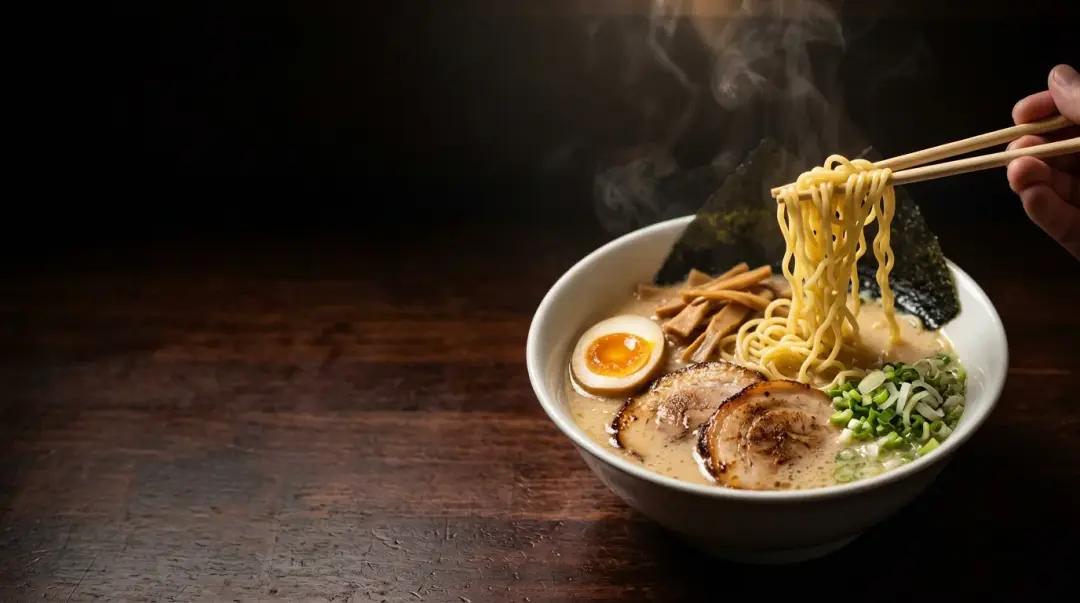
The broth blends pork bones and chicken bones, seasoned with that soy-sauce tare. Food in Japan describes the style as Yoshimura's merger of "creamy pork bone soup" from Kyushu with "clean chicken and soy sauce soup" from the Kanto region around Tokyo. The result is opaque like tonkotsu but tan instead of white, with a clear gold slick of chicken oil on the surface. If you want the full color-and-chemistry comparison, our tonkotsu vs tonkotsu shoyu guide walks through why the two broths look so different.
The noodles are the second giveaway. Iekei uses thick, straight, relatively short noodles with a heavy chew, a long way from the thin Hakata strands most diners picture under pork broth. Yoshimuraya's noodles are flat and medium-thick, made by Sakai Seimen, a noodle maker so tied to the style that Ramen Beast reports shops need Yoshimura's personal blessing to buy them.
The standard toppings:
- Chashu (CHAH-shoo), sliced braised or roasted pork
- Spinach, blanched
- Negi (NEH-gee), chopped green onion
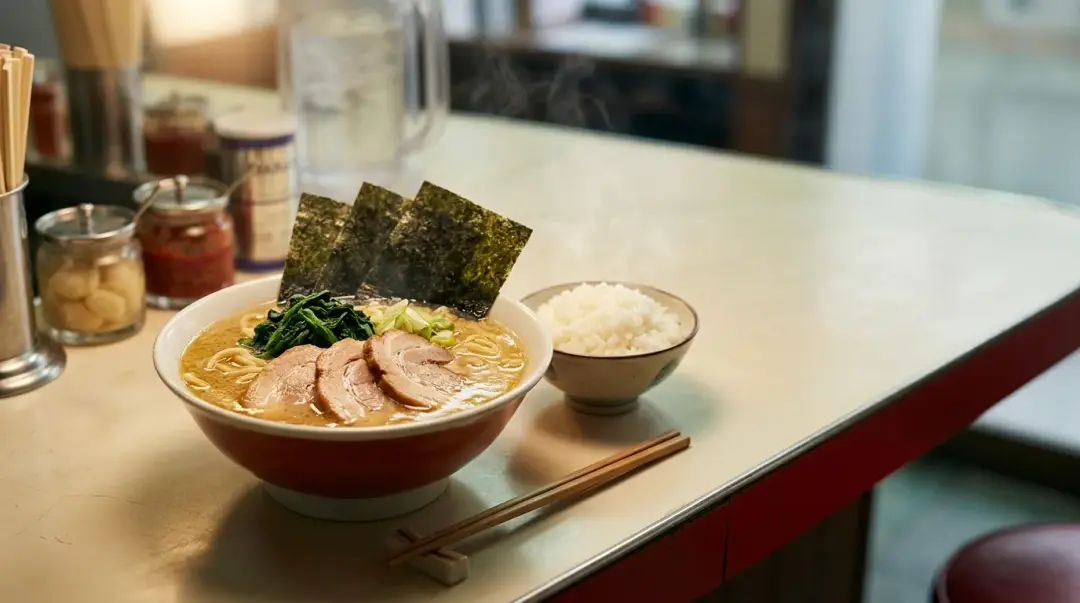
- Three sheets of nori, toasted seaweed, standing up along the rim
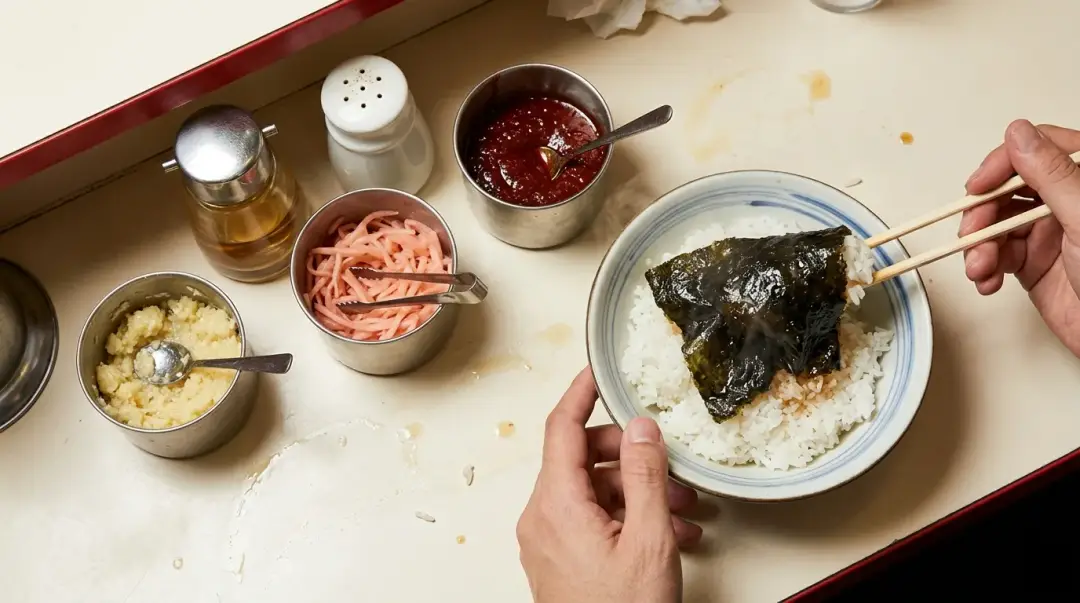
The nori is there for the rice. The move is to dip a sheet in the broth until it softens, then wrap it around a mouthful of rice. Japan Bites puts the usual price of a rice bowl at an iekei shop at about ¥100, and Taiken notes some shops make it all-you-can-eat at that price.
Then there's the counter. Iekei shops set out free condiments for ajihen (ah-jee-hen), changing the flavor partway through the bowl. Expect fresh grated garlic, pickled ginger, vinegar, white pepper and toubanjan (toh-bahn-jahn), the Japanese name for doubanjiang chili bean paste.
An iekei bowl is built to be eaten with rice: the nori, the salty tare and the chicken oil all point toward it.
Yoshimuraya, 1974
Minoru Yoshimura drove long-haul trucks before he made ramen. According to Food in Japan and the Kanagawa tourism board, his freight routes ran between Kyushu and the Kanto region, and Ramen Beast describes him as obsessed with Japan's regional ramen styles. The bowl he wanted mixed the pork-bone soup of Kyushu with the soy-sauce ramen of Tokyo. Ramen Beast adds that he apprenticed at a chain called Ramen Shop before opening on his own.
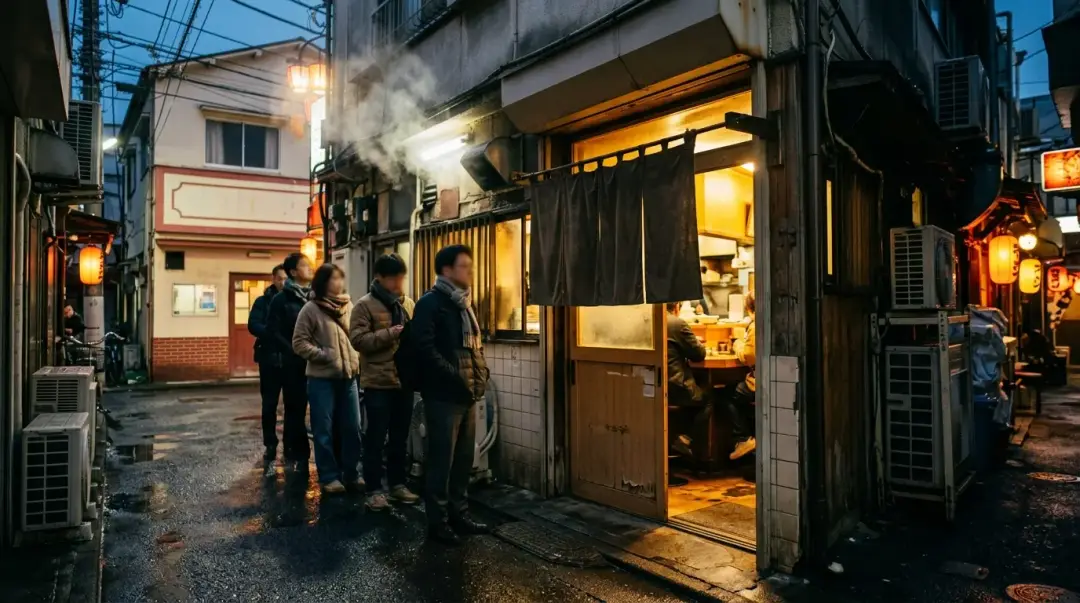
He opened Yoshimuraya (yoh-shee-moo-rah-yah) in 1974 near Shin-Sugita station in Isogo ward, in southern Yokohama. The shop's full name today is 家系総本山 吉村家, Iekei Sohonzan Yoshimuraya, where sohonzan is the word for a Buddhist sect's head temple. The name claims the role plainly: this is where the style begins.
The shop has moved. On March 24, 2023 it reopened at 1-6-4 Okano, Nishi-ku, about a seven-minute walk from JR Yokohama Station. The queue came along. One visitor guide describes a waiting zone for about ten people by the entrance and an overflow line in the alley beside Yokohama Hiranuma High School, with staff keeping order. Listed hours have been 11 a.m. to 8 p.m., closed Mondays, but check before you travel.
How One Shop Became a Family Name
Iekei is written 家系, literally "house lineage." The 家 is the same character read as -ya at the end of Yoshimuraya. Yoshimura's apprentices opened their own shops through noren-wake (noh-ren wah-keh), the Japanese custom of a master granting a trained cook permission to open a branch under the house's name, and kept the -ya ending. A bowl from one of those shops was a bowl from the "house" of Yoshimura.
The best-known descendant is Rokkakuya. Its founder, Takashi Jindo, trained under Yoshimuraya for seven years, including a stint managing Yoshimuraya's second shop, and opened Rokkakuya at Rokkakubashi in Yokohama in 1988. Rokkakuya is counted among the gosanke (goh-sahn-keh), the three most famous iekei houses.
Today the word covers two kinds of shop. Chokkei (choh-kay), "direct line," shops were trained by Yoshimuraya itself; OK Ramen names Sugitaya and Chibakiya among the direct disciples. Everything else is iekei-style, from independent shops to chains such as Machida Shoten, which OK Ramen says has popularized the style "albeit sometimes with a slightly milder edge."
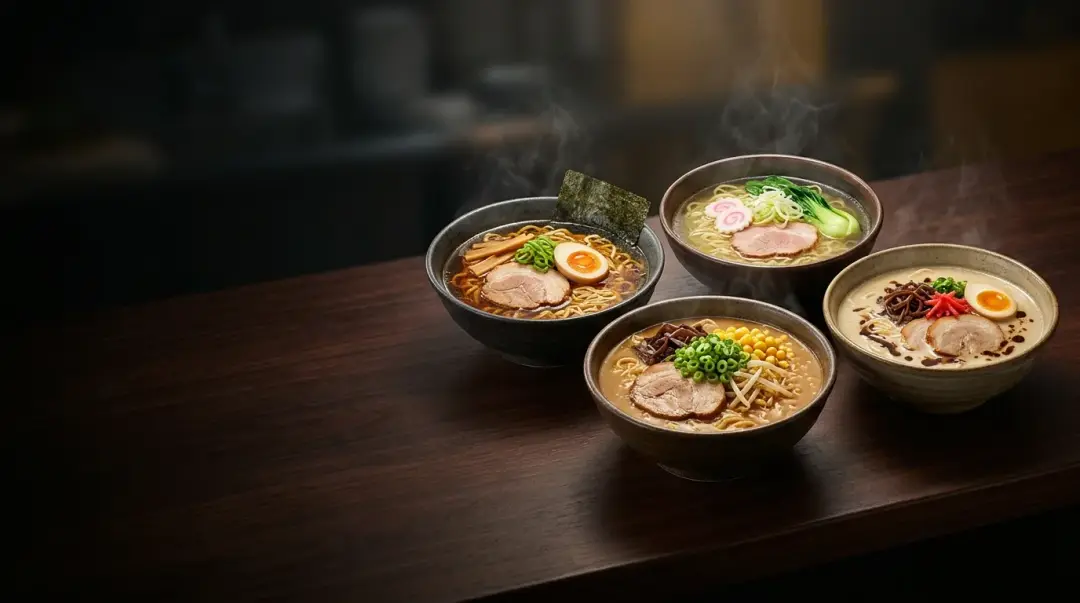
Taiken dates the chain boom to around 2013, when iekei-style shops spread across the Kanto region. Food in Japan counts more than 1,000 iekei shops nationwide. Variations have followed the numbers: shio (salt) iekei, miso iekei and tantan iekei, a spicy sesame version borrowed from tantanmen.
Yokohama's Bigger Ramen Story
Iekei is Yokohama's signature bowl, but the city's place in ramen history starts decades earlier, at the port.
Chinese immigrants in Yokohama's Chinatown served noodle soups from the late 19th century, and Japanese customers called them Nankin soba, after Nanjing, a word then used for things that arrived from China. In 1910, a Japanese entrepreneur named Kan'ichi Ozaki opened Rairaiken in Asakusa, Tokyo, and hired twelve Cantonese cooks from Yokohama's Chinatown to run the kitchen. Wikipedia describes it as the first specialized ramen shop. Ozaki called the dish shina soba, a term that later turned pejorative and gave way after World War II to chuka soba (choo-kah SOH-bah), "Chinese noodles." Japan's first ramen shop was in Tokyo, then, but its kitchen came from Yokohama.
The other landmark is the Shin-Yokohama Raumen Museum, which opened on March 6, 1994, and calls itself the world's first ramen-themed amusement park. The ground level covers ramen history, noodle-making and regional bowls, and a food court recreates a Japanese street from 1958, the year instant ramen was invented, with eight ramen shops from around the country. Rokkakuya was one of the original 1994 tenants and returned on April 8, 2024 as "Rokkakuya 1994+" to close the museum's 30th anniversary project. In 2020, Ozaki's grandson reopened Rairaiken inside the museum.
If you are in Yokohama for one day, the museum and Yoshimuraya cover iekei's past and present. The city's Cup Noodles Museum, listed by the Kanagawa tourism board alongside them, covers the instant side.
Iekei Outside Japan
Iekei shops are thin on the ground in North America compared with Hakata-style tonkotsu, which Ippudo and Ichiran made the default. Wikipedia's iekei entry points to Ramen Arashi in Banff and Canmore, Alberta, and Victoria, British Columbia, as the North American examples it tracks.
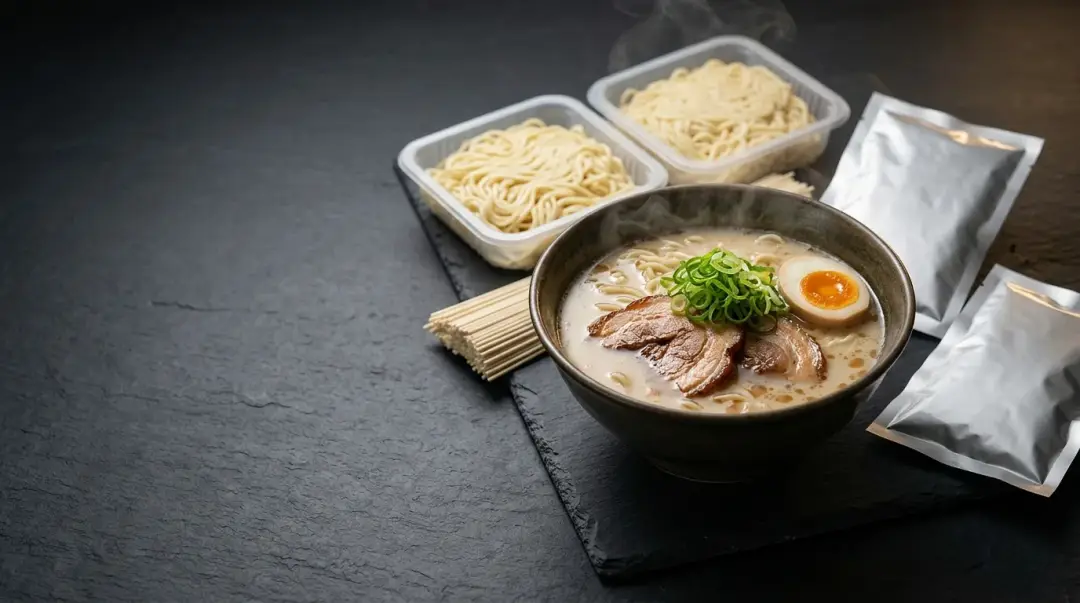
The practical route is a kit. Yamachan, a San Jose ramen maker, sells a Yokohama Tonkotsu Shoyu pack with two 120 g servings of fresh noodles and a pork-and-chicken soy soup base. The Ramen Rater gave it 5 out of 5 and singled out the noodles as "thicker than other varieties." They are wavy rather than straight, so it is iekei-adjacent, not a replica. Add blanched spinach, three sheets of nori, sliced chashu and a spoon of rendered chicken fat, and it gets close. Serve it in a deep bowl so the nori can stand along the rim, and if you render your own chicken fat, a fat separator lets you control the oil level the same way an iekei shop's "oome" and "sukuname" settings do. Our ramen bowls buying guide covers bowl sizes and materials. Our fresh ramen noodle roundup covers Yamachan's lineup, and the best ramen noodles guide lists the kits worth buying for a home tonkotsu-shoyu.
Your First Order, Written Out
Keep this on your phone. It covers the whole exchange, from the machine to the last spoon of broth.
An iekei order, step by step
| Moment | What to do or say | What it gets you |
|---|---|---|
| At the machine | Ramen button, plus rice | A ticket for each; rice is cheap at most shops |
| Handing over the ticket | "Futsuu" (normal) for all three | The house bowl, the safest first order |
| If you know you like it bold | "Katame, koime, oome" | Firm noodles, strong tare, extra chicken oil |
| If salt worries you | "Usume, sukuname" | Lighter tare and less oil |
| Halfway through | Grated garlic, a little toubanjan | The ajihen flavor change regulars expect |
| With the rice | Dip a nori sheet, wrap a bite | The bite iekei is built around |
If you miss one of the three questions, "futsuu" answers any of them.
FAQ
What is iekei ramen?
Iekei ramen is a Yokohama style created in 1974 at Yoshimuraya, where founder Minoru Yoshimura combined Kyushu pork-bone soup with Tokyo chicken-and-soy ramen. A standard bowl has a tonkotsu-shoyu broth topped with chicken oil, thick straight noodles, chashu pork, spinach, green onion and three sheets of nori. Diners choose noodle firmness, flavor strength and oil level when they order.
What does iekei mean?
Iekei is written 家系, which reads as house lineage or family style. The 家 is the same character as the -ya at the end of Yoshimuraya, and shops opened by Yoshimura's apprentices kept that -ya ending in their names. Over time the word came to cover any shop serving the style, whether or not it has a direct line back to Yoshimuraya.
How do you order iekei ramen?
Buy a ticket from the machine by the door, then hand it to the staff and state three preferences: noodle firmness (katame, futsuu or yawarakame), flavor strength (koime, futsuu or usume) and oil amount (oome, futsuu or sukuname). Saying futsuu, meaning normal, for all three is fine. Regulars often order katame, koime, oome for the boldest bowl.
Is iekei ramen the same as tonkotsu ramen?
No. Hakata tonkotsu is a milky pork-bone soup with thin, firm noodles. Iekei blends pork and chicken bones with a strong soy sauce tare, so the soup is tan and saltier, and it uses thick, short, chewy noodles plus a layer of chicken oil. Iekei is often described as a tonkotsu-shoyu style for that reason.
Where is Yoshimuraya?
Yoshimuraya opened in 1974 near Shin-Sugita station in Isogo ward, Yokohama. On March 24, 2023 it moved to 1-6-4 Okano, Nishi-ku, about a seven-minute walk from JR Yokohama Station. It uses a meal-ticket system and is known for long queues, with staff organizing the line. Check current hours before going.
Can you get iekei ramen outside Japan?
Iekei shops are rare in North America compared with Hakata-style tonkotsu. The easiest way to taste the style at home is a fresh kit such as Yamachan's Yokohama Tonkotsu Shoyu, sold at Japanese and Asian supermarkets, topped with spinach, nori and chashu. The Ramen Rater gave that kit a perfect score and noted its thicker noodles.
Read Next
Products mentioned in this guide
This section contains affiliate links. We may earn a commission at no extra cost to you.
- Y
Yamachan Yokohama Tonkotsu Shoyu Ramen (2 servings, 12.56 oz)
A fresh-noodle kit from San Jose built on pork and chicken broth with soy sauce, the closest packaged match to an iekei bowl. Add spinach, nori and a spoon of chicken fat.

Kikkoman Traditionally Brewed Soy Sauce, 33.8 oz
If you build your own tonkotsu-shoyu at home, the shoyu tare starts here. A traditionally brewed soy sauce gives the broth its tan color and salty backbone.
View on Amazon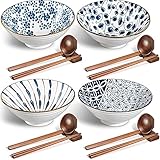
Geiserailie 40 oz ceramic ramen bowls, set of 4 with chopsticks, spoons and rests
An iekei bowl carries thick noodles, a tan shoyu broth, a slick of chicken oil and nori standing along the rim, so it needs a deep bowl. This set is four 40 oz ceramic bowls, 8 inches across, and comes with spoons, chopsticks and rests.
View on Amazon
OXO Good Grips 4-cup fat separator
The chicken oil layer is what gives iekei its shine, and a fat separator lets a home cook pull the fat off a stock and decide how much goes back in. This one holds 4 cups and has a strainer lid.
View on Amazon
Browse more related items
Opens Amazon · affiliate links
Buying guides for this topic
- Buying guideBest Ramen Noodles & Kits in 2026The best fresh and dry ramen noodles, plus premium ramen kits, available on Amazon — Sun Noodle, Hakubaku, Marusan, and Maruchan Seimen ranked.
- Buying guideBest Japanese Pantry Essentials in 2026The 10 Japanese pantry items needed to cook ramen, udon, soba, and yakisoba at home. Soy, dashi, mirin, miso, and yakisoba sauce, ranked.
- Buying guideBest Japanese Cookware in 2026The donabe, ramen bowls, sōmen sets, and tools you need to cook Japanese noodles at home. Real US Amazon picks across budget tiers.