Pad See Ew vs Pad Thai vs Drunken Noodles (2026)
· 11 min read · NoodleDex Editorial
Pad see ew vs pad thai vs drunken noodles: noodle width, sauce base, heat and sweetness compared, plus which one to order for spice-shy or heat-loving tables.
This page contains affiliate links. We may earn a commission at no extra cost to you. Disclosure
On this page(11 sections)
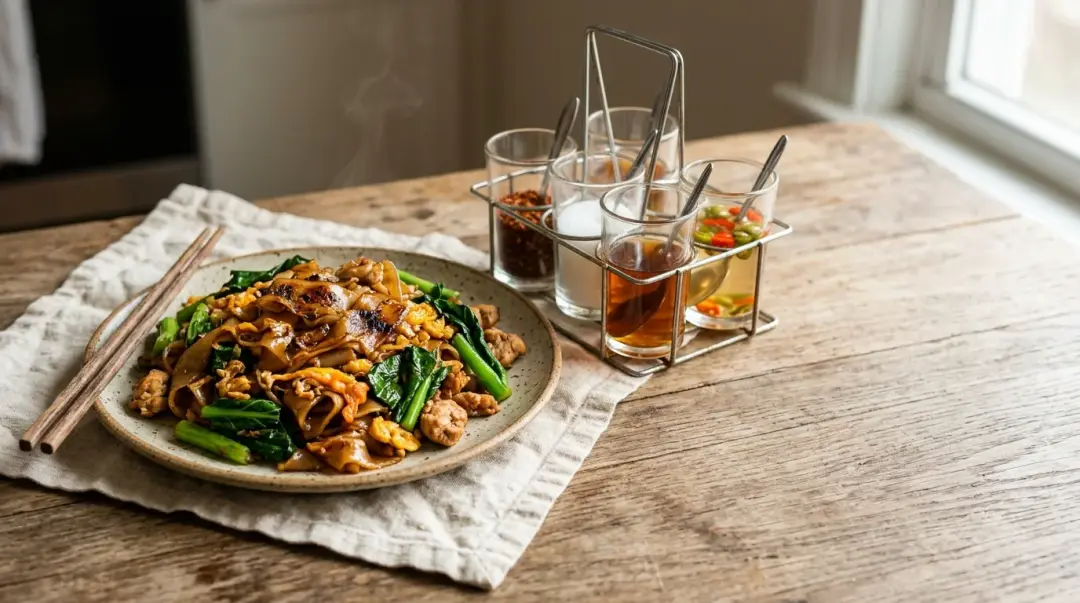
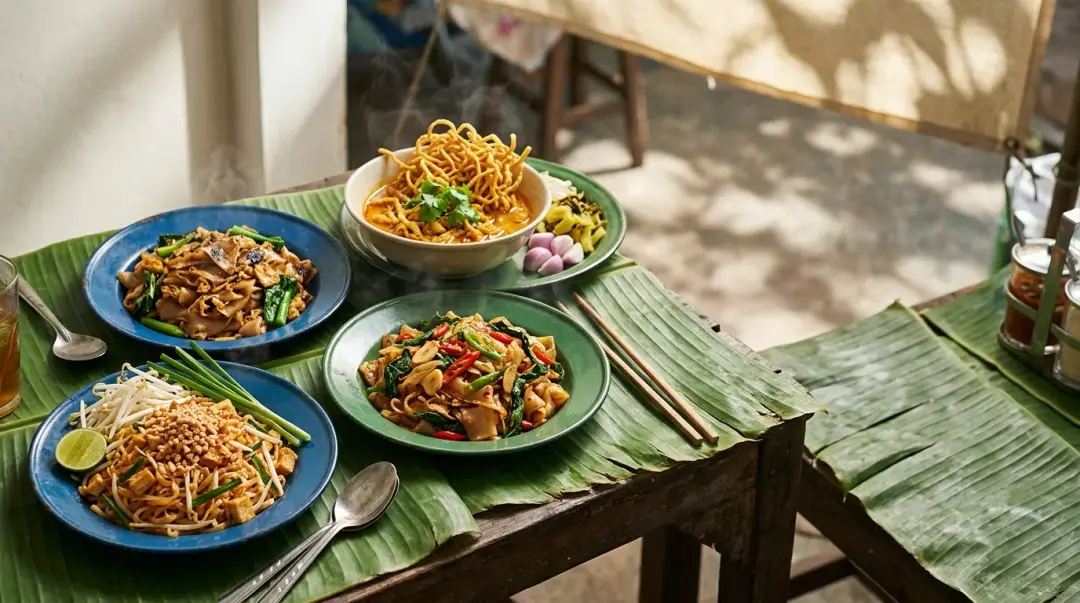
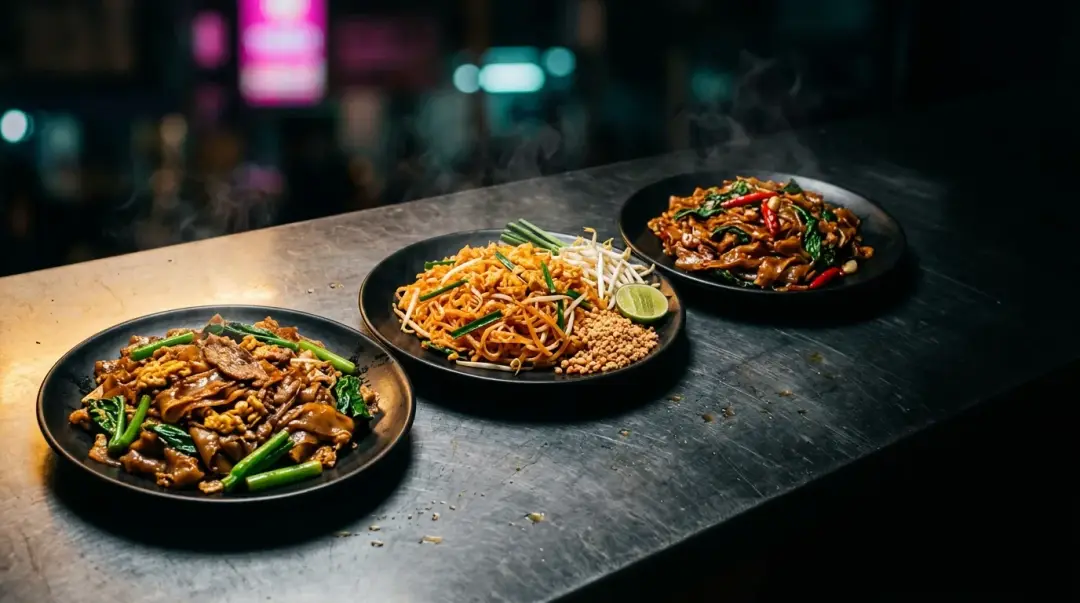
Plate one is dark brown and glossy, with flat noodles as wide as a finger, scorched at the edges, wound around soft scraps of egg and bright green stems of Chinese broccoli.
Plate two is orange-tan and dry to the touch, narrow noodles tangled with bean sprouts and chives under a drift of crushed peanuts, a lime wedge leaning on the rim.
Plate three is darker than the first and spotted red, the same wide noodles slick with oil, wilted basil leaves stuck to them and whole chilies you can count.
Those three plates sit on nearly every Thai restaurant menu outside Thailand: pad see ew (paht see-EW), pad thai (paht TIE) and pad kee mao (paht kee MOW), the dish English menus call drunken noodles. The first and third come out of the same bag of wide noodles and lean on soy and oyster sauce, which is why they get mixed up. Pad thai is the odd one out, and pad kee mao is the only one with real chili in it.
Three Plates, Five Variables
Most of the confusion goes away once you separate the noodle from the sauce. Thai cooks name rice noodles by width. In Pailin Chongchitnant's guide at Hot Thai Kitchen, sen lek (small) runs about 2 mm, the medium noodle Thais call sen pad thai runs about 3 mm, and sen yai (large) runs about 9 mm and is meant for stir-frying only. Leela Punyaratabandhu, writing at SheSimmers, puts the right pad thai noodle at 3 or 5 mm. Retail bags of sen yai are often labeled 10 mm.
Pad see ew vs pad thai vs drunken noodles at a glance
| Pad See Ew | Pad Thai | Drunken Noodles (Pad Kee Mao) | |
|---|---|---|---|
| Noodle | Sen yai, wide flat rice, ~9–10 mm | Sen lek or medium rice stick, ~3–5 mm | Sen yai, same as pad see ew |
| Sauce base | Light soy + sweet dark soy, a little sugar | Tamarind + fish sauce + palm sugar | Oyster sauce, soy, fish sauce, a little sugar |
| Heat in the base | None | Mild; chili usually on the side | High; Thai chilies cooked in |
| Sweetness | Low to medium, caramel-dark | Medium to high, balanced by sour | Low; buried under chili and basil |
| Signature greens | Chinese broccoli (gai lan) | Bean sprouts, garlic chives | Holy basil |
| Crunch | Charred noodle edges | Crushed peanuts | None to speak of |
| Order it for | Kids, spice-shy diners, soy lovers | A first Thai meal, sweet-sour fans | Heat seekers, a beer-with-dinner night |
The table hides one thing a plate makes obvious: pad see ew and drunken noodles are a pair. Wikipedia's entry on drunken noodles calls pad see ew its sister recipe, and both come out of the same wok with the same noodle. Pad thai stands apart, with its own noodle and an entirely different sauce.
Noodle Width: Two Wide, One Narrow
Sen yai is the noodle most diners mean when they say "the wide Thai noodles." It's sold fresh in Thai and Chinese groceries, usually as a refrigerated slab that has to be warmed and pulled apart. Fresh matters more here than in any other Thai dish. In her drunken noodle recipe, Chongchitnant is blunt about it: "Use fresh noodles. Yes, dry rice noodles exist; and they will work, but it is not the same and not nearly as good." Mark Wiens's pad see ew recipe at Eating Thai Food calls for 300 g of fresh sen yai and makes the same point.
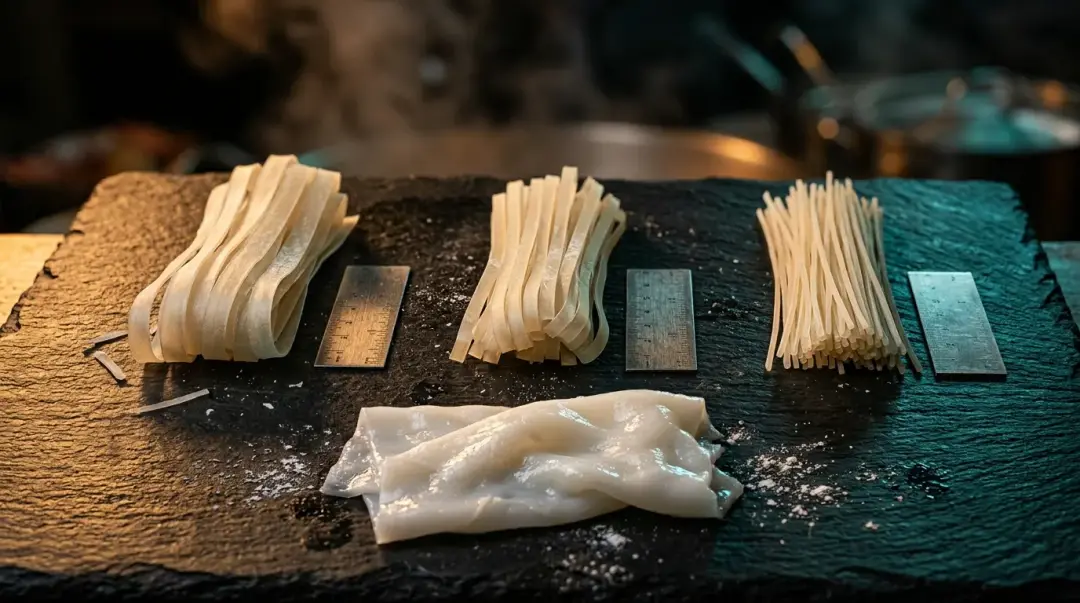
The width does a job. A flat ribbon around 9 mm across has enough surface to blister against hot steel, so the edges char and turn slightly crisp while the middle stays soft. That char is half the flavor of pad see ew and most of the texture of pad kee mao.
Pad thai's noodle is narrower and almost always dried. Punyaratabandhu notes that narrower noodles give you a better chance of a noodle that is cooked through but still chewy. The prep differs too: you soak dried rice stick in room-temperature water rather than boiling it. Hot Thai Kitchen puts a medium noodle at 50 to 60 minutes of soaking, and Punyaratabandhu warns against blanching before the wok because "hot water + starch = glue." The soaked noodle then finishes cooking in the pan, absorbing sauce as it softens.
So two of the three dishes share a bag of noodles. If you cook at home, one package of sen yai covers pad see ew on Monday and pad kee mao on Thursday. Pad thai needs a separate bag. Our pad thai noodle buying guide lists both widths, including a 10 mm sen yai for the wide pair.
Sauce Base: Soy, Tamarind, or Oyster and Chili
Pad see ew means "stir-fried with soy sauce," and that's the sauce. Wikipedia lists light soy, dark soy ("a more syrupy consistency") and white pepper. Wiens's version is close to the minimum: 1 tablespoon of light soy, ½ tablespoon of dark sweet soy and ½ teaspoon of sugar for a single plate. In his words, "the light soy sauce gives a saltiness to the noodles, while the dark sweet soy sauce will give your pad see ew a darker color and a little bit of sweetness." Many restaurants add oyster sauce. The stir-fry technique came from Chinese cooks, which is why the closest relatives are Cantonese chow fun and Malaysian char kway teow.
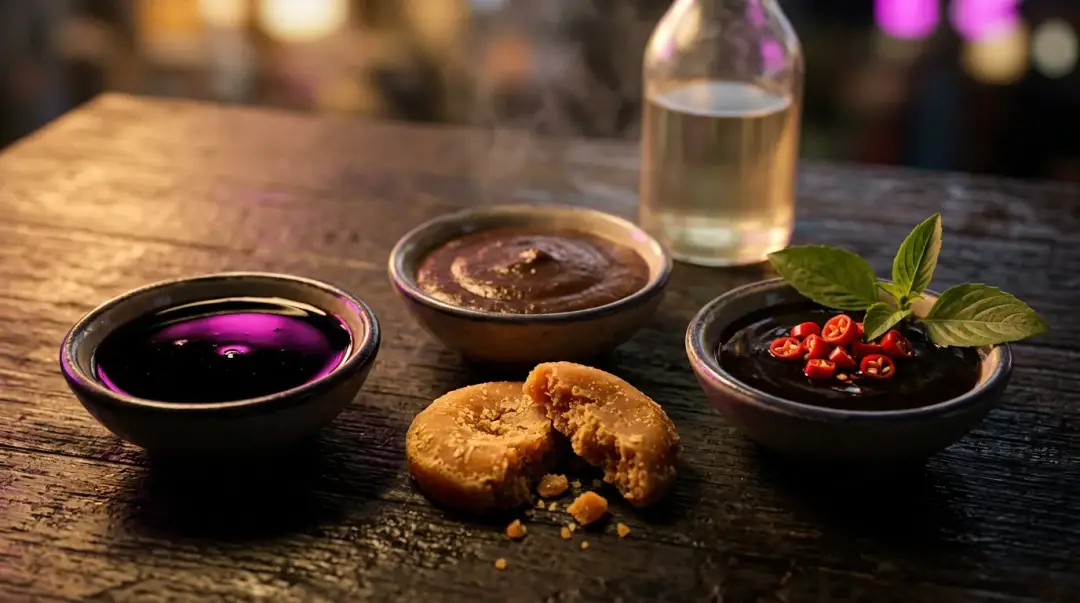
Pad thai runs on three liquids, tamarind, fish sauce and palm sugar, set against each other. Chongchitnant's recipe uses 35 g of palm sugar, 3 to 4 tablespoons of tamarind paste and 2 tablespoons of fish sauce, and she adjusts the tamarind by brand because "sourness of tamarind varies greatly between brands." She also states two rules worth knowing before you order: real pad thai "should not have ketchup or any tomato product in it," and it "should not be syrupy sweet." Preserved sweet radish and dried shrimp go in with the noodles. Peanuts, garlic chives, bean sprouts and lime go on at the end.
Pad kee mao is built on oyster sauce. For two servings, Chongchitnant uses 2 tablespoons of oyster sauce, 1 tablespoon of soy, ½ tablespoon each of Golden Mountain sauce (a Thai seasoning sauce) and fish sauce, and 2½ teaspoons of sugar. Garlic and chilies go into the oil first. Holy basil goes in at the end and wilts in seconds.
Pad see ew tastes like soy and smoke. Pad thai tastes like tamarind and sugar. Drunken noodles taste like chili, garlic and basil, in that order.
Heat: None, Some, Plenty
Heat is where ordering the wrong plate hurts most.
Pad see ew has no chili in the base. Wiens lists chili flakes, pepper and vinegar as things the diner adds at the table. That makes it the safest order for anyone who doesn't eat spicy food.
Pad thai sits in the middle. Wikipedia lists red chili among its usual garnishes, and kitchens vary on whether chili goes into the sauce or onto the side of the plate. Most versions land mild.
Pad kee mao is hot by design. Chongchitnant uses two kinds of chili: fiery Thai bird's eye chilies for heat and milder red chilies for flavor, because "if we only used the fiery Thai chilies, we can only add a few before it becomes too spicy." The chilies are fried in the oil at the start, so the heat coats every noodle. You can't pick it out.
Every Thai table also carries khrueang prung (KROO-ahng proong), the condiment set. ImportFood lists the standard four: nam pla prik (fish sauce with sliced chilies, shallots, garlic and lime juice), prik dong (chilies pickled in white vinegar), plain sugar and ground chili powder. A spoonful of prik dong on pad see ew is the traditional way to add sharpness and a little heat without changing dishes.
Sweetness: The Surprise in the Middle
Pad see ew looks like the sweet one, dark and sticky, but in most recipes pad thai carries more sugar. Palm sugar is one of its three main ingredients, and the tamarind's sourness lets the cook use a lot of it without the dish tasting like dessert.
Pad see ew's sweetness is smaller and deeper. Sweet dark soy and a pinch of sugar caramelize on the hot noodle, so what you taste is closer to toasted molasses than to sugar. A plate that tastes sugary rather than toasty usually means the wok wasn't hot enough to char it.
Drunken noodles have sugar too (2½ teaspoons for two servings in Chongchitnant's recipe), but between the chili, garlic and holy basil you rarely notice it. It's the least sweet of the three.
The Basil and the Broccoli
The greens are the fastest way to identify a plate.
Pad see ew uses gai lan (Chinese broccoli), a leafy green with thick, crunchy stems and a slight bitterness that cuts the sweet soy. Western broccoli florets show up in some restaurants outside Thailand. The dish still works, but it loses that bitter edge.
Pad kee mao uses holy basil (bai kaprao, by-ga-PROW), which tastes peppery and clove-like rather than sweet. It's the dish's signature and its weak point in kitchens outside Southeast Asia, because holy basil is hard to source. Even Chongchitnant suggests Italian basil as a stand-in when you can't find it, and one of her readers pushes back in the comments: "Holy basil has such a different taste than Italian basil that I personally wouldn't add Italian basil if I couldn't find holy basil." Our drunken noodles page explains why many restaurants outside Thailand use Thai sweet basil instead.
Pad thai uses bean sprouts and garlic chives, some cooked into the noodles and some served raw on the side for crunch.
How Each One Is Cooked
All three are wok dishes, and all three suffer from the same mistake: too much food in a pan that isn't hot enough. Chongchitnant's pad thai rule, "do not crowd the pan, especially if you have a weak stove," with no more than two portions at a time, applies to all three. Overcrowded noodles steam instead of fry, and a steamed plate tastes flat.
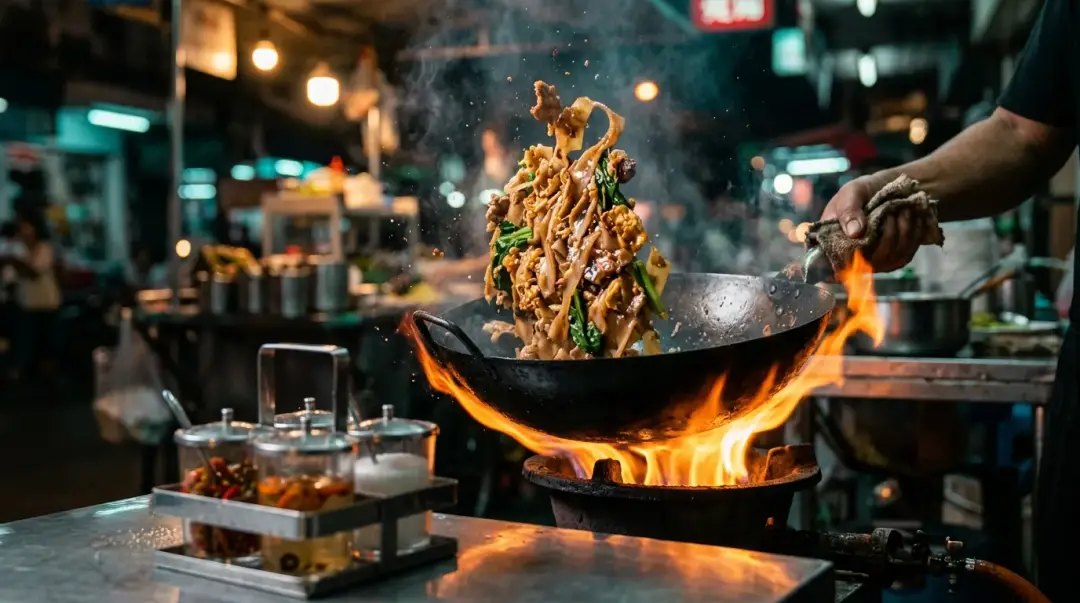
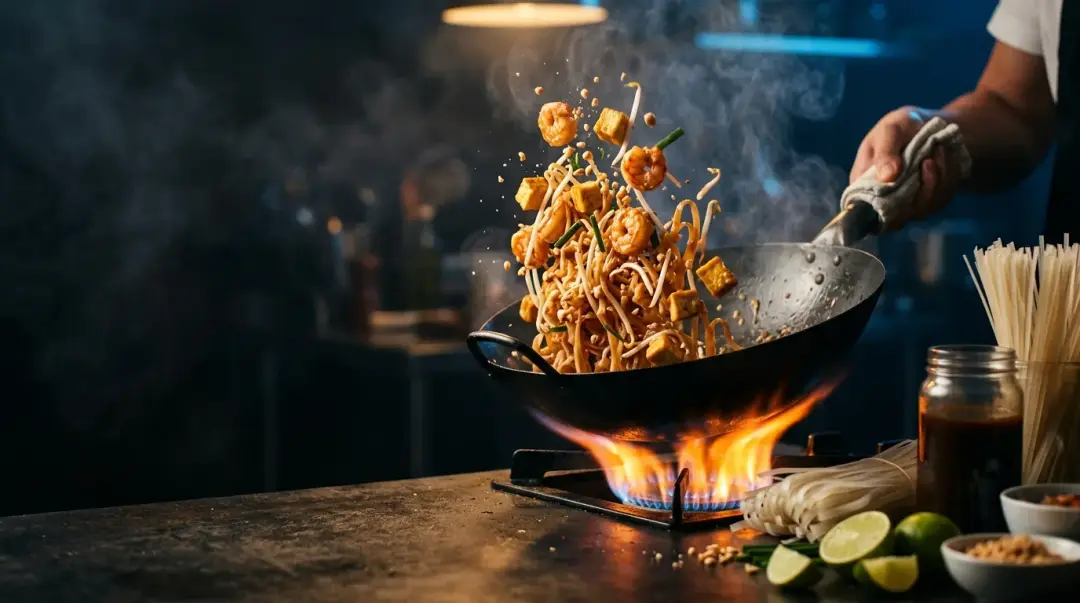
The order of the wok differs. Pad see ew is protein, then egg, then noodles and sauce, then gai lan, with the heat turned up at the end to char the noodles and egg. Pad thai adds tofu, radish and dried shrimp before the soaked noodles, and the noodles finish softening in the sauce. Pad kee mao starts with garlic and chilies pounded together and fried in oil, then the protein, noodles and sauce, with the basil folded in once the heat is off.
If you cook the wide-noodle pair at home, a carbon-steel wok or skillet chars better than nonstick, and a long spatula keeps the wide noodles from tearing as you turn them. Our Chinese wok buying guide covers both. A Thai granite mortar and pestle (8-inch, deep-bowl Thai-style granite) pounds the garlic and chili base that pad kee mao starts with, and crushes the peanuts for pad thai. The pad see ew page lists the shopping basics, from fresh sen yai to gai lan.
Where They Came From
Pad see ew and pad kee mao both come from the Chinese side of Thai cooking. Wikipedia traces pad see ew's stir-fry technique to China, and the soy-sauce name points the same way. Pad kee mao has no documented inventor. Wikipedia lists three stories for the name, which comes from khi mao, "drunkard": it was cooked from leftovers after a night of drinking, its chili was meant "to tear through the dulled palates of the inebriated," or a wife made it far too spicy to punish a drunk husband. None of them can be verified, and all three are still told.
Pad thai has a government in its backstory. Wikipedia credits Prime Minister Plaek Phibunsongkhram's government with promoting noodles over rice in the mid-20th century as part of building a modern Thai identity. Historian Mark Padoongpatt dates the dish to the 1930s, and another account places it during World War II rice shortages. Pad thai later became Thailand's best-known dish abroad, finishing fifth in CNN Go's 2011 readers' poll of the world's 50 most delicious foods. Our pad thai history covers the full story, and the pad thai type page covers the dish as it's served outside Thailand today.
Ordering by Situation
Use this as a cheat sheet when the menu has all three and the table can't decide.
| Who's ordering | Order this | Why |
|---|---|---|
| A child or anyone who avoids chili | Pad see ew | No chili in the base; soy and char only |
| Someone at a Thai restaurant for the first time | Pad thai | Mild, sweet-sour, peanuts and lime on top |
| Someone who wants real heat | Pad kee mao | Thai chilies fried into the oil |
| A table splitting two plates | Pad see ew + pad kee mao | Same noodle, opposite flavors |
| Anyone avoiding peanuts | Pad see ew or pad kee mao | Peanuts are standard only on pad thai |
| Someone who finds pad thai too sweet | Pad kee mao | The least sweet of the three |
| A soy-and-smoke craving | Pad see ew | The char is the point |
Two more tips. Ask for pad thai with the peanuts and chili on the side if anyone at the table has an allergy or low heat tolerance. Most kitchens keep both separate anyway. And if a menu says "spicy pad see ew," you're getting a hybrid; order pad kee mao if heat is what you want.
For the rest of the Thai menu, including rad na, khao soi and boat noodles, the Thai noodles explained guide sorts every dish by noodle width and sauce.
FAQ
What is the difference between pad see ew and pad thai?
Pad see ew uses wide sen yai rice noodles stir-fried with light and dark soy sauce, egg and Chinese broccoli, so it tastes caramelized and savory with no chili. Pad thai uses a narrower 3 to 5 mm rice noodle in tamarind, fish sauce and palm sugar, with bean sprouts, garlic chives and crushed peanuts, so it tastes sweet and sour.
Which is spicier, pad see ew, pad thai or drunken noodles?
Drunken noodles, by a wide margin. Pad kee mao cooks Thai chilies into the oil at the start, so the heat runs through the whole plate. Pad thai is mild, with chili usually offered on the side. Pad see ew carries no chili in the base at all, and diners add heat from the table condiments if they want it.
Which is sweeter, pad thai or pad see ew?
Pad thai usually reads sweeter because palm sugar is one of its three sauce pillars, balanced against sour tamarind. Pad see ew's sweetness is smaller and darker, coming from sweet dark soy and a little sugar that caramelize on the noodle. Drunken noodles use some sugar too, but the chili, garlic and holy basil cover it.
Are drunken noodles the same as pad see ew with chili?
Close, but no. Both use the same wide sen yai noodle and a soy-based sauce, which is why Wikipedia calls them sister dishes. Drunken noodles add Thai chilies, garlic, fish sauce, oyster sauce and holy basil, and usually drop the Chinese broccoli and the sweeter soy. Add chili flakes to pad see ew and it still tastes like pad see ew.
What should I order if I don't like spicy food?
Pad see ew. It has no chili in the sauce, the flavor is soy and char, and it is the usual pick at Thai restaurants for kids and spice-shy diners. Pad thai is the next safest choice, though some kitchens add dried chili to the sauce, so ask if you are sensitive.
Can I use the same noodles for all three dishes at home?
Two of them, yes. Pad see ew and drunken noodles both want wide sen yai rice noodles, ideally fresh, around 9 to 10 mm across. Pad thai needs the narrower sen lek or medium rice stick, about 3 to 5 mm wide. Wide noodles in pad thai turn heavy and gummy, and thin noodles in pad see ew can't hold the char.
Read Next
Products mentioned in this guide
This section contains affiliate links. We may earn a commission at no extra cost to you.

Authentic Thai Wide Sen Yai Rice Stick Noodles, XL-10mm (6-pack, 16 oz each)
The dried wide noodle for pad see ew and drunken noodles when you can't find fresh sen yai. Soak it, don't boil it, and stir-fry in small batches.
View on Amazon
Authentic Thai Pad Thai Rice Stick Noodles, 5mm Sen Lek (16 oz)
The narrow ribbon pad thai is built on. One bag covers several weeknight batches, and the 5mm width holds tamarind sauce without snapping.
View on Amazon
Healthy Boy Thai Black Soy Sauce
The thick, sweet dark soy that gives pad see ew its color and caramel edge. A splash also darkens drunken noodles.
View on Amazon
Craft Wok Flat Hand Hammered Carbon Steel Pow Wok, 14 Inch Flat Bottom
All three dishes are wok dishes, and carbon steel is what blisters the edges of wide sen yai into the char pad see ew and pad kee mao depend on. This listing is a 14-inch, 15-gauge hand-hammered pan with a flat bottom, a wooden handle and a steel helper handle, made for flat electric and induction stoves.
View on Amazon
YOSUKATA 17-Inch Wok Spatula and Ladle, Set of 2
Wide rice noodles tear when you stab or drag them, and a long stainless spatula lets you lift and fold them in small batches. This is a two-piece spatula and ladle set with 17-inch handles, sized for 13 to 14 inch or larger woks.
View on Amazon
Buying guides for this topic
- Buying guideBest Pad Thai Noodles & Sauces in 2026The best sen lek rice noodles and pad thai sauce kits on Amazon — A Taste of Thai, Erawan, and premium Thai brands ranked.
- Buying guideBest SE Asian Pantry Essentials in 2026The 10 Southeast Asian pantry items needed to cook pad thai, laksa, mì goreng, and more. Fish sauce, kecap manis, sambal, curry pastes, ranked.
- Buying guideBest Rice Noodles for Pho, Pad Thai, and MoreThe best rice noodles on Amazon: Three Ladies bánh phở, A Taste of Thai, Annie Chun's and Lotus Foods, ranked for pho, pad thai and more.
- Buying guideBest Carbon Steel Wok for Home Cooks: Size and Care (2026)The best carbon steel woks for home stoves: size, flat or round bottom, hand-hammered or machine-made, and how to season one and keep it rust-free.