Mie Goreng vs Bakmi: Indonesia's Two Traditions
· 9 min read · NoodleDex Editorial
Mie goreng vs bakmi: one is a fried-noodle method, the other a Chinese-Indonesian noodle family. Toppings, regional styles and where Indomie fits.
This page contains affiliate links. We may earn a commission at no extra cost to you. Disclosure
The Knock on the Cart
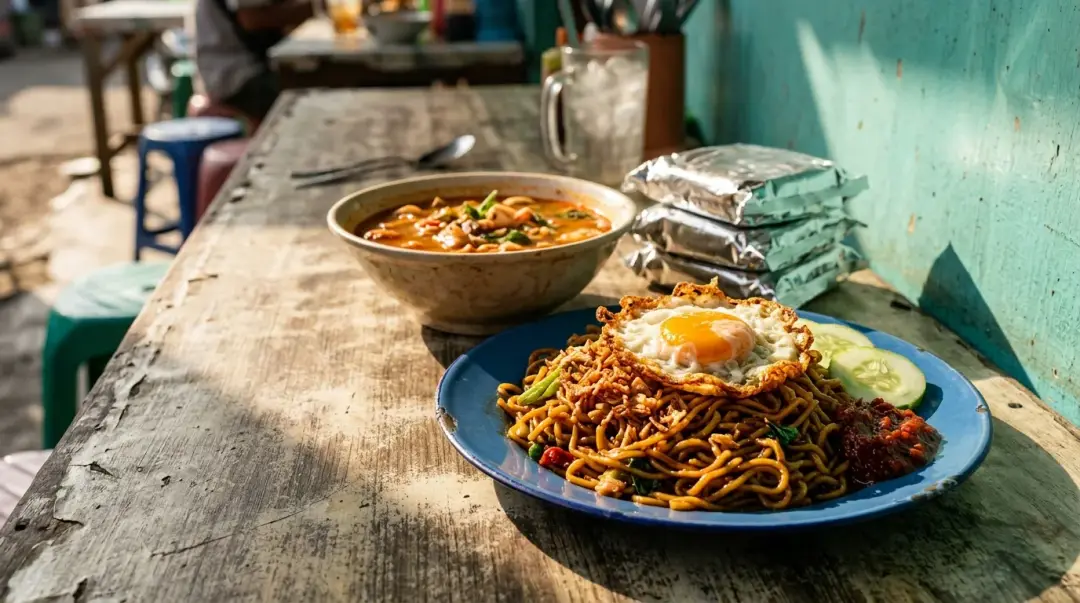
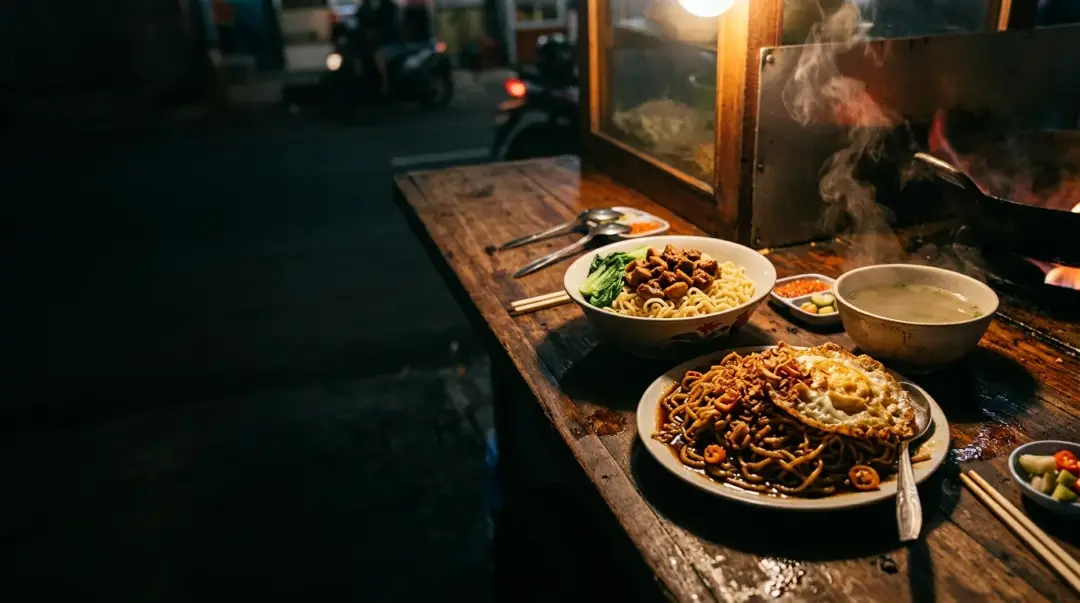
In parts of Java, you hear a noodle seller before you see him. One kind of cart vendor carries a kentongan (ken-TONG-ahn), a hollow wooden slit drum, and knocks it as he walks. The note it makes, dok-dok, became the name of what he sells. In Surabaya the dish is listed as mie goreng dhog-dhog, and recipe writers describe vendors cooking instant or egg noodles with egg, greens and a mix of sweet soy, tomato and oyster sauces, fried in the wok or simmered into a thick broth.
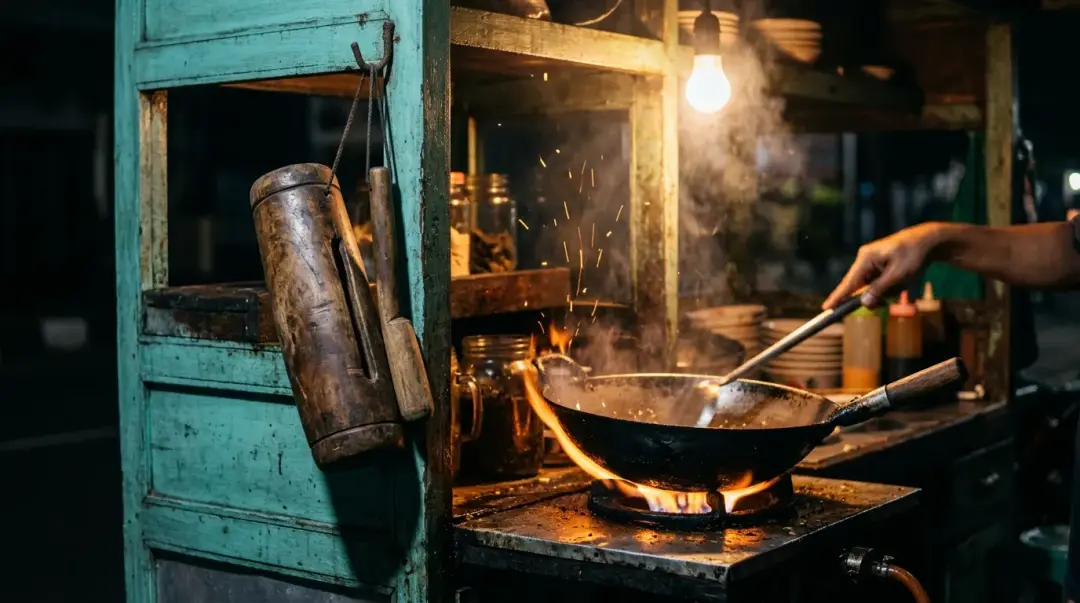
Another cart announces itself with metal. The tek-tek that gives mie tek-tek its name is the sound of a spatula striking a hot wok as the vendor stirs. Indonesian sources describe it as a night trade, started by street vendors in Java and now found in city and suburban neighborhoods alike.
Both of those carts sell fried noodles, and both sounds come from the business of frying. A bakmi shop sells a different bowl, built a different way, and that difference is the place to start untangling mie goreng (MEE GOH-reng) and bakmi (BAHK-mee).
Two Words, One Hokkien Root
Both words come from the same place. Bakmi joins two Hokkien Chinese words, bak (meat) and mi (noodles), so it literally means "meat noodles." Indonesian mie is the same Hokkien mi, and goreng is Indonesian for "fried." Chinese migrants from southern provinces such as Fujian brought wheat noodles to the archipelago, and Indonesia's noodle dishes grew out of that migration. Noodles themselves are older on Java: a 1391 inscription from the Majapahit era, the Biluluk inscription, is cited as evidence that people there were eating them.
The split is grammatical as much as culinary. Bakmi names a noodle and a style of bowl. Mie goreng names a technique, and the noodle in it can be anything from fresh yellow egg noodles to a block of instant ramen. That is why the question "mie goreng or bakmi?" has an answer that sounds like a dodge: bakmi can be fried, and in Central Java the same vendor will boil or fry it for you.
Bakmi: The Boiled Bowl
A standard bakmi is mie kuning (yellow noodles) made from finely milled wheat, sometimes enriched with egg. The noodles are boiled on their own, drained, tossed with seasoning, and topped. Broth comes in a separate bowl, or not at all, depending on how you order.
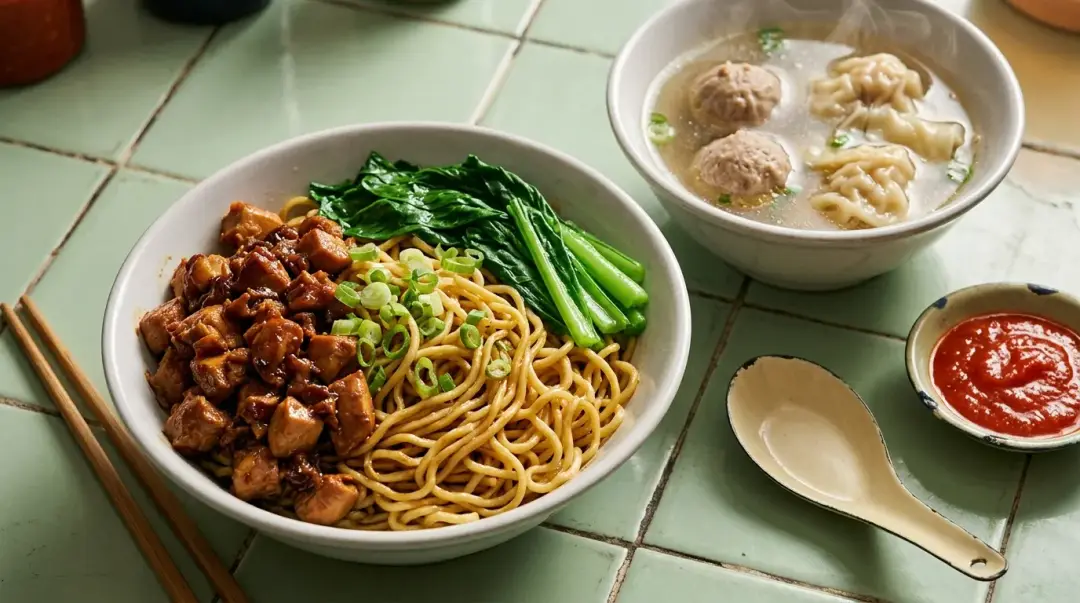
The toppings tell you which kitchen you're in. Chinese-Indonesian shops use diced seasoned chicken, char siu (Cantonese barbecued pork), mushrooms, choy sum (Chinese flowering greens), fried wonton skins and bakso (Indonesian meatballs). Because most Indonesians are Muslim, chicken replaced pork as the default, and the most common bakmi in the country is mie ayam (MEE AH-yahm), chicken noodles. Halal mie ayam is seasoned with chicken fat, vegetable oil or garlic oil instead of lard. Our halal noodles guide covers what to check on packaged versions.
Mie ayam itself comes two ways. Mie ayam biasa (regular) is dressed with salty soy sauce and chicken oil. Mie yamin uses sweet kecap manis instead. Both come with the chicken on top and broth, boiled Chinese cabbage, pangsit (wontons) and bakso alongside. The town of Wonogiri in Central Java is known as a mie ayam hub, and the trade traces back to Chinese noodle sellers in 18th-century Solo.
Regional bakmi is where the family gets interesting:
- Bakmi Bangka: minced, braised pork with mushroom.
- Bakmi Siantar: North Sumatran, topped with red char siu.
- Bakmi Aceh: a curry-like flavor.
- Bakmi Pontianak: from West Kalimantan, with crab meat and fish balls.
- Bakmi Jawa: the Central Java style, which blurs the line with mie goreng (more below).
The best-known bakmi restaurant in Indonesia started in 1959 on Gajah Mada street in Jakarta. Founded by Tjhai Sioe and Loei Kwai Fong, Bakmi GM had more than 50 outlets by 2022 and served about 30,000 customers a day, and in December 2024 the Djarum group bought an 85 percent stake. Its flagship bowl, Bakmi Spesial GM, is the urban, sit-down end of the same tradition the mie ayam carts serve.
Mie Goreng: The Fried Plate
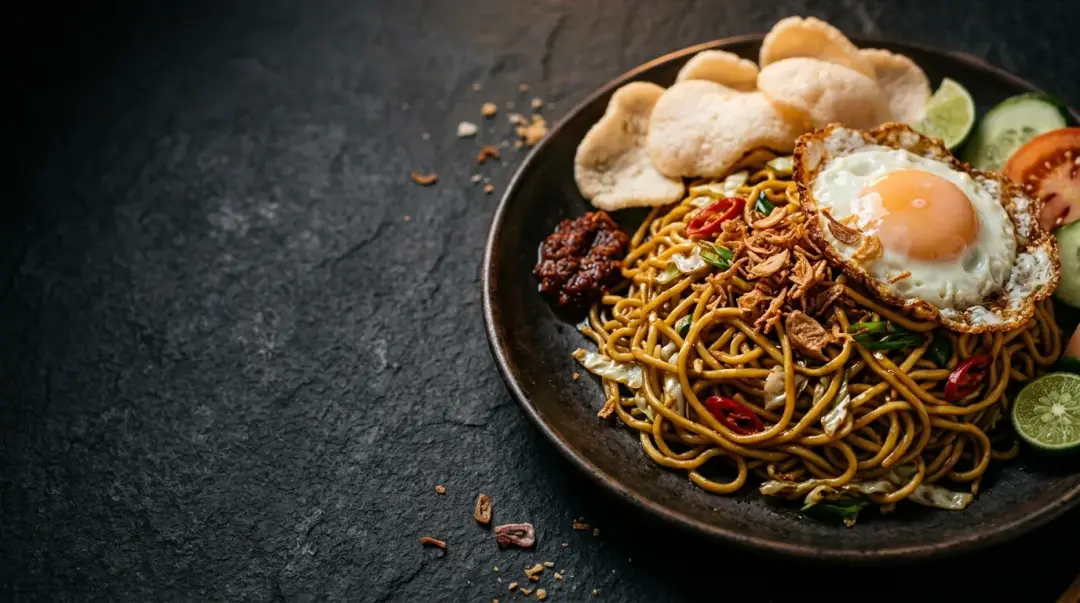
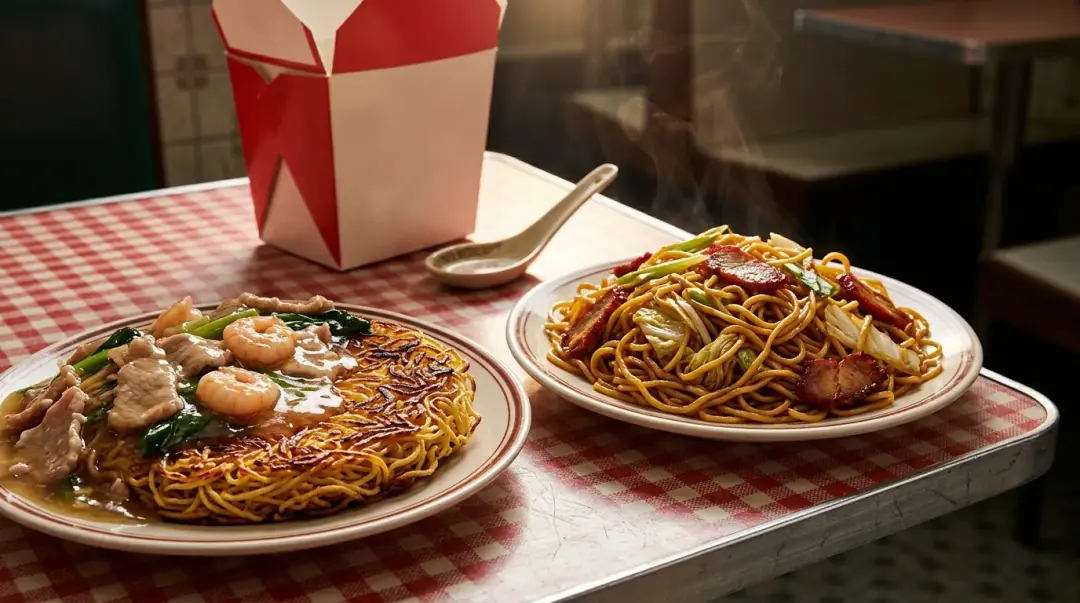
Mie goreng is the Indonesian descendant of Chinese chow mein, brought by Chinese immigrants and remade with the local pantry. The standard version stir-fries thin yellow noodles in oil with shallots, garlic and soy sauce, adds egg, vegetables and chicken, meat or seafood, and sweetens the whole thing with kecap manis. Pork is left out for the Muslim majority. Fried shallots and sambal (chili paste) finish it, and our mie goreng type page covers the shrimp paste, the garnishes and the fried egg that tops most plates.
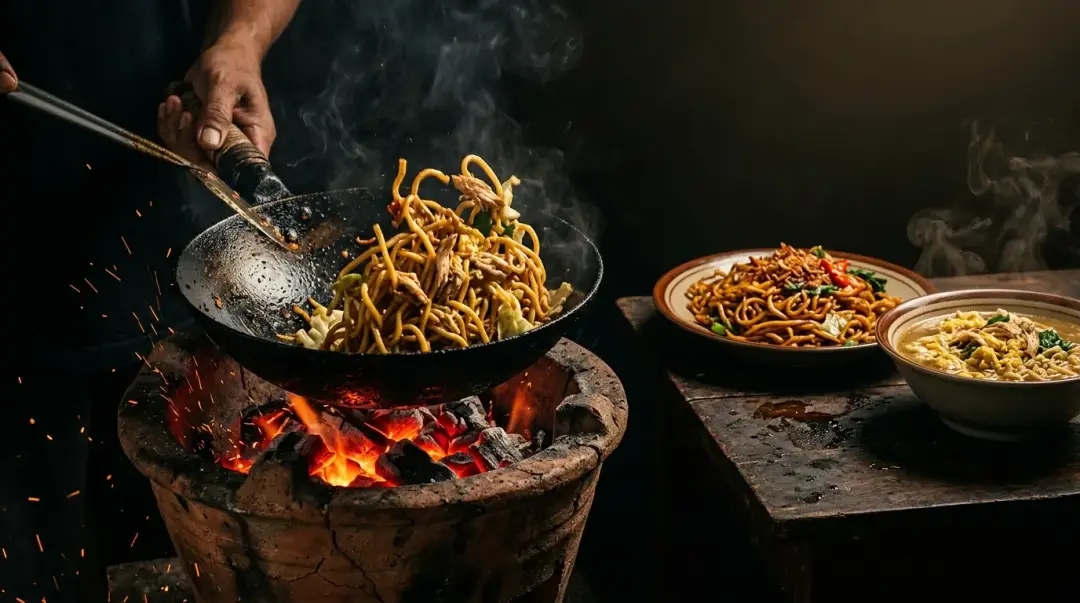
The ingredient that makes it Indonesian is the kecap manis. It is a thick soy sauce sweetened with palm sugar, closer to molasses than to Chinese light soy, and it lacquers the noodles dark and glossy in the wok. That caramel sweetness, pushed back with chili, is the clearest break from the chow mein the dish descends from. Shrimp paste, terasi in Indonesian, adds a savory floor that you notice more when it's missing than when it's there. A good plate tastes sweet first, then hot.
It is sold everywhere a noodle can be sold: by street hawkers, at warung (small family-run eateries), from roving carts and in high-end restaurants. Regional styles include:
- Mie goreng Aceh: thick noodles in a spicy, curry-like paste.
- Mie goreng Jawa: sweet soy, egg, chicken and vegetables, Central Java style.
- Mie goreng kerang: with clams, from Batam.
- Mie goreng dhog-dhog: the Surabaya cart noodle named for the kentongan.
- Mie Bangladesh: a Medan specialty.
Then there is bakmi Jawa, which sits on both sides of this comparison at once. It is a bakmi by name, from Yogyakarta and nearby Central Java towns, traditionally cooked on a charcoal-fired earthenware stove that gives it a smoky edge. The vendor will make it godhog (boiled, in chicken broth), goreng (fried and sweetened with kecap manis), or nyemek, moist and somewhere between the two. Same vendor, same noodle, three dishes. If you want proof that "bakmi vs mie goreng" is a question about method, this is it.
Side by Side
Bakmi vs mie goreng, the practical differences
| Bakmi | Mie goreng | |
|---|---|---|
| What the word names | A noodle and a style of bowl | A cooking method: fried noodles |
| Noodle | Yellow wheat noodle, sometimes with egg | Yellow wheat noodle, or instant noodles |
| How it is cooked | Boiled, drained, tossed with seasoning | Stir-fried in a wok with aromatics |
| Sauce | Soy and chicken oil, or sweet soy (mie yamin) | Sweet soy, soy sauce, sambal |
| Broth | Usually on the side | None, unless you order a wet version |
| Signature toppings | Diced chicken or char siu, wontons, bakso, greens | Fried egg, fried shallots, vegetables, chicken or seafood |
| Roots | Hokkien Chinese wheat noodles | Chinese chow mein, localized |
| Where you find it | Bakmi shops, mie ayam carts, chains like Bakmi GM | Warung, night carts, restaurants, instant packets |
Where Indomie Fits
Indomie's best-known instant noodle is a mie goreng, and it was designed to be one. Indomie launched in 1972 as a soup noodle brand. In 1982 Nunuk Nuraini, the food technologist who went on to run Indofood's flavor department for about three decades, built a seasoning kit that made a packet taste like the fried noodles sold from street carts, and Indomie Mi Goreng became the brand's first dry, soupless variant. You boil the block, drain it and toss it with five sachets: seasoning powder, seasoning oil, kecap manis, chili sauce and fried onions. Nothing gets stir-fried. The sweet soy does most of the work that the wok does on the street.
Indonesians ate 12.52 billion servings of instant noodles in 2019, more than any country except one. The loop closes on the street, too. The dok-dok carts cook instant noodles alongside fresh egg noodles, so a cart dish inspired a packet, and the packet went back to the cart.
For the bakmi side of the comparison, a packet only gets you partway. Indomie's US store lists soup flavors such as Chicken Curry, Special Chicken, Onion Chicken and Vegetable alongside the Mi Goreng line. None of them is a bakmi, which is a fresh-noodle tradition built around toppings and a side of broth, but a broth packet with some sweet-soy chicken on top lands closer to a bowl of mie ayam than a drained Mi Goreng does.
The US label for one 85 g packet of Mi Goreng lists 400 calories and 780 mg of sodium. For the flavors worth buying, see our best Indomie flavors ranking, and for the company behind it, the Indomie brand page.
Cooking Both at Home
The pantry overlaps almost completely. Buy a bottle of kecap manis, a jar of sambal, fresh yellow egg noodles from the refrigerated case at H Mart or 99 Ranch, and chicken thighs. Our Southeast Asian pantry essentials list covers the sauces.
A wide, heavy pan or a wok matters more for the fried plate than for the boiled one, and a long-handled spatula does the tossing; our Chinese wok buying guide covers both. For mie goreng, get the wok very hot, fry sliced shallot and garlic, add the blanched noodles with cabbage and chicken, and season with kecap manis, a splash of soy and sambal. Finish with a fried egg and fried shallots.
For mie yamin, simmer diced chicken in kecap manis, soy and garlic until glossy. Boil the noodles, drain, toss them in a bowl with a spoonful of chicken fat or oil and a little sweet soy, and top with the chicken and blanched greens. Serve a cup of the chicken broth on the side, which is the move that makes it a bakmi bowl instead of a stir-fry.
Ordering at a Cart or a Counter
Use this as a cheat sheet. The left column is what to say, the right is what arrives.
| Say this | You get |
|---|---|
| Mie ayam | Boiled yellow noodles with diced seasoned chicken, broth on the side |
| Mie yamin | The same bowl, dressed with sweet soy instead of salty soy |
| Mie ayam pangsit | Chicken noodles with wontons |
| Mie ayam bakso | Chicken noodles with meatballs |
| Bakmi Jawa goreng | Javanese bakmi fried with sweet soy, drier and sweeter |
| Mie goreng | Stir-fried noodles with sweet soy, egg and vegetables |
| Bakmi Jawa godhog | Javanese bakmi boiled in chicken broth, from a charcoal stove |
| Bakmi Jawa nyemek | Javanese bakmi cooked wet, between soup and fried |
| Mie dok-dok | The kentongan cart's noodles, fried or in thick broth, often instant |
| Pedas | Spicy; add it to anything above |
FAQ
What is the difference between mie goreng and bakmi?
Bakmi is a noodle and the Chinese-Indonesian family of dishes built on it: yellow wheat noodles, usually boiled and served with toppings, with broth on the side. Mie goreng means fried noodles and describes a cooking method: noodles stir-fried with sweet soy sauce, garlic, shallots and chili. You can make mie goreng with bakmi noodles.
What does bakmi mean?
Bakmi comes from two Hokkien Chinese words, bak for meat and mi for noodles, so it literally means meat noodles. Chinese migrants from Fujian brought the noodle to what is now Indonesia. Because pork is off the menu for most Indonesians, chicken became the standard topping, which is why the most common bowl is mie ayam, chicken noodles.
Is Indomie Mi Goreng real mie goreng?
It is an instant version of it. Food technologist Nunuk Nuraini, who later ran Indofood's flavor department, built the seasoning in 1982 to make packet noodles taste like the fried noodles sold from Indonesian street carts. The noodles are boiled and drained, then tossed with sweet soy, seasoning oil, chili sauce, powder and fried onions, so nothing is actually stir-fried.
Is bakmi halal?
It depends on the shop. Bakmi started as a pork-topped Chinese noodle, and some Chinese-Indonesian shops still serve char siu or minced pork. Mie ayam, the most common version in Indonesia, uses chicken and is usually made with chicken fat, vegetable oil or garlic oil instead of lard. Ask, or look for a halal certificate at the counter.
What is mie yamin?
Mie yamin is the sweet style of chicken noodles. The noodles are tossed with kecap manis, Indonesian sweet soy sauce, instead of the salty soy sauce and chicken oil used in plain mie ayam. Both come with diced seasoned chicken on top and a bowl of broth on the side, often with wontons and bakso meatballs.
What is mie dok-dok?
A street-cart noodle named for a sound. Vendors carry a kentongan, a wooden slit drum, and knock it to announce themselves, and its dok-dok note became the dish's name. Mie goreng dhog-dhog is associated with Surabaya. Vendors cook instant or egg noodles with egg, vegetables and sauces, either fried or in a thick broth.
Read Next
Products mentioned in this guide
This section contains affiliate links. We may earn a commission at no extra cost to you.

Indomie Mi Goreng Instant Stir Fry Noodles, Halal Certified, Original Flavor, 2.8 oz (30 Pack)
The packet version of street-cart mie goreng, launched in 1982. Boil, drain and toss with the five sachets for the closest thing to the cart at home.
View on Amazon
ABC Kecap Manis (Indonesian Sweet Soy, 21 oz)
The sweet soy that separates Indonesian mie goreng from Chinese chow mein, and the sauce on the chicken in a bowl of mie yamin.
View on Amazon
Huy Fong Sambal Oelek (Chili Paste, 18 oz)
Plain chili paste for the wok or the table. Add it to fried noodles while cooking, or spoon it over a bowl of bakmi to taste.
View on Amazon
SENSARTE Nonstick Frying Pan Skillet with Lid, 12 Inch
Mie goreng is a stir-fry, and a wide pan gives the noodles room to fry instead of steam on a home stove without a wok burner. This listing is a 12-inch, 5-quart nonstick pan with a glass lid and a helper handle.
View on Amazon
YOSUKATA 17-Inch Wok Spatula and Ladle, Set of 2
A long-handled spatula keeps your hand back from the heat while you toss noodles with kecap manis, and it is the tool behind the tek-tek sound of a cart vendor's wok. This is a two-piece stainless steel spatula and ladle set with 17-inch handles.
View on Amazon
Buying guides for this topic
- Buying guideBest Indomie & Indonesian Instant Noodles in 2026Indomie Mì Goreng and the best Indonesian instant noodles on Amazon — the cult favorite of global instant ramen, ranked.
- Buying guideBest SE Asian Pantry Essentials in 2026The 10 Southeast Asian pantry items needed to cook pad thai, laksa, mì goreng, and more. Fish sauce, kecap manis, sambal, curry pastes, ranked.
- Buying guideBest Chinese Wheat Noodles in 2026The best fresh and dry Chinese wheat noodles available on Amazon — Twin Marquis fresh, Wel-Pac dry, and premium hand-pulled options.
- Buying guideBest Egg Noodles: Reames to Pennsylvania DutchReames, Pennsylvania Dutch, No Yolks and Hakubaku: the four US egg noodle brands worth buying, ranked for stroganoff, soup and stir-fry.