Spaghetti and Meatballs History: How America Built It
· 9 min read · NoodleDex Editorial
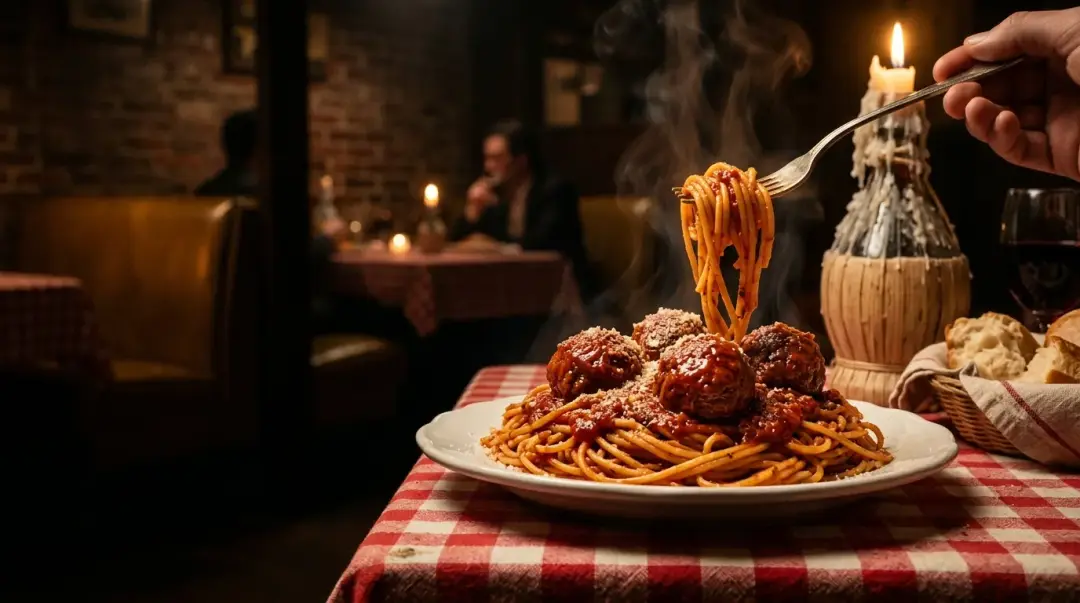
Spaghetti and meatballs history, from an 1888 New York cookbook to Chef Boyardee and Lady and the Tramp, plus why Italy's polpette rarely meet the pasta.
This page contains affiliate links. We may earn a commission at no extra cost to you. Disclosure
A Budget Cookbook, New York, 1888
In 1888 the New York publisher Harper & Brothers brought out Family Living on $500 a Year by Juliet Corson. Corson had founded the New York School of Cookery in 1876, and her books were about feeding a household on very little money. Among the recipes is one for pasta with meatballs in tomato sauce, and food historians usually cite it as the earliest printed version of the dish.
The date matters because of who wrote it. Corson was a cooking teacher, and the book bills itself as a daily reference for young and inexperienced housewives. An American budget manual printing pasta with meatballs tells you the parts were already on American shelves in the 1880s: dried pasta, ground meat, tomatoes. What came next was a population that cooked them together every week.
Two decades later, in 1909, the magazine American Cookery ran a recipe called "Beef Balls with Spaghetti." By the 1920s the National Macaroni Manufacturers Association, the trade group now called the National Pasta Association, was printing its own spaghetti and meatballs recipe. By then the dish had a fixed form, and that form was American.
A recipe from a manufacturers' association is marketing, and that tells you something too: by the 1920s spaghetti and meatballs was useful for selling pasta to Americans in general, well beyond Little Italy. Historian Donna Gabaccia makes the larger point bluntly: the dish was something new, built in the US from the ingredients immigrants found there, and peasants in Italy had not eaten it before they left.
What the Immigrants Left Behind
About 4 million Italians came to the United States between 1880 and 1920, according to Smithsonian magazine, and roughly 85 percent of them came from the south: Sicily, Calabria, Campania, Abruzzo and Molise. At home, meat reached peasants in tiny amounts. A Milanese laborer of the period, quoted in an Italian Journal essay on historian Hasia Diner's research, described Italian workers who were "forced to raise their own vegetables and could afford very little meat."
America reversed that ratio. Immigrant households went from spending about 75 percent of their income on food to about 25 percent, Smithsonian reports. Two brothers from Alia, Sicily, writing home from Napoleonville, Louisiana, in the early 1900s, put the trade in one line: il pane è molle, ma la vita è dura, "the bread is soft, but life is hard." The work was brutal and the food was plentiful.
That is the plain reason American meatballs are big. Meat had been the scarce ingredient. In the US it was the cheap one, and cooks used it the way people use anything they have just gained access to: generously, and in the center of the plate.
Three Supply Chains Meet in One Pot
Robert Sietsema, the New York food critic, argues that the dish appears around 1890 because that is when three American supply chains finally overlapped. Each one has its own history.
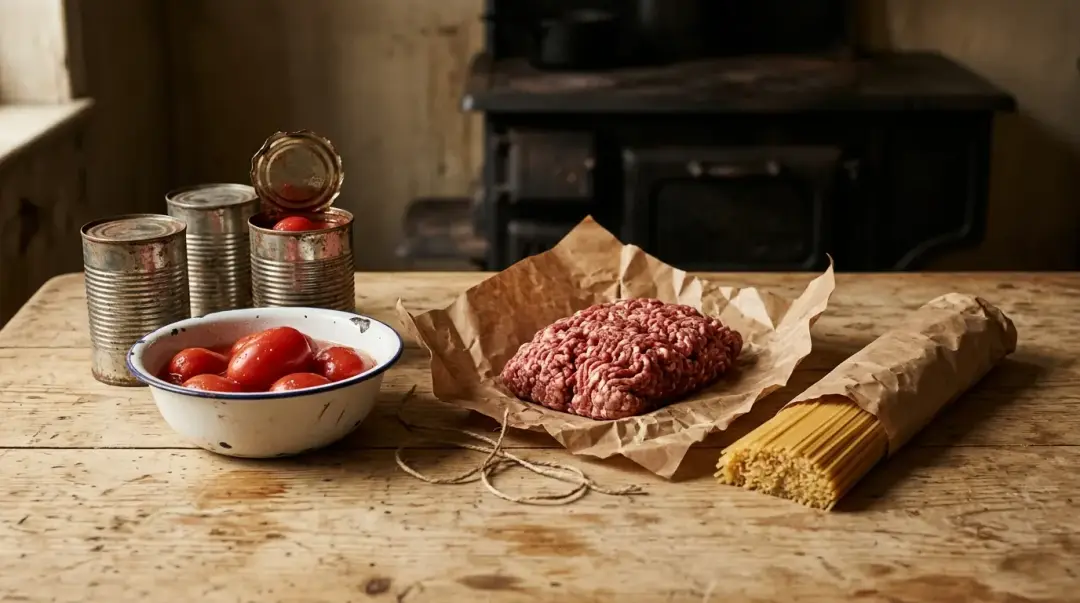
Beef. Chicago's meatpacking plants shipped cheap beef east by rail, and historian Donna Gabaccia points to ground beef from those plants as the meat that ended up in the meatballs. New York had a head start with ground meat: Sietsema traces "hamburger steaks" on restaurant menus to the 1870s.
Tomatoes. Industrial tomato canning began in the American Northeast in the 1860s, Gabaccia writes, and Sietsema puts canned tomatoes in general circulation by about 1890. California growers later planted Neapolitan plum tomatoes specifically for canning. A can of tomatoes meant tomato sauce in any month of the year.
Pasta. Anthony Zerega opened New York's first macaroni factory on Front Street in 1850, and by the second decade of the 20th century, immigrant entrepreneurs were turning out Italian-style pasta in American-style factories. By around 1890, Sietsema notes, durum wheat was growing in Nebraska.
Put those three together in a tenement kitchen and the dish nearly writes itself. The method came over with the cooks. Roman home cooking, as Ada Boni recorded it in 1929, already fried meatballs and then stewed them in tomato sauce. In the US there was simply more meat to stew.
Cheap beef, canned tomatoes and factory spaghetti overlapped around 1890, and the dish followed.
For the pasta itself, our guide to spaghetti covers thickness and the bronze-die question, and the Italian pasta shape guide explains why a long round strand suits a smooth tomato sauce.
Polpette: The Italian Side of the Plate
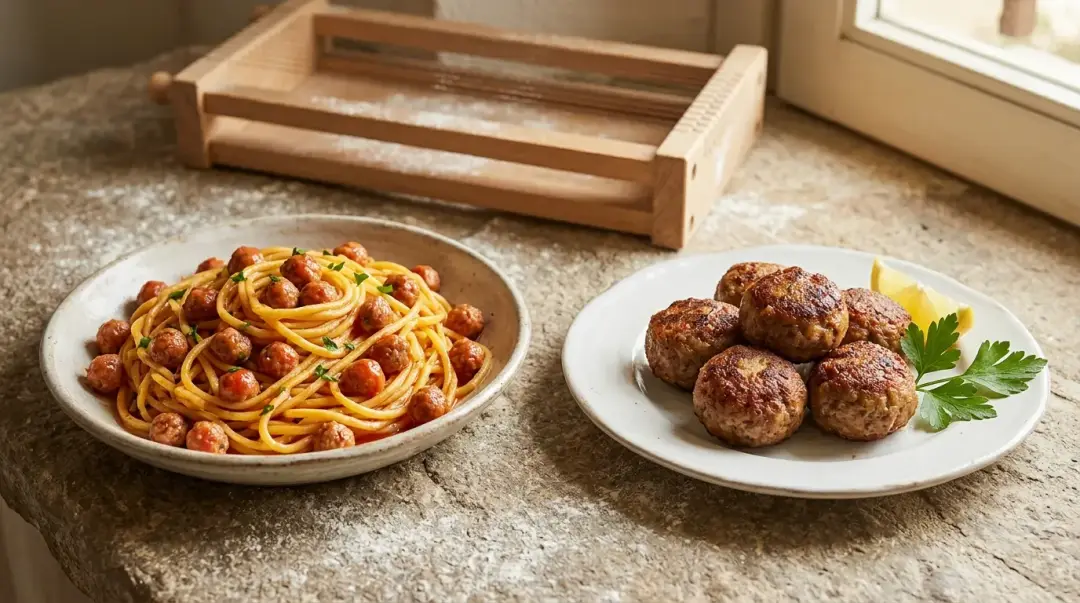
Italy has meatballs. It just doesn't usually serve them on a mound of spaghetti. Polpette (pol-PET-teh) are traditionally golf-ball size or smaller, Smithsonian notes, and in Abruzzo the version called polpettine can be as small as a marble. They are made from whatever meat the house has, turkey and even fish included, eaten plain or dropped into soup, and they turn up more often at family tables than on restaurant menus.
Pellegrino Artusi, the Florentine silk merchant who published an Italian cookbook in 1891, barely bothered to explain them: "Don't think I'm pretentious enough to teach you how to make meatballs. This is a dish that everybody can make."
There are real Italian precedents for pasta with meatballs, and they explain where the immigrant instinct came from. In Abruzzo, spaghetti alla chitarra (kee-TAR-rah; egg pasta pressed through a wire-strung frame called a "guitar," which gives the strands a square cross-section) is served in the Teramo area with pallottine (pal-lot-TEE-neh), tiny beef or lamb meatballs, according to Gambero Rosso. In Campania, small meatballs go into baked lasagna and into sartù, a rice timbale. Ada Boni's 1927 cookbook Il talismano della felicità includes maccheroni alle polpettine: mezzani, a narrow ziti, topped with small meatballs that are poached in salted water, not fried.
Italian polpette vs Italian-American meatballs
| Italian polpette | Italian-American meatballs | |
|---|---|---|
| Typical size | Golf ball or smaller; marble-size in Abruzzo | Much larger, often the centerpiece of the plate |
| Usual meat | Any meat on hand; also turkey or fish | Ground beef, cheap thanks to Chicago packers |
| How served | On their own, or in soup | On top of spaghetti, in tomato sauce |
| With pasta? | Regional: chitarra with pallottine, baked timballi | Almost always |
| Sauce | Often none; sometimes stewed in tomato | Long-simmered tomato sauce from canned tomatoes |
| Where you find it | Home kitchens more than restaurants | Italian-American restaurants, home kitchens, cans |
The difference is scale. Immigrant cooks with more beef than they had ever handled made the meatballs big enough to be the meal and put them on the pasta, where the Italian versions stayed small or stayed separate. Niccolò de Quattrociocchi, a Sicilian restaurateur, wrote in 1950 that he found spaghetti and meatballs "extremely satisfying" and thought "someone in Italy should invent them for Italians."
The Can and the Cartoon
Two products took the dish from immigrant neighborhoods to every American kitchen. One came in a can.
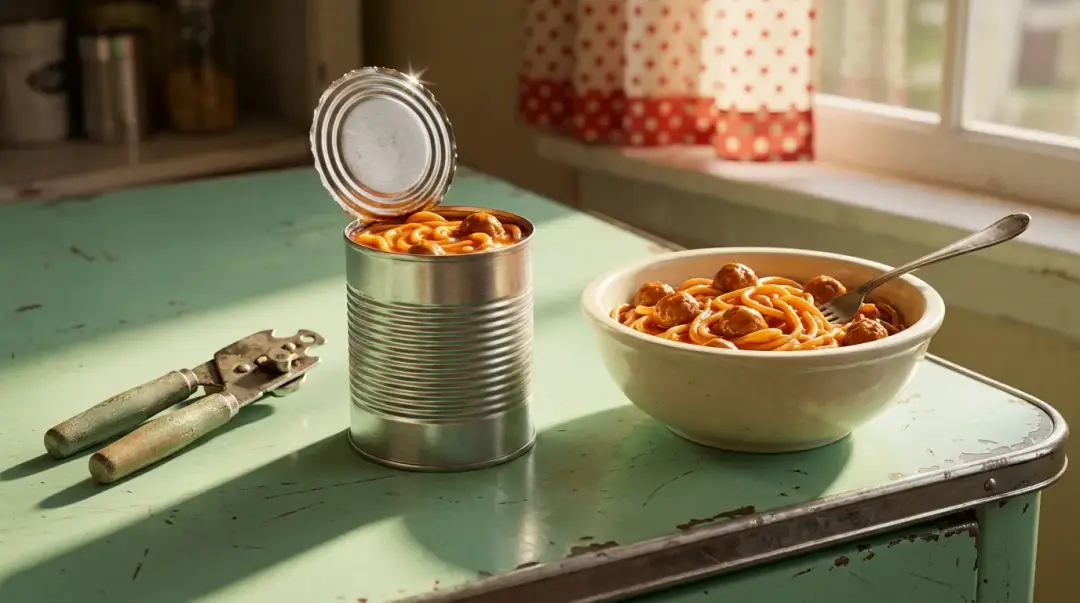
Ettore Boiardi was born in Italy in 1897, started cooking at about age 10 and arrived in New York around 1914. He cooked in New York hotel kitchens, then moved to Cleveland as chef at the Hotel Winton, and in 1924 opened Il Giardino d'Italia ("the Garden of Italy") at East 9th Street and Woodland Avenue. Carry-out orders grew until, by 1928, they needed factory production. That year he began selling a ready-to-heat spaghetti kit with dry pasta, tomato sauce and grated cheese, and he spelled the brand the way Americans should say his name: Chef Boy-ar-dee.
Production moved to Milton, Pennsylvania, by 1938, close to tomato and mushroom supplies. During World War II the US military contracted the company for rations and the factory ran 24 hours a day. In 1946 Boiardi sold the business to American Home Foods for about $6 million. Conagra bought the brand in 2000 and sold it to Brynwood Partners in 2025.
Boiardi was not first with the can, though. In 1931 a New Jersey company called Venice Maid was already selling canned "spaghetti with meatballs in sauce." What the canned versions did, together, was turn a dish that took an afternoon into a pantry staple you could open on a Tuesday.
The cartoon came in 1955. Disney's Lady and the Tramp premiered at the State-Lake Theatre in Chicago on June 16 of that year. Behind Tony's Italian restaurant, the two dogs share a plate of spaghetti and meatballs while Tony sings "Bella Notte," a song by Peggy Lee and Sonny Burke sung on screen by George Givot. They slurp the same strand from opposite ends, and the Tramp noses the last meatball across the plate to Lady. Walt Disney reportedly thought the sequence was distasteful. Animator Frank Thomas found the discarded story reel, animated it himself, and Disney kept it.
That scene probably did more to fix the dish in the American mind than any recipe. When Disney remade the film in 2019, the meatball moment was in the trailer.
Cooking It With History in Mind
If you want a plate that respects both sides of the story, the shopping list is short. Buy a good dried spaghetti; our best Italian pasta guide ranks the boxes, and De Cecco is the everyday benchmark. Then buy canned whole plum tomatoes, since the can is as much a part of this dish as the meat. The Italian pantry essentials list covers tomatoes, olive oil and the aged cheeses that go on top.
Two choices change the result more than any brand:
- Size. Make the meatballs smaller than you think, closer to a walnut than a baseball. They cook through in the sauce without drying out, and they sit closer to the polpette the original cooks grew up with.
- Order. Try it once with the meatballs on a separate plate, the way most Italian polpette are eaten, and the sauced spaghetti on its own. It is the same food, and you taste the pasta and the meat as two things instead of one heap.
A Dated Timeline
The story in eleven entries, from the first macaroni factory to the cartoon:
| Year | What happened |
|---|---|
| 1850 | Anthony Zerega opens New York's first macaroni factory on Front Street |
| 1860s | Industrial tomato canning begins in the American Northeast |
| 1876 | Juliet Corson founds the New York School of Cookery |
| 1880–1920 | About 4 million Italians emigrate to the US, roughly 85% from the south |
| 1888 | Harper & Brothers publishes Corson's Family Living on $500 a Year, with a pasta-and-meatballs recipe |
| 1891 | Pellegrino Artusi's cookbook treats meatballs as too simple to need teaching |
| 1909 | American Cookery prints "Beef Balls with Spaghetti" |
| 1920s | The National Macaroni Manufacturers Association publishes its own spaghetti and meatballs recipe |
| 1924–1928 | Boiardi opens Il Giardino d'Italia in Cleveland, then sells a packaged spaghetti kit |
| 1931 | Venice Maid sells canned spaghetti with meatballs in sauce |
| 1955 | Lady and the Tramp premieres in Chicago on June 16 |
FAQ
Is spaghetti and meatballs Italian or American?
It is Italian-American. The combination of long spaghetti, large beef meatballs and a big pot of tomato sauce took shape in US cities between the 1880s and the 1920s. Italy has meatballs and some regional pasta dishes with tiny meatballs, but the plate most people picture was built from American beef, American canned tomatoes and American factory pasta.
When was spaghetti and meatballs invented?
No single date exists. The earliest printed recipe usually cited is in Juliet Corson's Family Living on $500 a Year, published by Harper and Brothers in New York in 1888. A recipe called Beef Balls with Spaghetti ran in American Cookery in 1909, and the pasta industry's trade group printed its own version in the 1920s.
Do Italians eat meatballs with spaghetti?
Rarely in the American form. Italian polpette are usually golf-ball size or smaller and are eaten on their own or in soup. Abruzzo pairs spaghetti alla chitarra with marble-size meatballs called pallottine, and Ada Boni's 1927 cookbook has a recipe for short pasta with small poached meatballs, so the idea exists in Italy in smaller, regional versions.
Why are American meatballs so big?
Because meat was cheap. In Italy, peasants got meat in tiny amounts, and Italian immigrants in the US cut the share of income they spent on food from about 75 percent to about 25 percent. Chicago meatpacking made ground beef affordable, and the large meatball became a sign of that new plenty.
Who was Chef Boyardee?
A real chef named Ettore (Hector) Boiardi, born in Italy in 1897. He opened Il Giardino d'Italia in Cleveland in 1924, began selling a packaged spaghetti kit in 1928, spelled the brand phonetically as Chef Boy-ar-dee, and moved production to Milton, Pennsylvania, by 1938. He sold the company to American Home Foods in 1946.
What is the spaghetti scene in Lady and the Tramp?
In Disney's 1955 film, the two dogs share a plate of spaghetti and meatballs behind Tony's Italian restaurant while Tony sings Bella Notte. They slurp the same strand from opposite ends and end up kissing. Walt Disney reportedly found the scene distasteful, but animator Frank Thomas animated it anyway and Disney kept it in the film.
Read Next
Products mentioned in this guide
This section contains affiliate links. We may earn a commission at no extra cost to you.

De Cecco Spaghetti No. 12 Pasta, 16 oz
A standard-thickness Italian spaghetti that holds a heavy tomato-and-meatball sauce without going soft. The everyday box for this dish.
View on Amazon
Cento San Marzano Tomatoes (Whole Peeled, 28 oz)
Canned plum tomatoes are half the story of this dish. Crush one can by hand for a Sunday-style sauce that simmers with the meatballs.
View on Amazon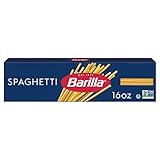
Barilla Classic Blue Box Spaghetti, 16 oz
The supermarket spaghetti many kitchens already know. A box made for feeding a crowd.
View on Amazon
Buying guides for this topic
- Buying guideBest Italian Pasta Brands in 2026De Cecco, Rummo, Garofalo, and premium bronze-die pasta brands ranked. The pasta upgrade worth making.
- Buying guideBest Italian Pantry Essentials in 2026Tomatoes, olive oil, Parmigiano, Pecorino, anchovies, guanciale — the Italian pasta foundation, ranked.
- Buying guideBest Pasta Maker, Extruder and Drying Rack in 2026Pasta makers compared: Marcato and Imperia hand-crank rollers, KitchenAid attachments, electric noodle machines, pasta extruders and drying racks.