History of Ramen: From Chinese Ports to Japan
· 10 min read · NoodleDex Editorial
The history of ramen from 1880s port-town Nankin soba to Rairaiken in 1910, postwar US wheat, Ando's 1958 instant noodle, and a 124-billion-serving world.
This page contains affiliate links. We may earn a commission at no extra cost to you. Disclosure
On this page(11 sections)
- Before 1910: Nankin Soba in the Port Towns
- 1910: Rairaiken Opens in Asakusa
- 1910s–1930s: Machines, Pushcarts and Factory Workers
- 1944–1952: Hunger, Flour and the Black Market
- 1955–1958: Kitchen Buses and Chicken Ramen
- 1958–1973: Construction Crews and a Cup
- 1976–1999: From Fuel to Hobby
- 2000s–Now: A Japanese Export
- Eat the Timeline in the US
- FAQ
- Products mentioned in this guide
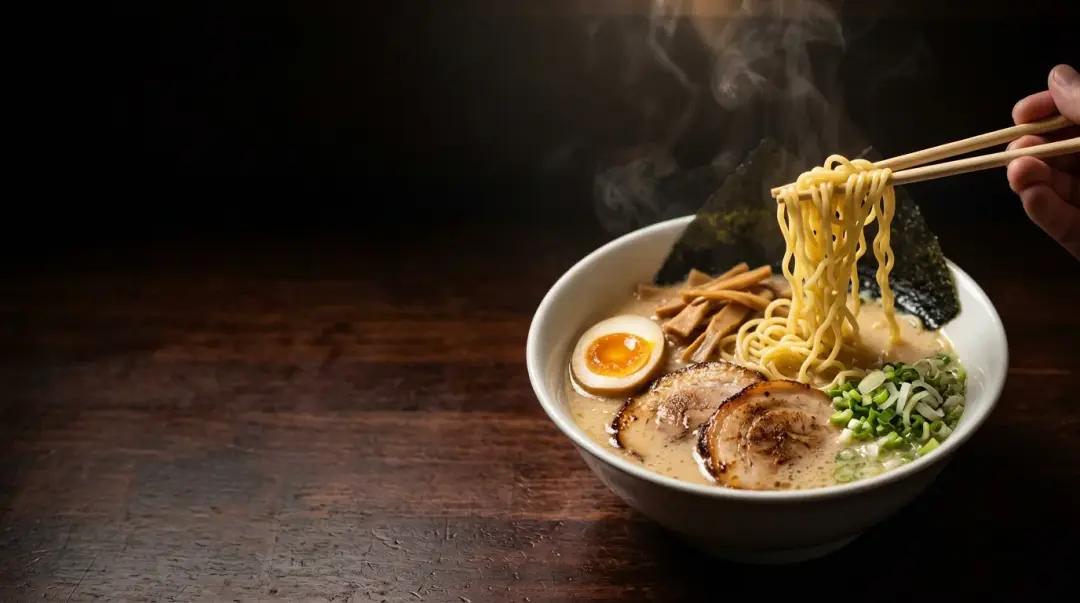
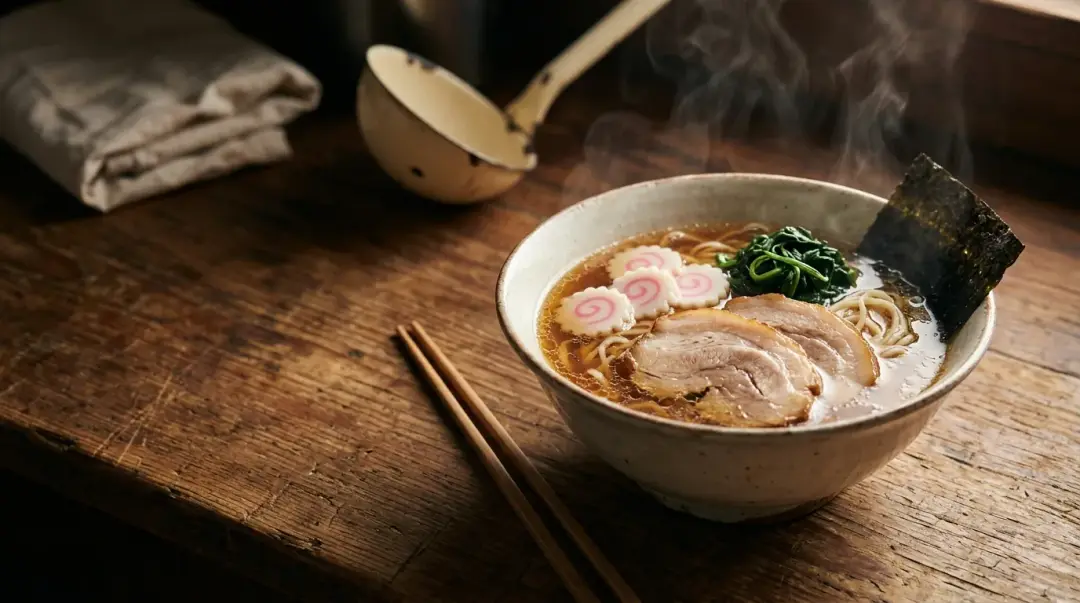
The story starts with one bowl. In 1910 Ozaki Kan'ichi (some sources romanize it Kenichi), a former customs official in Yokohama, opened Rairaiken (rye-rye-ken) in Asakusa, Tokyo, and hired twelve Cantonese cooks from Yokohama's Chinatown. They served wheat noodles in a soy-seasoned broth topped with chāshū (braised pork), naruto (a fish cake with a pink swirl), spinach and a sheet of nori. George Solt, whose The Untold History of Ramen (University of California Press, 2014) is the standard English-language history, treats those toppings as the model for Tokyo-style ramen.
At its peak Rairaiken fed about 3,000 people a day. It closed in 1976 because no one in the family would take it over. In 2020 Ozaki's descendants rebuilt it inside the Shin-Yokohama Raumen Museum, using a flour said to descend genetically from the wheat the original shop used.
Each part of that bowl has its own history. The broth and noodles came from Chinese port-town cooking, and the soy seasoning made the dish Tokyo's. After 1945 the flour came, more and more, from American farms. The timeline below follows the bowl.
Before 1910: Nankin Soba in the Port Towns
Japan opened its ports to foreign trade in 1859, and Chinese restaurants followed into the port towns. Barak Kushner, the historian behind Slurp! A Social and Culinary History of Ramen (2012), points out that the largest foreign community in mid-1800s Japan was Chinese. Japanese diners called the noodle soup these cooks sold Nankin soba, "Nanjing noodles," a catch-all name for Chinese food.
By 1884 Chinese noodle soups were popular in Yokohama, Kobe, Nagasaki and Hakodate. A Hakodate newspaper ran an advertisement for Nankin soba that year, which makes it arguably the earliest documented reference to ramen-style noodles in Japan. Whether Hakodate served Japan's first bowl is still argued. Yokohama's Chinatown, then called Nankinmachi, had a "Nanjing noodle restaurant" by 1903.
The noodle itself set these soups apart from soba and udon. Southern Chinese cooks made their dough with alkaline salts, which the Japanese call kansui (alkaline mineral water, a mix of sodium and potassium carbonates). It turns wheat dough yellow and springy, and it is still the technical line between ramen and other wheat noodles.
Two popular origin stories don't hold up. The first says the feudal lord Tokugawa Mitsukuni ate ramen in the 1660s on the advice of a Chinese refugee scholar. Solt calls it "the first and most imaginative" of the origin myths. Kushner calls it "preposterous because a Confucian gentleman wouldn't have cooked," and the noodles Mitsukuni reportedly ate were made of lotus-root starch and wheat, with no kansui. The second traces the word ramen to Chinese lamian (pulled noodles). Japanese ramen descends from southern, mostly Cantonese, noodle cooking, not northern pulled noodles, and Kushner doubts any straight line from Lanzhou to Tokyo. Where the word came from is still unsettled.
1910: Rairaiken Opens in Asakusa
Tokyo already had Chinese noodle peddlers in the early 1900s. Pushcart vendors in Ueno and Asakusa copied what they had eaten in Yokohama. Rairaiken took the idea indoors and gave it a name: shina soba (Chinese noodles). It is often described as the first Chinese restaurant owned by a Japanese national, and most accounts call it the first specialized ramen shop. The menu ran past noodles to wonton noodles, char siu noodles and shumai dumplings, with both handmade and machine-made noodles.
The model spread through the 1920s and 1930s. In 1925 Fan Qinxing, a cook from China's Zhejiang province, opened Genraiken in the town of Kitakata. A second Rairaiken opened in Meguro, Tokyo, in 1933 under Fu Xinglei. Chinese cooks were still opening many of the new shops.
1910s–1930s: Machines, Pushcarts and Factory Workers
Ramen grew up alongside Japanese industry. Mechanical noodle cutters were in general use by the late 1910s, which made noodles cheap and uniform. The bowl was quick to cook and quick to eat, which, Solt argues, suited the urban factory and office workers of the 1920s and 1930s. Its wheat and meat also tied it to Western food, which many Japanese saw as more healthful and nourishing. Kushner sums up the argument of Japan's military leaders at the time: the national diet needed to change "so that we aren't swallowed, both literally and figuratively, by the West."
Ramen was street food in this period, eaten by students, laborers and late-night drinkers. Kushner's line is blunt: "Ramen is not something you consume at home."
1944–1952: Hunger, Flour and the Black Market
Solt calls 1944 to 1947 "the worst period of hunger in Japan's modern history." In 1945 the official government ration was 775 calories per person per day. That December, Japan recorded its worst rice harvest in 42 years. The American occupation, which ran from 1945 to 1952, kept rationing in place and banned outdoor food sellers.
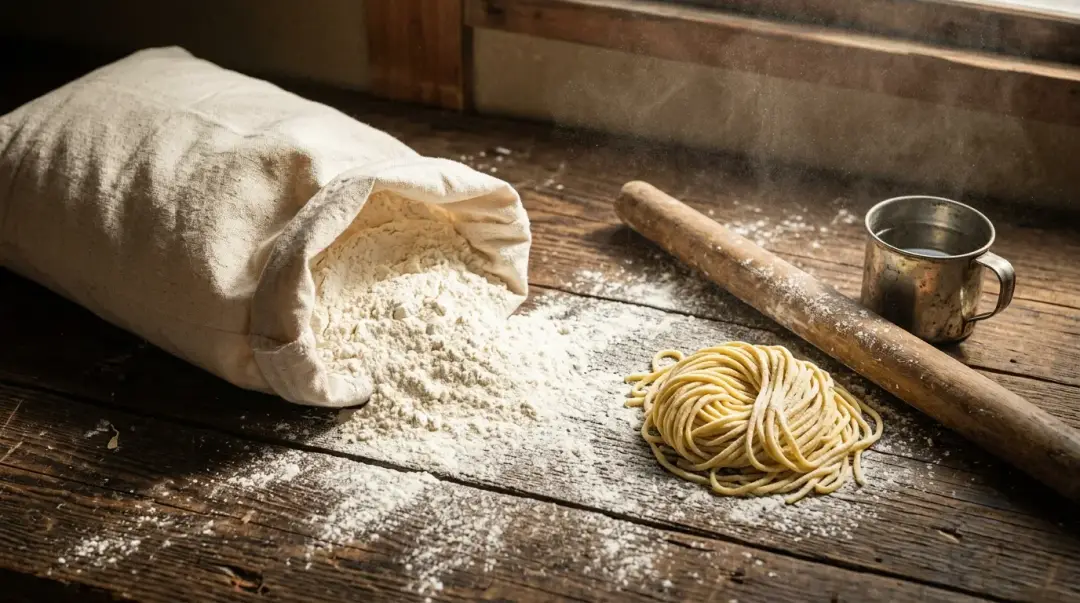
Wheat filled the gap. The US shipped in cheap flour, school lunches using imported wheat and milk began in December 1946, and the program grew from 250,000 children in Tokyo and Yokohama to 8 million by 1952. Bread consumption in Japan rose from 262,121 tons in 1948 to 611,784 tons in 1951. Much of the flour also went out the back door. Black-market stalls sold ramen made from it, nearly 90 percent of the stalls were under the control of yakuza-linked gangs, and thousands of ramen vendors were arrested during the occupation. In 1945, in the ruins of Osaka, a businessman named Momofuku Ando saw the long lines at those stalls.
Historians agree the wheat mattered and disagree on what it meant. Solt reads ramen's postwar rise as a product of Japan's "dependence on U.S.-imported wheat flour," tied to occupation and Cold War politics. Kushner stresses that the occupation at first had no plan to feed Japan at all and changed course only as communism rose in East Asia. In his account, the American effort to make Japan a bread-eating country "was a singular failure, because the Japanese don't cook bread at home." In this telling, the flour reached ramen bowls through the black market rather than by design.
The name changed too. Shina, the old word for China, had become a slur, and after about 1946 the dish was sold as chūka soba (Chinese-style noodles). The word ramen first appeared in print in 1947, in Hatsuko Kuroda's cookbook Enjoyable Home Cooking. In 1950 flour controls ended and vending rules loosened, and ramen stalls multiplied.
1955–1958: Kitchen Buses and Chicken Ramen
The wheat push became a marketing program. In 1956 American wheat growers and the US Department of Agriculture began a Japan project funded through Public Law 480, the US surplus-food law. Its "kitchen on wheels" buses toured Japan from October 1956 to December 1960, cooking wheat dishes for almost 2 million people at more than 20,000 stops. US wheat exports to Japan rose from 1.28 million metric tons in 1956 to 3.24 million in 1974. Japanese nutritionists joined in. One pamphlet of the era carried the title "Eating Rice Makes You Stupid."
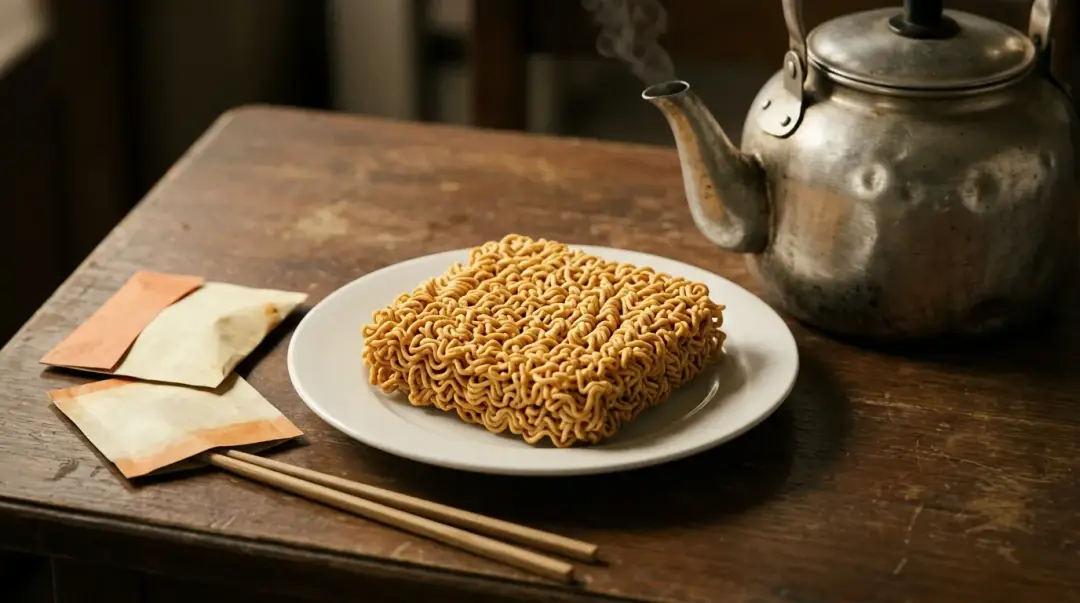
Instant ramen came out of the same years. An instant noodle called Ajitsuke Chūka Men went on sale in 1955, but its maker never secured a patent. Ando, who had lost his property in a 1957 credit-union collapse, spent a year in a shed behind his house in Ikeda, near Osaka. Watching his wife fry tempura, he saw that hot oil drove the water out of the batter. Fried seasoned noodles would dry out and come back to life in hot water. Nissin put Chicken Ramen on sale on August 25, 1958. Ando was 48.
1958–1973: Construction Crews and a Cup
The 1964 Tokyo Olympics brought a building boom (subways, the shinkansen bullet-train line, five new expressways), and the crews building them ate ramen. A new generation raised on school-lunch wheat and more meat grew up with the bowl. Class attitudes lagged. Solt points to the 1954 film Bangiku (Late Chrysanthemums), in which a middle-class mother still cannot eat ramen without embarrassment.
Instant ramen went abroad. On a 1966 trip to the US, Ando watched Americans break Chicken Ramen into paper cups and eat it with forks. Nissin set up a US company in Los Angeles in 1970 and launched Top Ramen that autumn. In 1972 its plant in Gardena, California, began making Top Ramen, the first instant ramen manufactured and sold in the US. Cup Noodles went on sale in Japan on September 18, 1971, and reached US shelves in November 1973 as Cup O'Noodles.
1976–1999: From Fuel to Hobby
Rairaiken closed in 1976, and the rest of the trade moved on. In the 1970s, one newspaper ran a weekly "Datsu-sara Report" on datsu-sara, salarymen who quit corporate jobs to open ramen shops. By the 1980s the pushcarts had disappeared. Specialty shops with short menus replaced the old Chinese restaurants, and queuing for hours at a famous shop became common enough to earn a name, rāmen gyōretsu (ramen lines). Kushner ties the boom in regional styles to the shinkansen network and national tourism campaigns, which made it easy to travel for a bowl.
The Shin-Yokohama Raumen Museum opened in 1994, billed as the world's first food-themed amusement park. Ramen chefs went on television. Younger cooks, following Kawahara Shigemi, founder of Ippudō, began wearing samue (Buddhist work clothes), a look Solt reads as presenting the ramen maker as "a Japanese craftsman with a Zen Buddhist sensibility rather than a Chinese food chef." In 2000, a Japanese poll named instant ramen the greatest invention of the 20th century.
2000s–Now: A Japanese Export
Solt argues that ramen became fully "Japanese" only in the 2000s, when domestic and foreign youth culture embraced it and the government folded it into efforts to sell Japan as a consumer brand.
In the US the craft wave rode on noodles. Sun Noodle, founded in Honolulu in 1981 by Hidehito Uki, opened a California plant in 2004 and a New Jersey plant in 2011, and it supplied New York shops including Momofuku Noodle Bar and Ivan Ramen. David Chang opened Momofuku Noodle Bar at 171 First Avenue in August 2004. The instant side kept growing: the World Instant Noodles Association counted 124.2 billion servings eaten worldwide in 2025, including 5.2 billion in the US and 5.95 billion in Japan. The broths themselves are their own story, told in our ramen broth guide.
Eat the Timeline in the US
Most of this history is still on sale, and you can taste it in order.
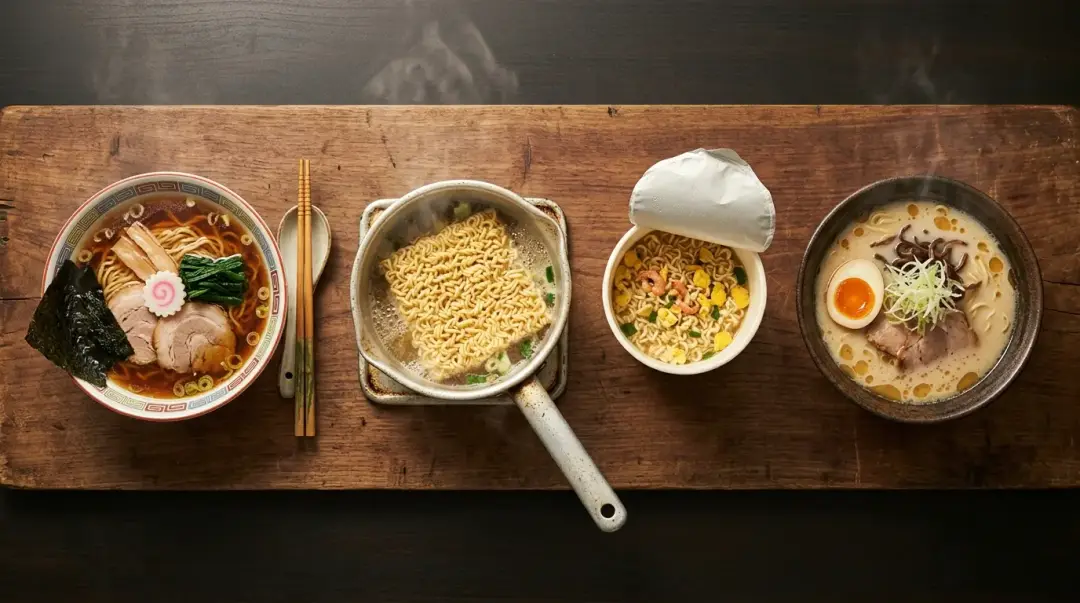
Ramen history you can buy or order in the US
| Era | What to eat | Where |
|---|---|---|
| 1910 Tokyo shoyu | Soy-sauce ramen with chashu, naruto, spinach, nori | Sun Noodle Shoyu kit (Whole Foods, H Mart) |
| 1958 instant | Fried, seasoned block noodle | Top Ramen, Nissin's US block |
| 1971 cup | Noodles cooked in their own cup | Cup Noodles, any US supermarket |
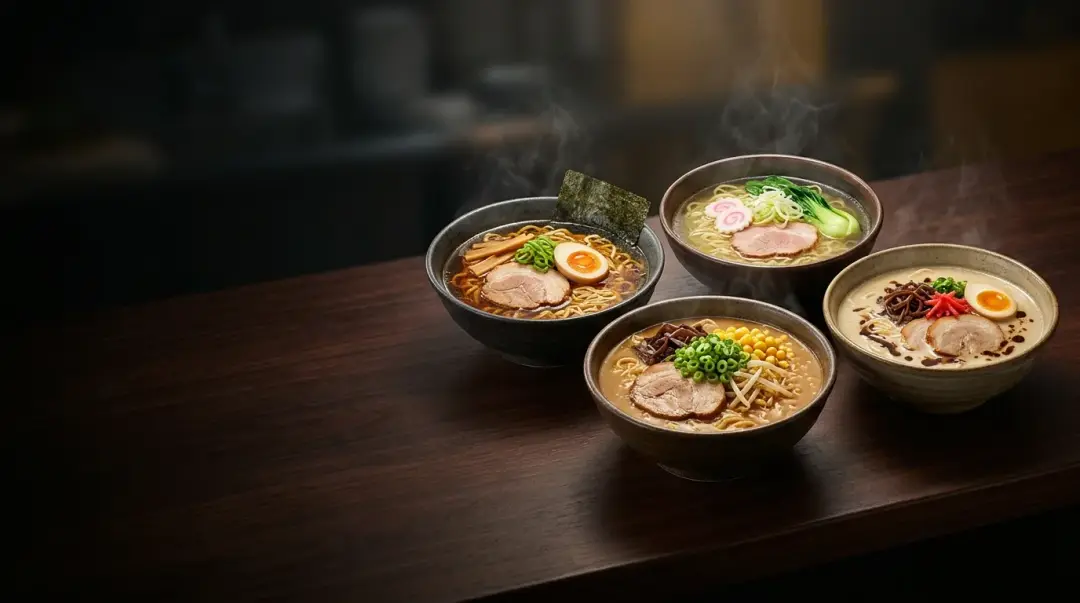
| 1980s–90s specialty shop | Regional bowl: tonkotsu, miso, shio | A ramen-ya near you |
| 2000s craft | Fresh alkaline noodles, house broth | Shops supplied by Sun Noodle |
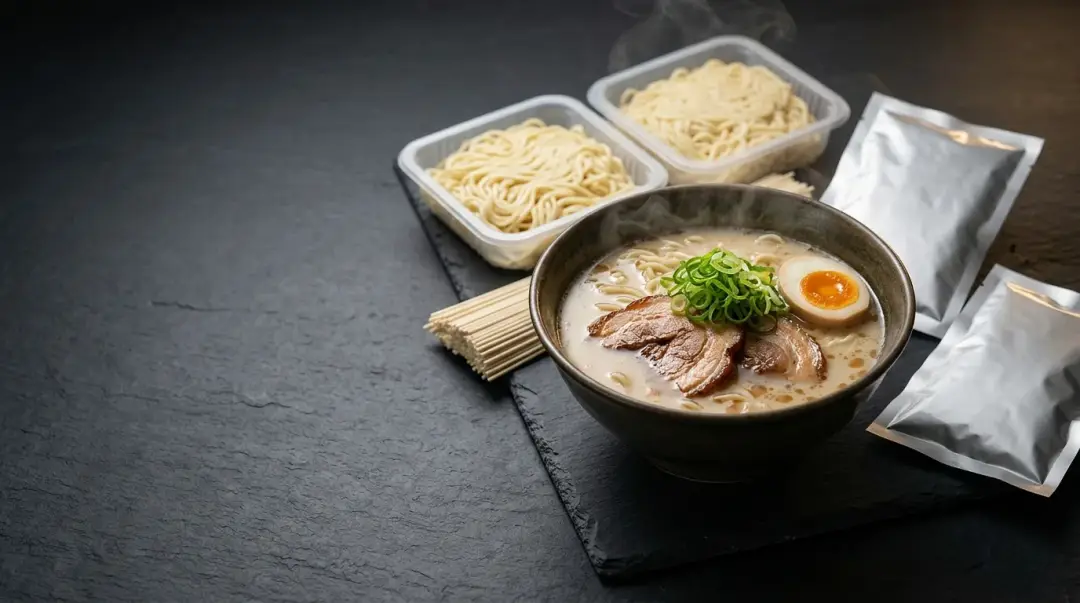
For the 1910 bowl, Sun Noodle's retail shoyu kit says it is inspired by early Tokyo soy-sauce ramen. Top it the Rairaiken way, with sliced pork, a few rounds of naruto, wilted spinach and nori. For the 1958 chapter, cook a block of Top Ramen in a pot of water for three minutes. For everything after that, fresh noodles are the upgrade, and our best ramen noodles guide lists the fresh and dried packs worth buying, from Sun Noodle's kaedama to Hakubaku's dried organic ramen. The ramen type page covers the regional styles the 1980s boom produced.
FAQ
Where did ramen originate?
Ramen began as Chinese noodle soup cooked by Chinese residents of Japan's treaty ports, including Yokohama, Kobe, Nagasaki and Hakodate, in the late 1800s. Japanese diners called it Nankin soba. Historians trace it to southern, mainly Cantonese, noodle cooking. It became a Japanese shop dish in Tokyo after 1910 and a national food after World War II.
Who invented ramen?
No single person. Chinese cooks in Japan's port cities made the first versions, and Rairaiken, opened in Tokyo's Asakusa in 1910 by Ozaki Kan'ichi with Cantonese cooks from Yokohama, set the soy-sauce template. Momofuku Ando invented instant ramen in 1958, though an earlier, unpatented instant noodle went on sale in 1955.
What was the first ramen shop in Japan?
Rairaiken in Asakusa, Tokyo, which opened in 1910, is usually called the first specialized ramen shop. The claim depends on definitions: a Hakodate newspaper advertised Nankin soba in 1884, and Yokohama's Chinatown had a Nanjing noodle restaurant by 1903. Rairaiken closed in 1976 and reopened in 2020 inside the Shin-Yokohama Raumen Museum.
Why did ramen become popular after World War II?
Hunger and wheat. Japan's December 1945 rice harvest was the worst in 42 years, and the US occupation shipped in cheap wheat flour. Much of it reached black-market stalls as ramen. Once flour controls ended in 1950, vendors multiplied, and the noodle fed the workers who rebuilt Tokyo for the 1964 Olympics.
Is ramen Chinese or Japanese?
Both, in sequence. The noodles, the alkaline dough and the early broths came from Chinese cooks, and the dish was sold as Chinese food in Japan for decades under the names shina soba and chuka soba. Japanese cooks then developed the regional styles, the specialty shop and instant ramen, and from the 1990s the dish was presented as Japanese craft.
When did the word ramen come into use?
The word was first recorded in print in 1947, in Hatsuko Kuroda's cookbook Enjoyable Home Cooking. Before that the dish was Nankin soba, then shina soba, then chuka soba once shina came to be seen as a slur after the war. Nissin's 1958 Chicken Ramen made the word ramen common.
Read Next
Products mentioned in this guide
This section contains affiliate links. We may earn a commission at no extra cost to you.

Sun Noodle Shoyu Ramen Kit, 2 servings (12.8 oz)
The closest thing to a 1910 Asakusa bowl in a US fridge case. Sun Noodle says its shoyu is modeled on early Tokyo soy-sauce ramen; add spinach and nori.
View on Amazon
Nissin Top Ramen Chicken Flavor, 3 oz (24-pack)
The 1958 idea in its American form. Nissin first made Top Ramen on US soil in Gardena, California, in 1972, and the chicken block is still the default.
View on Amazon
Nissin Cup Noodles Chicken Flavor, 2.25 oz (12-pack)
The 1971 chapter: noodles sold in their own cup, inspired by Americans eating Chicken Ramen from paper cups with forks. Ready in about two minutes.
View on Amazon
Buying guides for this topic
- Buying guideBest Ramen Noodles & Kits in 2026The best fresh and dry ramen noodles, plus premium ramen kits, available on Amazon — Sun Noodle, Hakubaku, Marusan, and Maruchan Seimen ranked.
- Buying guideBest Japanese Pantry Essentials in 2026The 10 Japanese pantry items needed to cook ramen, udon, soba, and yakisoba at home. Soy, dashi, mirin, miso, and yakisoba sauce, ranked.
- Buying guideBest Japanese Cookware in 2026The donabe, ramen bowls, sōmen sets, and tools you need to cook Japanese noodles at home. Real US Amazon picks across budget tiers.