Sanuki Udon: Kagawa's Square-Cut Noodle, Explained
· 9 min read · NoodleDex Editorial
Sanuki udon is Kagawa's thick, square-cut wheat noodle with a firm chew. How it is made, the label rules, six classic styles, and buying it frozen.
This page contains affiliate links. We may earn a commission at no extra cost to you. Disclosure
On this page(10 sections)
Kagawa: Japan's Smallest Prefecture, Its Biggest Udon Habit
Kagawa (kah-GAH-wah) is on Shikoku, and at 1,877 square kilometers (725 square miles) it is the smallest prefecture in Japan by area. Before the modern prefectures, this was Sanuki Province, and the noodle still carries the old name.
The numbers are lopsided for a place of under a million people (949,358 at the 2020 count). Wikipedia's prefecture entry puts Kagawa at more than 700 udon restaurants in 2008, and Tokyo Weekender's estimate runs from 600 to 800. In 2009 the prefecture produced 59,643 tons of udon, first in Japan and more than double second-place Saitama. In one survey of residents, 90.5% said they eat udon at least once a week. In 2011 the prefectural government leaned into it and launched a tourism campaign branding Kagawa the "Udon Prefecture."
The origin story everyone in Kagawa knows is a legend. Kūkai (KOO-kai), the Buddhist monk also known as Kōbō Daishi, was born in Sanuki and studied in Tang China. He is said to have returned around 807 with wheat know-how and a dumpling dough that became udon. Historians can't confirm it. The firmer evidence comes later: an Edo-period folding screen of the Konpira shrine festival already shows udon shops doing business.
How a Kagawa Self-Service Shop Works
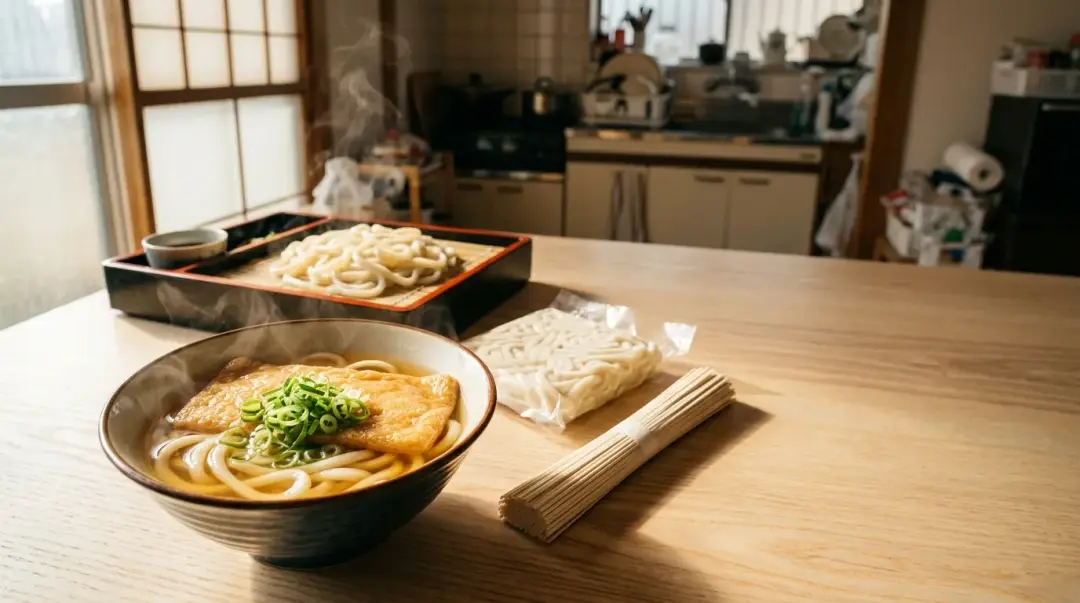
Most of Kagawa's udon is eaten fast, cheaply and before lunch runs out. Many shops take only cash. Arrive before noon if you can, because popular shops sell out. The self-service shop is the format visitors find most confusing, and Takamatsu's tourism office lays out the routine like this:
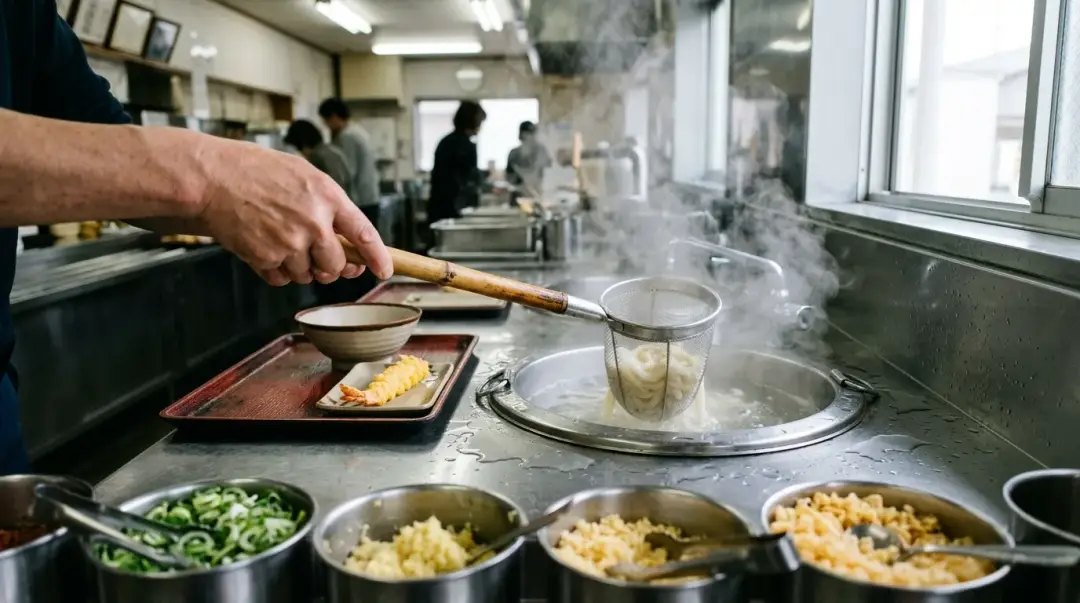
- Take a tray and join the line.
- Tell the counter your udon and your size. Shops name sizes differently: small, medium and large at one, one ball, two balls or three balls at the next. Leaving a large bowl half-eaten is considered bad manners, so order small the first time.
- Pick sides from the trays as you pass: tempura, oden (simmered fish cakes and vegetables), onigiri (rice balls). Some shops add these at the register instead.
- Pay with your tray in hand.
- At many self-service shops you reheat the noodles yourself. Drop them into a tebo (teh-boh), a long-handled strainer basket, dunk it in the hot water tank, give it a few shakes and drain.
- Ladle dashi from the urn, then help yourself to free toppings: sliced green onion, grated ginger, tenkasu (crunchy tempura bits), sesame.
- Eat, then return your dishes to the marked spot, sorting them the way the shop asks.
Once you know the order, the whole routine takes a few minutes, which is why a quick bowl works as a weekday breakfast or a quick lunch.
What Makes Udon "Sanuki"
Sanuki udon has three ingredients and a lot of labor. Kagawa Prefecture's own recipe for its local Sanuki no Yume wheat dissolves salt in water for the dough and adjusts the amount by season, with a little more salt in summer and a little less in winter. Salt tightens the gluten, so the dough comes out stiff and pushes back when you knead it.
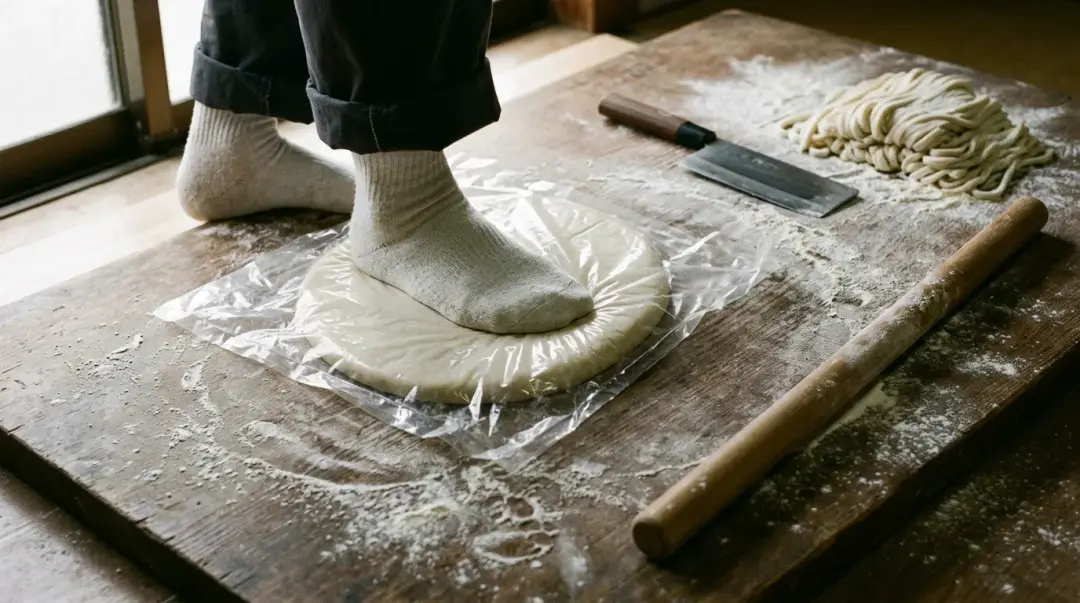
The kneading, often by foot
A stiff, salted dough is hard to work by hand, so the traditional method is to step on it. The dough is sealed in plastic and the cook treads on it, rolling weight from heel to toe and back. The flour industry guide at Flour-Net describes three treading sessions of about five, five and three minutes, with the dough folded and reshaped between each, then a rest of 30 minutes to an hour before rolling. Udon-making classes for visitors in Kagawa still include the stepping.
The cut and the boil
The rested dough is rolled about 3 mm thick, a job a straight, handle-free dowel pin suits at home, and cut about 3 mm wide, so each strand comes out close to square in cross-section, with clean, sharp edges. That square profile shows up in the bowl as defined corners on a glossy noodle. Then comes a long boil, 12 to 15 minutes in Kagawa's recipe, in a big volume of water. Kagawa warns that too little water gives you noodles without koshi.
Koshi (KOH-shee) is the word for the firm, springy resistance at the center of a good Sanuki noodle. Food in Japan attributes it to kneading and aging plus that long, rolling boil, which fully gelatinizes the starch. Cold Sanuki udon eats firmer; in hot broth it relaxes and turns more supple.
What the Label Rules Say
In Japan, "Sanuki udon" by itself is generally unrestricted. Noodles made anywhere can carry the name, which is why you'll see it on packs from factories far from Shikoku.
The stricter rules kick in when a label claims the noodle as a meisan (meh-ee-sahn, famous local product) or tokusan (toh-koo-sahn, local specialty). Under Japan's fair competition code for noodle labeling, as summarized by Zenmenren, the national federation of noodle-maker cooperatives, those products must meet every line below.
Requirements for 'meisan' or 'tokusan' Sanuki udon labeling
| Rule | Requirement |
|---|---|
| Where it is made | Inside Kagawa Prefecture |
| Method | Handmade, or handmade-style (te-uchi or te-uchi-shiki) |
| Water | 40% or more of flour weight |
| Salt | 3% or more of flour weight |
| Aging | 2 hours or longer |
| Boil | About 15 minutes, enough to fully gelatinize the starch |
Two details are easy to miss. The code accepts "handmade-style" alongside handmade, and plain "Sanuki udon" on a pack says nothing about where it was made. If you want the Kagawa-made version of an imported pack, look for the prefecture named on the back panel; wording varies by brand and market, so check the label.
Sanuki Udon vs Regular Udon
Sanuki is a regional style inside the udon family, and it set the pattern most people now think of as plain udon.
Sanuki udon against two other regional styles
| Sanuki udon | Hakata udon | Inaniwa udon | |
|---|---|---|---|
| Home region | Kagawa (Shikoku) | Hakata, Fukuoka (Kyushu) | Akita (northern Honshu) |
| Shape | Thick, square-cut, sharp edges | Thick | Thin |
| Texture | Firm, elastic (koshi) | Soft | Smooth, chewy |
| Dough | Flour, salt, water; long boil of 12 to 15 min | Wheat dough | Wheat dough, made over several days |
Our udon type page covers the wider family, and the ramen vs udon breakdown compares udon with Japan's other big wheat noodle.
Six Ways Kagawa Eats It
Shops in Kagawa serve the same noodle a half-dozen ways, and the name on the menu tells you how hot, how wet and how seasoned the bowl will be.
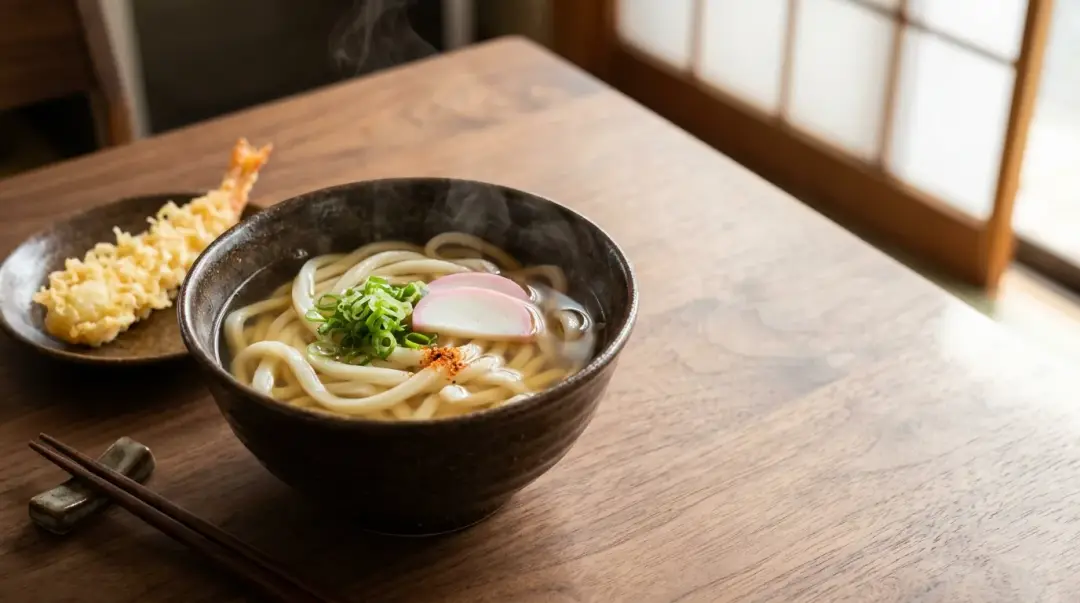
Kake (kah-KEH) is the default: noodles in hot broth. In Kagawa that broth is often built on iriko (dried sardines). Add green onion and tenkasu from the free bar.
Bukkake (boo-KAH-keh) skips the full broth. A small pour of concentrated sauce goes over the noodles, often with grated daikon radish and a lemon wedge.
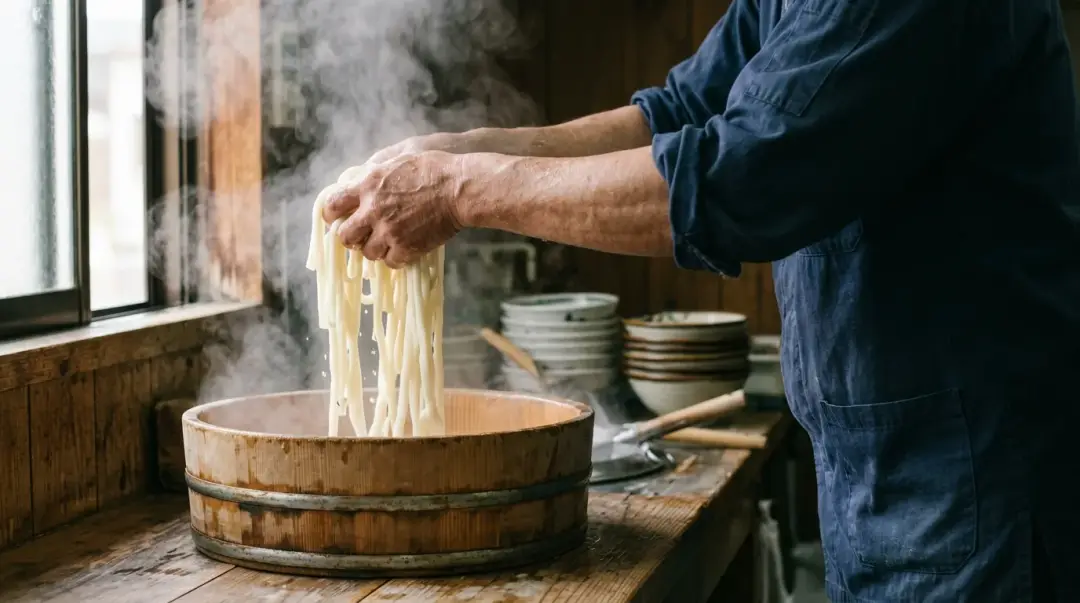
Kamaage (kah-mah-AH-geh) means "lifted from the pot." The noodles come in their hot cooking water, and you dip each mouthful into a separate cup of warm dipping sauce. Kagawa's home recipe boils them about two minutes less for this style.
Kamatama (kah-mah-TAH-mah) takes those same pot-hot noodles and tosses them with a raw egg and dashi soy sauce. The heat sets the egg into a glossy coating. The food blog I Am a Food Blog calls it carbonara-style, and it is the easiest of the six to make at home.
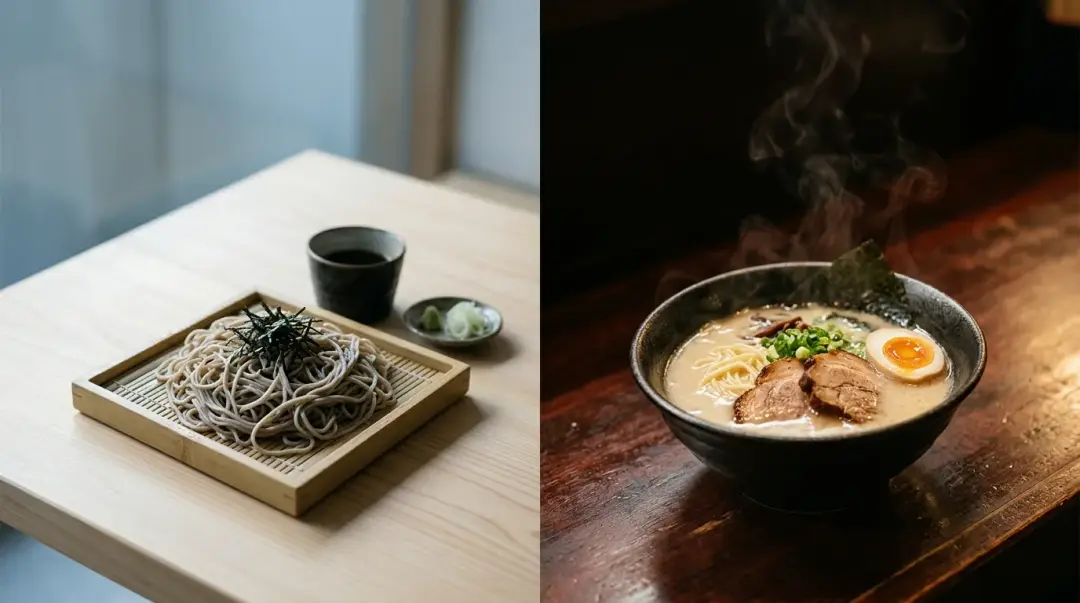
Zaru (ZAH-roo) udon is chilled and served on a zaru, a bamboo draining tray, with shredded nori and a cold dipping sauce of dashi, mirin and soy. Chilling shows off koshi best.
Shoyu (SHOH-yoo) udon is the minimalist's order: plain noodles with a splash of soy sauce and little else, so the wheat flavor carries the bowl.
Where to Get Sanuki Udon
Frozen blocks
Frozen Sanuki-style udon is the most practical way to eat this noodle at home. The blocks are sold already boiled; Shirakiku's Sanukiya bag holds five blocks in 44 ounces and calls for one minute in boiling water, and TableMark's frozen Sanuki udon calls for a minute and a half. Just One Cookbook recommends frozen Sanuki udon over dried, which it says won't give you the chewy bite. Japanese and Korean grocers such as H Mart and Mitsuwa keep them in the freezer case. For our brand picks, see the best udon guide.
Marugame Udon
The restaurant route is Marugame Udon, the US name for Japan's Marugame Seimen. The chain takes its name from Marugame, a city in Kagawa, but it started in 2000 in Kakogawa, Hyōgo, under Toridoll Holdings, and it has only one store in Kagawa itself, a sore point with locals. It is Japan's largest udon chain, and it runs the Kagawa format at scale: dough mixed and noodles formed in each restaurant's open kitchen, then a cafeteria-style line where customers order, carry and clear for themselves. The first overseas store opened in Waikiki on April 1, 2011. By April 2024 the US count was around a dozen, in California, Hawaii and Texas.
How Kamatama Is Made at Home
Kamatama is the easiest of the six styles to reproduce, because frozen Sanuki-style blocks arrive already boiled and need only about a minute in boiling water.
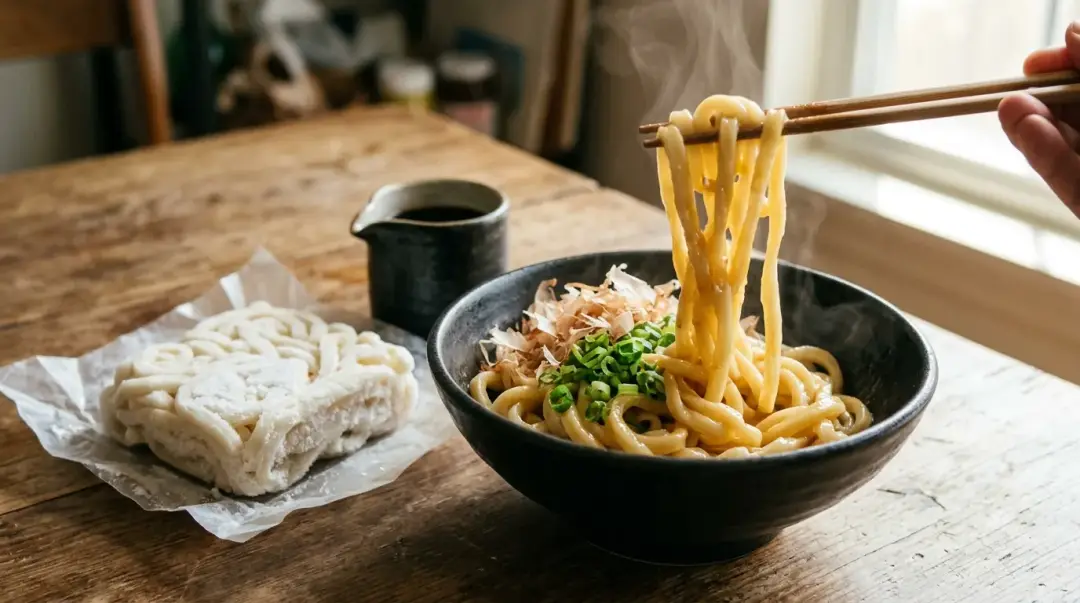
The dish is built from a frozen Sanuki-style block, a raw egg, soy sauce or dashi soy (tsuyu concentrate), and green onion, with bonito flakes, tenkasu or sesame as optional toppings. The method depends on a large pot, because a small one cools when the frozen block goes in and leaves the noodles soft. The egg is beaten in a bowl warmed with a ladle of the cooking water, and the noodles go straight from the pot into the egg without rinsing. Tossing them hard in the residual heat sets the egg into a glossy coating, and the soy sauce and toppings go on last. Because the yolk stays creamy, the FDA's advice for raw or barely cooked egg dishes applies: use pasteurized eggs.
If you cook udon often, a long-handled mesh strainer makes the pot-to-bowl transfer easier. It is the home version of the shop's tebo, and you'll find one in our Japanese cookware picks. A bottle of tsuyu concentrate from the Japanese pantry essentials list covers both kamatama and a quick kake broth.
FAQ
What is Sanuki udon?
Sanuki udon is the thick wheat noodle of Kagawa Prefecture on Shikoku, named after Sanuki, the province's old name. It is made from wheat flour, salt and water, cut square, and known for koshi, a firm and elastic chew. It is served hot in iriko dashi, cold with dipping sauce, or straight from the pot with raw egg.
What is the difference between Sanuki udon and regular udon?
Sanuki udon is one regional style of udon, and the one most supermarket and chain udon imitates. It is thicker and firmer than softer styles such as Hakata udon and much thicker than thin Inaniwa udon from Akita. The dough is salted, kneaded hard, often by foot, rested, and cut into strands with a roughly square cross-section.
Does Sanuki udon have to be made in Kagawa?
Not to use the plain name, which is generally unrestricted in Japan. Labels that claim it as a famous local product or specialty, under the noodle industry's labeling code, must be made in Kagawa, handmade or handmade-style, with at least 40 percent water and 3 percent salt by flour weight, rested two hours and boiled about 15 minutes.
Is frozen Sanuki udon good?
Yes, it is the closest most home cooks will get to a Kagawa shop at home. Frozen blocks are sold already boiled and need only about a minute in boiling water; Shirakiku's bag says one minute and TableMark's says a minute and a half. Just One Cookbook recommends frozen Sanuki udon over dried because dried noodles lose the chewy bite.
What is kamatama udon?
Kamatama udon is hot udon lifted straight from the cooking pot and tossed with a raw egg, then seasoned with soy sauce or dashi soy. The heat of the noodles thickens the egg into a glossy coating, which is why it is often compared to carbonara. The FDA advises pasteurized eggs for any dish where the egg stays raw or barely cooked.
Where can I eat Sanuki-style udon in the US?
Marugame Udon, the US arm of Japan's Marugame Seimen chain, makes udon in each restaurant and serves it cafeteria-style. As of April 2024 it had around a dozen US branches in California, Hawaii and Texas, starting with Waikiki in 2011. For home cooking, Japanese and Korean grocers such as H Mart and Mitsuwa stock frozen Sanuki-style blocks.
Read Next
Products mentioned in this guide
This section contains affiliate links. We may earn a commission at no extra cost to you.

Seki Japan MASAHIRO Japanese Noodle Knife, 240 mm (9.5 inch), for Soba, Udon, Ramen
Sanuki dough is rolled flat and cut into square strips, and a long noodle knife makes that cut. This listing is a Japanese soba and udon kiri with a 240 mm stainless steel blade and a magnolia wood handle.
View on Amazon
Shirakiku Yude Sanuki Udon Noodles with Soup Base, 22 Ounce
A shelf-stable option for when the freezer case is out of reach. It comes with soup base, so a quick kake bowl needs only green onion and tenkasu.
View on Amazon
Kikkoman Hon Tsuyu Soup Base
One bottle of tsuyu concentrate covers the dashi soy for kamatama and, diluted, a fast kake broth.
View on Amazon
Hiware Solid Stainless Steel Spider Strainer Skimmer Ladle, 5.4 Inch
A long-handled strainer is the home version of a Kagawa shop's tebo. It lifts noodles straight from the pot into the egg without a colander step. This listing is a 5.4 in solid stainless steel spider strainer.
View on Amazon
J.K. Adams Maple Wood Dowel Rolling Pin, 19 x 2 in, Handle-Free
Rested Sanuki dough is rolled to about 3 mm before it is cut, and a straight, handle-free pin suits that flat, even sheet. This listing is a 19 x 2 in maple dowel pin with a beeswax finish, made in the USA.
View on Amazon
Browse more related items
Opens Amazon · affiliate links
Buying guides for this topic
- Buying guideBest Udon Noodles in 2026The best dry, frozen, and fresh udon noodles available on US Amazon — Hakubaku, Maruchan Seimen, Sanuki, and Inaniwa ranked.
- Buying guideBest Japanese Pantry Essentials in 2026The 10 Japanese pantry items needed to cook ramen, udon, soba, and yakisoba at home. Soy, dashi, mirin, miso, and yakisoba sauce, ranked.
- Buying guideBest Japanese Cookware in 2026The donabe, ramen bowls, sōmen sets, and tools you need to cook Japanese noodles at home. Real US Amazon picks across budget tiers.