Japchae History: A Royal Dish That Had No Noodles
· 9 min read · NoodleDex Editorial
Japchae history from King Gwanghaegun's 17th-century court, where it had no noodles, to the 1919 Sariwon factory that put glass noodles in every bowl.
This page contains affiliate links. We may earn a commission at no extra cost to you. Disclosure
Two Plates, 350 Years Apart
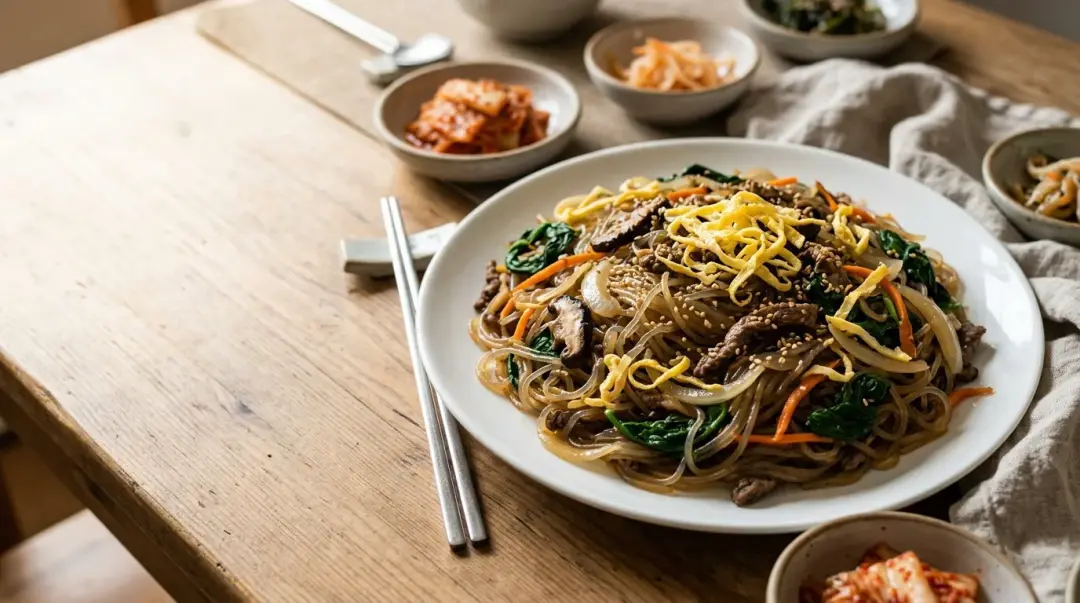
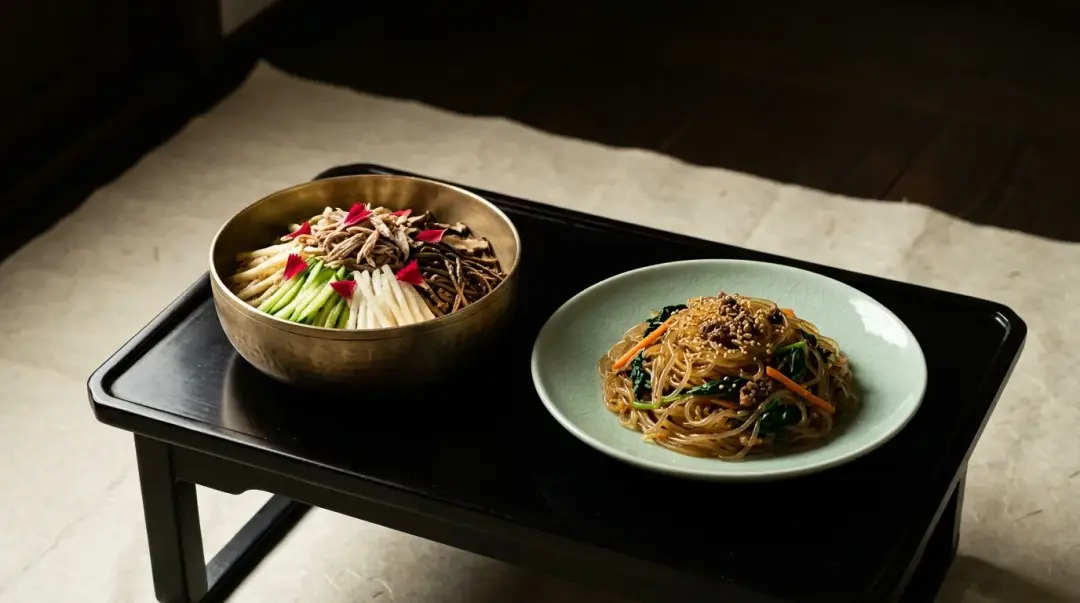
Around 1670, a recipe for japchae (JAHP-cheh) called for cucumber, radish, bracken, eggplant, several kinds of mushroom and shredded pheasant, dressed with soy sauce and tinted with red flowers. In 2026, the japchae in the deli case at H Mart is a tangle of glossy sweet potato noodles with spinach, carrot and beef threaded through it.
Both are japchae, and the name only fits the first. Jap (잡, 雜) means "mixed" and chae (채, 菜) means "vegetables." For most of its life the dish was exactly that: a composed plate of vegetables, cut fine, seasoned one by one, and served at court banquets. The noodles that define it now arrived in the 20th century, by way of a factory in Hwanghae Province.
This is the history of how one became the other. For the dish as you would cook and eat it today, start with our japchae type page.
The Official Who Cooked His Way Up
The story starts with a king and a favor. Gwanghaegun ruled Joseon from 1608 to 1623, a reign that ended when the Westerners faction at his own court overthrew him in a night coup in April 1623. During those fifteen years, an official named Yi Chung (1568–1619) became known at court for the food his household prepared.
Korean sources tell it simply: the king waited at every meal for the dishes that came from Yi Chung's house. Japchae was the one people remembered. Gwanghaegun promoted him, and Yi rose to hojo panseo, minister of taxation. One popular Korean telling says his advantage was a heated greenhouse that kept fresh vegetables coming through the winter.
The court did not admire this. Yi's rivals called him japchae panseo or japchae sangseo, "the japchae minister," and the satire stuck: a man who had won office by presenting a plate of vegetables instead of by merit. The official chronicle of Gwanghaegun's reign preserves the episode, which is why a dish with a nickname as its origin story has a documented date at all.
Japchae entered the written record as a joke about favoritism, and the joke is the reason we can date it.
Keep in mind when the record was written. Joseon chronicles were compiled after a reign ended, and work on Gwanghaegun's began in 1633, a decade after his overthrow. Like the record of the other deposed Joseon king, Yeonsangun, it is filed as an ilgi (diary) rather than a sillok (veritable record). A chronicle written under the men who replaced him had little reason to flatter his favorites. The dish was real. How much the promotion owed to the vegetables is the part to read with some salt.
What Was on the Plate in 1670
The oldest detailed recipe comes about fifty years after Yi Chung's death, in Eumsik Dimibang (음식디미방, roughly "knowing the flavors of food"), written around 1670 by Jang Gye-hyang (1598–1680), a woman of the yangban (noble) class. Korean food writers call it the oldest surviving cookbook written in the Korean alphabet.
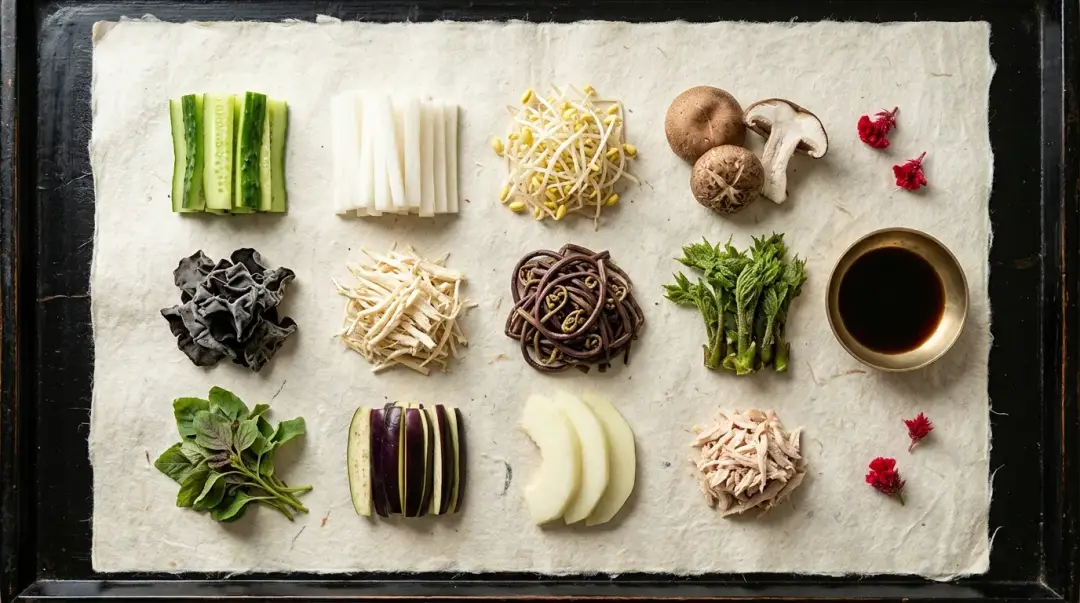
Her japchae is a long ingredient list split by treatment:
- Raw, cut into strips: cucumber, radish, bean sprouts and mushrooms, including stone-ear fungus, shiitake and pine mushroom.
- Boiled, then shredded: bellflower root, bracken, aralia shoots, amaranth, eggplant, melon, preserved vegetables, assorted greens and pheasant meat.
The method is short. Mix everything with soy sauce or stir-fry it, heap it in a large bowl, and sprinkle a sauce over the top. Then color it: Jang uses bellflower and red celosia flowers, or wild grape when those aren't available, so the plate shows a range of colors.
Two details stand out against a modern japchae. There are no noodles at all, and there is meat, pheasant, which is easy to miss in a dish named for vegetables. Korean accounts of the court version differ on this point: some describe it as vegetable-only, while Eumsik Dimibang, the earliest recipe anyone can read, includes the bird. Some later Joseon versions reportedly used thin strips of glutinous rice pancake in place of anything noodle-like.
Where Dangmyeon Came From
Dangmyeon (DAHNG-myun) means "Chinese noodles." Dang (唐) is the Korean reading of the character for the Tang dynasty, long used in Korean to mean China, and myeon means noodles. In China the same starch noodle is fentiao or fensi. Food historian Joo Young-ha, writing in the Kyunghyang Shinmun, traces Korea's first dangmyeon factory to Yang Jae-ha, who built the Gwangheung factory near Sariwon Station on the Gyeongui rail line in Hwanghae Province. Most Korean accounts date it to 1919, during the Japanese colonial period.
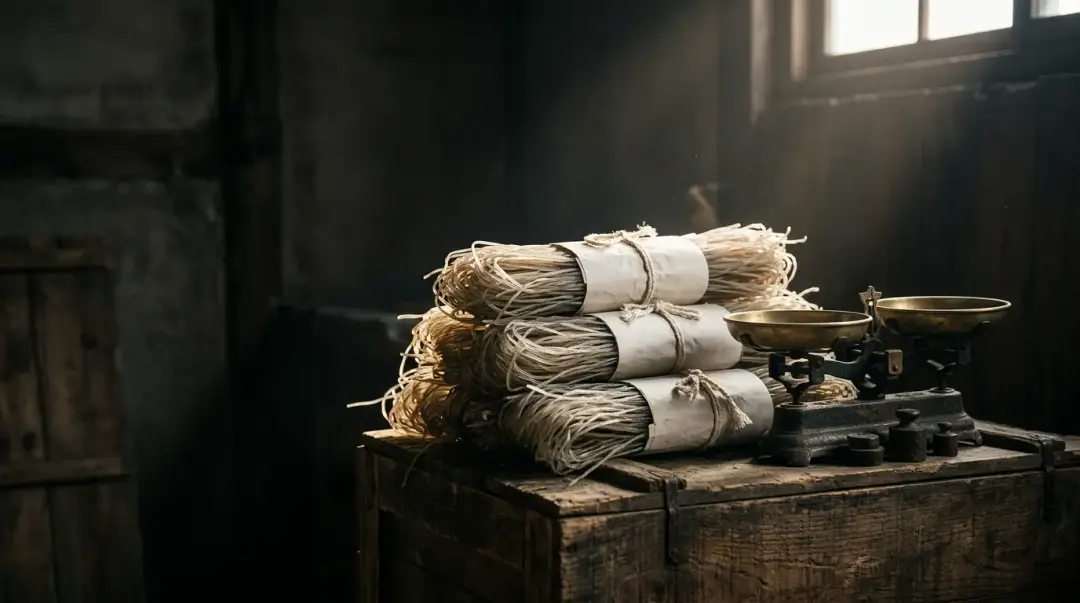
The business grew fast. On October 28, 1923, the Dong-A Ilbo newspaper ran an advertisement for dangmyeon "made with our own hands." By 1939 the Gwangheung factory had 120 workers and annual sales of 230,000 won, according to Joo.
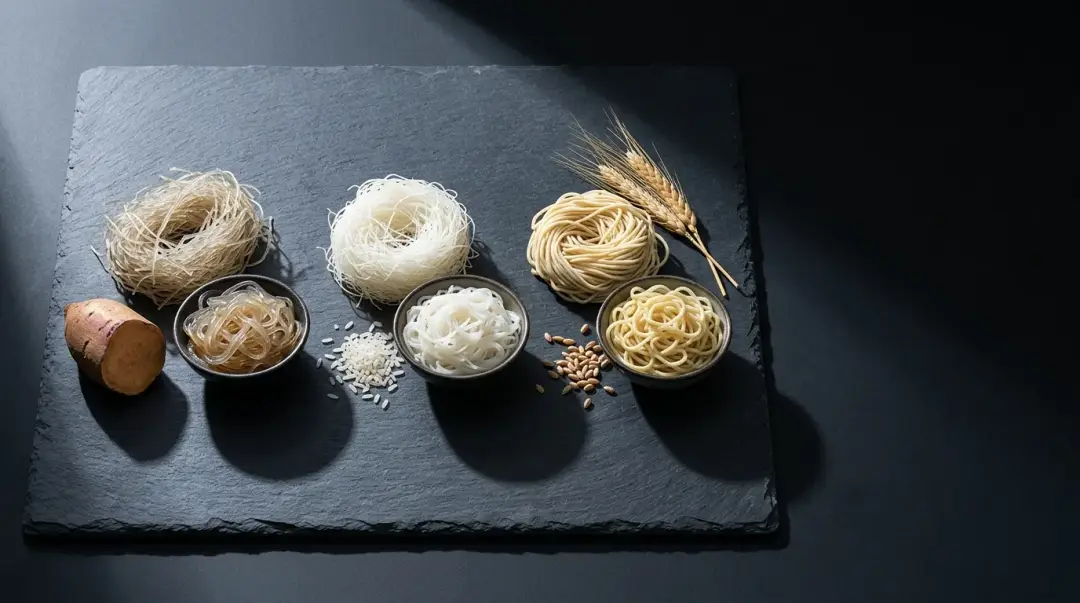
For a cook, dangmyeon solved a problem. Sweet potato starch noodles cook up glossy and bouncy, carry little flavor of their own, and keep their texture at room temperature. That last quality matters for a dish served at banquets and parties, where platters sit out. Our glass vs rice vs wheat noodles guide explains the starch science behind that bounce.
How the Noodles Took Over
The noodles moved into japchae within a few years of the factory opening. A 1921 cookbook by Bang Sin-yeong, who later taught at Ewha Women's College, already gives the modern method: stir-fry the vegetables and meat, then mix them with cooked dangmyeon.
On March 6, 1930, the Dong-A Ilbo printed a detailed japchae recipe by Song Geum-seon, a teacher at Dongduk girls' school. Hers called for Japanese-style soy sauce. Joo points out that Japanese soy sauce production had industrialized after 1918, and its sweeter, less salty profile was new to Korean cooks. Today's japchae leans sweet as well, with sugar alongside the soy and sesame oil. In 1937 the Sariwon women's normal school published its own dangmyeon japchae recipes, in the same town as the factory.
Japchae in three eras
| Court japchae (c. 1670) | Colonial-era japchae (1921–1930s) | Japchae today | |
|---|---|---|---|
| Base | Shredded vegetables and mushrooms | Vegetables and meat mixed with dangmyeon | Dangmyeon, with vegetables and beef |
| Noodles | None | Sweet potato dangmyeon, newly factory-made | Sweet potato dangmyeon |
| Protein | Pheasant, in Eumsik Dimibang | Meat stir-fried separately | Beef, often marinated; vegetarian versions common |
| Seasoning | Soy sauce, colored with red flowers | Japanese-style soy sauce appears by 1930 | Soy sauce, sugar, toasted sesame oil |
| Where you found it | Royal and noble banquets | Cookbooks and newspaper recipe columns | Holidays, weddings, banchan plates, deli cases |
After liberation in 1945, noodle japchae became a standard of Korean home cooking and of the celebration table. The irony is that the court label stuck to the new version. Hwang Hye-seong's 1976 Korean cooking encyclopedia listed japchae as royal court cuisine, when nearly every japchae in the country was made with a factory noodle Korea had been producing for less than sixty years.
In 2021 japchae entered the Oxford English Dictionary, about 400 years after Yi Chung's rivals turned it into an insult.
Where Japchae Lives Now
The modern dish kept one thing from the court: it is still food for occasions. Japchae is the noodle of Korean weddings, birthdays and holidays, and in Korean restaurants it arrives as banchan (small side dishes served before the main) more often than as an entrée, a half-cup portion next to kimchi and pickled radish. At a Korean BBQ table it plays the role coleslaw plays at an American barbecue, a sweet starchy counterweight to grilled short rib and pork belly.
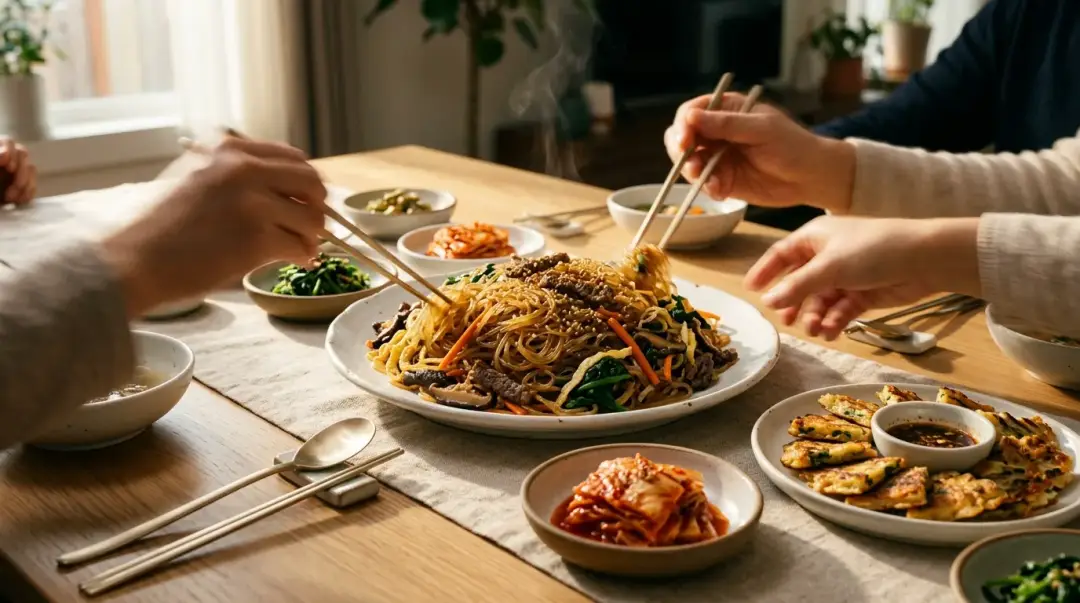
In the US, the easiest japchae to find is in a grocery store. H Mart sells it by weight at the prepared-foods counter in most locations, and CJ Bibigo and Pulmuone both make frozen microwave trays. Korean catering platters in New York and Los Angeles almost always include a tray of it, because it holds up at room temperature, which is also what suits it to a banquet table.
Vegetarian japchae is common too. Take the noodles out of one and you are most of the way back to a 17th-century court plate.
Cooking Either Version Now
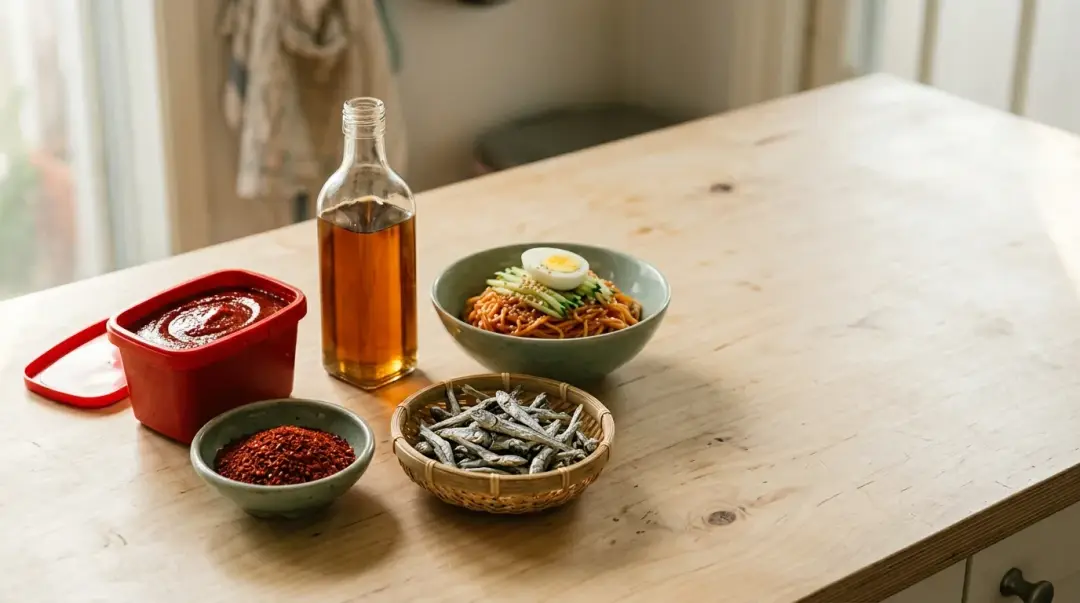
The modern dish needs three things from a Korean grocery, and our Korean pantry essentials list covers all of them: sweet potato dangmyeon, toasted sesame oil and Korean soy sauce. For the noodle itself, the best dangmyeon glass noodles guide compares the bags you'll find at H Mart. Thin, clear-to-amber strands are sweet potato. If the bag looks gray and opaque, it is probably mung bean, a different starch and the wrong noodle for this dish.
The 1670 version needs a Korean grocery and a vegetable stand. Cut cucumber and radish into matchsticks and leave them raw. Blanch bellflower root, dried bracken and spinach, then shred them. Sauté a mix of mushrooms. Dress everything with soy sauce and sesame oil and pile it into one bowl. It eats like a crunchy, savory salad, and it makes the name make sense.
The Korean noodle pronunciation guide covers japchae, dangmyeon and the rest of the vocabulary if you're ordering at a Korean restaurant.
What the Record Doesn't Settle
A few questions stay open, and the honest answer to each is that the written record runs out.
Did Yi Chung invent japchae, or just make the best one? The sources credit him with the dish that won Gwanghaegun over. None of them shows that mixed vegetables were unknown before him. The name may be older than the fame.
Was there meat in the original? Modern summaries often say the court dish was vegetables only. The earliest recipe on paper, from about 1670, includes pheasant. The two may describe different kitchens, or the court version may simply be lost.
When exactly did the first factory open? Most Korean sources say 1919. Joo Young-ha writes "around the 1910s," and another account describes several dangmyeon factories at Sariwon in the early 1920s. The October 1923 advertisement is the earliest dated print evidence Joo cites.
How did Chinese restaurants shape it? Dangmyeon was a Chinese noodle, and Chinese restaurants were common in colonial Seoul: a 1937 report counted 294 of them before the Sino-Japanese War cut the number to about 50, according to Nongmin Shinmun. How much their glass-noodle stir-fries influenced the home japchae of the 1920s has not been documented in detail.
FAQ
Where did japchae originate?
In the Joseon royal court of the early 1600s. Korean tradition credits Yi Chung, an official under King Gwanghaegun, who reigned from 1608 to 1623, with making a mixed-vegetable dish the king liked so much that Yi was promoted for it. The name comes from jap, meaning mixed, and chae, meaning vegetables.
Did original japchae have noodles?
No. The court dish was a plate of shredded, seasoned vegetables. The oldest surviving written recipe, in the cookbook Eumsik Dimibang from about 1670, lists cucumber, radish, several mushrooms, bellflower root, bracken, eggplant and shredded pheasant, dressed with soy sauce. Sweet potato glass noodles were added only in the 20th century.
When were glass noodles added to japchae?
In the early 20th century. Korean accounts usually date the first dangmyeon factory, near Sariwon in Hwanghae Province, to 1919. A 1921 cookbook by Bang Sin-yeong already mixed stir-fried vegetables and meat with cooked dangmyeon, and a 1930 Dong-A Ilbo newspaper recipe is close to the version Koreans cook today.
Why is it called dangmyeon?
Dang is the Korean reading of the Chinese character for the Tang dynasty, used in Korean to mean Chinese, and myeon means noodles. The name marks the starch noodle as a Chinese import. In China the same kind of noodle is called fentiao or fensi. Korean factories began making it locally in the colonial period.
Who was Yi Chung?
Yi Chung (1568 to 1619) was a Joseon official who won King Gwanghaegun's favor partly through the food his household sent to the palace. Korean sources say the king waited for dishes from Yi's house at every meal. He rose to minister of taxation, and critics mocked him with the nickname japchae panseo, the japchae minister.
Is japchae a royal court dish?
Its origin is. The vegetable dish started at Gwanghaegun's court, and Korean cookbooks have long filed japchae under court cuisine. The noodle version is a 20th-century dish, though. A 1976 Korean cooking encyclopedia listed japchae as royal cuisine at a time when nearly every japchae in Korea was made with factory dangmyeon.
Read Next
Products mentioned in this guide
This section contains affiliate links. We may earn a commission at no extra cost to you.

Ottogi Korean Sweet Potato Glass Noodles (Dangmyeon)
The noodle that took over japchae in the 20th century. Sweet potato starch gives the glossy, bouncy strand the modern dish is built on.
View on Amazon
Kadoya Pure Sesame Oil (11.1 oz)
Toasted sesame oil dresses both versions of japchae, the 17th-century vegetable plate and today's noodle toss. A bottle lasts months.
View on Amazon
Buying guides for this topic
- Buying guideKorean Pantry Essentials: A Complete Guide (2026)The 10 Korean pantry items you actually need to cook Korean noodles at home — gochujang, gochugaru, sesame oil, dashi anchovies, and more.
- Buying guideBest Korean Noodle Bowls & Spoons in 2026The best Korean-style noodle bowls and spoons for ramyeon, naengmyeon, and more — large enough for proper broth, available on Amazon US.
- Buying guideBest Rice Noodles for Pho, Pad Thai, and MoreThe best rice noodles on Amazon: Three Ladies bánh phở, A Taste of Thai, Annie Chun's and Lotus Foods, ranked for pho, pad thai and more.